
Of all the bizarre, scandalous, eccentric senior officers in the Union Army during the American Civil War — and the list is long — Sir Percy Wyndham may be unique. Even his birth was unusual: The son of Royal Navy Captain Charles Wyndham, Percy was born aboard His Majesty’s warship Arab in the English Channel on September 22, 1833. At age 15 he began his military career by fighting in the Revolution of 1848 to help overthrow King Louis Philippe and usher in the Second French Republic. He then served in the French navy and marines, achieving the rank of ensign. Returning to Britain, he served in the Royal Artillery. Wyndham again left England to join the Austrian army’s 8th Lancers, rising to command a squadron. In May 1860, he resigned from the Austrian army to participate in Guiseppe Garibaldi’s campaign in Sicily. For that service the officer was knighted by Victor Emmanuel, King of Piedmont and later of a unified Italy.
When the American Civil War broke out in April 1861, Sir Percy offered his services to the Union. Major General George B. McClellan knew of Wyndham’s fighting reputation and recommended him highly to the governor of New Jersey, who appointed him to command the 1st New Jersey Cavalry (Volunteers). He was not actually welcomed with open arms when he assumed his new command on February 9, 1862. The New Brunswick Times asked, ‘Have we no material in New Jersey out of which to manufacture competent colonels without resorting to foreigners to fill up the list?’ His men soon warmed to their new commander, however, thanks to the way he restored discipline, obtained them regular pay, improved their rations and removed their camp from a swamp.
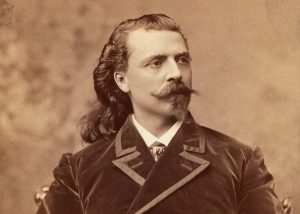
Wyndham’s personal appearance was as impressive as his soldierly reputation. He affected ornate spurs, high boots and a plumed slouch hat. His men learned that if he twirled his 10-inch-long moustache it meant that he was agitated and someone would pay.
In April 1862, the 1st New Jersey Cavalry proceeded to Virginia, where it joined a brigade under the command of Brig. Gen. George D. Bayard. After about a month’s inactivity Bayard’s brigade, along with the corps of Maj. Gen. Nathaniel Banks and Irwin McDowell, went to the Shenandoah Valley to deal with Confederate Maj. Gen. Thomas J. ‘Stonewall’ Jackson.
On June 6, during a skirmish with Turner Ashby’s cavalry covering Jackson’s rear, Sir Percy’s impetuosity undid him. The 1st New Jersey was on the road to Port Republic when it ran into a combined cavalry-infantry ambush south of Harrisonburg. Wyndham decided to crash through the Rebels, but his attempt failed miserably. Under heavy fire, the 1st New Jersey fled, leaving Sir Percy, 63 of his men and his colors cut off. In surrendering, a seething Wyndham is said to have remarked that ‘he would not command such cowards.’ Ashby was killed in another encounter that same afternoon. Wyndham, however, was paroled within two months — and resumed command of the 1st New Jersey.
On August 29, Rebel forces under the command of Maj. Gen. James Longstreet were advancing on the right flank of Maj. Gen. John Pope’s Army of Virginia while Jackson was engaging part of Pope’s army at Groveton. Longstreet’s force had to pass through Thoroughfare Gap, and Union cavalry, tried to delay his progress. Wyndham ordered his men to seize every ax they could find and block the gap with an abbatis of felled trees. As Sir Percy put it, ‘No horse could expect to pass with life and even infantry would be obliged to pick their way.’ Longstreet brought up more troops, however, compelling the Federals to withdraw from the gap.
The afternoon of August 30 found Bayard’s cavalry on the left flank of Maj. Gen. Fitz-John Porter’s V Corps, being heavily shelled by Rebel artillery. Wyndham, magnificently cool as usual, led his troopers under heavy fire until ordered to retreat. As the 1st New Jersey wheeled about to retire, Sir Percy became angry. Apparently believing that his troopers had shown ‘undue haste to come around,’ he ordered them to wheel again to face the enemy. Halting them, he explained amid much moustache twirling that he disliked the confusion and disorder they had displayed. He told them that he would drill them in this maneuver then and there until it was performed to his satisfaction. With the enemy approaching, the next performance was indeed satisfactory. One of his troopers later remarked that ‘the ground was pitted with musket balls by that time, but the twirl of that moustache was more formidable than a rifle!’
soon after that Union defeat at Second Bull Run, Wyndham was given command of Maj. Gen. Franz Sigel’s cavalry brigade. In early 1863, his brigade was headquartered at Fairfax Court House and became engaged in a series of running battles across northern Virginia with partisan rangers led by Lt. Col. John Singleton Mosby. Sir Percy, schooled in the ‘honorable’ open-field style of fighting, despised Mosby’s guerrilla tactics and called him a horse-thief. To counter Mosby’s tactics, he threatened to burn down local towns until the rangers’ whereabouts were revealed, earning Wyndham the reputation of an unscrupulous marauder.
In reply to Sir Percy’s slur, Mosby decided on a personal response. Learning the location of Wyndham’s headquarters from a deserter, the Rebel ranger gained entrance on the night of March 9. Sir Percy had left for Washington the previous day, but Mosby did capture his uniforms, two of his aides and Brig. Gen. Edwin H. Stoughton. This affair proved embarrassing to the Union Army and Wyndham.
Sir Percy’s first role after this debacle was as a leader in Brig. Gen. George Stoneman’s raid toward Richmond on April 29-May 11, 1863. Although the raid was generally held to have been a tactical failure, Wyndham’s detached force of 400 troopers performed very well, capturing Columbia, Va., and destroying stores and infrastructure. Their destruction of a canal prevented its use by the Rebels for several months.
Without doubt, Wyndham’s star performance was in the Battle of Brandy Station. Crossing the Rappahannock at Kelly’s Ford on June 9, he took his force south to the station, where the battle was already in progress. Wyndham personally led the attack up Fleetwood Hill, mustache aflutter as he engaged in hand-to-hand combat. Greatly outnumbered, he personally formed the rear guard and twice forced the Rebels back with furious charges. Wounded in the leg, he remained in the saddle until loss of blood forced him to retire. Though forced off the hill, Wyndham was fulsome in his praise of his men’s performance: ‘It affords me no small degree of pleasure to be able to say that all of my command that followed me on the field behaved nobly, standing unmoved under the enemy’s artillery fire and, when ordered to charge, dashing forward with a spirit and determination that swept all before them!’
Invalided to Washington for recuperation, he was given command of the capital’s cavalry defenses. During Maj. Gen. J.E.B. Stuart’s raid prior to the Battle of Gettysburg, Sir Percy managed to raise a force of some 3,000 fully equipped men, mostly mounted. His final assignment was command of the District of Columbia Cavalry Depot.Mustered out of the Army on July 5, 1864, Wyndham returned to New York and established a military school, then returned to Italy to serve on Garibaldi’s staff in 1866. At the end of the war in Italy, he and a chemist partner went back to New York to establish a petroleum refining business. Soon thereafter, however, an explosion destroyed his main distillery.
He soon left New York for India, and in Calcutta established a comic newspaper, The Indian Charivari, modeled on London’s Punch. He also established an Italian opera company and married a wealthy widow. A later venture, logging teak in Mandalay, Burma, dissipated the profits from his Calcutta ventures.
Afterward he briefly served the Burmese government as commander-in-chief of the army, but he was eventually reduced to penury. One of Sir Percy’s more quixotic projects was the construction of a huge balloon. But in January 1879 his monster machine (70 feet tall and 100 feet in circumference) exploded at an altitude of 300 feet with him aboard.
Thus at age 46 died one of the more colorful figures of the American Civil War and the 19th century in general. Given his career, it may not come as a surprise that some believe Sir Percy inspired 20th-century author George McDonald Fraser’s fictional rogue of the Victorian era, Sir Harry Flashman.
This article was written by Lewis Scheuch-Evans and originally published in the December 2005 issue of Military History magazine.
For more great articles be sure to subscribe to Military History magazine today!