
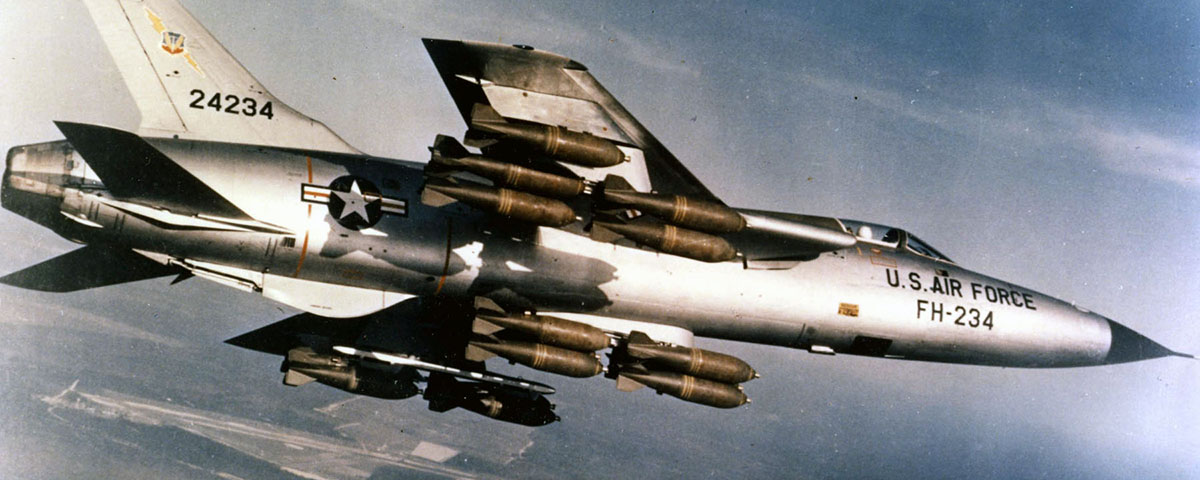
Republic Aircraft’s F-105 Thunderchief, better known as the ‘Thud,’ was the Air Force’s warhorse in Vietnam.
It has been said that great events make great men…that extraordinary situations–wars, revolutions, disasters–offer individuals the opportunity to rise to the occasion. Applying this theory to an aircraft, the F-105 Thunderchief fighter-bomber serves as a case study in achieved greatness.
Designed under the inspired aeronautical tutelage of Alexander Kartveli, Republic Aircraft’s chief engineer, the F-105 Thunderchief, better known by its affectionate nickname ‘Thud,’ bore Kartveli’s developmental trademarks–speed, size and power. In the true tradition of its predecessors, the venerable P-47 Thunderbolt and F-84 Thunderjet, the F-105 possessed all of these attributes, plus an advanced electronic navigation and bombing package that gave it a distinct advantage over its rivals.
The Thud was first conceived as an ‘in-house’ private venture to succeed the first-line F-84 series of fighter-bombers. No less than 108 configurations were investigated by the Republic team before the basic concept was finalized as a single-seat, single-engine fighter-bomber to fill the tactical nuclear strike role. Its stated mission was to fly low level and at high speed into the Soviet homeland to deliver, with great precision, a tactical nuclear bomb housed within its internal bomb bay.
The airframe was engineered to withstand these extremely exacting requirements, incorporating a highly swept short wing and a ‘coke bottle,’ pinched-waist fuselage, and exploiting the then new ‘area rule’ concept for reduced aerodynamic drag at transonic speeds. Also incorporated were unusual forward-swept air-intake ducts located at the wing root, and a ventral fin on the underside of the rear fuselage to provide enhanced lateral stability at high speeds. The largest single-engine airplane ever built, the F-105 stood 19 feet 83/4 inches high, more than 3 feet higher than the very large, twin-engine F-4 Phantom jet. The Thud’s great size and weight demanded a powerhouse of an engine, and it got one–eventually.
Originally, the Thud was to be powered by the new and technically advanced Pratt & Whitney J-75 turbine engine, but the unavailability of that power plant necessitated the installation of the less powerful Pratt & Whitney J-57-P-25 in the two YF-105A-1-RE prototypes, the first of which flew on October 22, 1955. By the time the third aircraft was completed on May 26, 1956, Pratt & Whitney J-75s were ready for installation in the first batch of F-105s.
The J-75 packed one heck of a punch, delivering a powerful maximum static thrust of 23,000 pounds at sea level, burning JP-4 fuel at a rate of 776 pounds per minute. It represented the new generation of two-spool geometry engines, employing concentric shafts to allow the N1 and N2 compressors and turbines to operate at their respective optimum rotational speeds. Water injection was also added to increase thrust beyond that provided by afterburning. This crowned the J-75 as the undisputed king of contemporary turbine engines.
The principal outstanding feature of the F-105 ‘D’ model, the mainstay of the Thunderchief force, was its highly sophisticated, integrated electronics. The AN/APN-131 doppler navigation system would automatically supply the pilot with continual position coordinates, ground speed, wind direction, distance to target, heading and other pertinent information. The R-14A monopulse radar provided all-weather terrain avoidance for pinpoint, low-level bombing missions. The AN/ASG-19 Thunderstick fire-control system was optimized for blind or visual and manual or automatic weapons delivery.
This innovative, supersensitive gadgetry identified the Thud as the first ‘black box’ fighter and subsequently singled it out as the only aircraft capable of penetrating the equally sophisticated Soviet-supplied air defense system fortifying North Vietnam. But there were a number of ‘bugs’ that had to be worked out of its complex systems before it went to war.
Initially, the F-105 was a maintenance nightmare, and it gained a variety of dubious handles, including ‘Ultra-Hog,’ ‘Lead-Sled’ and finally ‘Thud.’ But then, slowly, specific problems were identified, classified and resolved. Maintenance personnel who until then had had little or no experience with electronic components and systems began to absorb their rudimentary fundamentals and learned the Thud’s own peculiar problems and idiosyncrasies.
With an unprecedented one-third of its total cost stemming from electronic hardware, the F-105 represented a new dimension in aircraft technology and, consequently, a true learning experience for everyone involved, from chief engineer to line mechanic. But by 1964, things were finally looking good for the new fighter. Successful deployments to U.S. and overseas air bases were taking place, the flamboyant Air Force Thunderbirds demonstration team was re-equipped with specially modified F-105B models to show off the Thud’s awesome performance envelope and gut-wrenching raw power. With increasing success, the F-105 was being integrated into America’s new supersonic, superslick, nuclear-minded air force.
Then on August 2, 1964, three North Vietnamese patrol boats attacked the U.S. destroyer Maddox in the Gulf of Tonkin. The United States was at war. As a prophetic sign of the F-105’s dominant role in the hot air war about to take place over North Vietnam, four Thuds of the 36th Tactical Fighter Squadron on temporary duty at Korat Royal Thai Air Force Base flew a rescue combat air patrol mission during that same month for a pilot shot down by the Pathet Lao over the Plain of Jars in Laos. On this first mission, F-105D No. 62-4371 became the first Thunderchief to be hit by enemy fire. It limped back to base wounded but in one piece, an indication of the Thud’s ability to withstand copious amounts of punishment and still return to base.
When North Vietnamese torpedo boats attacked two U.S. destroyers in the Tonkin Gulf that same month, the Tactical Air Command deployed its first F-105 unit to Da Nang. However, the great majority of Thunderchief units would be stationed at Thailand’s Korat and Takhli air bases, mainly because they provided ample room for growth not found in the small, crowded air facilities in South Vietnam.
There were three excellent reasons why the F-105 was chosen to bear the brunt of the intense air war over North Vietnam: speed, range and bombload. The nature of the extremely dangerous, long-haul missions into the north country demanded an aircraft of unprecedented versatility and survivability. The Thud possessed both. On a daily basis, it had to confront an unbelievably dense air-defense system designed and supplied by the Soviets and manned by specialized Chinese and North Vietnamese operators. There were hundreds of radar-directed SA-2 SAM (surface-to-air missile) sites and radar-controlled 57mm, 80mm and 120mm gun batteries too numerous to count, as well as Mikoyan-Gurevich MiG-17 and MiG-21 interceptors flown by North Vietnamese and Soviet pilots. And then there was the weather–some of the worst on the planet, including ‘thunderbumpers’ with tops reaching over 50,000 feet that could toss around a fighter like a basketball, ceilings so low and thick that punching through the underside often meant exchanging greetings with a hilltop farmer, and monsoon rains strong enough to cut visibility down to zero.
Despite the many obstacles, Thud pilots persevered. The Thunderstick bombing and navigation system that had previously caused operational headaches was now paying off–in spades. Hauling a 12,000-pound bombload, the F-105 could fly the 600-mile route to the North from bases deep within Thailand, push Mach 1 down Thud Ridge on approach to target Hanoi while skimming the terrain and dodging SAMs, MiGs and anti-aircraft artillery, and put its bombs right on the money. Kicking in the afterburner, the Thud was on its merry way back to Thailand via a rendezvous with a Boeing KC-135 tanker.
The North Vietnamese MiGs had a nasty habit of harassing Thud pilots just as they were approaching or departing the target. But at low altitude, where the F-105 was designed to operate, it could more than handle the air circus. During the course of the war, F-105 aircrews downed 271/2 MiGs, sharing one with a F-4D Phantom crew. Twenty-five of those kills were achieved with the Thud’s deadly M-61 20mm Vulcan cannon, which could spit out rounds at a fantastic rate of 6,000 per minute. The remaining MiGs were downed with AIM-9 Sidewinder missiles.
To combat the many SAM sites plaguing Thud pilots, the F-105F trainer was equipped with ECM (electronic counter measures) equipment, anti-radiation sensing devices and missiles. Dubbed ‘Wild Weasel,’ the F-105F was crewed by a pilot and an electronic weapons systems officer who locked on to radar-emitting guns and SAM batteries, countering them with radar-seeking Shrike missiles. Although the system was new and in need of continual refinement — at first, Wild Weasel crews were shot down faster than they could be formed–it proved very successful in the latter stages of the war. Today, Wild Weasels are an integral part of Air Force strike missions.
The year 1968 witnessed both the end of the Rolling Thunder bombing campaign against the North and the widespread incorporation of the F-4 Phantom into the Air Force inventory. The battle-scarred warhorse F-105s, their numbers depleted by the intensity of the northern air war, began being phased out of active duty and relegated to Air Guard and Reserve units. On May 25, 1983, the last Thud was retired from service with the Georgia Air National Guard. It was a somewhat somber occasion, shrouded in memories, but the illustrious, lone Thud stood on the line big and proud as ever, reflecting the glory of the many who flew beside her.
This article was written by John D. Cugini and originally published in the February 1996 issue of Vietnam Magazine. Read more about the F-105 here.
For more great articles be sure to subscribe to Vietnam Magazine today!