
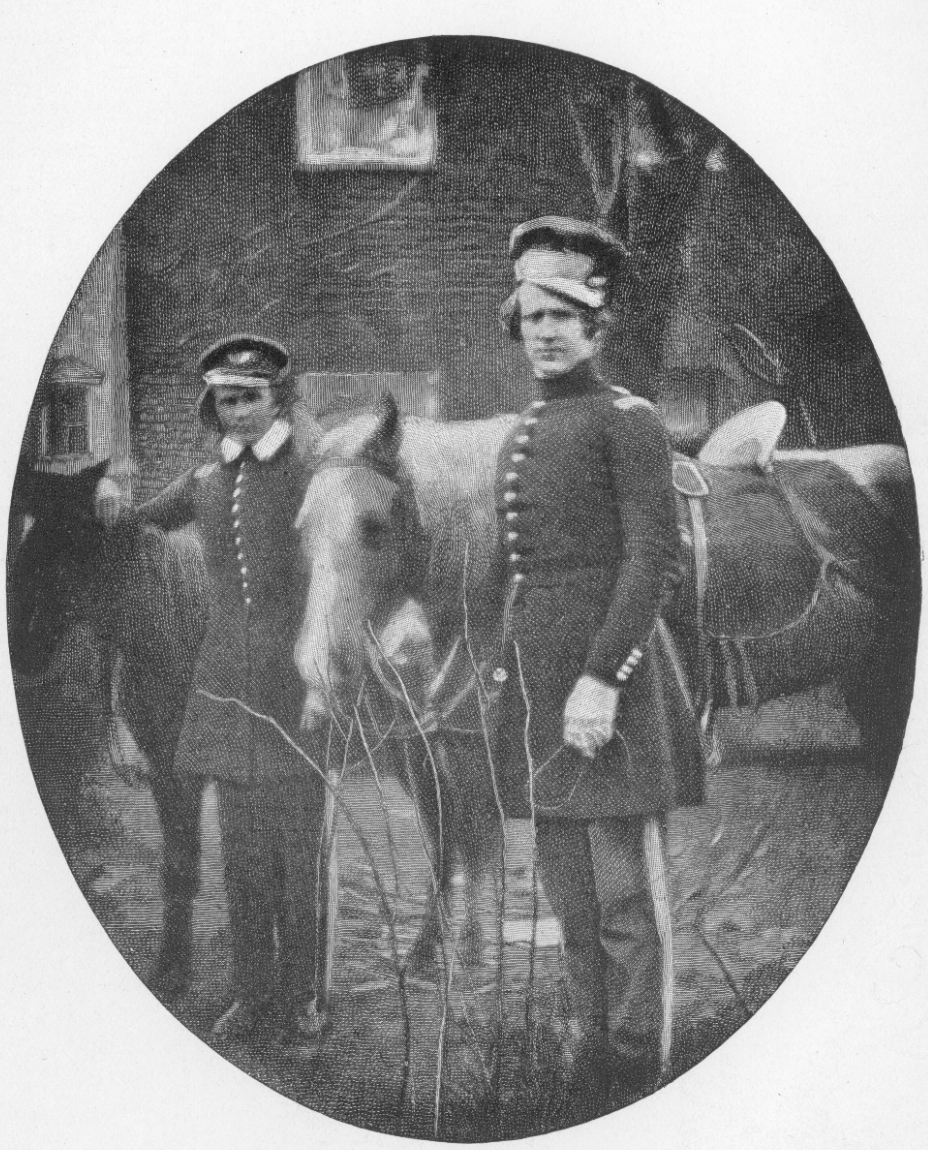
Chatham Roberdeau Wheat would one day lead a famous Louisiana battalion called ‘Wheat’s Tigers into battle for the Confederacy. He would fight and die in the Battle of Gaines’ Mill, Virginia, in 1862. But that was still some 15 years in the future; right now, the young law student’s attention was directed toward adventure in another conflict, the Mexican War of the 1840s. There, whether he lived or died, he would be a winner, a hero. In his own florid fashion, he wrote: I would ask for no greater glory — while our spirits should wing their flight to a brighter & a better world where we should enlist under the captaincy of Great Michael and mingle with the hosts of Heaven — and…with Washington & the heroes that have gone before, hang out our banners from the battlements of Heaven & let the shout of our exulting voices ring from arch to arch of heaven’s bright canopy.
In the best case, of course, Wheat and his comrades would live, be victorious, enter the city of Mexico, and stand in the halls of the Montezumas covered with glory & with bright stars upon our breasts…. In either case, he concluded, we are victorious, victorious even in death — how sublime! How pleasing the thought!
George Brinton McClellan, who would command the Union armies early in the Civil War, was a fire-new graduate of West Point when the Mexican War began. He couldn’t wait to get to the front and fight the crowd — musquitoes & Mexicans &c. Hip! Hip! Hurrah! he wrote home. War at last sure enough! Aint it glorious!
For young army officers of the time, the Mexican War was not only the road to glory, it was the road to promotion. Advancement in the peacetime army was maddeningly slow. An officer could stagnate in the same low grade year after year until those above him were promoted, resigned, or died, making room for his own advancement. When war came, everything speeded up. Armies expanded and fought, the unfortunate were killed, and the fortunate were promoted. Most young subalterns welcomed the war for that reason.
What they didn’t know was that the war would be their rite of passage, their crucible, their proving ground. They would learn how to endure hardship, how to inspire the loyalty of troops, how to fight and win battles. In that reasonably tidy little foreign war of 1846-1848, they would be tempered for command in an incomprehensibly larger and messier domestic war to come: the American Civil War.
Compared to the Civil War, the Mexican War was small. Of the 17,000 or so Americans who became casualties during the conflict, only about 1,700 were killed in battle. The Union Army suffered a larger number of casualties in just three days of fighting at the Battle of Gettysburg in the Civil War. Despite this difference in scale, the Mexican War was by no means insignificant. It would add half a million square miles of territory to the United States, territory that would become the modern states of Arizona, California, Nevada, New Mexico, Utah, and part of Colorado. Indeed, it was the desire for westward expansion that sparked the war.
When the United States admitted the Republic of Texas as a state in December 1846, the Mexican government still considered Texas a rebellious Mexican province. Tension between the two countries prompted U.S. President James K. Polk to dispatch Brigadier General Zachary Taylor to Texas with a force of 3,000 men to defend the Rio Grande.
Anti-American Mexicans viewed this as an act of war. Many Americans felt the same, seeing the move as a case of blatant aggression against a weaker nation, designed to satisfy the United States’ lust for territory. Congressman Abraham Lincoln of Illinois was one of the most vocal critics of the war. Army Lieutenant Ulysses S. Grant, who would eventually command all Union armies in the Civil War, called the conflict in Mexico one of the most unjust ever waged by a stronger against a weaker nation.
Despite his reservations, Grant accompanied Taylor on his march across Texas in March 1846. On arriving at the Rio Grande, Taylor’s troops built an earthen fort in a provocative position across the river from the Mexican city of Matamoros. The Mexican War could be said to have begun when Mexican artillery finally opened fire on the fort in May. When Grant heard the bombardment from his camp miles away, he later wrote, I felt sorry that I had enlisted.
Others, like McClellan, were not yet in Mexico and were just as sorry to be missing the action. The Battles of Palo Alto and Resaca de la Palma, both American victories against larger Mexican forces, came within a week of the first bombardment. Taylor entered Matamoros on May 18 and in July pushed west on a campaign toward the city of Monterey. There, again, the Americans would be outnumbered by their Mexican foes.
Monterey was extraordinarily well fortified and surrounded by rugged terrain. The battle for the city would last three days and cost hundreds of American casualties.
On the third day of the battle, the Americans had taken control of Monterey’s outskirts and began pressing in from all sides toward the grand plaza at its center, held by Mexican troops. An American head poked into one of the streets radiating out from the plaza would instantly summon a hail of artillery and musket fire, and snipers seemed to lurk on every roof. Lieutenant Grant, although officially acting as a regimental quartermaster, had managed to find his way to the firing line. When the unit he accompanied began to run out of ammunition, he volunteered to ride to Taylor’s headquarters to plead for more.
One of the finest horseman ever to pass through West Point, Grant found a creative solution to the hazard of moving through Monterey’s open streets. He swung to the side of his horse farthest from the enemy, leaving only one foot holding to the cantle of the saddle and one arm over the neck of the horse — Indian style. Shielded from stray bullets by his mount’s body, Grant sped through the streets at such a furious clip that few of the city’s defenders got off clean shots at him; both man and horse arrived at headquarters unharmed.
Thanks to that and similar instances of audacity, creative tactics, and good luck, the Americans were able to overcome Monterey. It was a resounding triumph for Taylor; news of the victory spread quickly north to the United States. To some eager young officers who had yet to reach the front, missing that battle seemed the ultimate tragedy of their military lives. McClellan was among those who arrived too late for the fight. It was a piece of bad luck, he moaned, which I shall regret as long as I live.
McClellan would soon see his share of action. Taylor’s victories were producing no overtures of surrender from the Mexican government. Convinced that nothing less than a campaign against the national capital, Mexico City, would bring the war’s end, President Polk sent Major General Winfield Scott, the army’s senior commander, to organize a coastal invasion of central Mexico. For that operation, Scott requisitioned the cream of Taylor’s force: most of his U.S. Army regulars and his cadre of West Point-trained officers. Taylor reluctantly acceded to Scott’s order and remained at Monterey with a force consisting primarily of volunteers.
Taylor’s volunteers would be tested in one last fight: the Battle of Buena Vista. There, Taylor was nearly routed by a larger Mexican army led by General Antonio Lpez de Santa Anna. The swift and resolute action of troops from Indiana and Mississippi saved the day. The commander of the Mississippi volunteers was Jefferson Davis, future president of the Confederacy.
Buena Vista was the end of the campaign in northern Mexico, but far from the end of the war. Taylor stayed in Monterey and later returned home, but Scott spent the winter preparing a sea-borne invasion of Mexico’s greatest port, Vera Cruz. McClellan, meanwhile, was having the time of his young life. Around the campfires at night, he wrote his mother, you never saw such a merry set as we are — no care, no trouble — we criticize the Generals — laugh & swear at the mustangs & volunteers…. Waking before dawn was common: When on a march, we get up at 2 or 3, when we halt, we snooze it, till 8 or 9 — when we have cigars we smoke them, when we have none, we go without — when we have brandy, we drink it, when we have not, we make it up by laughing at our predicament — that is the way we live.
The novelty of campaign life did little to ease the desire for battle, especially for one of McClellan’s West Point classmates, a young artillery lieutenant named Thomas Jonathan Jackson. Jackson would become one of America’s most famous generals, earning the nickname Stonewall during his service to the Confederacy. But in 1847 he had yet to hear a shot fired in anger. Walking on a beach in February with another future Confederate general, Lieutenant Daniel Harvey Hill, he said: I really envy you men who have been in action. We who have just arrived look upon you as veterans. Then he added wistfully, I should like to be in one battle.
Jackson would not have long to wait. Early in March, Scott landed his army of around 10,000 men on the beaches near Vera Cruz, along with a host of cannon. The walled city was nearly impervious to infantry attack, so Scott decided to shell it into submission. Jackson manned one of the batteries that began bombarding the city later that month. A cannonball came within five steps of sweeping him into oblivion, but he paid it no mind; he was doing what he most wanted — commanding guns in battle and attracting glittering acclaim for his coolness and judgment. One of his West Point classmates, Lieutenant William Montgomery Gardner, a future Confederate brigadier, saw him under fire for the first time and said Old Jack was as calm in the midst of a hurricane of bullets as though he were on dress parade at West Point.
The success of the bombardment of Vera Cruz would depend not only on the skill of the artillerists, but also on the efforts of the engineers who oversaw the landing and placement of the guns. One of them was a 40-year-old captain named Robert E. Lee. Lee’s only previous field service had been a brief stint with Taylor, but from the moment he joined Scott’s staff in January 1847, he began to shoulder ever greater responsibility. His role in positioning guns for the siege of Vera Cruz could be seen as his first step up the ladder toward military fame and immortality. The bombardment brought the city’s surrender in less than a week.
Scott consolidated his force at Vera Cruz and then began a march inland up the National Road toward Mexico City. This movement met its first resistance in mid-April near the town of Cerro Gordo. There, Santa Anna had entrenched his troops in strong positions along the only passable road through the mountains for miles. Scott saw that any frontal assault on Santa Anna’s positions would be suicidal. He asked his engineers to find a route to the flank or rear of the Mexican position. A young lieutenant with the lyrical name of Pierre Gustave Toutant Beauregard thought he had spied such a route: he suspected the dense jungle and ravine-scarred landscape on the Mexicans’ left could be penetrated. Like McClellan and Lee, Beauregard was an engineer, an officer who specialized in reconnaissance and in moving men and equipment through hostile terrain. And like Lee, he would later become one of the Confederacy’s top generals.
Beauregard’s speculation prompted Scott to send Lee, fast becoming the general’s trusted right hand, to investigate. Gifted with a singular sense of direction and an unparalleled feeling for topography, Lee determined that Scott’s army could indeed cut a path where Beauregard suspected and surprise Santa Anna’s forces.
Scott did exactly that. While part of his force feinted against the Mexican front to draw Santa Anna’s attention, the bulk of the American army crept through the dense underbrush and passed through deep ravines to reach the Mexican rear. There, in a classic surprise attack, they swept Mexican troops from poorly defended positions. Santa Anna’s army broke and retreated toward Mexico City.
Scott settled into camp at the cities of Jalapa and Puebla to await reinforcements and, perhaps, peace overtures from the Mexican government. But he quickly ran into problems supplying his army from its base at Vera Cruz. The route between his inland bases and the coast was long and filled with Mexican guerrillas, and he could not spare enough troops to make sure his supply trains arrived safely. In the face of this quandary, Scott made a bold decision: he abandoned the lengthy supply line and consolidated his force at Puebla. His army would survive on whatever it could wrest from the Mexican countryside and its inhabitants.
To everyone’s surprise, it worked. Mexico City made no request for peace negotiations, but Scott was able to maintain his army as an effective fighting force through the summer. And when reinforcements arrived, swelling his army to about 13,000 men, he decided to push farther inland.
South of Mexico City, the Americans again encountered defenders in overwhelmingly strong positions. Again Scott turned to his engineers, particularly Lee, to find an option other than a pointless frontal attack. Again Lee served him well. The rugged terrain in the area included the Pedregal, as pure an impassable piece of desolation as any army would ever see, a barren no-man’s-land that looked as if a tumbling sea of molten lava had instantly congealed. It was fissured, pocked with caves, bristling with jagged outcroppings, and devoid of life. Santa Anna felt secure enough to leave the area only lightly guarded; there seemed no way to push a goat, let alone an army, through such a dead desert. But Lee found a way and led a team of workmen on an expedition to cut a path for Scott’s army. The resulting Battle of Contreras, on August 20, was another American victory, and the Mexican army retreated north to nearby Churubusco.
There, another battle came on the same day as Contreras. Again, Santa Anna’s troops held strong defensive positions. This time, though, there was no alternative to a frontal assault. Scott attacked from several directions at once. He did not pause to reconnoiter, instead relying on the momentum of his troops, who were pursuing fleeing Mexicans from Contreras.
The Battle of Churubusco lasted all afternoon and cost Scott more than 1,000 casualties, but again he triumphed, thanks to the bravery and skill of his soldiers. A number of young men distinguished themselves on the field at Churubusco, including Philip Kearny, a captain of dragoons who suffered wounds that cost him his left arm. He owed his survival to a lieutenant who bravely ensured his safe return to American lines. Kearny would later become a major general in the Union army during the Civil War. His rescuer, Richard Ewell, would achieve the rank of lieutenant general — and lose a leg — fighting for the Confederacy.
Scott had at last forced Santa Anna into Mexico City itself. Now, the city’s defenses were all that stood between the Americans and victory. Early in September, Scott made his move. The linchpin of the city’s defenses was Chapultepec, a towering hill surmounted by a fortified castle bearing the same name. After a costly preliminary fight at Molino Del Rey on September 8, Scott launched an attack on Chapultepec on the 13th. If he could carry the castle, he would control the ground in front of the final Mexican defenses at the city’s gates.
One of the battalions attacking Chapultepec was led by Lieutenant Colonel Joseph E. Johnston. Beauregard, who witnessed the assault, later wrote that the gallant Colonel Johnston urged his men on against as terrible a fire as I had yet seen! The battalion was Johnston’s first independent command; he would be brevetted to full colonel for his part in the battle and would eventually join Beauregard as one of the highest-ranking generals in the Confederacy.
Chapultepec would not fall without a fight. Lieutenant Jackson could attest to the passion of the castle’s defenders; he was on the army’s left when the assault began and soon found himself in a mess of trouble. In plain view of most of the army, Jackson was stuck in a ditch with his guns, under heavy cannon fire. Nearly all the horses in his battery had been killed or wounded, and his men had scattered for cover. His infantry support, except for a small escort that continued to try to hold its ground, had also disappeared.
Not only could Jackson himself not disappear under the circumstances, he didn’t want to. He intended to return fire, if he could just get his guns over the ditch and aimed at the enemy. But he was working alone. He had lifted one gun over, but needed help to take it any farther. He strode up and down the shot-torn road, prodding and exhorting his cowering command. There is no danger! he lied, as a cannonball caromed between his legs. See! I am not hit!
His men stared back at him with justified skepticism. The rest of the army could hardly bear to watch. His commander sent an order to retire, but Jackson replied that it would be more dangerous now to withdraw than to stay. If the general would give him 50 veterans, he would attempt to capture the Mexican breastwork instead. Help finally did come, and Jackson got his gun into position and engaged the Mexican battery in a virtual muzzle-to-muzzle shootout. In time, thanks mainly to Jackson’s sheer will, the enemy gun was overpowered and the breastwork stormed.
Jackson was not the only one to distinguish himself that day. Among the first men in the ditch guarding the castle was Lieutenant Lewis A. Armistead. A step behind him, bearing the colors, was Lieutenant James Longstreet. And beside him was the man who had finished dead last in Jackson and McClellan’s West Point class, Lieutenant George E. Pickett. A musket ball struck Longstreet, but as he fell Pickett caught the colors and carried them heroically over the wall and into the castle. Last at West Point, Pickett was first at Chapultepec.
Little did these three young men suspect that 16 years later, on a hot July 3, 1863, at Gettysburg, Pennsylvania, their destinies would again intertwine. On that day Longstreet would command the Confederate corps that would make the most famous charge in American history. Directly under him, in command of the main division making the charge — and for whom the charge would be named — would be George Pickett. One of Pickett’s brigadiers, destined to die there, would be Lewis Armistead.
Unlike Pickett’s Charge at Gettysburg, the charge at Chapultepec was a success. The Americans overran the castle in just over an hour, but Mexico City was not yet theirs. They had only made it possible to attack the last line of defense at the city’s gates. As Jackson raced down the causeway toward the city with his artillery caisson, dying to administer the coup de grce, he was accompanied by Lieutenants D.H. Hill and Barnard Bee. All were urging Captain John Magruder, a hothead himself, to let them continue the assault. All four of these officers would one day be Confederate generals.
Two others in that category, Beauregard and Lieutenant Cadmus Marcellus Wilcox, were at that moment in deep trouble at the Belen Gate, at the southwest corner of the city. Both were finding it an emphatically hot place — so hot that nearly everyone there was wounded, including Beauregard. Wilcox, however, led a charmed life. A Mexican musket ball hammered into the side of the Colt revolver hanging on his left hip, spinning him around and dazing him. But he was unhurt, and when he picked up the musket ball that had struck his revolver, he found it flattened to the thickness of a silver dollar by the force of the impact. Clearly stamped on one side of this lead wafer was the name of the pistol’s maker and the place where it was made. The same luck would follow Wilcox through the Civil War. At the Battle of White Oak Swamp, Virginia, in 1862, he would take half a dozen bullet holes through his clothing but emerge untouched. Indeed, he would pass through his four years of service to the Confederacy without a single serious injury.
North of the Belen Gate into Mexico City was the San Cosme Gate, where resistance to the invaders was equally spirited. Ulysses S. Grant, still nominally a regimental quartermaster, had again made his way to the front lines. As his comrades dodged Mexican bullets, Grant spied a church belfry that seemed to command the area behind the gate. He commandeered a mountain howitzer, ordered it hauled up into the belfry, and from there, less than 300 yards from the gate, dropped fire on a startled and confounded enemy with striking effect. The Americans controlled both gates before evening and prepared for a final push through the city on the following day. But Santa Anna evacuated overnight, and the next day city authorities surrendered. The war was all but over.
The Mexican War gave America’s young crop of army officers a taste of glory and opportunity for advancement, but it also gave them a look at what war was really like. They didn’t always like what they saw. After Mexico City fell, Jackson wrote his sister in Virginia that he had seen sights that would melt the heart of the most inhuman of beings: my friends dying around me and my brave soldiers breathing their last on the bloody fields of battle, deprived of every human comfort, and even now I can hardly open my eyes after entering a hospital, the atmosphere of which is generally so vitiated as to make the healthy sick. Jackson was finding that while battle elated him, war did not.
Even as hawkish an officer as George McClellan lost some of his enthusiasm during the war. At Contreras he had two horses killed under him and was knocked flat when canister fire struck the hilt of his sword. By the war’s end, when he was in Mexico City and still alive, he would say: Here we are — the deed is done — I am glad no one can say ‘poor Mac’ over me.
When the deed was done and the participants looked back on the war, they all agreed it was an unparalleled military experience. Grant, who would one day have a few successes of his own on other fields, praised Scott and summed up the accomplishment this way: He invaded a populous country, penetrating two hundred and sixty miles into the interior, with a force at no time equal to one-half of that opposed to him; he was without a base; the enemy was always intrenched, always on the defensive; yet he won every battle, he captured the capital, and conquered the government.
Although from the beginning of the war to the end of it some 100,000 men, regulars and volunteers, entered the American army, at no time did more than 14,000 fight in any one battle. Scott entered the valley of Mexico with only 9,000 troops and was not reinforced until after Mexico City had fallen. In every battle fought, the Mexicans were superior — often overwhelmingly so — in numbers of troops and small arms and in numbers and weight of artillery. They had a superior cavalry and fought gallantly. Yet, the Americans consistently defeated them. Why?
What the American army had that the Mexicans didn’t was overwhelming superiority in military skill. The Mexicans were outgeneraled and outmaneuvered at the top. But even more important, they were outmanned in the middle by the solid core of young officers, West Pointers mostly, who formed the backbone of the army’s officer corps.
The group of officers who earned the most voluminous praise were West Point engineers. Lieutenants McClellan and Beauregard and Captain Lee were among the bright engineering talent that shone like burnished steel throughout the war. Their ability literally shaped victories for General Winfield Scott along the National Road from Vera Cruz to Mexico City in the spring and summer of 1847. All would go on to command huge armies in the coming Civil War. Even in that group of luminaries, though, one officer shone more brightly than most: Robert E. Lee.
There was not a general in the American army in Mexico who didn’t, between Vera Cruz and Mexico City, praise the work of this brilliant engineer at least once. Scott called Lee’s two trips across the Pedregal near Contreras on the night of August 19 the greatest feat of physical and moral courage performed by any individual, in my knowledge, pending the campaign. Lieutenant Ewell, who would one day command a corps in Lee’s Army of Northern Virginia, wrote in his account of that battle: I really think one of the most talented men connected with this army is Capt. Lee, of the Engs. By his daring reconnaissances pushed up to the cannon’s mouth, he has enabled Genl. Scott to fight his battles almost without leaving his tent.
A decade after the war, Scott was still aglow over Lee, describing him in an official letter as the very best soldier that I ever saw in the field. When the Civil War was just beginning in April 1861, Scott was the aged, overweight, and immobile general-in-chief of the U.S. Army. He still thought enough of Lee’s abilities that he suggested the colonel for command of the entire Federal force then being assembled to put down the rebellion. Lee refused — he could not take up arms against his people in seceding Virginia — but the offer was a signal honor.
Lee may have been the star of Scott’s campaign, but he was by no means alone in earning the commanding general’s praise. Scott gave credit generally to his young West Point-trained officers. At Contreras, he exclaimed to Beauregard, If West Point had only produced the Corps of Engineers, the Country ought to be proud of that institution. Later, at a dinner in Mexico City, he said that but for the science of the military academy this army, multiplied by four, could not have entered the capital of Mexico.
After the war Scott said flatly: I give it as my fixed opinion that but for our graduated cadets the war between the United States and Mexico might, and probably would, have lasted some four or five years, with, in its first half, more defeats than victories falling to our share; whereas in less than two campaigns we conquered a great country and a peace without the loss of a single battle or skirmish.
The same officer corps that earned such overwhelming praise in the Mexican War would rise to the highest commands of the Civil War. Of course, not every great Civil War general learned to lead armies from the experience in Mexico. Nathan Bedford Forrest, the unschooled military genius who rose from private to lieutenant general of cavalry in the Confederacy, was never in Mexico. William T. Sherman spent the Mexican War on garrison duty in California, a thousand miles from the heart of the action. Philip Sheridan was part of an entire generation of great Civil War commanders who were too young for the Mexican War. But for many of the generals who rose to highest command in the Union and Confederate armies, the Mexican War was their war college, their main preparation for command in the Civil War. Lee, Grant, Jackson, McClellan, Beauregard, Longstreet, Albert Sidney Johnston, Joseph E. Johnston, George Gordon Meade, Edmund Kirby Smith, George H. Thomas, Braxton Bragg, Joseph Hooker, and dozens of others all learned to make war in Mexico.
Not all of them would apply what they learned equally well, and some would forget the lessons altogether in the heat of combat, but Mexico would influence the way they fought nearly every battle in the Civil War. So it is a fair question: what exactly did the Mexican War teach them that they then fell back on in the 1860s, when suddenly they found themselves fighting one another?
To begin with, they had good teachers in Generals Taylor and Scott. The two men were cut from entirely different cloth, but both offered important role models for their young subordinates. Taylor was the soldier’s general. He often came up short on tactics and he lacked skill in the logistics of war, but when his men called him Old Rough and Ready, they meant it as a compliment. He was somebody to have confidence in. He shared every hardship in the field with his troops and demonstrated an astonishing personal courage.
A reporter with Taylor’s army wrote in the Cincinnati Chronicle in early 1847, Gen. Taylor has gained more influence over his army than any other general, save Napoleon, that ever lived. There is not a man of them, I suppose, who ever thinks of any thing else than success, when Taylor leads them in battle. A certain conviction rests upon the mind of the soldier that old Rough and Ready cannot be whipped, and it nerves his arms and strengthens his heart to do and dare more than he could with any less feeling of confidence.
It was the same sort of confidence Civil War soldiers were to feel in Robert E. Lee, Stonewall Jackson, and U. S. Grant. Probably no commander in the Civil War patterned himself on Taylor as closely as Grant did. In describing Taylor in his memoirs, Grant might have been describing himself. No soldier could face either danger or responsibility more calmly than he, Grant wrote. These are qualities more rarely found than genius or physical courage. General Taylor never made any great show or parade, either of uniform or retinue. In dress he was possibly too plain, rarely wearing anything in the field to indicate his rank, or even that he was an officer; but he was known to every soldier in his army and was respected by all.
That was Grant’s style as well. It might have been his style had he never seen Taylor, but from Taylor he learned it was a style that invoked trust, respect, and confidence in troops and officers.
Taylor also offered some practical, useful lessons of war. Lee, in his short service with Taylor, learned at least one such lesson that would influence his Civil War service. Lee was at Taylor’s quarters one day when an excited young officer rode up and announced he had seen 20,000 Mexican troops moving up with 250 guns.
Taylor, familiar with the resources available to his opponent, was naturally skeptical. Captain, he asked, do you say that you saw that force?
Yes, General, the captain said.
Captain, Taylor said, if you say you saw it, of course I must believe you; but I would not have believed it if I had seen it myself.
Sixteen years later, on the field at Chancellorsville, Virginia, Lee was to greet wild reports of the Federal strength and movements by recounting Taylor’s skepticism. The incident had left a deep impression.
But it was Scott, the thinking man’s general, who emerges as the true mentor of the great Civil War commanders. Scott was perhaps the finest military mind of his century, and one of the best of any century. In personality he was the polar opposite of Taylor: conceited in his way, devoted to pomp and circumstance, quick to take offense, jealous of his prerogatives, often undiplomatic. He came to be known as Old Fuss and Feathers. But he, too, was courageous in the face of enemy fire, and he added to that trait a precise and original military intellect.
Lee was 20 months in Mexico, most of it with Scott. In those months, he learned lessons he would apply with striking effect in the Civil War a decade and a half later. One of his biographers, Douglas Southall Freeman, listed several military traits Lee learned under the brilliant Scott. Others learned the same lessons, but few would apply them with such success.
The first of these traits was audacity. Everything in Mexico called for audacity. The disproportionate size of the two armies, the professionalism of the American officers as opposed to the Mexican, the highly trained nature of Scott’s army, all favored audacity, and Scott’s campaign reflected it at every turn. Lee later carried that quality into battle after battle in the Civil War, and Jackson displayed it in abundance in his classic Shenandoah Valley campaign and at Second Manassas and Chancellorsville under Lee. On the Union side, Grant never lacked it.
Another lesson Scott taught was the need to delegate responsibility. He believed a commanding general’s job was to plan an operation, acquaint his commanders with the plan, see that his troops were brought to the seat of action at the right time and the right place — and then leave the fighting of the battle in detail to his subordinates. A number of Civil War commanders borrowed that style from Scott, but Lee emulated him most closely.
Scott also knew the importance of a trained staff. He leaned heavily on his talented West Pointers; he knew winning was impossible without them. In the Civil War, Lee, Grant, and Jackson all put a high priority on building and maintaining smart, efficient, well-trained staffs.
Reconnaissance was a Scott byword. He relied on it at every turn along the National Road to Mexico City, and Lee had been his reconnaissance star. It was this all-important reconnaissance that made possible Scott’s victories at Cerro Gordo and Contreras, and the importance of reconnaissance became firmly embedded in the minds of Scott’s most successful pupils.
Cerro Gordo, one of the great flanking movements in all of military history, was in itself a critical lesson of the Mexican War. The flank attack was a staple of Napoleonic tactics; every West Point cadet would have been familiar with it in theory, but Cerro Gordo vividly demonstrated the impact of an attack where an attack was least expected. It would become the tactic virtually every Civil War general yearned most to emulate and recreate in his own campaigns. Lee fashioned Cerro Gordos with stunning success at Second Manassas and Chancellorsville. In both cases his instrument was Stonewall Jackson, a man who also thought in terms of Cerro Gordos and whom an admiring Union officer would one day call the supremest flanker and rearer the world had ever seen. Grant, too, knew the value of the flanking movement. He repeatedly tried to get around Lee’s right flank in the battles from the Wilderness to Petersburg in 1864, failing only because Lee always anticipated him.
Even George McClellan looked for Cerro Gordos, beginning at Rich Mountain in western Virginia in early 1861. He won that little battle with a flanking strategy, but unlike his peers, McClellan possessed little of the audacity that successful flanking movements require. He was never able to successfully repeat the maneuver.
One lesson Scott taught ran counter to accepted military practice. During the march toward Mexico City, he boldly abandoned his lines of supply and communication. Many who weren’t on the scene predicted disaster, but his army lived successfully off the countryside and was able to win battles even while it was isolated. Lee emulated this strategy later in both of his invasions of the North — into Maryland in 1862 and Pennsylvania in 1863. Grant also boldly abandoned his lines of supply and communication, Scott-style, at Vicksburg in 1863. And Sherman, Grant’s protg, took the tactic to its zenith in his march through Georgia and the Carolinas in late 1864 and early 1865.
Scott also taught a healthy respect for fortification. Under Scott’s command, Lee placed the batteries at Vera Cruz and at Chapultepec. He had also seen well-laid-out Mexican fortifications at Cerro Gordo and Contreras that had failed to work only because the Mexican generals didn’t know how to use them properly. Scott did know how to use them, and so did Lee.
Not everyone who marched with Scott learned the same lessons, or learned them so well. McClellan, perhaps more than any of his peers, loved the siege. He, like Lee, Jackson, Grant, and so many others, had seen a classic siege at Vera Cruz. He saw yet another as an observer of the Crimean War in the 1850s. He was sold on them. Lacking the audacity of his contemporaries, who used it only as a last resort, siege was one of the first tactical tools McClellan thought of. It was, for instance, a Vera Cruz and not a Cerro Gordo that he thought of when he laid siege to Yorktown on the Virginia Peninsula in 1862. Given the choice, Lee, Grant, and certainly Jackson, would have tried a number of other approaches before resorting to a siege.
But of all the things the commanders in the Civil War learned in Mexico under the brilliant Scott and the dogged and confident Taylor, the most valuable may have been what they learned about one another.
Grant later put it this way: The Mexican War made the officers of the old regular armies more or less acquainted, and when we knew the name of the general opposing we knew enough about him to make our plans accordingly. What determined my attack on Donelson [Fort Donelson, Tennessee] was as much the knowledge I had gained of its commanders in Mexico as anything else. But as the war progressed, and each side kept improving its army, these experiments were not possible. Then it became a hard, earnest war, and neither side could depend upon any chance with the other. Neither side dared to make a mistake.
One of the men Lee came to know best in Mexico was McClellan, who had served with him as an engineer. They had labored side-by-side in reconnoitering, constructing batteries, building roads, and serving artillery. Lee was acquainted with McClellan’s strengths and weaknesses. When they met as opposing generals on the Virginia Peninsula and later at Antietam, Maryland, in the Civil War, Lee knew his man well and was able to base his strategy and tactics on that knowledge. McClellan had had as much opportunity in Mexico to observe and learn about Lee, but if he learned anything, he used it far less effectively. Had he been able to exploit his friend Lee as well as Lee exploited him in those important early campaigns of the Civil War, that conflict might have turned out far differently than it did.
Whether or not the generals of the Civil War absorbed their lessons well in Mexico, there is no denying that the lessons had been offered. Those who did absorb them and then used them, generally went on to greatness. Many of them stand today in the pantheon of great American generals, in large part because of what they learned in that little foreign war that took them so triumphantly together to the halls of the Montezumas.

this article first appeared in civil war times magazine