
On August 29, 1941, elements of the German Sixteenth Army seized the strategically important railroad town of Mga, some thirty miles southeast of Leningrad, the old Russian capital formerly known as St. Petersburg. A desperate counterattack by Soviet units defending the celebrated city of Peter the Great and Lenin recaptured Mga the next day, but on the thirty-first, Wehrmacht soldiers again wrested the town from the Red Army’s grip. By early September it was clear that the German advance post would hold, effectively severing the last railroad line linking the city with the rest of the Soviet Union, a fact trumpeted in a communiqué from German army headquarters declaring that ‘the iron ring around Leningrad has been closed.’
This act signaled the beginning of the most prolonged, brutal, and dramatic siege of World War II. Leningrad’s struggle not only earned it a place in the military annals of the Soviet-German war but also inspired a monumental musical composition that continues to serve as a living reminder of its epic ordeal.
 |
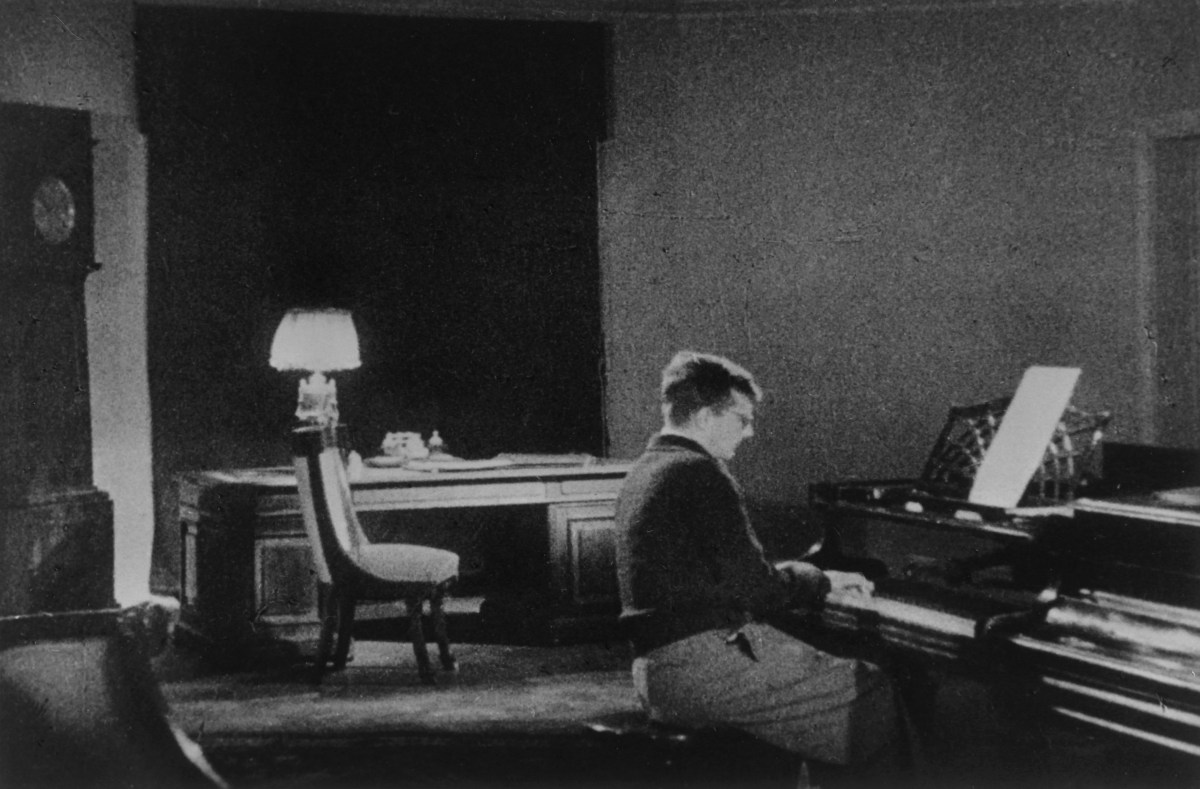
| A native of Leningrad, Dimitri Shostakovich composed most of his Seventh, or Leningrad, Symphony from the besieged city. (Library of Congress) |
The shocking news of the German attack on the Soviet Union, Operation Barbarossa, had reached Leningrad at midday June 22 as loudspeakers throughout the city broadcast the voice of Commissar for Foreign Affairs V.M. Molotov announcing the bare facts and proclaiming: ‘Our cause is just. The enemy will be crushed. Victory will be ours.’ Among the thousands of Leningraders hearing the news was a thirty-four-year-old composer whose music was among the most valuable cultural material Communist Russia exported to the outside world. While not exactly a household name, Dimitri Shostakovich was familiar to classical music lovers in such faraway places as New York, Boston, and Philadelphia. His distinctive, original, and emotionally communicative symphonic works marked Shostakovich as one of the premier talents of modern music.
From the perspective of the Soviet leadership, an internationally recognized figure such as Shostakovich was a mixed blessing. On the one hand, the regular inclusion of his music in concert programs in the capitalist West seemed to validate the Soviet system’s accomplishments. On the other hand, the language of music is far less precise than the written word or even visual representations. Kremlin arbiters of taste and ideas could never be sure if the sounds of a Shostakovich composition were truly extolling the glories of a Communist society — or ironically commenting on its many shortcomings, which were never to be openly acknowledged.
By his birth and training, Shostakovich was very much a Soviet artist. ‘We Soviet musicians are constantly searching for a new style,’ he announced in 1942. ‘We must continue…ceaselessly perfecting ourselves,…never for a moment forgetting that our art serves our people.’
The rise and fall and rise again of his reputation mirrored the changes within his country as the Communist dictator Josef Stalin consolidated state controls over all aspects of everyday life. Through works such as his delightfully insouciant Symphony No. 1 (1924-25) and his scandalously R-rated opera Lady Macbeth of the Mtsensk District (1930-33), Shostakovich established himself on the international scene. Such an independent voice was anathema to the Stalinist system of top-down control, and in 1936 the brash young composer was formally castigated for his ‘deliberately dissonant, muddled stream of sounds.’
It was a time of show trials, followed by executions or harsh imprisonments for those denounced as enemies of the state, so this official censure had serious implications. The composer eventually responded to the charges with his Fifth Symphony (1937), a piece that — on one level at least — expressed the loyal response of a good Soviet citizen-artist to criticism by following an approved path (struggle ending in triumph) in an accessible musical language readily grasped by the masses. (The work’s quality is such that it remains among the Shostakovich pieces played most often, while its message is ambiguous enough that some current writers hail its subtle subversiveness.) The Fifth Symphony’s immediate success proved a timely rehabilitation for the composer. Just six months prior to its premiere, Shostakovich had seen his powerful friend and patron, Red Army Marshal Mikhail Tukhachevsky, arrested, tried, and shot for treason.
The start of the Great Patriotic War stirred Shostakovich as it did millions of his countrymen. He tried twice to enlist in the Red Army but was turned down because of his poor eyesight. He then joined a Home Guard unit drawn from members of the Leningrad Conservatory (where Shostakovich taught), and the world-famous composer spent several weeks laboring to build defensive lines that Soviet military leaders were belatedly erecting around the city.
Shostakovich was next transferred to a firefighting brigade, where he was posted to extinguish any incendiaries that might land on the conservatory’s roof. This assignment proved largely symbolic, as the school’s directors always found excuses to keep their most valuable faculty member busy elsewhere.
Nonetheless, on July 29, 1941, Soviet propagandists posed fireman Shostakovich for a number of photos that were widely distributed and which came to symbolize the unshakable determination of Leningrad’s defenders. Shostakovich had also turned his prodigious talents to arranging small musical works for the spare instrumental combinations used to entertain troops at the front. In addition, he wrote some original marches and a suitably rousing patriotic anthem that concluded with the words: ‘The great hour has come, Stalin leads us to battle, his order is law! Go boldly into dread battle!’ Then, on July 19, Shostakovich began composing a large-scale symphonic work.
According to an old Russian proverb, ‘When guns speak, the muses keep silent.’ While war, soldiers, and the dramatic scenes of battle have been a subject for art almost since the first weapon was raised in anger, the disruptive and destructive nature of military actions makes it difficult, if not impossible, to complete anything as sophisticated as a symphony amid the turmoil. Yet this is what Shostakovich set out to do.
‘I couldn’t not write it,’ he later said. ‘War was all around.’ Declared musicologist Nicholas Slonimsky: ‘No composer before Shostakovich had written a musical work depicting a still-raging war, and no composer had ever attempted to describe a future victory, in music, with such power and conviction, at a time when his people fought for their very right to exist as a nation.’
The period between June 22 and July 19 had been marked by a seemingly endless series of German victories and Red Army defeats. Taking full advantage of superior organization, effective tactics, and flexible battle plans, Adolf Hitler’s forces swiftly shattered all Soviet efforts to halt them. Thanks to utterly misplaced confidence in their defensive schemes, Russian military planners were rocked by disaster after disaster as one position after another was either bypassed or encircled. While their eyes were firmly on the prize of Moscow, German commanders realized that taking Leningrad was an important precondition, so its capture loomed large in Hitler’s strategy.
When Shostakovich began writing his symphony, German columns were pressing Red Army troops who were struggling to hold a line stretching southeast from the Gulf of Finland along the Luga River to Lake Il’men’, some seventy-five to one hundred miles south of Leningrad. By the time he had completed a full copy of what became the first movement of his new symphony, it was September 3 and German forces were consolidating for a direct assault on the city, their shells even reaching Leningrad proper.
At a time when entire contemporary symphonies rarely exceeded twenty-five to thirty-five minutes in length, Shostakovich lined out a war symphony that was gargantuan in size by finishing a first movement that itself lasted more than twenty-six minutes. He was writing at what one commentator later termed an ‘incredible speed.’ The Soviet propaganda line was that the momentous events animated the composer; however, it is also likely that he drew upon material already sketched out for other purposes, even before hostilities began. As Leningrad conductor Nikolai Rabinovich remembered, Shostakovich professed to having found his inspiration in the experiences of ‘those ordinary Soviet citizens before whose heroism he bowed in admiration….’
When the symphony was in an early planning stage, Shostakovich titled this initial movement ‘War,’ a designation that he soon discarded. Its most striking feature occurs some six minutes after its sweeping, urgent opening, when a simple tattoo played by the snare drummer introduces what one critic described as ‘a little puppet-like tune’ and what later Soviet writers declared to be a ‘psychological portrait of the enemy.’ (The snare drummer’s repetitive part continues for so long — 352 bars — that the composer suggested employing a relief drummer.) The tune begins quietly, even playfully, but in the course of this movement it grows greatly in intensity and darkens considerably in mood, becoming positively Goyaesque in its brutality.
This melody — the source of which remains a matter of conjecture (some trace it to an operetta by Franz Lehár, said to be one of Hitler’s favorites, while others believe it to be a masterful distortion of ‘Deutschland über alles’) — is heard twelve times, and varies only in dynamics and orchestration, in the manner of Maurice Ravel’s famous Bolero. Shostakovich expected the comparison. As he told a friend, ‘Let them accuse me, but that’s how I hear war.’
A few score pages convey a visual representation as well, with notes arranged with an orderly precision suggesting a vast formation marching through Red Square. A portion toward the end of the long movement offers a poignant requiem for the fallen, which one musician likened to a ‘mother searching for her dead son on the battlefield.’
A second movement was finished on September 17. By then elements of the Finnish army, which was allied with Germany, were actively threatening Leningrad from the northwest, while Wehrmacht operations south of the city continued to chew up Soviet positions and defensive forces. So serious had matters become that Stalin put his principal military troubleshooter, Red Army General G.K. Zhukov, in command of Leningrad’s defense.
Shostakovich later termed this elegiac section (running about half the length of the first) ‘life in opposition to war,’ and in his early planning scheme titled it ‘Memories’ or ‘Reminiscences.’ In a broadcast that day carried throughout the city over Leningrad Radio, the composer said: ‘An hour ago I finished the score of two movements of a large symphonic composition. If I succeed in carrying it off, if I manage to complete the third and fourth movements, then perhaps I’ll be able to call it my Seventh Symphony. Why am I telling you this? So that the radio listeners who are listening to me now will know that life in our city is proceeding normally.’
For the next twelve days the tempo of combat along the southern approaches to the city was unrelenting; both sides finally halted in mutual exhaustion in late September. Casualties were high for attackers and defenders. Yet on September 29, Shostakovich finished his symphony’s third movement, an adagio, or slow movement. Originally titled ‘Our Country’s Wide Vistas’ or ‘Native Expanse,’ it has been described as some of the most beautiful music written by Shostakovich, who was not known for his tender moments. Said critic Kenneth Furie, ‘The ‘Adagio’ of the Seventh speaks, like perhaps no other piece of music, for victims — for the innocents who have been stripped of hope and reduced to their last shred of dignity.’ The next day, September 30, Shostakovich was ordered to leave Leningrad. He departed the city with his wife and two children, taking a plane to Moscow on October 1. Even as Soviet officials uprooted and transported essential armaments industries eastward, away from the advancing German armies, they also acted to protect their cultural treasures. There had already been several waves of evacuations of important artistic material and personnel from Leningrad before Shostakovich received his peremptory instructions to fly out of harm’s way.
Since Moscow itself was under a direct threat from the advancing Germans, the composer and his family soon had to flee once more, packed aboard a refugee train. Shostakovich brought with him just three scores: Igor Stravinsky’s Symphony of Psalms, his own opera Lady Macbeth, and the manuscript for his new symphony. The last was briefly misplaced during the hectic, chaotic journey, but was recovered without having suffered any damage. On October 22, Shostakovich and his family detrained at the reserve Soviet capital, Kuybyshev (present-day Samara), the location of one of several centers established for artistic Soviet refugees.
The disruption caused by the hurried evacuation broke Shostakovich’s concentration. Even though his public pronouncements were positive, Shostakovich was stymied. ‘You know, as soon as I got on that train, something snapped inside me,’ he told a friend. His writer’s block was due in part to the travel, but more so to the crowded living conditions in Kuybyshev, where he, his family, and a piano were all crammed into a one-room apartment. Not until December 10, when Shostakovich was able to obtain a separate room in which to work, was he able to begin composing the symphony’s finale.
In distant Leningrad, where members of Shostakovich’s family remained, military matters had not improved. With a determined German thrust toward Moscow underway, Stalin recalled Zhukov while, at the same time, ordering Leningrad’s defenders to strike back. The result was a series of localized offensives beginning in mid-October. The attacks, which added to the growing casualty lists, merely sustained the status quo. Cold and snow at last slowed the pace of events. By the end of December, Leningrad remained a Soviet citadel, but it was closely invested and about to endure the darkest, deadliest winter in its history.
It was during a small party for friends in Kuybyshev, on December 27, that Shostakovich announced he had finished his Seventh Symphony, now dedicated ‘To the City of Leningrad.’ The fourth and final movement was roughly sixteen minutes long — longer than the second but shorter than the third. Origi-nally called ‘Victory,’ the section exuded grim determination and conviction, dispensing with any heroic flourishes or morale-boosting bombast. (The composer also ignored a suggestion to conclude with a choral section singing Stalin’s praise.) There were no overt gestures to the masses, just a resolute struggle that ends with the victor grimly satisfied but not celebratory. Nonetheless, Pravda dutifully proclaimed that the ending represented ‘the triumph of light over darkness.’ In its final bars, a rhythmic allusion is made to the most famous victory music of World War II: The dot-dot-dot-dash opening of Beethoven’s Fifth Symphony.
The state’s cultural propaganda machinery immediately began organizing a performance in Kuybyshev, using the pit band of Moscow’s Bolshoi Theater, which had been evacuated there. Conductor Samuil Samosud, better known for his operatic work than for symphonic concerts, was given the task, and by late January the work was in full rehearsal. Conditions for Shostakovich remained difficult: His apartment lacked sufficient heat, he had problems finding enough music paper for his work, and the news from Leningrad was greatly discouraging.
What the Germans could not win by force of arms on the ground they now tried to claim through bombardment and starvation. More than three million civilians were trapped in Leningrad, and they faced one of Russia’s harshest winters, with most city services either overwhelmed or destroyed. A tenuous supply line crossing Lake Ladoga allowed a trickle of supplies to reach the starving metropolis. Death was a daily feature on Leningrad’s streets, as people perished from starvation, exposure, and enemy action. ‘Today it is so simple to die,’ recorded a diarist. ‘You just begin to lose interest, then you lie on the bed and you never again get up.’
On March 5, 1942, Kuybyshev briefly became the cultural capital of the world when Shostakovich’s Seventh (Leningrad) Symphony was played in the Palace of Culture for the first time. Everything about it was larger than life — including its length (approximately eighty minutes) and the oversized orchestra it required. Yet, incredibly, the massive, abstract work forged as a symbol of resistance to fascism became a cultural icon in the Soviet popular mind. The symphony’s Moscow premiere some twenty-four days later was just as moving and emotionally powerful. Even the urgent blare of air raid sirens could not restrain the audience, whose applause rang out for twenty minutes once the music had ended.
Already plans were underway for the worldwide dissemination of the work. In a journey whose cloak-and-dagger aspects seem somehow appropriate, the score was handled like a high-priority state document. It was copied onto 35mm film, packed into a small tin box, and shipped out via plane to Tehran, then by automobile to Cairo, and finally on a plane to the West. English radio listeners first heard it on June 22 — a year to the day after Hitler launched Operation Barbarossa.Three of America’s most distinguished conductors — émigrés Serge Koussevitzky, Leopold Stokowski, and Arturo Toscanini — vied for the right to introduce the Leningrad Symphony in the United States. The Russian Koussevitzky landed the concert premiere, but it was to follow a nationwide radio broadcast by the NBC Symphony.
English-born Leopold Stokowski (something of a cult figure thanks to his lofty presence in Walt Disney’s Fantasia) had alerted NBC officials to the forthcoming symphony as early as December. At that time, Stokowski was sharing the NBC podium with another classical celebrity, Italian Arturo Toscanini, well known for his opposition to Benito Mussolini’s rule. Because of his foresight in scouting the work, and his own history of presenting other Shostakovich compositions to American audiences, Stokowski expected to do the honors with the Leningrad Symphony radio broadcast. NBC had other plans, however.
The company had created the NBC Symphony expressly for Toscanini, and even though its relations with the often-temperamental musician were rocky at times, he was still their most marketable cultural personality. Stokowski and Toscanini exchanged some polite letters, each advancing his claim to the U.S. premiere, but in the end it was Toscanini’s to decline. After reviewing the score (‘I was deeply taken by its beauty and its anti-Fascist meanings,’ Toscanini wrote), the Italian maestro decided he would direct the work’s American premiere.
The concert was scheduled for July 19, 1942. All these high-art maneuvers took place at a time when Franklin D. Roosevelt’s administration was actively promoting the Soviet Union as America’s new ally. Through books, films, op-ed pieces, and other means, the government and national media churned out stories emphasizing Soviet sacrifices and heroism, some even comparing life under Stalin favorably to the American way of life (reaching its most effusive expression in the epic Warner Brothers movie Mission to Moscow). All the while, the U.S. government downplayed the darkly tyrannical nature of Stalin’s regime and its recent cynical dismemberment of Poland and imperialistic war against Finland.
During the week of the NBC premiere of the Leningrad Symphony, Time magazine featured composer Shostakovich on its cover, replete with fire helmet, over the caption: ‘Amid bombs bursting in Leningrad he heard the chords of victory.’ Inside that issue was an extended article titled ‘Shostakovich and the Guns’ that outlined his life story, the symphony’s dramatic genesis and travels, and the artistic scrimmage to first perform it in the United States. Time proclaimed the piece ‘a musical interpretation of Russia at war.’
The July 19 radio broadcast was opened by the ubiquitous Ben Grauer, announcing that the program was dedicated to Russian War Relief. Then the president for that charitable agency read a telegram from Shostakovich expressing his gratitude for the fund’s efforts. Grauer returned to tell the story of the symphony’s epic journey to America, closing with the reading of another ‘radiogram’ from Shostakovich to Toscanini that sounded committee-written: ‘I am confident that with your consummate inherent talent and superlative skill you will convey to the public of democratic America the concepts I have endeavored to embody in the work.’ Following a performance of ‘The Star-Spangled Banner,’ the NBC Symphony under Toscanini played the Leningrad Symphony. After it was over, the Russian War Relief official spoke once again of that country’s battle against the ‘Hitler hordes’ and offered more praise for this’symphony written within range of gunfire’ before the program closed with a war bond appeal. NBC later estimated the listening audience at twenty million.
Reaction in the United States was divided between the music critics (who mostly did not like it) and everyone else (who mostly did). The New York Herald Tribune‘s Virgil Thomson complained that the piece’seems to have been written for the slow-witted, the not very musical and the distracted.’ The populist American poet Carl Sandberg proclaimed that the composition had been ‘written with the heart’s blood,’ while novelist Erskine Caldwell wondered, ‘Who in hell can defeat the nation that wrote such music!’ As a piece of propaganda art and as music written for the moment, the Leningrad Symphony more than met the need. There were no fewer than sixty-two performances in the United States during the 1942-43 season.
All those glittering galas paled before the shabby one that took place in Leningrad itself. During the time that the piece was making its way across the globe, Soviet fortunes on the Leningrad front had not dramatically changed. Efforts by the Red Army to open a secure corridor to resupply the city had failed, and violent German counterattacks showed no lessening in their resolve. Despite all the privation, or perhaps because of it, the decision was made to bring Shostakovich’s symphony to Leningrad.
Once again, this lengthy, expansively scored composition proved a rallying point for patriotic fervor. With the famous Leningrad Philharmonic Orchestra evacuated to the east, an orchestra had to be cobbled together around the pitifully small core of the city’s Radio Orchestra, augmented by every musician who could be summoned from retirement. Even then, a call was issued for drafted musicians serving at the front, and it reached a point where some of the necessary brass players had to be forcibly pried loose from their units. Many of the instrumentalists were so weak from starvation diets that initial rehearsals ended within fifteen minutes and extra rations had to be authorized. After the conductor fainted from exhaustion while walking home following one run-through, worried officials secured a bicycle for him. Only a single 252-page conductor’s full score could be brought in through the blockade, making it necessary for copyists to work day and night to prepare the more than twenty-five hundred pages of individual player parts. In the face of all these formidable obstacles, a performance of the symphony took place in Leningrad on August 9, 1942.
Karl Eliasberg, who conducted on that occasion, noted that Soviet artillery pounded known German battery positions just prior to the concert in order to silence them. The performance was carried throughout the city via a loudspeaker network, and, in a psychological move, additional monitors projected the music toward the German lines. While the quality of the playing can only be imagined under the harsh circumstances, the historic moment was less about art and more about expressing defiance. A playwright in that ragged audience wrote, ‘People who no longer knew how to shed tears of sorrow and misery now cried from sheer joy.’
‘One cannot speak of an impression made by the symphony,’ reported another present. ‘It was, not an impression, but a staggering experience.’ More than a year of suffering still faced Leningraders, who would not see the siege lifted until early 1944. By that time perhaps as many as one million of the city’s civilian population had perished.
Shostakovich’s Leningrad Symphony was not the only concert work to be created as an artistic response to events of World War II. In America especially, composers did their part by writing works large and small. One of the biggest was a nearly hour-long paean (forgotten today) to the U.S. Army Air Forces; among the briefest were Aaron Copland’s still-popular Fanfare for the Common Man as well as his perennial occasion piece, A Lincoln Portrait.
In the years immediately following the conflict, the passions of the Cold War and changing tastes in music made it easy for critics to deride the Leningrad Symphony as a bloated, vulgar composition of no lasting consequence. Yet, like Mark Twain commenting on his premature obituary, the piece lives on, in concert performances and recordings. A new generation of music writers is finding levels of meaning beyond the events surrounding its birth, and many today view it not as a battle piece but as an artistic commentary on totalitarianism.
Post-Cold War assessments aside, the Leningrad Symphony stands as a courageous artistic expression forged in the crucible of conflict by one of the twentieth century’s greatest symphonists. When compared to other military events of the Soviet-German war — Moscow’s defense, the struggle for Stalingrad, the fight for the Kursk salient — most of what happened on the Leningrad front generally merits less attention. Yet despite this, and even though the winds of change have recast the city of Peter and Lenin once again as St. Petersburg, the story of Leningrad endures in no small measure because the Leningrad Symphony continues to bring the story of its tremendous suffering, sacrifice, and eventual triumph to new audiences. At a time when Soviet arms could not deliver even a symbolic victory to convince the West of its viability, a Soviet artist did. ‘It is, if you like,’ said Shostakovich, ‘a polemic against the statement that ‘when the cannons roar the muse is silent.” Continuing his thought in the Time magazine article, the composer declared, ‘Here the muses speak together with the guns.’
This article was written by Noah Andre Trudeau and originally published in the Spring 2005 edition of MHQ. For more great articles, subscribe to MHQ: The Quarterly Journal of Military History today!