
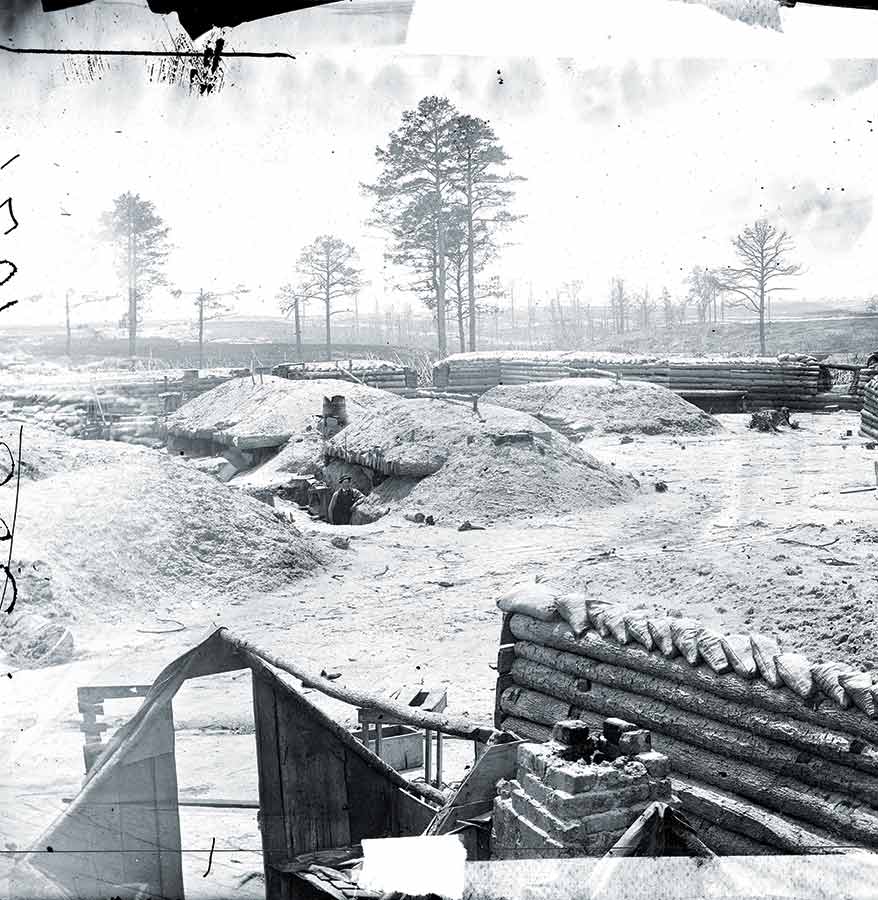
After more than nine months of squalid trench warfare around the beleaguered Southern city of Petersburg, Virginia, the spring of 1865 found Confederate General Robert E. Lee and his 44,000-man Army of Northern Virginia facing an overwhelming enemy force of 128,000 troops commanded by the indomitable Lieutenant General Ulysses S. Grant. Lee had been successful against long odds before, but never before had he and his men faced a situation as desperate as this. Less than 150 miles away in North Carolina, General Joseph Johnston and his depleted Army of Tennessee were trying to hold back Major General William Tecumseh Sherman and four times as many Union troops, while a third Federal force, under Major General Philip H. Sheridan, had just joined Grant outside Petersburg. Soon, Lee knew, he would be facing more than 200,000 battle-tested foes. Not even Robert E. Lee could defy those odds.
It had already been a long and grueling winter inside the Confederate trenches at Petersburg. Hunger, cold, illness, desertions and the constant threat of deadly snipers had sapped the spirits of the once defiant Virginians. In one five-week stretch that winter, nearly 3,000 Southern soldiers deserted–nearly 8 percent of Lee’s total strength. The few new recruits that came into the army–usually grudgingly, via the widely hated draft–could not replace the hardened veterans of so many earlier campaigns. “The men coming in do not supply the vacancies caused by sickness, desertions, and other casualties,” Lee admitted. Although the general still retained the affection and loyalty of his men, both Lee and his underlings realized that it was only a matter of time before the war reached a point of no return. Said one Maryland soldier: “There are a good many of us who believe this shooting match has been carried on long enough. A government that has run out of rations can’t expect to do much more fighting, and to keep on is reckless and wanton expenditure of human life. Our rations are all the way from a pint to a quart of cornmeal a day, and occasionally a piece of bacon large enough to grease our plate.”
Lee himself made a fruitless trip to Richmond to plead his army’s case before the Confederate Congress, but bitterly told his son Custis, “I have been up to see Congress and they do not seem to be able to do anything except to eat peanuts and chew tobacco, while my army is starving.” Meanwhile, the Union forces were growing stronger by the day. A massive supply depot at City Point, seven miles northeast of Petersburg at the confluence of the James and Appomattox rivers, bulged with mountains of food, clothing, arms and ammunition for the Federal troops.
Lee’s desperate attempt to cut the enemy supply lines at the juncture of Prince George Court House Road and the City Point Railroad on March 25 went terribly awry. Major General John Gordon, aiming his assault at the enemy salient of Fort Stedman, quickly seized the fort, but a massive counterattack rained down death and destruction on the Confederate attackers. After only a few hours, Lee called off the attack, but not before losing another 4,000 irreplaceable troops while gaining absolutely nothing.
Even worse, Lee’s halfhearted assault put Grant on alert. The Union commander was no longer worried that Lee could defeat him (if indeed he ever had been), but he was concerned that the wily Confederate might slip away under cover of darkness and join Johnston’s forces in North Carolina. On March 29, Grant assembled 50,000 troops on the Union left under one of his favorite commanders, Sheridan, who had already cleared the Shenandoah Valley of all effective Rebel resistance. Two days later, Sheridan’s force pushed northwestward toward Five Forks, a strategic wilderness crossing a dozen miles south of Petersburg. Lee, rather than extending his thin lines of defense an additional four miles to meet the Union threat, dispatched a 10,500-man mobile force of cavalry and infantry to oppose Grant’s flanking movement. The idea was that the quicker-moving Confederate cavalry could bridge the gap between the existing lines and the 6,000 supporting infantry troops until they could be properly situated.
On March 31, a portion of Sheridan’s force reached the outskirts of Five Forks but were repulsed by Maj. Gens. George Pickett and Fitzhugh Lee. A terse message soon arrived from General Lee. “Hold Five Forks at all hazards,” he ordered. Incredibly, Pickett and Fitzhugh Lee chose the next day to hold a holidaylike shad bake behind their lines, and that same afternoon the relentless Sheridan struck, routing and scattering the leaderless Confederates. In one stroke, Lee’s entire right flank disappeared.
To replace the lost infantrymen on the right and attempt to continue holding his lines around Petersburg, Lee sent a desperate appeal that night to Lt. Gen. James Longstreet, who was north of the James River guarding Richmond, to come immediately to his aid. Major General Charles Field’s 4,600-man division was at least 12 hours away from Petersburg, and could not be expected to arrive before 7:30 a.m. on April 2. In the meantime, Confederate troops were moving out of their old earthworks and shifting toward the right to meet the enemy flanking movement there, with the slight hope that Field’s reinforcements would arrive at Petersburg before a general Federal assault fell on the defenders across the entire line.
Grant, however, alertly launched a heavy attack along the whole length of the Confederate lines south of the Appomattox River at dawn (4:45 a.m.) on April 2, and the center of Lee’s lines was soon broken at a thin section held by Lt. Gen. A.P. Hill’s III Corps. As Lee came out of his headquarters behind Hill’s lines at the Turnbull house before daylight on the morning of April 2 to investigate the heavy firing that was in progress, he could just make out a long line of men coming toward him from the southwest. In the growing light, Lee could clearly see the blue uniforms of the troops, who were not more than half a mile away.
Hill was present at headquarters by this time, and he immediately set out with a lone courier to try to ride around the advancing Federals in a desperate attempt to rally his troops and restore the broken lines. The III Corps commander had said recently that he had no wish to survive the fall of Richmond, if that should occur. His wish was soon fulfilled–as Hill was killed instantly when knocked from his horse by a shot through the heart. In the meantime, a six-gun battery set up on the grounds of the Turnbull house opened fire to slow the advance of the oncoming Federals.
A semicircular section of the Confederate line held by Gordon on the left, surrounding Petersburg itself and running from the Appomattox River on the east to Fort Gregg well west of the city, had remained intact. The only chance to buy sufficient time for an evacuation of the major portion of Lee’s army that night required that the Federals be kept out of the 11Ž2-mile-wide gap in the lines on the west (running north from Fort Gregg to the Appomattox River) until Field’s approaching division could be brought into place about noon to establish an effective inner line of defense.
Lee himself was presently outside the intended inner line of defense, with hardly any Confederate troops between him and the enemy, a mere half mile away. Undaunted, Lee took time to go back into his headquarters and rapidly complete his dressing, including the unusual step of strapping on a dress sword with his full uniform. Reluctant to leave even then, Lee took personal charge of the guns. Later, a Federal officer reported: “As we advanced over rolling and open country, a rebel battery opened on our left. Several times, as it was forced to change positions by the fire of the First Maine, we noticed a fine-looking old officer on a gray horse, who seemed to be directing its movements. At length the guns went into battery again on a hill near a large house, and their presence became more annoying than ever. By common consent the three brigades attempted to charge the hill, but the canister fire was so hot that the first attack was a failure. Later, I asked a mortally wounded artillery officer left behind what battery it was. ‘Poague’s North Carolina’, he said, and then I asked who was the officer on the gray horse? ‘General Robert E. Lee, sir, and he was the last man to leave these guns.'”
Lee remained so long at the front that he eventually had to ride away at a gallop on his beloved Traveller, under heavy artillery fire. A shell burst so near the little band of retreating riders that the horse of one of his staff officers was killed. This caused Lee to rapidly jerk his head to one side, as he sometimes did when angry, and glare over his right shoulder toward the source of the fire as he rode along. Some shells also passed through the just-abandoned Turnbull house, setting it on fire and soon leaving only four tall chimneys standing where the headquarters had been.
As he rode through a thin inner line that was beginning to form across the open western end of the earthworks, Lee was cheered by his men as enthusiastically as he had been when he rode into the opening around the Chancellor house following Stonewall Jackson’s flank attack at Chancellorsville almost two years earlier. Before leaving the Turnbull house, Lee found time to send a telegram to the War Department in Richmond (received at 10:40 a.m.) stating, “I advise that all preparations be made for leaving Richmond tonight.” This dispatch was delivered to President Jefferson Davis, who was attending Sunday morning service at Saint Paul’s Church. After receiving the message, Davis got up quietly and left the church to prepare for the evacuation of Richmond that night.
The army had achieved so much for Lee that even now he must have wondered if there might not be one more miracle left. In a way there was, for otherwise the troops would never have been able to get away from Petersburg. Relief came in the form of two small earthworks under construction just beyond the south end of an open area, where it was hoped that an inner line could be established and held. Fort Gregg and Fort Baldwin (also called Battery Whitworth from its nearness to the Whitworth house) were about a quarter mile apart and mutually supporting. The works were occupied by Brig. Gen. Nathaniel Harris’ Mississippi brigade, which was a part of Maj. Gen. William Mahone’s division of Hill’s III Corps. This brigade had been one of the first reinforcement units to be thrown into the broken mule-shoe salient at Spotsylvania 10 months earlier. During that battle, Lee had been riding beside Harris at the head of this column when a solid artillery shot passed under Traveller’s raised forefeet as the rearing horse pawed in the air. Soldiers of the brigade called out: “Go back, General Lee! For God’s sake, go back!” Completely composed, he said, “If you will promise to drive those people from our works, I will go back.” The troops shouted their promise, and then made good on it with the assistance of an Alabama brigade from Mahone’s division that arrived shortly thereafter.
Harris’ brigade consisted of the battle-thinned remnants of four Mississippi regiments (the 12th, 16th, 19th and 48th), which numbered about 400 men in total–not even enough for one good-sized regiment. The brigade was augmented in the Gregg and Baldwin redoubts by about 100 North Carolinians who had been cut off from Maj. Gen. Cadmus Wilcox’s division of Hill’s corps when the left of Wilcox’s line had collapsed during the Petersburg breakthrough. Harris put just under half of those troops into Fort Gregg (214 men, including portions of the 12th and 16th Mississippi and the remnants of Brig. Gen. James Lane’s North Carolina brigade), along with two rifled cannons, one manned by the famed Washington Artillery of New Orleans and the other by the 4th Maryland Battery.
Harris took the rest of the men (about 286, including most of the 19th and 48th Mississippi) and three guns from the Washington Artillery with him to Fort Baldwin, which lay just north of Fort Gregg and had a field of fire of a mile and a quarter to cover, running all the way to the Appomattox River on the north.
Fort Gregg was a square earthwork with a water-filled ditch around three sides of its steeply sloped walls. On the north side, the building of a trench and an elevated parapet to connect with Fort Baldwin had only just begun, and this unfinished section gave a narrow access into Fort Gregg. Likewise, there was an opening in the side of Fort Baldwin to accommodate the planned connecting entrenchment. Thus, each fort depended somewhat on the sweeping cannon fire of its neighbor to prevent enemy forces from entering through its open side. Also, there was no ditch along the unfinished side of the Gregg garrison.
Before Harris left Fort Gregg about noon, he shouted out Lee’s orders over the roar of the ongoing cannonade. “Men,” he told them, “the salvation of the army is in your keep. Don’t surrender this fort. If you can hold out for two hours, Longstreet will be up.” As he left the fort, after placing Lt. Col. James Duncan of the 16th Mississippi in charge, he heard someone shout out behind him: “Tell them we’ll not give up!” This was the second promise to Lee that the Mississippians would honor in every respect.
Two 6,000-man Federal divisions were put in place to overrun the Rebel earthworks as soon as the bombardment was lifted at 1 o’clock. One division was assigned to each of the works. The attack on Fort Gregg got underway promptly, but there was a delay at Fort Baldwin because of the heavy smoke from nearby burning buildings that the Confederates had set ablaze to improve their field of fire. The Federals advanced toward Fort Gregg in three columns, each containing a 2,000-man brigade, which were to converge on the fort as they approached.
Hit by massed volleys of fire, the attacking columns fell back, regrouped and came again, only to meet the same destructive fire and have to fall back once more. Longstreet was on the field by this time, swiftly positioning his lead brigades inside an inner defensive line as soon as they arrived. He and Lee observed the attack on Fort Gregg from a high vantage point. After each unsuccessful storming attempt, faint cheering could be heard from Fort Gregg and Fort Baldwin, which was not yet under heavy attack. At one point Lee called his staff around him, pointed to Fort Gregg and asked them to remember the most gallant defense they had witnessed here. Under a tree on a hillside in another part of the field, Grant was also observing and directing the assault on the fort.
Union Maj. Gen. John Gibbon, in charge of carrying out the attack, eventually called for one of the brigades in the division still standing idle before Fort Baldwin. This increased his assaulting force to about 8,000 men, and they were now sent against what was left of the 214 men inside Fort Gregg in one single flood designed to swamp the defenders, instead of in successive waves. The attackers completely surrounded the fort and gained entry through the unfinished side. While the Confederates tried to drive the Federals out through the opening, more troops attacked the other sides of the fort, standing on the shoulders of their comrades to reach the tops of the parapets.
Eventually, hand-to-hand fighting broke out on parapets all around the perimeter of the battered fort. At one time, six Federal regimental battle flags were visible on the parapets. Wounded Confederates inside the fort continued to load rifles taken from dead and disabled soldiers and pass them up to the sharpshooters atop the walls. Tumbling over the parapets, sometimes lifted on the raised bayonets of the unwavering defenders, the attacking Federals achieved a tenuous foothold inside the fort. Still, for another 25 minutes, hand-to-hand fighting continued within Fort Gregg, where defenders made use of everything available to them, from bayonets and clubbing rifles to bricks gathered from chimneys toppled by artillery fire.
Finally, only one gun was in action within the redoubt, and that was manned by a single cannoneer who held the lanyard taut on a gun loaded with double-shot canister. Told to “drop the lanyard or we’ll shoot!” the gunner yanked on the lanyard and shouted, “Shoot and be damned!” whereupon he was riddled with bullets and fell dead across the smoking gun. A similar incident had occurred on May 3, 1863, during the Second Battle of Fredericksburg, when the last gunner of the Washington Artillery fired point-blank into surrounding attackers. The unit’s well-earned reputation was not harmed by their work on April 2, 1865.
It was just after 3 o’clock when the last fighting terminated in Fort Gregg. The defenders had been true to their word–they had not given up. Moreover, they had given Lee the two hours he wanted, plus an extra hour for good measure. With the collapse of Fort Gregg, the defenders of Fort Baldwin now made a rush for the inner lines before their now-indefensible position could be surrounded, losing about 60 men as they fled. Left inside Fort Gregg were 55 dead defenders, 129 wounded and only 30 men who surrendered uninjured. The Federals suffered more than 700 casualties during the reduction of the two unfinished earthworks. Now, however, the victorious Federals faced a stronger inner line of works, manned by defenders whose resolve had been strengthened by witnessing the heroic defense of Fort Gregg.
The exhausted Federals were content to remain in a line just outside the range of Confederate rifle fire until nightfall, when the Confederates began their retreat across bridges over the Appomattox River about an hour after darkness fell (8 p.m.). There was no organized interference from the Federals except for continued cannon fire. Because of the enemy firing, the Confederates could roll their artillery over the cobblestone streets of Petersburg without being heard during their retreat. Perhaps the retreat went undetected. But after losing well over 40,000 casualties in the trenches around Petersburg during the past 293 days (including more than 700 lost that afternoon in overwhelming 500 Confederates in Forts Gregg and Baldwin), perhaps Grant was perfectly willing to allow the Army of Northern Virginia to gain unopposed access to the open country.
As they walked through Fort Gregg and the surrounding Petersburg trenches following the evacuation on April 2, the victorious Federals could not fail to notice the beardless faces or silver strands of hair of many of the fallen Confederates. Major Washington Roebling wrote: “Old men with silver locks lay dead, side by side with mere boys of thirteen or fourteen. It almost makes one sorry to have to fight against people who show such devotion for their homes and their country.” The Confederate manpower shortage became acute during the last stage of the war, but the boys and older men in the trenches continued to fight as desperately as any of Lee’s veteran troops ever had.
The evacuations of Petersburg and Richmond on the night of April 2 were accomplished successfully, with most of the artillery intact, and the two wings of the army were on the march, in good order, toward a juncture at Amelia Court House on the Richmond & Danville Railroad, about 40 miles from the evacuated cities. The army, reunited for the first time since the battle of Cold Harbor 10 months earlier, planned to evacuate along the railroad through Burkeville to link up with Johnston’s forces somewhere beyond Danville, which was more than 100 miles from Amelia Court House. Although the retreat started well, not much went right thereafter; not the least of the blunders was a failure to deliver rations to the starving army at Amelia Court House. The surrounded army was forced to surrender at Appomattox Court House on April 9, only a week after the gallant defense of Fort Gregg had allowed a last slim chance for escape. In the meantime, many thousands more had died for a cause that appeared to be altogether hopeless, even before the Petersburg lines were finally broken.
Still, the defense of Fort Gregg was not without benefit, over and above providing an example of conspicuous gallantry in pursuit of a near hopeless cause that ranks alongside any armed resistance in modern or ancient times, including the Spartan defense of Thermopylae. Indeed, the delay of the Federal attack may have saved a great many lives, at least on the Confederate side. As it turned out, the defense presented an opportunity to draw the army together and allow Lee to make a collective and reasoned decision regarding the surrender of what was left of his once-great army. Even after a week of hard marching with hardly any food, with his army totally surrounded by a vastly superior force, Lee found the decision so agonizing that when contemplating surrender he was heard to remark: “How easy I could be rid of this, and be at rest! I have only to ride along the lines and all will be over!” He must have been thinking about A.P. Hill’s recent death as he said this. Then, after some reflection, Lee added: “But it is our duty to live. What will become of the women and children of the South if we are not here to protect them?”
Some 28,356 paroled Confederate troops returned home from Appomattox. Many of these men might have been shot down, one by one, in the streets of Petersburg if the stout defense of Fort Gregg had not stalled the Federal advance until the Confederates could retreat across the Appomattox bridges. Lee’s life may well have been one of those saved by the orderly evacuation, because it is difficult to imagine that he would have peacefully surrendered with troops still actively engaged in the field. To believe otherwise goes against a considerable body of evidence on Lee’s behavior under fire. His taking charge of the cannons on the morning his lines were broken at Petersburg is but one example of the commander’s steadfastness in battle. Lee’s troops were equally dedicated, some giving their lives at Fort Gregg so that others would have an avenue of retreat. In that way, at least, they did not die in vain.
Ronald E. Bullock of Cardiff, Calif., is a longtime student of the Civil War and has published several articles on this and other subjects. For further reading, see Shelby Foote’s The Civil War: A Narrative, Vol. 3; Douglas Freeman’s R.E. Lee, Vol. 4; and E.P. Alexander’s Military Memoirs of a Confederate.