
In the late summer of 55 BC Julius Caesar stood on the north coast of France and looked out over the Channel. Some 30 miles across the water lay an island, which, according to travellers’ tales was rich in pearls, lead, gold, and tin, but Caesar’s interest in Britain was dictated not so much by a desire to exploit her mineral wealth as by the strategic position of the island. He could clearly see that Britain posed a backdoor threat to his latest and greatest conquest (France) whose subjugation Caesar had now enforced after eight years’ hard campaigning. During those years the Celts of Britain had aided their Gallic kinsmen against Caesar and he judged that until Britain was his, the north coast of France would always be vulnerable to surprise attack.
Caesar, however, was aware that there was little time left — before winter brought campaigning to a halt — to complete a British invasion, not time enough, in fact, to mount the usual Roman form of attack that called for long-term tactics, infiltrating enemy territory and sapping morale through propaganda and subversion. There was no time either for proper reconnaissance of the island, of for gathering information about the nature and size of the country, its harbours and the methods of fighting used by its inhabitants.
Caesar had already tried to extract this information from the Veneti, a tribe living in Britanny who traded regularly with the British. But the Veneti had refused to talk. Their recent defeat by the Romans had been marked by the massacre of their nobility and the sale into slavery of most of their people, and Caesar’s questions only prompted them to warn the Celts of Britain that Rome’s greatest general was now interested in their land.
Caesar’s reputation in Britain was well known and the Celts knew they would have little chance against the magnificently equipped Roman Army unless their defense was carefully planned. While they armed in secret, they also began to play for time, sending representatives to Caesar at Boulogne ostensibly to offer their submission to Rome. The Celts knew that Caesar would not doubt the sincerity of this; arrogant and accustomed to success as he was, he took this submission as his natural right.
The Celts returned to Britain accompanied by Caesar’s ambassador, Commius, King of the Atrebates, one of the Gallic tribes. With Commius Caesar send 30 horsemen, who had instructions to ‘visit as many of the tribes as possible, to persuade them to place themselves under the protection of Rome, and to announce that Caesar himself would shortly be arriving.’
Caesar arrived within a few weeks, on an early autumn morning. He came with 80 transports and the X and VII Legions, but without his cavalry, whose ships had been trapped in France by savage Channel winds. As Caesar approached the white cliffs of Dover, he found an impressive sight awaiting him. On the clifftops stood rank upon rank of Celts, waiting, Caesar had no doubt, to pay homage to himself and his legions. It was only when the Roman ships came closer to the shore that Caesar saw this was no welcoming party: the British ranks were bristling with weapons.
GET HISTORY’S GREATEST TALES—RIGHT IN YOUR INBOX
Subscribe to our HistoryNet Now! newsletter for the best of the past, delivered every Monday and Thursday.
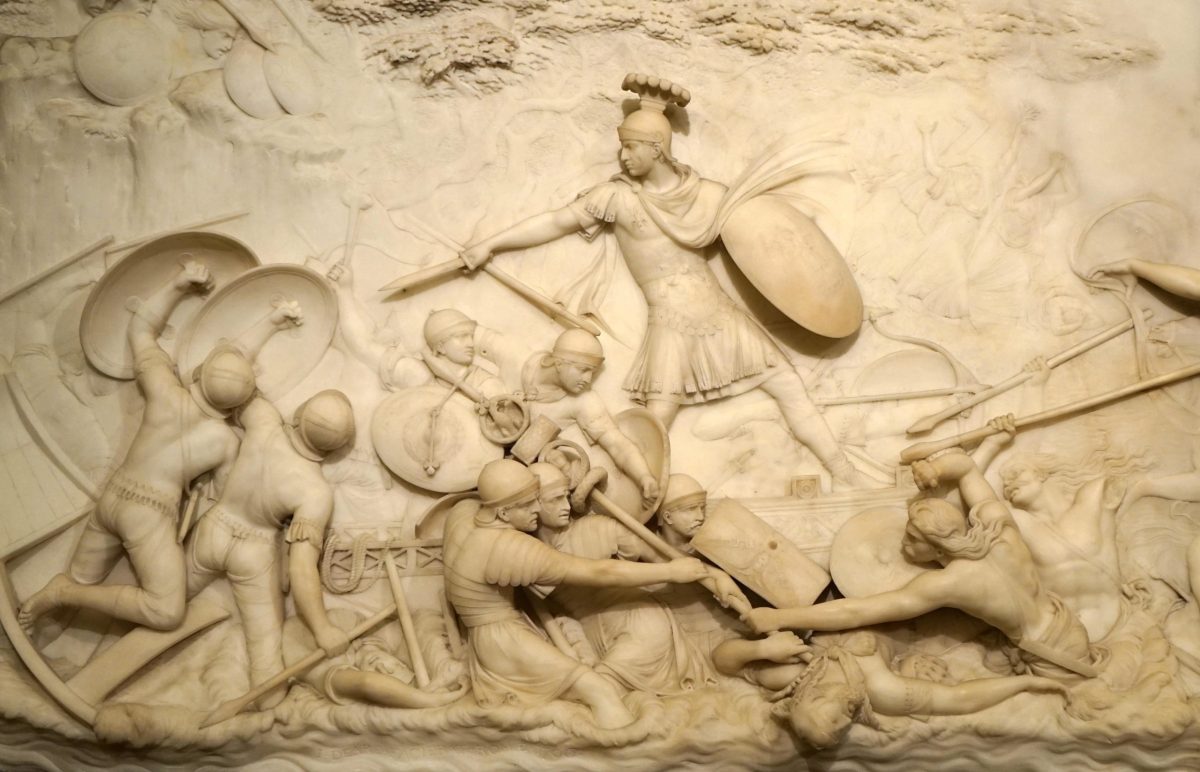
The Roman galleys sailed northeast towards Deal, and the Celts walked and rode along the clifftops, pacing the ships. It was an unnerving sight for the would-be invaders, and by the time the galleys were as close to the beach as their size would allow, even the courageous X Legion, Caesar’s favourite, was apprehensive. Quite uncharacteristically, these legionaries hesitated for several minutes before obeying the order to jump into the waist-high water. Their hesitation was soon justified. The men were still wading towards the shore, weighed down by their arms and the heavy mailed leather jerkins they wore, when the British horsemen came riding out into the surf, swinging their swords and shouting battle cries. Behind the horsemen, on the beach, stood more Britons armed with stones and javelins. Bombarded from above and slipping on the shingle, some of the Romans fell into the water. Enough reached the beach, however, to form up in line and charge their assailants, and with the menacing line of Roman javelins now advancing on them, the Celts turned and fled. It was fortunate for them that Caesar, lacking his cavalry, could order no pursuit.
The Britons now had tested the strength and determination of the Romans, and had found them to be considerable. They decided therefore to play for time once again and the following day sent a deputation to Caesar offering apologies for their hostility. With the arrival of the British chieftains who swore loyalty to Caesar, the general once again began to hope that Britain would prove an easy conquest.
The Celts’ goodwill, however, was soon seen to vanish when an unexpected but powerful ally came to their aid–the British weather. About a week after Caesar’s arrival, the ships carrying his cavalry appeared on the horizon, almost at once, a fierce storm blew up, tossing the ships about on the water, snapping their masts and tearing their sails to shreds. As the fury of the gale mounted, the ships were driven back towards France, and by the time darkness came, all had disappeared from sight. The bleak dawn that followed revealed a beach littered with the wreckage of Caesar’s transports. All that remained at anchor was a pitiful row of storm-battered hulks.
As the Romans surveyed the appalling scene, the morale of the Celts rose once more. The British chieftains began to slip away from the camp. Peasants were rounded up, war chariots made ready, arms burnished and sharpened. Now that the Romans seemed marooned on their unfriendly island, the Britons were once more preparing to fight them.
The Romans, however, were far from helpless. Roman legionaries were not only superb fighters, they were skilful engineers as well, and this would not be the first time they had repaired ships by using the wreckage of those more badly damaged. They were even able to forge the nails that held the timbers together. While the men of the X Legion began this repair work, their colleagues of the VII went foraging for food. From their dense oak forests the Britons watched the Romans begin to reap their barley fields, waited till the task absorbed them and then rushed out of the trees, yelling war cries and brandishing spears. Some distance away in the Roman camp, sentries saw a huge rising cloud of dust. Immediately Caesar himself and a handful of troops stormed out of the camp and ran towards the fields. At their approach the Britons fled back into the forest.
The next few days brought more heavy rain, but on this occasion the weather worked to the Romans’ advantage. It kept the Britons away long enough for them to finish repairing some of their ships and send them to Boulogne to fetch more materials. However, when the downpour at last abated, the Britons staged another lightning raid. The Romans drove them back to their forest hideouts, but by this time Caesar had lost patience with so capricious an enemy. The following evening he packed his troops into the remaining galleys and sailed back to France. He had spent less than three weeks in Britain.
The Latest on Ancient Rome
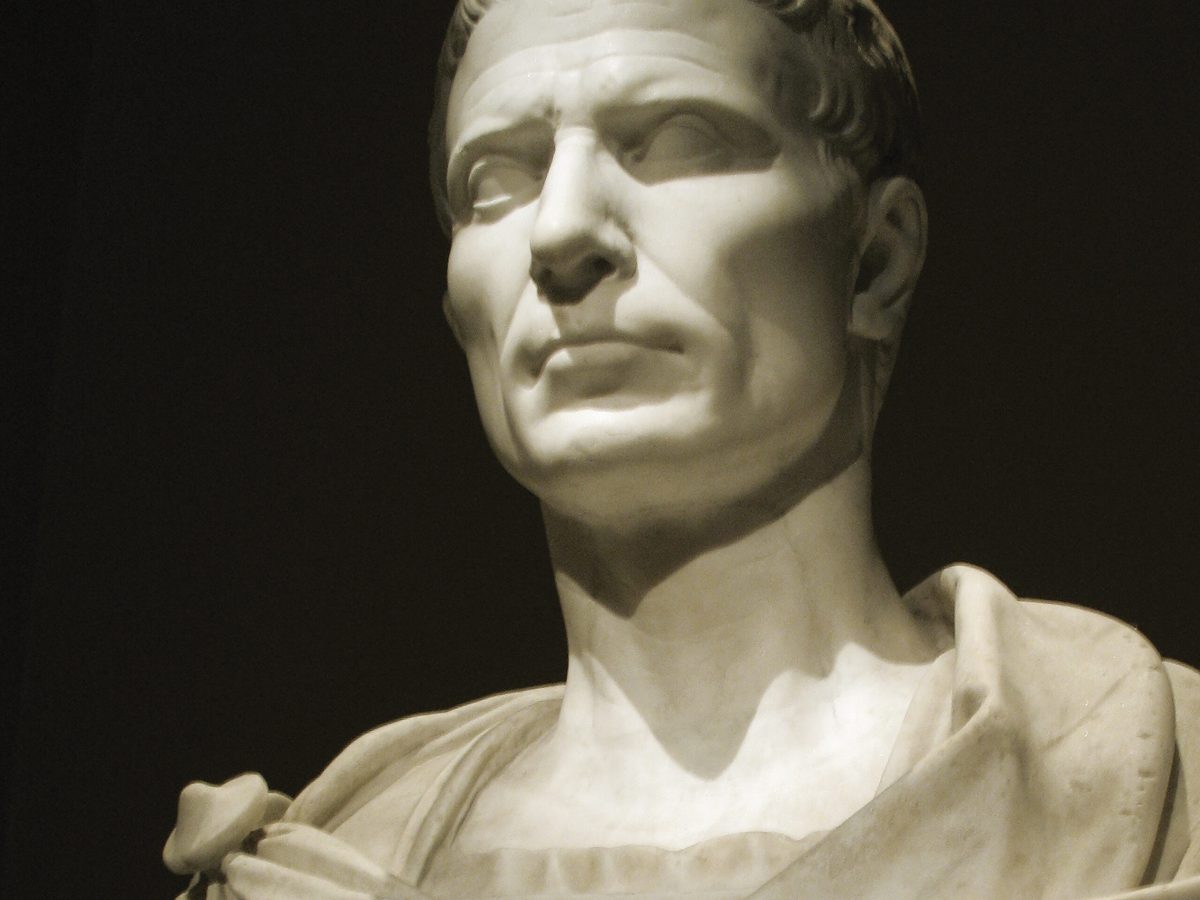
Caesar did not record his feelings about the failure of his 55 BC invasion, but he was careful to send a report to the Senate in Rome painting a favourable picture of what had, in reality, been a near disaster. As a result, the Senate voted a 20-day period of thanksgiving for Caesar’s ‘exploit.’ To explain its lack of success, Caesar intimated that his expedition had been a mere dress rehearsal for a full-scale assault, planned for the following year. Convinced now that a new ‘province’ would soon be added to the Roman Empire, a motley group of opportunists, treasure-seekers, and adventurers joined Caesar’s second invasion force. This time he took with him five legions (25,000 men) and 2,000 cavalry. He also embarked an elephant — probably the first ever to be seen in Britain.
The Roman fleet of 800 ships arrived off the Kent coast in the summer of 54 BC to find the landing beach deserted. The newcomers, unaware of the events of the previous summer, supposed that the mere sight of the Roman galleys had frightened the Celts away. Caesar knew better. He guessed, correctly, that the Britons had decided to wage guerrilla warfare on the Romans, a plan well suited to their inferior weapons and tactics. A pitched battle, which Caesar knew the Britons could not win, was what he now desired most.
Caesar sent scouts to round up a few prisoners, and from them he learned that the Britons were about ten miles away. It was nearly midnight, but Caesar set off immediately and marched through the moonlit forests and marshes of Kent towards Canterbury. There was a brief skirmish near the banks of the river Stour, but as soon as the Romans began to attack in earnest, the Britons disappeared into the trees. The further the Romans advanced, the further the Britons retreated, drawing the invaders deeper and deeper into the forest.
Once again, the weather came to the Britons’ aid. No sooner had the Romans sighted the British rearguard, than a messenger came running up to Caesar with the news that a gale in the Channel had wrecked his ships, plucking them from their moorings and smashing them down upon the shore. A disappointed and angry Caesar was obliged to abandon the pursuit of his elusive enemy and return to the beach to survey the damage. Forty ships had been completely destroyed. Those less badly damaged were dragged up on the beach and for ten days the Romans worked around the clock to repair them. That done, Caesar ordered his men to dig themselves in behind earthen ramparts and wait for the Britons to attack in force.
The Britons let them wait. They had now overcome petty rivalries in their own camp and had united under one leader, Cassivellaunus, King of the Catuvellauni tribe. He was content now to nibble at the Romans, by sending out raiding parties and staging a few ambushes, knowing that sooner or later, Caesar would have to take the initiative.
Summer was fast fading into autumn when Caesar at last lost patience and marched from his fortified camp towards the Thames. The Romans arrived at the only crossing place to find that the Britons had barricaded it by driving stakes into the riverbed. The obstacle was overcome when the Romans clothed their elephant in an armor of iron scales and placed on its back a tower full of archers and slingers. The great beast lumbered into the Thames, with a shower of arrows and stones pouring down from the tower. The terrified Britons bolted for the protection of the trees and refused to come out, except to make a few hit-and-run forays, which did them little good.
Now the unmistakable smell of autumn was in the air and Caesar, aware that time was running out, resorted to subversive tactics. He had in his camp the son of a British chieftain recently defeated by Cassivellaunus. When Caesar promised to restore this young man to his stolen kingdom, some of the smaller tribes deserted their leader. Cassivellaunus, in his growing isolation, persuaded the four kings of Kent to attack Caesar’s base camp and so draw the Romans away to defend it. The plan failed, but Caesar eagerly seized his chance when Cassivellaunus asked for a truce.
Caesar negotiated a treaty imperiously, almost as if he had won a great victory. Cassivelaunus promised to abide by it, but Caesar, impatient now to be gone, took no precautions to ensure that he did so. All Caesar wanted was to get away from this inhospitable island, from its abominable weather, and its cunning inhabitants. Autumn gales were already blowing round the coast and the winds were frothing up dangerously choppy seas when the Roman ships weighed anchor and sailed for France.
Julius Caesar never returned to Britain. The island was left undisturbed for nearly a century, until AD 43 when the Emperor Claudius ordered the invasion that succeeded where that of Rome’s greatest general had so conspicuously failed.