
American novelist Marcia Davenport wanted to discover for herself the Wild West. The problem was that her quest for that West took place only in 1932, a few decades too late, many Americans must have thought. That year the wildest encounter for most people would be grappling with economic gloom and doom. Davenport, however, did find her Wild West and wrote about it in Good Housekeeping magazine in an article she titled “Covered Wagon—1932.”
“[I] wanted adventure, or whatever semblance of it could be had in the year 1932,” she wrote. “So, of course, I flew.” Davenport believed that to cross the United States from Los Angeles to New York “prosaically by rail was to be cheated.” She explained that it “made no sense for me to sit for days in big plush armchairs, tended by troops of expert servitors, eating and drinking delicacies, looking for ways to consume one’s ennui.” Instead of the steady “hum of the safe steel rails,” Davenport embarked on a journey that for her invoked the romance of “Oh, Susanna!” gone to Oregon by covered wagon “with a banjo on my knee.”
It required four separate flights to make the transcontinental journey. On the segment from Salt Lake City, United forwarded the eight passengers aboard a lumbering trimotor biplane that followed the Overland route “made dear by song, verse, and story, the route of the ox trains, the Forty-niners, the stagecoaches, the pony express.” On the way to Cheyenne, bad weather forced Davenport’s plane to make an unscheduled landing at a U.S. government airmail emergency field called Parco, Wyo. the site of “a beacon tended by a man and his wife and his daughter who lived in a little woolly-western shack on the edge of the field.”
At this isolated airfield the passengers waited out the tempest. After a restless night of little sleep, the group flew east again the next day only to be forced by dense fog to make a second emergency landing, this time in Laramie. For Davenport, all such trouble seemed to serve as a happy reminder of a time when the unpredictable nature of travel across the West made every journey a memorable adventure, but many years earlier, the railroads had taken the “Wild” out of the West and made long-distance travel safe, predictable, and hence to adventure-minded travelers like Davenport, boring.
The Transformers
Like a skilled magician, the railroads of the 19 th century had transformed America in ways that awed and dazzled onlookers. “The iron arms” of the railroad, observed Charles and Henry Adams in 1871, “have been stretched out in every direction; nothing has escaped their reach, and the most firmly established institutions of man have proved under their influence as plastic as clay.” Perhaps in no other part of the United States was the power of railroads to transform as well as create afresh more visible than in its wildest West (beginning with the first transcontinental railroad in 1869). “Railroads have been built, and the means of water communication have been extended, the result of which already has been the redemption and occupation of rich areas from the primitive wilderness,” boasted an 1883 publication devoted to settlement of the Pacific Northwest. “Within the brief time since these enterprises began, the advancement of the country has been everywhere apparent, and what has been already accomplished is simply wonderful.”
Railroads of the West excelled at creating industrial order where no pattern of organization existed apart from nature, of being agents of change that essentially tamed the frontier. Consider, for example, how surveyors used precisely calibrated instruments to mathematically quantify the West as never before in terms of curvature, elevation and distance as they staked out prospective railroad lines. The process of transforming the West continued, and even accelerated, once actual railroad operations began. Approximation was no longer good enough in the West the railroads made. Something seemingly so simple as the space between the rails could not vary by more than a fraction of an inch, or the locomotives and cars would derail. Over time, and with occasional prodding from the federal and state regulators, everything from paper thickness to envelope sizes in company offices was standardized within the railroad industry.
Lengthy sets of rules governed train operations—and even employees’ leisure hours off the job. No railroad company tolerated a drunken employee endangering the safety of passengers or fellow employees. For example, “the use of intoxicating liquors and frequenting of saloons is prohibited,” warned the Oregon Railway & Navigation Company railroad rulebook in 1881. Any employee “appearing in a state of intoxication” was to be dismissed immediately. Conversely, loyal employees who avoided intoxicating beverages received preferential treatment in promotion. No ambitious railroader dared to spend a leisurely evening at a boisterous saloon, one of the institutions synonymous with the Wild West. The railroads, which saw themselves as “civilizers” of the wild frontier by imposing industrial order and uniformity in place of unpredictability both in human behavior and in nature, took justifiable pride in engineering achievements that ensured efficient, habitual and safe operations of their trains year around.
A Matter of Time
In the fall of 1883 a group of well dressed ladies and gentlemen gathered with much fanfare in the wilds of Montana Territory. In their stylishness and cool elegance they looked conspicuously out of place. Some had traveled from as far as England, the Netherlands, and Germany to this isolated patch of sagebrush and sand on the banks of the Clark Fork River, and they had done so willingly. Nearby stood a large sign that read “ Lake Superior 1,198 miles / Puget Sound 847 miles.” It reminded visitors that they had assembled almost literally in the middle of nowhere.
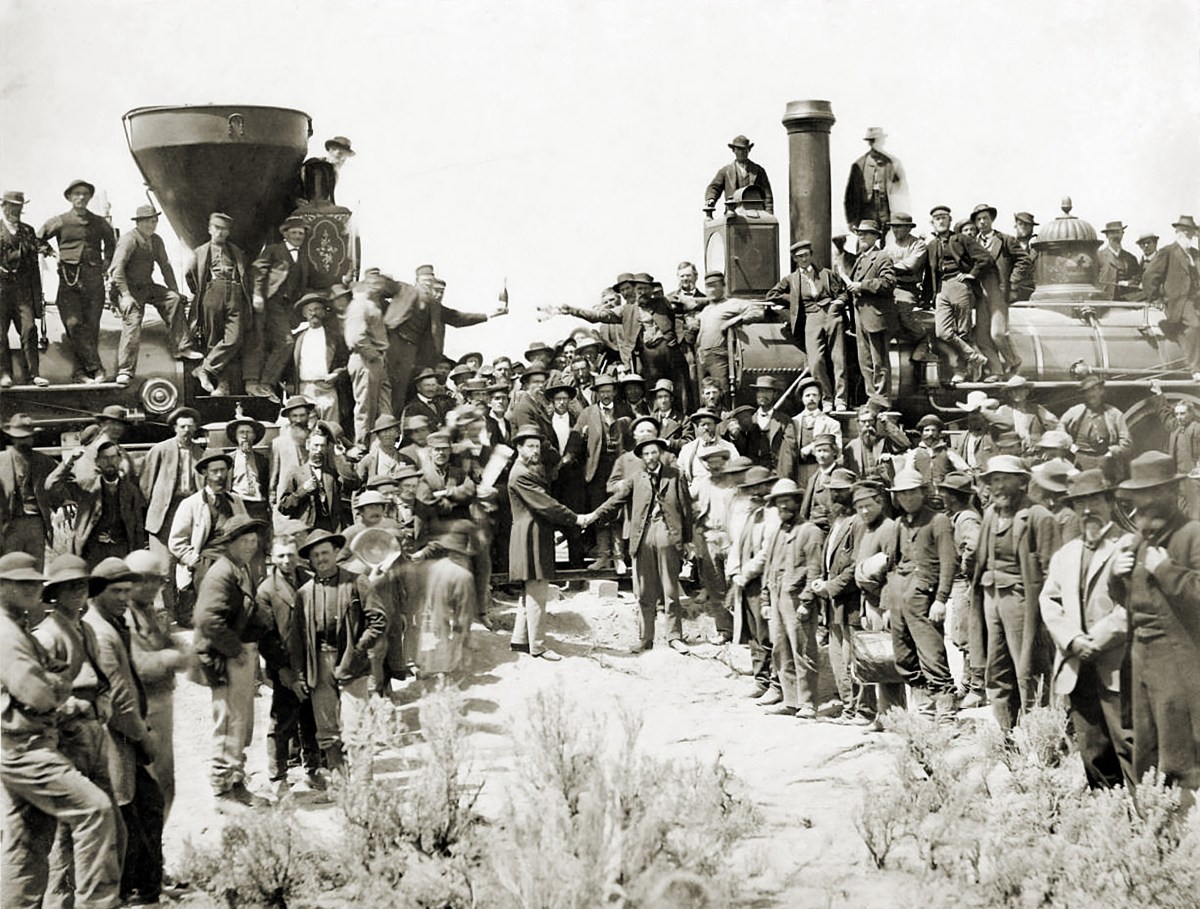
Guests of the Northern Pacific Railroad had traveled to Gold Creek aboard five luxury trains to witness the driving of a last spike that mark ed the formal opening of the first transcontinental rails linking the Great Lakes and Mississippi Valley with Puget Sound and the Pacific Ocean. After the loud band music, the flowery oratory, and the last sledgehammer blows drove a golden spike into place, the Glittering Ones reboarded their special trains and left Gold Creek, most of them never to return to Montana. The day had been rich in symbolism. For one moment the old Wild West popularly associated with Indians, fur trappers and pioneer settlers stood face to face with the new West of high finance, nationwide mark ets and rapid advances in communication and transportation.
A little more than two months later in 1883, on another day rich in symbolism, North Americans collectively reset their clocks and watches to standard time, and like the symbolism of business moguls driving a golden spike in the wilds of Montana, the new system of timekeeping was an unadorned statement of railroad power. Our present time system was invented to resolve the confusion caused for the railroads of North America by dozens of local time standards—hundreds, in fact. Time back in the days of trail travel to Oregon and California needed only be measured casually by noting the position of the sun or by mark ing off each passing day. Every spring in the 1840s and 1850s individuals and families traveled west by wagon train, leaving the familiar Missouri Valley and rolling slowly across the lush grasses of the Great Plains. Their collective goal was to reach Golden California or fertile Oregon by September or October before snowfalls blocked mountain passes. The Donner Party resorted to cannibalism because it lost the seasonal race to the West Coast and became trapped by deep snow in the Sierras during the winter of 1846-47.
Before the fall of 1883 when the railroads created standard time, local variations prevailed throughout the West, and in most places approximate time was good enough to meet the demands of daily life. Minutes seldom seemed to matter. On June 17, 1866, to cite one example, a frontier newspaper, the Idaho World, chose to remind readers how communities of the West reckoned the passing hours during the era innocent of railroad regularity, an era in which idiosyncratic and imprecise timekeeping served as a metaphor for a simpler, preindustrial age: “The difference in time between Idaho City and New York is about two hours and forty minutes; between San Francisco and this place about thirty-five minutes. When it is 12 o’clock at Idaho City it is about twenty minutes to 3 o’clock in New York and twenty-five minutes past 11 o’clock in San Francisco.”
Railroad managers wanted to schedule their trains safely over single-track lines—the kind that predominated across the West and much of the rest of the United States —but safe operation was impossible except by imposing a precise system of time discipline. The relaxed “about time” reckoning that met the needs of stagecoach and steamboat travel was no longer acceptable in any community served by a railroad. All along the West’s rapidly expanding network of rail lines, time discipline meant educating employees to follow timetables and train orders to the exact minute. Failure to observe accurate time might well result in a bloody head-on collision between two speeding trains inadvertently attempting to defy physics by occupying the same section of track at the same time. That was the kind of headline-grabbing misfortune every railroad engineer feared most. A growing number of long-distance travelers grew concerned about accurate timekeeping, too, because the numerous local time standards caused confusion that resulted in impossibly tight connections and missed trains.
These were some of the reasons railroad managers, acting without support from governments at any level, resolved the confusion by introducing railroad time zones on November 18, 1883 —the so-called day of “two noons.” Taking his cue from the railroad managers, Governor Thomas Crittenden encouraged Missourians to set their clocks and watches to the new Central Time. However, across the nation there were pockets of resistance. To the critics, the unilateral action by railroad managers was highhanded and thus all too typical of railroad power to shape and dominate all phases of human existence. The diehards kept their clocks and watches set on local time, but they were fighting a losing battle and they knew it. Symbolically, the railroad companies of the United States and Canada had collectively taken upon themselves a form of power that for millennia had belonged solely to God, or so their critics complained. What was the brave new world defined by railroad power coming to? The railroads new role as the self-appointed guardians of time epitomized as nothing else their seemingly limitless power to transform the Wild West through the practical application of science and engineering.
Imposition of standard time was only the most successful and far-reaching triumph of railroads over local and pre-modern ways governed by the rhythms of nature such as seasonal changes, extremes of weather, and even the contrast between the hours of daylight and darkness. Railroad regularity invariably triumphed over nature’s cycles, seasonal variations, and the weather eccentricities that heightened the unpredictability of travel by stagecoach or steamboat and made every long-distance journey across the West an adventure.
Bridges for all Seasons
One particularly dramatic photograph dating from the early 1880s shows steam locomotives lined up like circus elephants atop the Northern Pacific’s newly constructed bridge over the Missouri River at Bismarck, Dakota Territory. The image illustrates a common method railroads used at the time to field-test the strength and safety of bridges before the first passenger and freight trains chugged across them. Less obvious was that the bridge at Bismarck towered above the water corridor that Lewis and Clark followed eight decades earlier and steamboats based in St. Louis had used in more recent years for fur trade commerce and gold-camp traffic. Feats of railroad engineering triumphed literally as well as symbolically over familiar steamboat technology and the seasonal variations that could impede or halt steamboat travel on the rivers of the northern West for months at a time.
One reason that the Lewis and Clark Expedition spent the winter of 1804 at Fort Mandan, an historic site about 50 miles north of the new bridge, was that the Missouri River froze solid and impeded water travel until the spring thaw six months later. In later years, the Missouri River commerce based in St. Louis shut down each winter. On the Columbia River’s water highway system west of the Rockies, winter ice likewise halted steamboat traffic between Portland and the inland port of Lewiston (in present-day Idaho), trailhead for the northern mines in the 1860s.
During the 1850s and 1860s, when steamboats and stagecoaches dominated long-distance travel across the West, their schedules varied according to the season. Not only did cold weather and ice halt river travel for months at a time, but ice and drifting snow in high mountain passes greatly slowed the pace of overland stagecoaches and their vital cargoes of mail, or stopped them literally in their tracks. In the new railroad era, steam locomotives and their passenger and freight trains would roll with impunity across frozen waterways and through the icy mountain passes of the West to reach their destinations regardless of the weather, and generally they would do so according to the printed schedule.
Railroads used a combination of technology and muscle to triumph over nature. They dispatched snowplows of various types and armies of shovel-wielding workers to clear the tracks and keep trains moving. Only infrequently did their best efforts fail. On the rare occasion when railroads of the West lost a battle with Old Man Winter, their temporary plight gladdened the hearts of local journalists eager to write maudlin human-interest stories about snowbound trains and passengers marooned in the high Sierras, Rockies or Cascades. With proper equipment on the job and hard work, there was no reason why winter passenger train schedules should be significantly different from summer.
Further, with steady and consistent service no previous mode of transportation had been able to provide, railroads transformed or eliminated many seasonal variation once ingrained in Americans since birth. Only consider the nation’s dietary habits. Fresh oranges and grapefruit, for instance, were once unimaginable luxuries on the breakfast table, and especially for residents of the High Plains and mountain West during winter months. Yet, beginning with the widespread use of refrigerated cars beginning in the 1880s, all kinds of fruit—from apples and cherries to lemons and peaches—sped east from the newly planted orchards in southern California and the Pacific Northwest to help provide wholesome and nutritious meals for families in places as distant as Iowa and New Hampshire. Perishable cargoes traveled inside insulated cars that protected them from the ill effects of winter chill and summer heat. In time, seasonal variations meant no more to the railroads of the West than differences between night and day, which the carriers had early resolved by adding massive headlights to their locomotives.
Wherever railroads chose to run their tracks, they transformed the West by naming (or renaming) what they perceived to be boundless and undefined space. Some of the names recall the supremacy of a generation of western railroad builders, promoters, financiers and executives, all working tirelessly to transform the landscape of the Wild West. For example, Billings, Mont., was named for Frederick Billings, one of the many Northern Pacific founding fathers; and Avery, Idaho, was named for Avery Rockefeller, and investor in the Milwaukee Road. Railroads claiming the right to inscribe names of their own choosing across the West made sense only because many parts of the region appeared far younger historically to the Euro-Americans doing the naming (or renaming from an Indian perspective) than comparable lands in the Great Lakes or Mississippi River country. Vast portions of the modern American West were, in effect, the children of railroad parents who did so much to shape and transform them, and in many cases that included naming the land and its distinctive features.
When railroads first appeared in states such as Pennsylvania, Maryland, New York, and Massachusetts during the 1830s, the builders wedged their tracks and support structures into an existing landscape composed of farms and towns, some of them already generations old. Montana, by contrast, was the last of the lower 48 states and territories to hear the whistle of a steam locomotive, that ubiquitous sound of modernity. That auditory milestone did not occur until 1880, the year the first tracks entered the still sparsely settled territory. By then half a century had passed since the first steam locomotives thrilled residents of the East Coast.
Promoting the West
“Are the Indians troublesome to settlers?” rhetorically asked a Northern Pacific guide issued in 1873 to promote settlement of Washington and Oregon. “No. There are but few Indians in Washington Territory, and these have been for many years on reservations, living by fishing and agriculture.” They have “long since abandoned all thought of hostility to the whites, and have mostly adopted civilized customs and habits of industry.” Transcontinental railroads increased Uncle Sam’s ability to control American Indian populations in the West and prevent conflict, or so claimed another of the Northern Pacific’s 1873 brochures: “The Indian question in the Northwest cannot in any other way be so promptly, so thoroughly, so economically and so humanely settled as by the construction of the Northern Pacific Railroad.”
When in 1913 the Northern Pacific issued a brochure to promote summer vacations on the Pacific Coast, enough time had elapsed for Indians to be thoroughly transformed from Wild West natives inspiring fear and antipathy into stalwart agrarian capitalists—if not also into tourist attractions. One brochure wordsmith jauntily observed that the railroad’s main line “runs through the heart of the old Indian and buffalo country made historic by the many encounters between the various Indian tribes and the old fur traders and early miners, and later by the campaigns against the Indians by Generals Hancock, Terry, Howard, Custer, Miles and Gibbon. Now the buffalo and other game are replaced by cattle, sheep and horses; the Indians and their tepees by white settlers and their comfortable homes. In a word, the country has been transformed by Immigration and Irrigation. Even the Indians now have their farms and irrigation works.”
Along the numerous rail lines that by the 1880s bisected the Great Plans, new settlements sprang up like Kansas wildflowers—and many died just as quickly. At that time, what perhaps most impressed and sobered transcontinental train travelers was what was missing among the Great Plains wildflowers. Keen observers of the transformation of the American West fretted aloud over the rapid disappearance of wild animals. Where were the immense herds of bison that had so recently roamed freely across the prairies? Only a generation or two earlier, travelers by stagecoach had marveled at a spectacle of nature as they paused for minutes and even hours as innumerable bison crossed the overland trail ahead of them.
It had been easy for early travelers to imagine that western wildlife was abundant beyond belief, and that the trigger-happy man who relieved the boredom of an overland stage journey by using bison, antelope, prairie dogs, grouse and other wild creatures for target practice could never diminish their numbers. The sight of a great moving mass of dark and shaggy bison, recalled Frank Root, a veteran stage driver on the Overland Route across the Great Plains, “was one greatly admired by all the passengers” aboard a coach. Root added that it was “genuine sport for some of the stage passengers, even while moving along at a lively gait, to pull their revolvers and shoot out of the windows of the coach at a herd of antelope perhaps a few hundred yards distant.” The same “sport” helped to occupy the time of bored passengers aboard steamboats on the two-month long journey up the Muddy Missouri from Saint Louis to Fort Benton, Montana Territory, in the 1860s. Missouri River steamboatman Charles Bailey recalled the “frenzy of excitement” that erupted when passengers saw a herd of about fifty antelope plunge into the water and swim rapidly toward the opposite shore. Bailey estimated that nearly 500 shots were fired into the herd.
Hunting for sport—if that is what one called randomly targeting wildlife from a slow-moving stagecoach or the deck of a Missouri River steamboat—was common on the long journeys that required weeks of hard traveling. The popular sport continued into the early railroad era in the West. Elizabeth Cuter, wife of Lt. Col. George Custer, recalled, “When the sharp shrieks of the train whistle announced a herd of buffaloes the rifles were snatched, and in the struggle to twist around for a good aim out of the narrow window the barrel of the muzzle of the firearm passed dangerously near the ear of any scared woman who had the temerity to travel in those tempestuous days.….” White men not only hunted buffalo for sport but also to provide meat for the railroad workers. William “Buffalo Bill’ Cody, for example, might have killed more than 4,000 buffalo as a meat hunter for the Union Pacific. What’s more, the railroads meant that buffalo meat and robes could be shipped in greater numbers and at lower costs to mark ets in the East. By the early 1880s, train passengers were crossing the Great Plains without seeing a single buffalo.
Railroads in recent years, grumbled the journal Forest and Stream, had “sought eagerly for the transportation of meat and hides from the regions where they were killed by hunters, forgetting that by thus encouraging the slaughter of this game, they were cutting off one of the greatest attractions to passenger traffic over their lines.” For that reason the Northern Pacific Railway ceased quoting rates for wild meat in the late 1880s. The northern transcontinental had come to realize almost too late that for many of its long-distance passengers the fish and game of the region served by the railroad was an important attraction. “This large and ever increasing class of travelers are well-to-do people, who have money to spend, and are thus desirable patrons of the road.” If the wild animals they enjoyed seeing from train windows disappeared, warned Forest and Stream, such passengers would likely travel across the West over another railroad having better scenery that included wild animals (presumably for viewing and not shooting).
All across the West, railroads made it possible for pioneer settlers to grow grain, fruit and vegetables and to raise sheep and cattle in areas once located beyond the limits of human perception and to ship even the most perishable commodities by train to once impossibly distant mark ets. W. Milnor Roberts, chief engineer for the Northern Pacific Railroad, observed in 1878 that farmers living near Colfax, Washington, could haul grain by wagon to steamboat landings on the Snake River, but “the transportation charges by the time it reaches Portland or Astoria will nearly equal its value, leaving a very small margin for the farmer.” Asking a farmer in that quandary “if he wants a railroad” was like asking any candidate for political office if he wanted to be elected. “Everybody—men, women, and children—want a railroad.” A “bright intelligent lady” assured Roberts that if the Northern Pacific would construct a line connecting eastern Washington farms with Puget Sound ports “it would pay more than two hundred percent profit every year.”
In return for all the profit agrarians expected to earn following the long-awaited arrival of railroad tracks, farm and ranch families across the West must have anticipated that they would soon be able to peruse the illustrated catalogs issued by merchandisers like Sears, Roebuck and Company in distant Chicago and order the latest fashions in dresses and suits, bigger and more efficient farm implements, or whatever else tickled their fancy, and have these prized purchases delivered in a timely manner to the nearest railroad station. And they were right. By the end of the 19 th century the railroads had created a nationwide mark et that made it possible for ranch families in Wyoming or New Mexico to dress in clothes every bit as modern as those found in the emporiums of East Coast cities
Ironically, railroads well into the first half of the 20 th century would uphold and promote their version of the “Wild West” to tourists contemplating vacations in the West, but the “Wild” of the railroad tourist’s West was contrived and controlled in a way to add a safe measure of excitement without posing any real risk or hardship. In fact, everything about the many ways railroads transformed the American West was intended to eliminate the wild and unpredictable in both nature and human behavior—and the sober-minded civil engineers and their mathematical calculations, the thick books of employee rules, the bureaucratic operating procedures, and the standardized methods of timekeeping all testify to the railroads’ desire to keep it that way.