
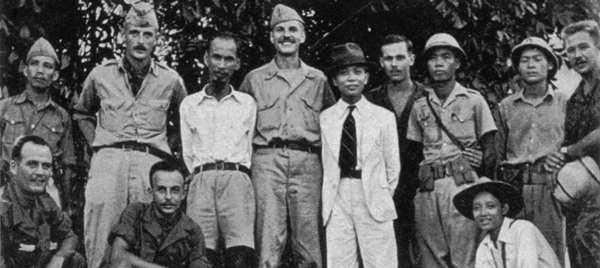
In the mid-1940s, the Viet Minh, under Ho Chi Minh, looked to the West for help in its independence movement and got it.
As U.S. Army Major Allison Thomas sat down to dinner with Ho Chi Minh and General Vo Nguyen Giap on September 15, 1945, he had one vexing question on his mind. Ho had secured power a few weeks earlier, and Thomas was preparing to leave Hanoi the next day and return stateside, his mission complete. He and a small team of Americans had been in French Indochina with Ho and Giap for two months, as part of an Office of Strategic Services (OSS) mission to train Viet Minh guerrillas and gather intelligence to use against the Japanese in the waning days of World War II. But now, after Ho’s declaration of independence and Japan’s surrender the previous month, the war in the Pacific was over. So was the OSS mission in Indochina. At this last dinner with his gracious hosts, Thomas decided to get right to the heart of it. So many of the reports he had filed with the OSS touched on Ho’s ambiguous allegiances and intents, and Thomas had had enough. He asked Ho point-blank: Was he a Communist? Ho replied: “Yes. But we can still be friends, can’t we?”
It was a startling admission. In the mid-1940s, the Viet Minh leadership, under Ho Chi Minh, looked to the West for help in its independence movement and got it. As World War II ended, the United States and its allies, most of them former colonial powers, now confronted a new problem. Independence movements were emerging all over the East. But former colonial powers had lost their military muscle, and the Americans simply wanted to “bring the boys home.” During the war, the United States had sought any and all allies to combat the fascist powers, only to find, years later, it may have inadvertently given birth to new world leaders either through misconceptions or missed opportunities. Vietnam’s independence leader, Ho Chi Minh, had been only a relatively minor figure just a few years earlier. In 1945, Ho became the leader of a movement that would result in revolutionary tumult for decades to come.
Deer Team Meets a “Mr. Hoo”
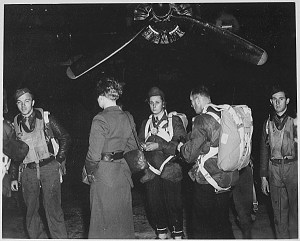
Two months before Thomas’ farewell dinner with Ho and Giap, he and six others from Special Operations Team Number 13, code-named “Deer,” had parachuted into a jungle camp called Tan Trao, near Hanoi, with directions to proceed to the headquarters of Ho Chi Minh, whom they knew then only as a “Mr. Hoo.” Their mission, as they understood it, was to set up a guerrilla team of 50 to 100 men to attack and interdict the railroad from Hanoi to Lang Son to prevent the Japanese from going into China. They were also to find Japanese targets such as military bases and depots, and send back to OSS agents in China whatever intelligence they could. And they were to provide weather reports for air drops and U.S. Army Air Forces (USAAF) operations on an as-needed basis.
Thomas had parachuted in on July 16, 1945, part of a three-man advance team that also included radio operator 1st Sgt. William Zielski and Pfc Henry Prunier, their interpreter. Not knowing who or what to expect when they reached the drop zone, Thomas and his team soon found themselves surrounded by 200 guerrilla fighters who greeted them warmly and showed them to their huts. They then met with Ho Chi Minh, who called himself “C.M. Hoo,” at his headquarters to coordinate operations with him. Thomas had no idea that Ho was a Communist, spoke Russian or had visited the Soviet Union. Nonetheless, Ho openly discussed politics with Thomas, stressing not only the abuses by the French, but also his desire to work with the French toward a solution.
In his first official report to OSS director Archimedes L.A. Patti in Kunming, China, the following day, Thomas noted, referring to Ho: “He personally likes many French but most of his soldiers don’t.” This may have been one of Ho’s ongoing ruses to ingratiate himself with potential but temporary allies. In his mid-50s, Ho apparently thoroughly convinced the Deer Team commander of his sincerity. In an effort to further dispel OSS or U.S. government concerns about Ho, Thomas emphatically wrote in the report: “Forget the Communist Bogy. VML [Viet Minh League] is not Communist. Stands for freedom and reforms from French harshness.”
On July 30, the remainder of the Deer Team parachuted in, consisting of the assistant team leader, Lieutenant René Defourneaux, Staff Sgt. Lawrence R. Vogt, a weapons instructor, photographer Sergeant Aaron Squires and a medic, Pfc Paul Hoagland. Defourneaux, a French expatriate who had become a U.S. citizen, had parachuted into France earlier in the war to help the Resistance before joining the OSS.
The first person that Defourneaux met when he reached the drop zone was a “Mr. Van,” General Giap, who seemed to be in charge. Ho was not around much, but when Defourneaux saw him, his first impression was of a sick old man clearly suffering from some disease. In one of the ironies of history, the Vietnam War, at least with the Communists under Ho Chi Minh, might never have happened if the Americans hadn’t arrived when they did.
“Ho was so ill he could not move from the corner of a smoky hut,” Defourneaux said. Ho didn’t seem to have much time to live; Defourneaux heard it would not be weeks but days. “Our medic thought it might have been dysentery, dengue fever, hepatitis,” he recalled. “While being treated by Pfc Hoagland, Ho directed his people into the jungle to search for herbs. Ho shortly recovered, attributing it to his knowledge of the jungle.”
In other reports to the OSS, Thomas had raised a number of political concerns, from Ho’s allegiances, to Indochina’s struggle with the French, Vichy, Japanese, Chinese and the British. In a July 27 report, Thomas had stated that Ho’s league was an amalgamation of all political parties that stood for liberty with “no political ideas beyond that.” Thomas added, “Ho definitely tabooed the idea that the party was communistic” since “the peasants didn’t know what the word communism or socialism meant—but they did understand liberty and independence.” He noted that it was impossible for the French to stay, nor were they welcome since the Vietnamese “hated them worse than the Japs….Ho said he would welcome a million American soldiers to come in but not any French.” (Read more about the OSS and Ho Chi Minh here)
Control of French Indochina During WWII
French Indochina during World War II was a simmering cauldron of colonial powers on the decline, of colonial powers divided and other powers on the rise. Comprised largely of Vietnam, Cambodia and Laos, French Indochina had become in the late 19th century the “jewel in France’s crown” in Southeast Asia.
Among the several competing global, regional and internal interests in French Indochina during World War II were: Vichy France, which controlled its colony only with permission of its Japanese ally and German dominator; followed then by the French Republic, which sought to reclaim its colonial territories; the United States, which was fighting against Japan; and Japan, which sought to maintain its regional hegemony. Also involved were the warring Communists and Nationalists in China, which sought to influence the region to their south; and a variety of independence-seeking indigenous factions that all wanted to remove the yoke of any colonial or imperial power.
Vietnam itself was divided into three main regions with their own factions fighting for control: the northern Tonkin, central Annam and southern Cochinchina. French control over Indochina was challenged only when France fell to the Germans in 1940 and was divided into two governments—occupied France, and to the south the nominally neutral, German-dominated Vichy government under World War I hero Marshal Henri Philippe Pétain. Vichy retained control of most of the French overseas territories during the war, including Indochina. However, the French remaining in Indochina were less loyal to the German puppet Vichy government than they were to Pétain.
As Japan expanded into the Pacific and Asia early in World War II, it ironically found itself hamstrung by its own alliance with Nazi Germany. For, so long as both the Vichy government and Imperial Japan were tied to Germany, the French retained de facto control of Indochina, although Japan was permitted to establish military bases. As the war in the Pacific wound down, however, the Allied invasion of Normandy and liberation of Paris resulted in the fall of Vichy France in August 1944 and, with it, any claims on colonial territories.
Throughout most of World War II, the United States was finding and supporting allies in China and other Southeast Asian regions, including French Indochina, to pose a threat to the Japanese military wherever possible. With the liberation of France in 1944, the U.S. government turned to its primary coordinator of intelligence during the war: the OSS, created in 1942 by President Franklin D. Roosevelt.
OSS to Ho: Work With Us Against the Japanese
At the time, the OSS was operating a base in China’s wartime capital, Chungking. With the growing military complications in Indochina, William Donovan, the director of the OSS, instructed his staff to use “anyone who will work with us against the Japanese, but do not become involved in French-Indochinese politics.” The Viet Minh, a liberation movement that had emerged under Ho Chi Minh in the early 1940s, was seeking not only Vietnam’s independence from France, but also freedom from the Japanese occupation. In mid-1944 the OSS approached Ho to help organize an intelligence network in Indochina to help fight the Japanese and to help rescue downed American pilots. By then, “Ho had been cooperating with the Americans in propaganda activities,” wrote Captain Archimedes Patti, head of the OSS base in Kunming, China, and later Hanoi.
The American association with Ho had actually begun in December 1942 when representatives of the Viet Minh approached the U.S. Embassy in China for help in securing the release of “an Annamite named Ho Chih-chi (?) [sic]” from a Nationalist Chinese prison, where he was being held for having invalid documents. In September 1943, when Ho was finally released, he returned to Vietnam to organize Vietnamese seeking independence. An October 1943 OSS memo proposed that the United States “use the Annamites…to immobilize large numbers of Japanese troops by conducting systematic guerrilla warfare in the difficult jungle country.” The missive went on to suggest the OSS’s most effective propaganda line was to “convince the Annamites that this war, if won by the Allies, will gain their independence.”
As the Axis retreated in Europe, and what remained of the Vichy French government fell, Japan was no longer restrained in Indochina by its ties to Germany. The Japanese quickly made inroads into Vietnam, staging a coup d’état in March 1945 that dissolved the French government and established a puppet government. On March 11, Emperor Bao Dai proclaimed Vietnam’s independence and his intent to cooperate with the Japanese. Ho Chi Minh was surprised by this development, and regarded another independence movement as a threat to the Viet Minh’s. At the same time, with the Japanese coup against the French, the OSS realized it was cut off from the flow of intelligence from French Indochina to its base in Kunming, and it urged Ho to work with the United States.
“The coup has produced many new and perhaps delicate problems which will demand considerable attention,” the OSS officers in China reported to headquarters. “The French are no longer in power. There are 24 million [Vietnamese] in Indochina [offering] support for the new nationalistic regime. Militarily, it calls for an alteration of military plans; we can’t count on French and native troops.” The Japanese did not have the military strength to defend all of Vietnam, however, and the Viet Minh began to organize themselves as the provisional government in all but the largest towns, where the Japanese had strongholds.
Also in March 1945, Viet Minh guerrillas rescued a U.S. pilot who had been shot down in Vietnam. Ho Chi Minh himself escorted the pilot back to the American forces in Kunming, where the Fourteenth Air Force was based. Rejecting an offer of a monetary reward, Ho asked only for the honor of meeting Maj. Gen. Claire Chennault, founder of China’s legendary American Volunteer Group, the “Flying Tigers,” and now commander of the Fourteenth Air Force. During the meeting on March 29, Chennault thanked Ho, who, after promising to help any other downed American pilots, requested only an autographed photo of the general. Ho would later cannily show the picture to other nationalist Vietnamese factions as proof of his warm relations with—and implied support from—the Americans. At this time, few knew that Ho (whose real name was Nguyen Ai Quoc) was a long-time Communist who had been trained in the Soviet Union. Even the Office of War Information reportedly was impressed by Ho and his “English, intelligence and obvious interest in the Allied war effort.”
On April 27, Captain Patti met with Ho Chi Minh to ask him for permission to send an OSS team to work with him and the Annamites to gather intelligence on the Japanese. “Welcome, my good friend,” said Ho in greeting Patti. He agreed to work with an OSS team and asked Patti for modern weapons. Ho then set up a training camp in the jungle, at place he called Tan Trao—the former hamlet of Kimlung and the new location of Viet Minh headquarters—about 200 kilometers from Hanoi. There he prepared for the Americans’ arrival.
Deer Team Begins Training the Viet Minh
Captain Patti’s OSS group, the Deer Team, was established on May 16 and made its way from the United States to the OSS station in Kunming, where it waited two months for permission to enter French Indochina. Finally the decision was made for Major Thomas and the team’s six other members to parachute to the Tan Trao training camp in July.
Captain Patti had served with Thomas in North Africa and thought he “was a fine young officer but understandably unsophisticated in the way of international power struggles.” Thomas became quick friends with Ho and Giap at Tan Trao, often ignoring the rest of the team. Part of the team’s mission was to indicate targets for the USAAF, but Thomas spent most of his time with Ho and Giap, and even redirected USAAF targets against the Japanese based on Ho’s recommendations, in direct conflict with orders he had received from the OSS.
Defourneaux, who had assumed the alias of Raymond Douglas, the son of a Franco-American mother, to protect him from the locals, had a different experience with Ho. The leader continually probed Defourneaux and challenged his cover story, wary of him. Ho told Defourneaux he hoped the United States would handle Vietnam the way it had the Philippines. “We deserved the same treatment,” said Ho. “You should help us reach the point of independence. We are self-sufficient.” Defourneaux did not believe that Giap and Ho were “on the same wavelength,” and that Giap was doing things independently. At the time, he did not know that Giap, or “Mr. Van,” another of the OSS’s “friends of the forest,” was running an indoctrination school on communism.
As Thomas’ friendship with Giap and Ho grew, his relationship with his own men deteriorated, and Defourneaux became wary of them. Ho, and especially Giap, had “full control over our leader,” said Defourneaux. In his diary, Defourneaux wrote of Thomas: “I stay with the boys and cannot help hear their conversations. They hate him, personally I hate him more and more every day.” He said that Thomas thought Ho and Giap were simply agrarian reformers, “but Ho didn’t know how to use a shovel and Giap didn’t know how to milk a cow.”

The members of the Deer Team had to wait a couple of weeks for supply drops in early August before they could start small-arms and weapons training for the guerrilla forces. Once the arms arrived, the Americans showed the Viet Minh (most were recently civilians) how to fire the American M-1 rifle and M-1 carbine, and how to use mortars, grenades, bazookas and machine guns. For training, they used U.S. Army field manuals, and focused on guerrilla warfare.
Japan Surrenders and Ho Declares Vietnamese Independence
Shortly after training began the second week in August, Sergeant Zielski, the team’s radio operator, picked up a broadcast on August 15 announcing the Japanese surrender, following the atomic bombing of Hiroshima on August 6, and Nagasaki on the 9th.
Realizing its training mission was over, the Deer Team issued arms to the soldiers and prepared to leave the following day. Under the terms of Japan’s surrender, the British would occupy the south of Vietnam, and the Chinese would move to the north to disarm Japanese soldiers and return them to their homeland.
The Americans left camp on August 16 and traveled on foot with Giap and his troops to Thai Nguyen, the French provincial capital. There, the guerrillas fought the French and the Japanese until the French governor capitulated, on August 25, and the Japanese, finally realizing their homeland had surrendered, accepted a truce the next day. During this fighting, Giap had arranged for the Deer Team to stay hidden away in a safe house on the outskirts of town.
Meanwhile, the Viet Minh had planned to hold a conference in Tan Trao on August 16, the National People’s Congress. About 30 delegates from Vietnam, Thailand and Laos had assembled in the village to discuss their concerns. Over the next several days, amid political uncertainty, several of the delegates had attempted to seize control. Ultimately Ho Chi Minh claimed leadership and was elected president of the provisional government on August 27. They proposed and voted on a new national anthem, and a new national flag with a gold star on a red background, which would become intimately familiar to most U.S. ground troops two decades later.
A week later, on September 2, the same day General Douglas MacArthur received the formal Japanese surrender aboard the battleship Missouri, Ho Chi Minh was in Hanoi and declared Vietnamese independence from all colonial powers, using the American Declaration of Independence as his template. Banners of “Welcome to the Allies” (specifically, the United States) flew in the city’s Ba Dihn Square, the OSS contingent in Hanoi photographed the occasion and Minister of the Interior Giap recognized U.S. support in a speech.
Coincidentally, the same day of Ho’s declaration of independence, Lt. Col. Peter Dewey, the nephew of two-time presidential candidate Thomas Dewey, arrived in Saigon. The colonel was commander of another OSS team in Indochina, code-named “Embankment,” which was overseeing intelligence in the Saigon area. As the month wore on in Saigon, the British, free from hostilities with the Japanese, became politically involved, chaos ensued and civil war raged. Dewey was ordered out of Vietnam by the British, who suspected him of working with the Viet Minh. Before leaving, Dewey wrote in a report to the OSS: “Cochinchina is burning, the French and British are finished here, and we ought to clear out of Southeast Asia.”
On September 26, two days after the Viet Minh led a national strike in response to British-imposed martial law, Dewey was ready to depart Saigon. Leaving in an unmarked jeep for the airport, he was ambushed and killed a few yards from an OSS house, thus becoming the first American casualty in Vietnam, nearly two decades before full U.S. involvement in the Vietnam War. Although there was wide speculation on the shooters, ranging from conspiracies involving allies to cases of mistaken identities, an investigation failed to produce an answer. Captain Patti informed Ho Chi Minh of Dewey’s death, and Ho expressed his regrets to U.S. headquarters in Saigon.
OSS Ends Its Mission in Indochina
With the war in the Pacific over, the OSS ended its mission in Indochina. The Deer Team had stayed in Thai Nguyen for a few days following the Viet Minh victory there, “getting fat, getting a sun-tan, visiting the city and waiting for permission [from Patti] to go to Hanoi,” said Defourneaux. “The Viet Minh did everything to make our stay as pleasant as possible for us.” Once they arrived in Hanoi, the Americans prepared to return to the United States. The night before leaving, Major Thomas had his private dinner with Ho and Giap.
In the years that followed, Ho Chi Minh continued to write letters of a diplomatic nature to President Harry Truman, asking for U.S. aid, but the letters were never answered. Ho didn’t break with the United States until the Americans gradually became involved with the French in working against the Vietnamese in the 1950s.
Although OSS agents clearly played a role in Indochina during the World War II, clear causes and effects with regard to the future U.S.-Vietnamese conflict are far more cloudy.
First, working with individuals or organizations that did not share American values or interests was not uncommon, particularly during World War II. Perhaps the best example was the U.S. alliance with the Soviet Union, specifically with Josef Stalin.
Second, the United States needed to reach out to an established and recognized organization within Indochina. There was no natural indigenous U.S. ally in that region, nor was there an embedded colonial interest because France itself was divided.
Third, through its in situ OSS team, the United States had little immediate effective tactical, operational or strategic impact on Ho Chi Minh, the future General Giap or the Viet Minh.
Was America, through the OSS, responsible for the rise of Ho Chi Minh and his subsequent war against the United States? No, but neither was it completely free of such responsibility. Ho manipulated the inexperienced leader of the Deer Team as well as U.S. diplomatic officials in Kunming to serve his unstated needs. Having a personal photo of Chennault or having OSS agents stand by his side demonstrated his international standing among the Vietnamese. Also, the failure to identify Ho Chi Minh as Soviet-trained and a Communist ideologue was a major American intelligence shortcoming that smoothed the way for Ho’s emergence as a national leader and in the end, an enemy of the United States.
In later years when asked by journalists or historians about his relationship with Ho, Thomas was defensive: “I was friendly with him and why shouldn’t I be? After all, we were both there for the same purpose, fighting the Japanese…it wasn’t my job to find out whether he was a Communist or not.”
Ultimately, out of the chaotic and momentous conclusion of World War II—almost imperceptibly—the die was cast for the coming storm that over the next three decades would pit the world’s greatest superpower against an indigenous movement led by men who, at its birth, sought the friendship and support of the United States.
Claude G. Berube teaches at the United States Naval Academy and is the co-author with John Rodgaard of A Call to the Sea: Captain Charles Stewart of the USS Constitution.