
The 600-foot light carrier USS Princeton (CVL23) was commissioned in the Philadelphia Navy Yard on February 25, 1943, and was sunk 20 months later, on October 24, 1944, in Leyte Gulf during heroic efforts to retake the Philippines from the Japanese. One of two light carriers in Task Group 38.3, Princeton carried 23 fighters and 10 torpedo bombers. I am probably one of only two living eyewitnesses to a tragic event. Except for a buddy and me, everyone who had been in a position to see the start of the explosion that eventually sank Princeton was killed outright that day. Official tallies on casualties from the death of Princeton were 347 killed, 552 wounded and 4 mising.
The majority of those casualties were not aboard Princeton, however, but were, as was I, aboard USS Birmingham, a light cruiser that was also part of the task group. Birmingham had drawn alongside to assist Princeton after the light carrier was crippled by a successful bombing run by a lone enemy plane. Aboard Birmingham, the tally was 230 dead, 408 wounded, and 4 missing.

I am convinced that it would have been impossible to improve upon what a single Japanese pilot, flying a Yokosuka D4Y ‘Judy’ dive bomber with two 550-pound bombs, achieved that day, had the bombing been the result of a meticulous plan rather than a chance encounter. In the explosion that occurred hours after the Judy’s bombing run, my right leg was blown off at the knee and buried at sea. So, in effect, I already have one foot in the grave.
Birmingham had been at sea for eight months. It had become part of Task Group 38.3 in August 1944. For eight weeks, the fast carrier forces ranged throughout the Palau and Philippine islands, inflicting serious damage and destruction on the enemy. From the 18th through the 23rd of October, in fair and calm weather, Task Force 38 launched extensive airstrikes covering the length and breadth of Luzon, as part of the drive to retake the Philippines.
October 24 dawned with broken clouds and occasional squalls, but there was good visibility, allowing continuing airstrikes in support of land operations on the island of Leyte. The day began before sunrise, with general quarters sounded for all the ships in Task Force 38.
To start the day, Princeton contributed 20 fighter planes to the air battle over Leyte Gulf. The first wave of 40 to 50 Japanese planes was intercepted and their attack broken up with many enemy losses. A second group of about 30 enemy aircraft quickly took to the air. Out of the two waves, Princeton’s planes alone shot down 34 enemy aircraft with a loss of only one. Pilots became aces in a matter of minutes. The planes returned to the carrier for refueling and arming in preparation for an airstrike against a Japanese force of four battleships, eight cruisers and 13 destroyers southeast of the island of Mindoro.
At 9:12 a.m., USS Essex reported a possible bandit plus a friendly aircraft about six miles away. No other unidentifieds were within a radius of 25 miles. At 9:38 a.m., a single Judy was sighted by Princeton‘s lookouts, diving on their vessel from out of the low cloud cover ahead of the ship. The plane immediately came under fire from the forward 20mm and 40mm batteries, and the helm was put over to port in an evasion attempt. The Judy dropped two bombs. One missed Princeton and fell harmlessly into the sea. The other 550-pound bomb fell almost in the center of Princeton‘s deck, causing jarring on the bridge and a dull thud in central station. Black smoke issued from the hole in the flight deck, the forward elevator and every access trunk to the hangar aft of the island. Ed Butler, a radarman, said, ‘I saw him [the Japanese pilot] high-tailing it away from our stern, trailing smoke.’
Pete Callan, one of the crew who had refueled and armed the torpedo planes, says he heard machine-gun fire at a more rapid rate than any of the guns aboard Princeton were capable of. He heard bullets striking the wooden planking of the flight deck. Fifty years later, Pete told me, ‘The Japanese pilot utilized the striking bullets to guide his aim by stitching the deck and the surrounding water, then making the appropriate corrections to his bombing run.’ The bomb passed through the flight deck, leaving a small jagged hole about 15 inches in diameter, continuing downward and severing the main gasoline line used to fuel the planes. The bomb then passed through an auxiliary drop tank under one wing of Lieutenant Tom Mooney’s torpedo plane parked in the hangar. The bomb continued on its path, piercing the hangar deck and detonating in the crew’s galley on the second deck. The bomb blew a hole through the second deck into the third, above the after engine room.

Structural damage was relatively minor, but a raging gasoline fire flared up in the wreckage of Mooney’s plane and spread rapidly to the other five planes parked there. The quantity of gasoline dumped onto the hangar deck from the severed gasoline main is unknown, but those six fully fueled planes had held more than 2,500 gallons of high-test aviation gasoline. The bomb had created a 5-foot indentation around the small 15-inch hole, which acted as a funnel for the gasoline spilling onto the hangar deck, directing it into the lower decks where the fire raged. Within seconds of the explosion there were fires on the third deck over the after engine room, on the second deck, and in the hangar. Billowing black smoke from burning gasoline poured from every opening in the lower decks.
Less than 10 minutes after the bomb was dropped, the firefighting sprinkler system was completely disabled. Within the same short timespan, the main engines lost almost all power, which first slowed Princeton, then brought her to a halt and turned her into a drifting, burning hulk.
Many American naval history books refer to USS Birmingham as the most tragic ship to participate in World War II, because of the number of engagements she was involved in and the damage she sustained. By the same measure, Princeton must be considered the most unlucky. One small bomb, which should have been a minor inconvenience for the light carrier, caused a great deal of death and destruction.
Lieutenant Mooney said: ‘I was in the pilot’s ready room, which was directly under the flight deck on the portside, forward of the hangar. At the instant the bomb pierced the flight deck, the TBM [torpedo-bomber] pilots in their ready room heard a thump or a bump similar to the sound made if a heavy object dropped somewhere. The ready room door led onto a companionway which was normally closed, but at this time for some reason was open.’ Mooney looked toward the door and saw something he will never forget. ‘It was a fireball, a true ball of molten flame, maybe the size of a basketball, that sailed forward through the companionway past the open ready room door!’ Mooney and the other pilots wasted no time leaving immediately through an emergency hatch opening onto the portside catwalk, then up to the flight deck, where Mooney saw controlled chaos. Everyone had something to do and was doing it ‘with great vigor and proficiency.’
Pilots had not been assigned a ship’s function, so Mooney grabbed a fire hose and joined a group directing streams of water down into the forward elevator shaft, which was partially below the flight deck. Several other crewmen were similarly engaged when an incredible eruption blasted the elevator platform out of its shaft. Mooney was knocked backward but otherwise unhurt. In the hangar, the fire-sprinkling apparatus had completely failed, probably because the engulfing fire had destroyed the electrical circuitry that controlled the firefighting equipment in the hangar. Ten minutes after the bomb hit, Princeton began to drop out of formation.
The destroyers Irwin, Cassin Young and Gatlin, along with the anti-aircraft cruiser Reno, were ordered to stand by to render assistance to Princeton. From her flight deck, several small explosions were felt. There were about 12 men in the executive officer’s office who were badly burned but could not be reached because of the very hot water on the decks.
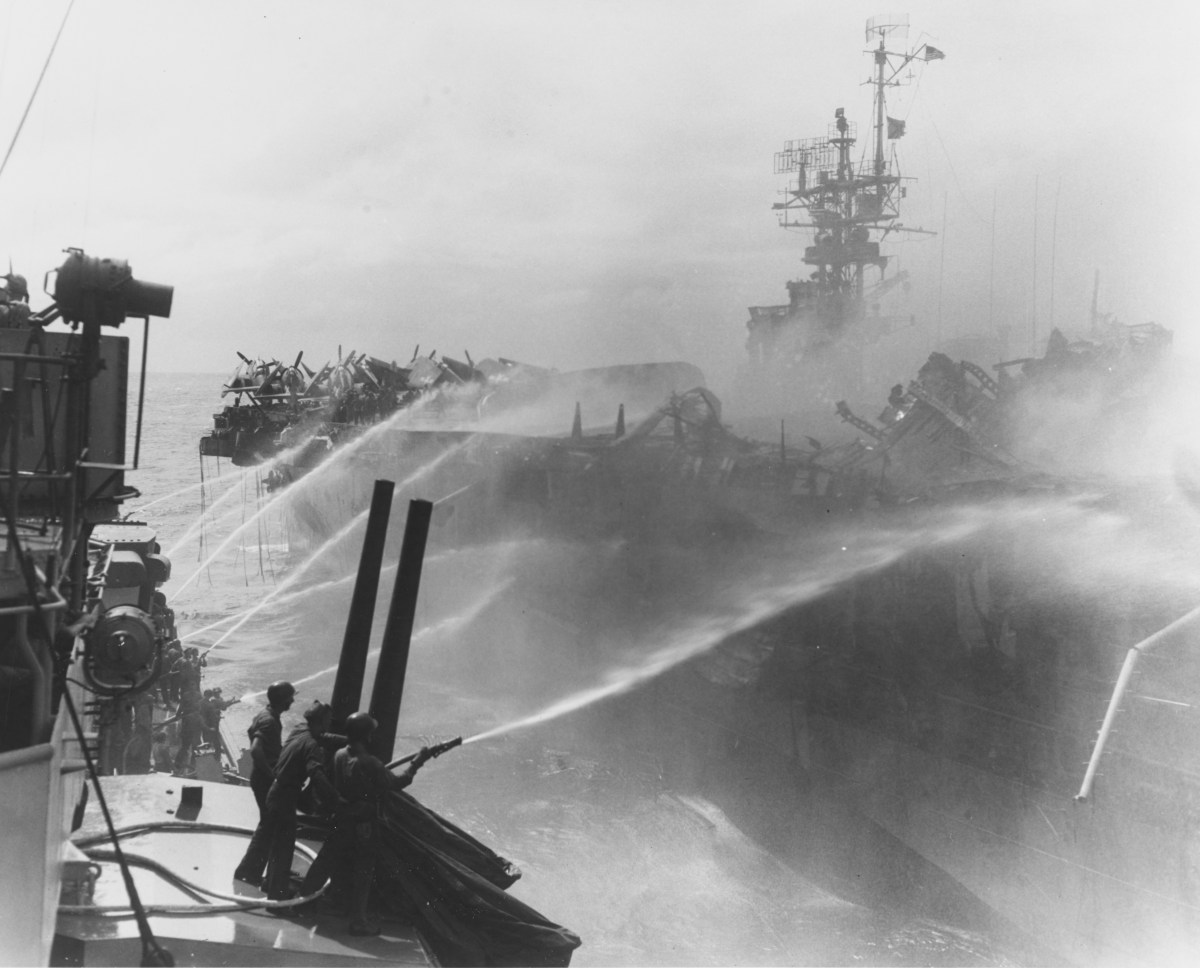
Eighteen minutes after the bomb struck, steering control in the pilot house was lost. Irwin came alongside Princeton‘s port side to fight the fires, but was too small to have much effect on the furnace that Princeton had become. Irwin took aboard more than 600 of Princeton‘s crew who had been forced to abandon ship. Moderately heavy swells caused Irwin to collide with Princeton, a much larger vessel, and the little destroyer took a physical beating from the collisions. Her port engine was out of commission because its main circulator pump and condenser screen had become plugged with debris floating on the water. There continued to be explosions aboard Princeton, and Irwin cast off for fear of being too heavily damaged. Reno attempted to come along Princeton‘s starboard side, but the carrier constantly drifted into her.

Nearly 90 minutes after the bomb hit, Birmingham was ordered to fall out of formation and assume command of the firefighting operations. Birmingham maneuvered aft on Princeton‘s port side. The two ships were built to the same hull design, so Birmingham was not so heavily battered as Irwin. Coming in from the weather side also allowed Birmingham better control. But things did not go smoothly for long.
Reno failed in her attempt to position her bow between Princeton and Birmingham. She was not able to hold her own and disengaged from the firefighting operations when the fire had abated considerably.
Birmingham moved forward on Princeton‘s port side, the ships smashing into each other in the incessant swells. It was sickening to watch; it seemed as though the two ships were attempting to destroy each other.
To be effective, Birmingham had to stay in direct contact so firefighters could move from ship to ship. To stay in physical contact, Birmingham deliberately crowded Princeton. Princeton‘s anti-torpedo blisters on both sides below her waterline amidships effectively limited the approach of any supporting ships to the bow or stern areas.
After an extended all-night shift belowdecks making repairs in the after engine room of Birmingham, I was relieved from duty. I went above with Vernon Trevethan and George Thompson. No longer serving under general quarters, we were off duty and sightseeing.
George, Vernon and I headed for the open bridge above the starboard flying bridge. We wanted to observe the firefighting efforts on Princeton but still stay out of the way. Clearly, Birmingham‘s starboard side and Princeton‘s port side were severely damaged by the grinding impacts that ensued during Birmingham‘s attempt to maneuver to the advantage of the firefighters aboard both ships.
Damaged by the constant collisions between the two vessels, a hatch door was ripped from Princeton‘s hull, exposing the interior of what appeared to be a companionway. Today the memory of what I saw scares me. Then, however, I was only 23 and not easily intimidated by potential danger. What I saw was a row of bombs standing upright. If memory has not failed me, those bombs were in the neighborhood of 5 feet tall and 12 inches in diameter. Firefighters on Birmingham were directing streams of water onto those bombs, causing them to sizzle like a hot frying pan when water is sprinkled onto its surface. This effort by Birmingham‘s crew to cool down the bombs with fire hoses was desperately hampered because of the narrow quarters and the constant rolling of the ships. The bombs were hissing and generating clouds of steam. My buddies and I watched this activity from our vantage point less than 20 feet away from the nearest bomb. Birmingham‘s skipper, Captain Thomas Inglis, was just below us on the flying bridge, directing the entire operation. The grim expression on his face indicated his deep concern at the stress of the situation.
Three hours and seven minutes after Princeton was hit, the destroyer Morrison came alongside starboard amidships. In short order, a jeep and an aircraft-towing tractor fell from Princeton‘s deck onto Morrison‘s bridge. Fifteen minutes after coming alongside, Morrison became wedged between Princeton‘s No. 2 and No. 3 stacks. As a result, Morrison’s mast bent and eventually broke.
At around 1:32 p.m., Birmingham sounded general quarters as she pulled clear of Princeton due to threats of air and submarine attacks. Fires and smoke were still observed pouring out of Princeton. While clearing Princeton, Birmingham moved to the carrier’s starboard side, and from Birmingham‘s deck we could see Morrison in her predicament. Morrison looked so ludicrous with her mast bent 90 degrees at its base that it provoked uncontrollable laughter from Birmingham‘s crew. My companions and I left for our respective battle stations.
Four hours and 16 minutes after the encounter with the Judy, Morrison finally cleared herself and rejoined the screen of destroyers with her mast dragging in the sea. Reno fired on enemy planes, but a concerted attack did not develop.
About 90 minutes later, general quarters ended with the all clear. Again Birmingham moved alongside Princeton. My little group reconvened. Now we perched on the after mushroom ventilator, between the No. 3 and No. 4 turrets, intently watching the activities on Princeton. Birmingham prepared to rig for towing. From an estimated distance of 50 to 75 yards, absolutely no smoke or fires were observed, only patches of foglike vapors coming from the numerous openings in Princeton‘s flight deck. Princeton appeared to be serenely drifting with the current. It appeared as if the fires had gone out on their own. Our little group on Birmingham figured the excitement was all over. The fires aboard Princeton had been extinguished.
The ships were still separated by about 50 feet when sailors shot their messenger lines across in order to secure a spring line between the two ships. George, on my right, suddenly exclaimed, ‘Look at that flame!’ We saw a single tongue of flame shoot out from the area of the after elevator, followed by an enormous puff of white smoke like a billowy cumulus cloud. To our horror, a slender column of pale orange-colored smoke shot several hundred feet straight up. All hell broke loose with an enormous eruption. One hundred and thirty feet of Princeton’s stern blew off, as well as 180 feet of her flight deck.
As a high-speed shock wave headed my way, my reflexes took over. I threw myself backward before the concussion could hit me head on. This reflex action undoubtedly saved my life. Still, the force of the shock wave tumbled me backward 30 or 40 feet and about 10 feet into the air before dropping me on the deck. The shock wave hit me a split second before the thunder of the explosion reached my ears.
While I was tumbling, I was aware that Vernon, my best friend, was also somersaulting. I saw him land on his feet andrun around the barbett of No. 3 turret to disappear from my sight. Some time later, I learned he had dropped dead on the other side of the turret.
I was stunned momentarily, yet at the same time my senses were heightened. When the roar of the explosion abated, I became aware of an ear-splitting silence that seemed to last for an eternity and was almost painful to my ears. The deafening hush was finally brought to an end by the sound of burning hot shrapnel raining down all around me. The shrapnel was burning through my clothes in what seemed to be hundreds of places. I had to get out from under that shower of hot steel. When I glanced down I saw that my right knee was mangled, so I thought I would get up on my left leg and hop to the overhanging No. 4 turret. But my left leg would not support me because it was broken. I tried to crawl on my belly, but the pea-sized, gravel-like bits of Princeton on the deck painfully burned my hands and forearms as well as the nape of my neck. All I could do was roll around on the deck, trying to escape the searing pain. Finally, the shrapnel stopped falling and the pieces of steel cooled. I collected myself enough to look around at hundreds of dead or unconscious bodies. Out of maybe 300 crew members on the after starboard deck of Birmingham, there was only one person other than myself who was conscious. There was no moaning, only an eerie quiet.
On my back and propped on my elbows, I surveyed the extent of the damage. Wherever I looked there was carnage. Rivers of blood poured from the scuppers into the sea. It was a scene from a nightmare. I was wondering what to do when another shipmate, John Miksis, suddenly appeared from nowhere. His face was burned cork black, and he was completely covered with soot. At first I did not recognize him. Only his voice identified him to me. He was excited. I was calm. He started clapping both my cheeks. Maybe I was going into shock, but this was irritating. I snarled at him, ‘Cut it out, John!’ Miksis promised to find some more help and went below, where he bumped into Dick Stern, another shipmate. Miksis and Stern tore a bunk from its hanger and then rushed back to the deck to carry me to a first aid station below. While I waited for John’s return, my limited view was of the deck strewn with assorted body parts and rivers of blood draining into the water.
Gerald Baldwin was one of my best friends on board Birmingham; in fact, he was like a brother. When Princeton‘s stern was blown off, he was standing after and a little to port of Birmingham‘s No. 4 turret. The explosion’s shock wave pitched Baldy over the port side into the sea. He was stunned and wounded from a piece of steel in his shoulder. Shortly after he had landed in the water, Birmingham slowly backed down, leaving him forward of the bow. Baldy drifted across Brimingham’s bow to the starboard side, about 20 feet from Princeton‘s port beam. He then spotted Princeton‘s broken stern floating aft, swam to it and attempted to climb aboard. It was too slippery, so he abandoned it to grasp onto Birmingham‘s No. 2 screw guard. That was hazardous duty because the ship was maneuvering forward and aft for short distances. During those maneuvers the wash of the No. 2 screw would suck him below toward the rotating screw. Fortunately the screw would stop turning before he got chewed up.
After Baldy had been pulled below three of four times, he decided there was a limited future in floating near the screw. He made his way to Birmingham‘s stern, where there were ladder rungs welded to the hull leading up from the ship’s waterline to her weather deck. Unfortunately the bottom three rungs had been broken off. The sea, however, was swelling to such an extent that the crests buoyed him up enough to grasp the lowest intact rung with both hands. Baldy’s vigor, however, had been sapped because of his previous exertions and possibly because of the chilling effects of the waters of the Pacific Ocean. His strength had been depleted to a degree that he was unable to hang onto the rung. He lost his grip and fell back into the sea.
At that point, as he treaded water, Baldy came to the conclusion that to remain in the area would be fatal. But where to go? He had spotted two wooden planks floating in an oil slick, and they seemed to be his best bet. He managed to swim over to the planks and then lay down atop the boards until the destroyer Cassin Young came along and hauled him out of the ocean.
Aboard Princeton, four people had miraculously escaped the incredible explosion that had originated abaft the after elevator on the hangar deck. They were about 280 to 300 feet from the origin of the explosion. One of them, Gene Mitchell, sustained multiple wounds. Mitchell pulled himself together enough to look over at Birmingham. What he saw was so ghastly and traumatic that he experienced flashbacks for years. He saw the same horrors and rivers of blood washing the deck as I had.
The prompt action of my shipmates saved my life. Events from that time on are a blur. Birmingham had left San Francisco on February 18, 1944, and had been at sea for months with only an occasional stop at some hot, unbelievably humid, mosquito-infested tropical island for supplies or repairs. We had been in a combat zone constantly for two months. Now, during one of the first lulls in the fighting, at a time when I was off duty, my war had come to an end.

Years later I met an ex-Navy man who had been attached to the Mare Island Navy Yard at the time Birmingham came in for repairs after the battle to save Princeton. He told me that civilian workers brought in to clean up Birmingham so it could be repaired actually refused to do the job. The stench of rotting flesh, even after three months, was too awful. A crew of naval enlisted men was assigned to the job.
Despite Princeton‘s punishment, however, and even after that final tremendous explosion, the carrier was still afloat without even a list. Her buoyancy probably was provided by the side blisters that contributed greatly to her marvelous stability.
Princeton‘s skipper grudgingly gave orders to his damage-control party to abandon ship for the destroyer Gatling. The gallant light carrier was to be scuttled by torpedoes.
Irwin fired her first torpedo from 2,500 yards to no effect. A minute later she fired a second torpedo, again with no effect. Two minutes later, Irwin fired a third torpedo that ran true for 1,500 yards but reversed course, U-turning right down the pipe back toward Irwin. The destroyer was forced to outrun its own torpedo on less than healthy engines. Three minutes later, Irwin tried again, firing her fourth and fifth torpedoes, both of which missed. Later examination showed that Irwin‘s torpedo tubes had been seriously damaged during her earlier encounters with Princeton.
The destruction of the carrier was finally assigned to Reno. The anti-aircraft cruiser fired two torpedoes into Princeton‘s main magazine, where some 70 tons of explosives were stored, triggering an enormous explosion. Princeton disappeared under the waves of the Pacific in about 45 seconds. She didn’t die easily. She was a tough old ship.
This article was written by Harry Popham and originally appeared in the May 1997 issue of World War II. For more great articles subscribe to World War II magazine today!