
Aero Club officials, nervous at the prospect of approving a flying license for a female, suffered through a brief siege of soul-searching before taking the historic step. In those early years of the 20th century, women were simply not supposed to step out of character by knocking on the doors of new fields of endeavor. Female invasion of such a maledominated pursuit as aviation seemed especially questionable.
However, there was no escaping the fact that the fair Harriet had indeed done her homework and met the requirements of the day. Instructor Andre Houpert of the Moisant Aviation School at Nassau Boulevard, Garden City, Long Island, N.Y., had soloed Quimby after 33 lessons spanning four months and involving 4 1/2 hours of flight in a 30-hp Blériot-type monoplane. At that point Quimby decided to try for her license.
Her review board consisted of two judges from the Aero Club, the licensing agency in the United States under authority of the Federation Aeronautique Internationale. To win her license, she had to land her plane within 100 feet of where she left the ground. Her first attempt fell short, but on the next day she set her craft down only 7 feet, 9 inches from the mark, and qualified for the coveted certificate. She thus became the second woman in the world to receive a pilot’s license, the Baroness Raymonde de la Roche of France having received hers in 1910.
A newspaper account of the day noted that the Aero Club, despite its misgivings, ‘was forced to make the award owing to the splendid flying being done daily at Nassau Boulevard.’
Who today knows anything about Harriet Quimby and her tragically short life? Very few. A syndicated news columnist wrote: ‘No one remembers Harriet Quimby. Its as though she never existed.’ The column, a touching tribute to Quimby, stirred a few memories among the senior set, but its brevity left most questions unanswered. For some, there remained the nagging thought that Quimby deserved more than a few fleeting words of rememberance and then oblivion once again.
Harriet Quimby is remembered and has not been, as the columnist feared, ‘thrown out with the old newspaper clips.’ She lives, first, in the pages of a dozen or more encyclopedias and aeronautical histories, not only as this nation’s first licensed female flier but also as a talented writer and drama critic. She lives as the first woman to fly an airplane across the English Channel, and as a fearless young woman of high ambition, intelligence, personality and beauty. Still, the references to her tragic end — a horrifying accident in the summer of 1912 — seem sketchy and inconclusive.
Quimby lives also in newspaper microfilm and in aviation journals of the day, their tattered pages Scotch-taped against further wear. It is to these that one must turn to track down the story and put it into focus. Even then one must apply latter-day aviation knowledge, for contradictions and controversy abounded among the flying fraternity of the time.
An aura of mystery surrounds Harriet Quimby’s early years. It was generally believed that she was born into wealth on an orange plantation in Arroyo Grande, Calif., in 1884 and enjoyed a private school education in America and Europe. Other evidence suggests she may have been born in 1875 on a farm in Coldwater, Mich., and educated in public schools, thanks to the sacrifices of her hardworking mother. Quimby seems to have preferred the California version; at least she did nothing to deny it. Whatever the facts, it was her achievements as an adult that brought her admiration and fame as ‘the darling of her day.’
Quimby began writing in 1902 for the Dramatic Review in San Francisco, and did features for the city’s newspapers, The Call and The Chronicle. She also wrote for Leslie’s Weekly, a popular magazine of the time, and in 1906 moved to New York as that magazine’s drama critic.
Her interest in aviation dated to her attendance in January 1910 at the Los Angeles International Aviation Meet, the first air meet in the United States. It soared to enthusiasm in October that year when she attended a big international air meet at Belmont Park, N.Y., the nation’s third such meet (after the Harvard-Boston meet a month earlier). At that time she lived with her widowed mother in New York City’s Hotel Victoria and numbered among her friends many of the day’s most interesting people, including the small but new and exciting aviation community.
At Belmont Park, Harriet marveled at the ‘birdmen-heroes’ perched on the wings of their Curtiss, Wright, and Farman biplanes, or seated half-in and halfout of the cockpits of the faster Blériot and Antoinette monoplanes. She cheered with the rest as wealthy young John Moisant (an architect with mining investments) upheld the honor of the United States by flying his Blériot to the Statue of Liberty back (36 miles in 34 minutes) to defeat the best that Europe could offer.
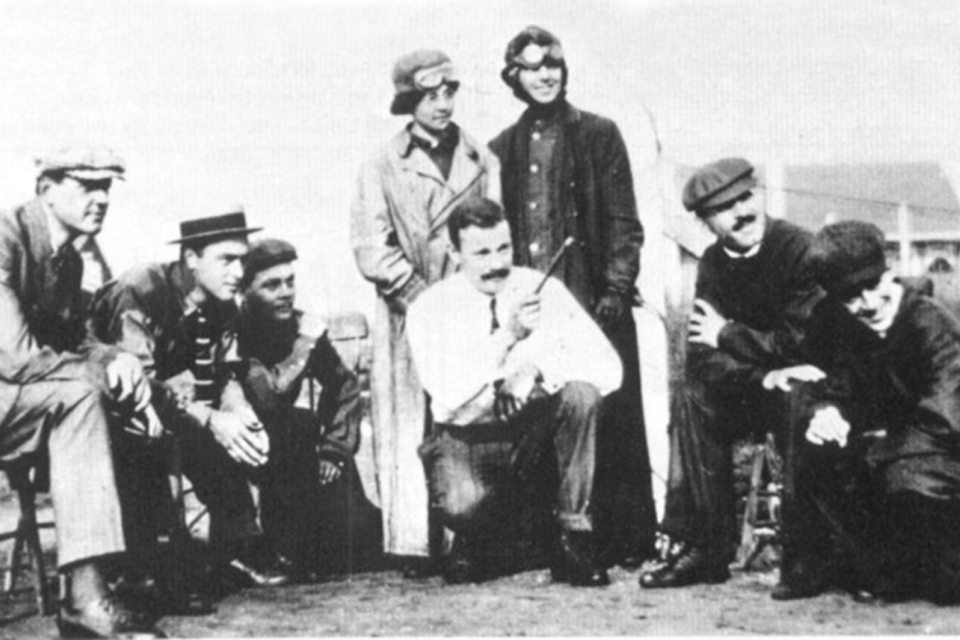
Already ‘an ardent sportswoman and expert autoist’ (as one reporter later wrote), Quimby decided to take the next natural step into adventure — and learn to fly. That evening when she happened to see Moisant having dinner at the Hotel Astor, she asked him to teach her to fly. He agreed, possibly not really taking her seriously. Quimby did not abandon the idea, even when Moisant died as his monoplane plunged to earth at an air meet in New Orleans on December 1, 1910.
John Moisant left a legacy, the Moisant Aviation School, which opened in April 1911. It was there that Harriet Quimby enrolled in the summer of 1911, entering into a friendly competition with Moisant’s sister, Mathilde, for the honor of becoming the nation’s first licensed woman pilot. Both flew Moisant monoplanes, copies of the famous Blériot design. (Mathilde received her license on August 17, 1911, to become this country’s second licensed woman aviator.)
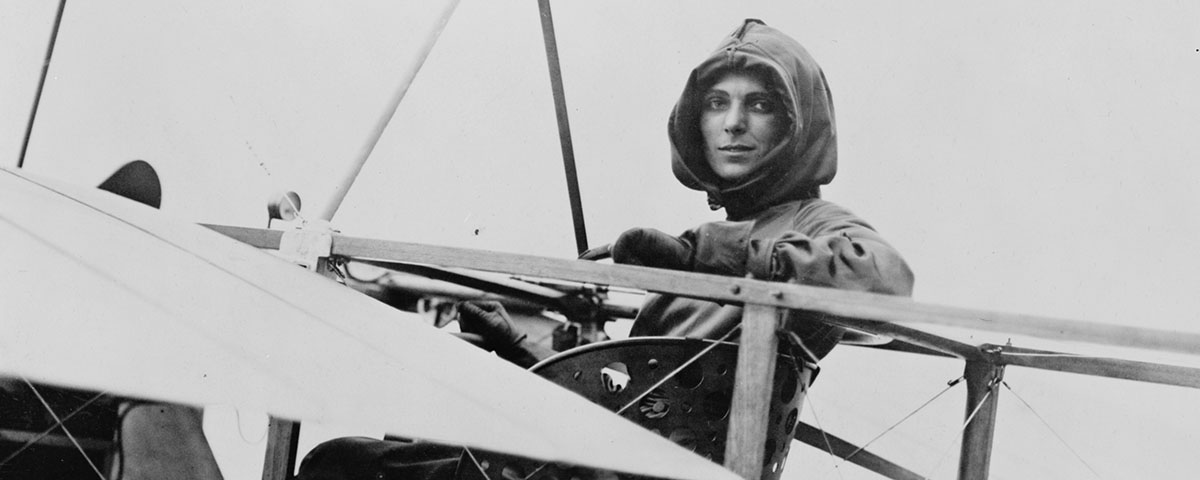
Would her bosses at Leslie’s frown at their drama critic’s unwomanly activities? Quimby dodged the question by taking her flight lessons at dawn and concealing her femininity in a flying suit and face-shielding hood. The secret was short-lived, especially after her first solo flight and license award when she accepted an invitation to join the Moisant International Aviators, an exhibition team.
Shortly after receiving her license, Quimby won headlines by making a moonlight flight over Staten Island, N.Y., to the amazement of a crowd of 20,000, a feat for which she received $1,500. During a meet at the Nassau Boulevard airfield in September 1911, she beat the leading French aviatrix, Helene Dutrieu, in a cross-country race, winning $600.
The following month, having added to her experience in several large exhibitions with the Moisant group, she teamed up with Mathilde Moisant on a flying tour of Mexico. She flew over Mexico City, the first woman to do so, as part of the inauguration ceremonies for President Francisco Madero. A secret no longer, Quimby’s flying had won the approval of her journalistic bosses at Leslie’s Weekly. She continued to contribute to Leslie’s and wrote an account of her Mexican tour for that magazine.
If her flying feats made it difficult to ignore Harriet Quimby, her personality and dainty elegance made it even more so. Spectacular was the word on all counts. ‘Lovable,’ ‘popular,’ ‘charming’ and ‘intelligent’ were a few of the adjectives applied by the newspapers. The few photographs available, though hardly doing her full justice, provide a hint of her grace and good looks. From all accounts she was, as the columnist noted, ‘a glamorous, green-eyed beauty.’
To those attractions, add her flight costume: trousers tucked into highlaced boots, a long-sleeved blouse, choker collar and a monklike hood-all of plum-colored satin and all designed by Quimby herself. Other early women fliers also dispensed with the sweeping skirts and huge picture hats of the day in favor of garb better suited to dignified and decent decorum on the breezy wings of a biplane or in the almost equally wind-blown cockpits of the monoplanes.
When her writing and flying activities failed to absorb all her energies, Quimby found herself tempted by another aeronautical ‘first’ — a flight across the English Channel. Since Louis Blériot had first flown the Channel on July 25, 1909, other famous male fliers had followed. But no woman, although there were several European female fliers at the time, had dared challenge the Channel.
In New York, Quimby agreed with Leslie’s request for exclusive American rights to a first-person account of the proposed flight. She obtained a letter of introduction to Louis Blériot and, in March 1912, sailed for England.
In London, she concluded an agreement with The Mirror to finance her flight at ‘a handsome inducement,’ as she later described it. Meeting Blériot in Paris, she made another wily move, ordering a new 70-hp plane and at the same time arranging to borrow a new 60-hp Blériot for her flight. Both were two-seaters, and the borrowed craft was the same general type (Moisant’s ‘copy’) that she had flown in America.
Temporary, but annoying, setbacks followed. She found deplorable weather at the French Channel resort town of Hardelot, where Blériot had a hangar and where she was to practice in her borrowed plane. With flying impossible for days, she returned to England, first arranging to have the untried aircraft shipped in secret to an airfield at Dover. She wanted no woman to beat her to the Channel flight.
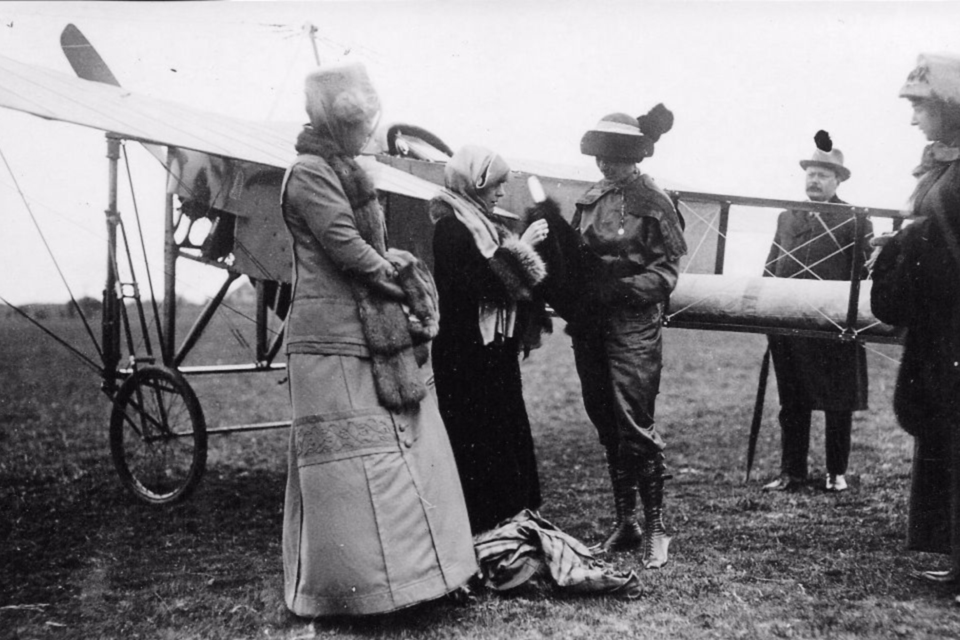
She confided her plans to a British pilot, Gustav Hamel, who seemingly violated the confidence by flying an English woman, Eleanor Trehawke Davies, across the Channel on April 2. But Davies had been only a passenger and the far greater glory of flying a plane across remained open to Quimby.
Hamel, ironically, turned up in Dover to help Quimby, flight testing the borrowed Blériot and serving as technical adviser. He stressed the need for constant attention to the plane’s compass, an instrument Quimby had never used before. He warned that even a minor error could send her wandering above the cold expanse of the North Sea.
From the outset, Hamel had been unsure of a woman’s ability to fly an aircraft across the Channel. He even suggested that he dress up in Harriet’s satin flying costume, pilot her plane across the Channel, and land at a deserted spot where she could meet him naturally, refused.
It may be difficult today to see why the 22-mile Channel hop could be considered hazardous. Yet it was, and several fliers had already been lost in the attempt. For Quimby, this was her first flight in a Blériot, first with a compass, and first across water. Add to that a flimsy plane that warped its wings to turn, an engine that needed prayer as well as fuel, and finally, as it turned out, fog that hid the water for much of the flight.
Thus it was a worried group of friends who saw Quimby off early on the morning of Tuesday, April 16. Heavily clad against a chill, damp day, she wore under her satin flying suit (as she later wrote), ‘two pairs of silk combinations, over the suit a long woolen coat, over this an American raincoat, and around and across my shoulders a long wide stole of sealskin.’ Her friends even pressed on her a hot water bag which Hamel tied to her waist. That Quimby still found space within the Blériot’s cramped cockpit testified to her petite figure.
Airborne at 8:58 a.m., Quimby climbed in a wide circle above the heights of Dover, reaching 2,000 feet before heading out over the Channel. Before running into a fog bank, she caught a brief glimpse of The Mirror‘s rented tugboat, which was jammed with reporters and photographers.
She climbed through the mists to 6,000 feet, seeking clear sky, but found only more mists and ‘a bone-chilling cold.’ She kept a close watch on her compass, recalling Hamel’s warning. Finding no clear air, she nosed the plane down, only to meet more trouble: the nose-down angle flooded the carburetor and the engine began to misfire. She leveled out, preparing to ditch and hoping to pancake into the water as gently as possible, when the engine, to her vast relief, resumed its steady purr.
The little monoplane was flying at 200 feet when it broke into the clear. Though dazzled by the rising sun, Harriet could see the shores of France ahead. She sighted a deserted stretch of beach dead ahead and soon passed over the Cape Grisnez Lighthouse. She flew briefly toward Boulogne, and then spiraled down to a landing on a flat, sandy fishing beach where she was quickly surrounded by villagers. By a stroke of luck she was at Hardelot, not far from the Blériot hangar, about 25 miles south of her planned destination, Calais.
Despite the Blériot’s cruise speed of almost 60 miles an hour, the 22-mile crossing had taken nearly an hour because of the climbing and landing spirals, the long, slow ascent to 6,000 feet, and the course variation.
Harriet Quimby, now ‘Queen of the Air,’ was feted in London and Paris and returned to the United States as a celebrity on two continents. She performed at air meets throughout the country, occasionally carrying passengers.
In June she entered the 1912 Boston meet to be held at Harvard Field in Squantum on the shores of Dorchester Bay, scene of big international meets in 1910 and 1911. The 1912 meet proved a troubled affair from the start as the management, a group of local promoters, squabbled with the Aero Club of America, the rules maker for such competitive meets. The meet, which attracted many famous fliers of the time, eventually ended $25,000 in debt and with the licenses of seven aviators suspended for the rest of the year. Worse, it brought death to two of its key figures.
Monday, July 1, the second flying day of the meet, went quite well, according to the news accounts, ‘with some good flying during the day.’ Just before 6 p.m., with the competitive events concluded, Quimby took off with a passenger, William A.P. Willard, the meet manager, for a flight around Boston Light, about eight miles away in Boston’s island-dotted outer harbor. Willard, father of Charles F Willard, a noted Curtiss exhibition pilot, had tossed a coin with another son, Harry, two days before to see which would fly first with Quimby. Harry had won and went up for a short flight earlier that day. The elder Willard had been looking forward to his own flight as ‘a great ad for his show,’ in which he had invested heavily with family funds.
After taking off, Quimby and Willard circled the field and headed east toward the Light, climbing to a height of 6,000 feet. Quimby sat in the front cockpit of the new 70-hp Blériot (the craft she had ordered in Paris), the plane’s white wings extending from just below and to either side of her. Willard, a large man of 190 pounds, rode the rear cockpit about three feet behind the pilot. The plane’s center of gravity was forward, at the wings, so Willard’s weight kept the fuselage level, replacing sandbags usually carried to prevent the tail from rising too high when Quimby was flying alone.
Returning from the Light some 20 minutes later, the Blériot descended in a wide circle and, heading eastward, reached a point near the mouth of the Neoponset River, midway between the Squantum and Dorchester shores. The plane, already in a steep glide, suddenly slanted even more sharply down and started a turn to the left, presumably to make its final approach to the field.
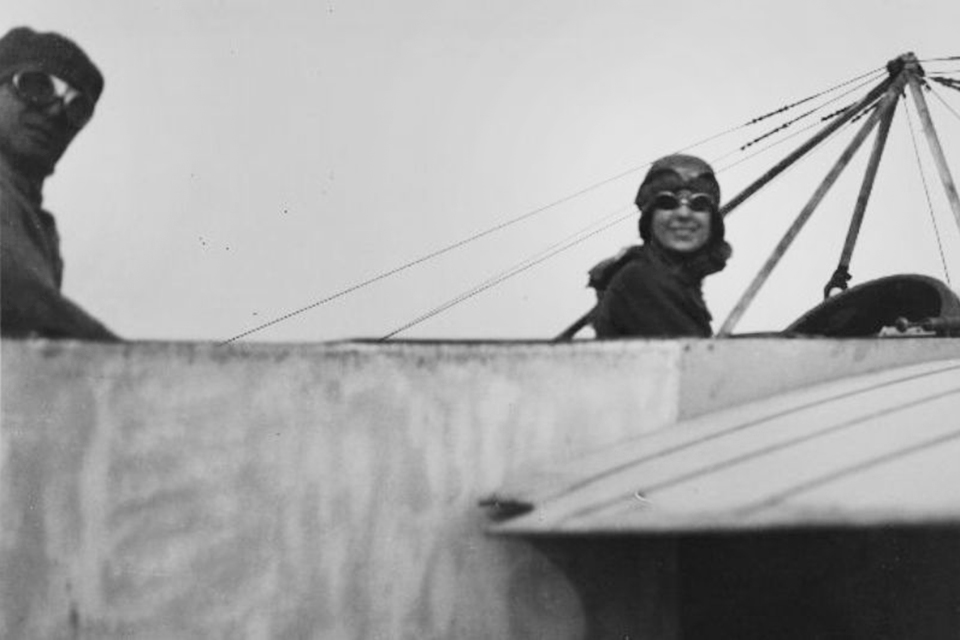
Then the unbelieveable and horrifying occurred. Willard was seen to hurtle clear over the nose of the plane, followed a second or two later by Quimby. Both plunged into the muddy river 1,000 feet below which, with the tide out, was barely three or four feet. deep. Death was instantaneous. Ironically, the plane recovered from its dive, crashlanded in the river and, tripped by its landing gear, flipped upside down with only minor damage. It was intact enough for a thorough inspection of its controls.
Quimby’s flying career had spanned a scant 11 months, and she was 28 (or 37, Michigan version) when she died.
A.J. Philpott, in the next morning’s Boston Globe, described the accident as ‘one of the worst tragedies that ever happened at an air meet in America,’ one, he wrote, that ’caused women to shriek and men to turn sick at heart.’ He added, ‘Just exactly what happened — what caused the accident — no one will ever know.’ A premature judgment, as events turned out, yet not entirely unjustified.
What caused the tragedy? The best that the encyclopedias and histories seem able to offer are such phrases as’some unexplained reason,’ ‘Nobody could ever explain the cause of the tragedy,’ and ‘Miss Quimby was killed in a flying accident at Boston in 1912.’ Hardly enlightening.
Philpott and other reporters did their best. The Globe of July 2 quoted several experts who were quick to advance their theories, however conflicting. Earl Ovington, a leading pilot of the day, and one of the first to reach the partially submerged plane, said he found that a rudder control wire was caught over the lower end of the vertical control lever used to warp the wings. This, he explained, caused the machine ‘to turn left and pitch headforemost downward,’ catapulting the occupants out. Ovington said that the jammed controls ‘unquestionably’ caused the accident. The jamming sequence began, he declared, when Quimby ‘moved the vertical warping lever sharply to the right, probably to correct for a gust of wind which struck her on the starboard side.’
Others disputed Ovington’s theory. Although conceding that. the beliefs of’such an experienced aviator should command respectful consideration,’ the Evening Globe of July 2 declared that ‘a careful examination of that particular part of the machine this morning with a full knowledge of Ovington’s theory in mind failed to verify his findings. Photographs were taken to substantiate the apparent errors in Mr. Ovington’s deductions.’
Of Ovington’s contention that a loosened wire had caught over the end of the control post, the Globe said: ‘This morning that self-same experiment was tried and it was found that the wires… failed to come anywhere near the tip of the vertical rod. With that theory disproved, all sorts of experiments were tried with the vertical post and the rudder and warping wires and the elevating wires. The rudder wires, controlled by the feet, in no way conflicted with the wires leading to the elevator, and the warping wires were safely removed from possible contact with the other sets.’
The experiments supported the views of Quimby’s French mechanic, Hardy, who, the Globe reported, became ‘wrathy’ when Ovington,only minutes after the accident, stated his beliefs to several bystanders, including Hardy.
Asked for his theory on the failed flight, Hardy had replied: ‘Too steep a glide. The machine lost its balance.’ He voiced strong doubts there had been any mechanical failure. ‘I personally tested every screw, bolt. and wire before we pushed the machine from the hangar, he said. ‘I always did that for I would never allow Miss Quimby to get into the seat, much less allow her to carry a passenger, unless I was satisfied that every part of the machine was perfect. But what could have happened? I can only say what has always happened to Blériot monoplanes …. Most of the accidents to Blériot types have happened almost always alike. They all have lost their balance.’
A reference in the Globe of July 3 added further support to Hardy’s words. ‘It appears,’ said the item, ‘that accidents similar to this one have occurred many times in France — always with fatal results and nearly always in the Blériot monoplane. The French government is at present engaged in an investigation of this kind of accident with the Blériot monoplane. It is supposed to be due to the curve at the entrant edge of the planes.’
The Globe also noted that John Moisant had been flying a monoplane ‘modeled after Blériot’s most up-to-date machine when he plunged headforemost to earth’ at New Orleans.
Witnesses speculated on other possible causes — a broken control wire, a snapped fuselage, a sudden downward movement of air, an attack of vertigo affecting the pilot, an abrupt foreward movement by the passenger. One news story noted: ‘There were many on the field who felt that Mr. Willard had no business to make such a flight under the circumstances. He had been under a heavy strain for months in getting up this meet. He was nervous and high-strung and his friends felt that it would be better for him not to make the flight… ‘
The lack of proper seat belts was quickly seen as a factor. The Globe of July 2 said that Quimby, before taking off, ”had buckled a broad strap across a space in front of her’ and that this space ‘from the back of her seat to the strap measured slightly less than a foot:’ Nothing, strangely, was mentioned of such a strap in the rear seat. The reporter wondered how Quimby ‘could have been thrown from her seat without first unbuckling the strap.’ From today’s perspective, it seems clear that he knew little of the forces acting on the occupants of a fast-diving aircraft that makes such a sudden change in direction as apparently occurred in this case.
Incidentally, the reports of the time include no evidence that the Blériot pilots who had died in similar steep diveinduced crashes (John Moisant’s, for example) had been catapulted from their planes in midflight.
In its August 1912 issue, the magazine Aircraft, a leader in its field, devoted almost four pages to the accident. Included were articles by Walter H. Phipps on the Blériot’s dangerous instability, and Denys P Myers, who conceded the instability but agreed with Ovington that the main cause was jammed controls. Included also were reports from four key eyewitnesses — two favoring instability as the cause, a third (Ovington) who clung to his jammed-control theory, and a fourth who suspected a broken ‘forward truss wire’ under the wing, but offered virtually no proof.
Phipps’ article, ‘The Danger of the Lifting Tail and its Probable Bearing on the Death of Miss Quimby,’ had a convincing ring of fact. Phipps pointed out that the fixed horizontal tail surface of the two-seat Blériot was actually a small cambered wing, similar aerodynamically to the craft’s main lilting wing. A normal horizontal tail surface has a fixed, non-lifting surface for longitudinal (nose up or down) stability with a movable control surface, the elevator. Further, Phipps wrote, the tail surface was set at a higher lifting angle than the main wing to help carry the weight of a passenger who sat well back of the airplane’s center of gravity. His article, complete with photographs and drawings, showed how the combination of a lifting tail and the difference in angle created a situation of grave potential danger.
‘A machine of this type,’ he wrote, ‘has not the slightest degree of automatic longitudinal stability and … is an extremely tricky and dangerous type to handle. The horizontal tail should act as a stabilizing damper, preventing the machine from either diving too steeply or stalling and not under any circumstances as a lifting plane… it must be either a flat or slightly negatively inclined surface.’
The danger, he explained, is that if an airplane with a lifting tail is suddenly nosed downward (by a gust of wind or by negligence of the pilot), the tail gains in lift as the dive speed increases until a critical angle is reached. Then, he wrote, ‘it is impossible to get the tail down even though the elevator is pulled up…. The faster the machine dives the more the tail lifts (because it is set at a greater angle than the main plane) until the slight pressure under the main plane (wing) shifts to the top when the machine assumes a vertical position and throws the occupants out, unless, of course, they are strapped in.’
Phipps concluded with a litany of experienced pilots who had died in Blériot crashes. ‘The action of the lifting tail,’ he said, ‘probably explains the cause of the deaths of John B. Moisant, F Blanchard, Jules Noel, Rene Vallon, Valdemar, Kimmerling, W. Smith, Leforestier, Lieut. Edmond Boerner and others, all of whom were killed while attempting steep glides on lifting-tail machines.’
Although that design flaw quite possibly spelled doom for Quimby and Willard, other questions remain unanswered. What tipped the ship into its fatal position? Did Quimby permit the craft to dive too fast and too steeply in the descent from 5,000 feet? Or did Willard move his weight forward for some reason, thus giving the lifting tail a chance to do its deadly work? Or did the controls in fact become fouled, flipping the craft over? Did a downdraft drop the craft in a split second from under the occupants, and if so why didn’t they leave the plane simultaneously instead of a second or two apart?
Myers accepted without question Ovington’s disputed claim that the controls had become fouled. ‘The Boston Aeronautical Society,’ he wrote, ‘has issued a statement asserting the cause of the accident to be the lack of fore and aft stability to counteract rotation on the center of gravity of the machine. This is no doubt true as a tendency in the present machine, but in this case does not consider the fact of the caught rudder cables.’ Thus did he blithely convert a questionable theory into ‘fact.’
A. Leo Stevens, Quimby’s manager, wrote that he believed the accident had its origin in ‘Willard suddenly straining forward to speak to Miss Quimby.’ Stevens, a friend of the Wright brothers and a famous balloonist, said he had twice warned Willard before the flight not to leave his seat under any circumstances. ‘This warning I was very particular to give;’ he wrote, ‘because I knew him to be a man of sudden impulses. Many a time while talking with him I have known him to suddenly leap from or lean forward in his chair to communicate an idea that had flashed into his mind … I believe that as the flight drew to its conclusion, Willard, enthusiastic over Miss Quimby’s splendid performance, for a moment forgot the danger of moving and suddenly stretched forward to shout a word of congratulation.’
A.A. Merrill, in charge of flying contests the day of the accident, dismissed as useless any discussion of whether anything on the plane broke in the air. He declared that ‘what happened must invariably happen under certain circumstances even with the machine intact. The fault is inherent in all existing machines, but especially in monoplanes.’ He cited three reasons for the accident:
‘First, Miss Quimby dived too abruptly. Second, she was not quick enough in throwing up the rear elevator, and, third, she was flying a machine that had no fore and aft stability and she and her passenger were not strapped in.’ He ended by warning plane builders to ‘wake up to the fact that the flying machine of the present is unsafe and will not be purchased by the public.’
Today we may rightly view the beautiful and vibrant Harriet Quimby as a victim of aviation’s age of innocence. Surely the cards were stacked against America’s one-time ‘Queen of the Air’ and her unsuspecting passenger that sad, summer day nearly eight decades ago.
Whatever the triggering cause — too steep a glide, abrupt shifting of the passenger’s weight, air turbulence, even a fouled rudder wire — no doubt it can remain that this specific Blériot type, with its treacherous lifting tail, was a terribly unforgiving aircraft, even for pilots of far more experience than Harriet Quimby.
Author Frank Delear, was raised in Squanturn,, Mass, a mile or so from the site of the Harvard-Boston air meets held a decade earlier. He first heard of Harriet Quimby from. his parents, who lived in nearby Dorchester at the time of the meets of 1910, 1911 and 1912. Suggestions for further reading include ‘What Killed Harriet Quimby?‘ in Yankee magazine (September 1979); and ‘U.S. Women in Aviation through World War I,’ in Smithsonian Institution Studies in Air and Space (No. 2), by Claudia M. Oakes.
This article was originally published in the January 1991 issue of Aviation History. For more great articles subscribe to Aviation History magazine today!