

At a presidential press conference a dozen years after the December 1944 Battle of the Bulge, President Dwight D. Eisenhower confessed, “I didn’t get frightened until three weeks after it had begun, when I began to read the American papers and found…how near we were to being whipped.” On the enemy side, with Lieutenant General George S. Patton below the southern flank of the surprise German thrust, the high command under Feldmarschall Gerd von Rundstedt realized the hazards of the Bulge from the start. Whatever the initial momentum, the operation had to succeed quickly. As bespectacled General der Panzertruppen Erich Brandenberger acknowledged in ironic self-congratulation afterward, “Patton had [already] given proof of his extraordinary skill in armored warfare, which he conducted according to the fundamental German conception.”
Whether or not he practiced the German mode of war, Patton, who wrote martial verse all his life, penned a rude rhyme in 1944 that roughly paralleled Brandenberger’s principles. Advocating relentless pressure on the enemy, Patton urged unrhapsodically:
For in war just as in loving, you must always keep on shoving,
Or you will never get your just reward:
For if you’re dilatory in the search for lust and glory
You are up shit creek and that’s the truth, Oh! Lord.
Recommended for you

Patton was never a role model for Sunday schools, and could be trouble even when the going was good. In army hospitals in Sicily in 1943 he had slapped two GIs whom he accused of malingering. General “Ike” Eisenhower, his commander, covered it up until the press was about to break the story. The embarrassment cost Patton, the engine of the Sicilian campaign, a prized command on D-Day in Normandy.
Then, performing the innocuous job of offering greetings at the opening of an English “Welcome Club” for servicemen in Knutsford six weeks before D-Day, he remarked that until that evening “my only experience of welcoming has been to welcome Germans and Italians to the ‘Infernal Regions’”—and he went on to predict the “evident destiny of the British and Americans, and of course the Russians, to rule the world.” He said he hoped that the war would come to “a quick conclusion, and I will get a chance to go and kill Japanese.” Subtlety was lost on Patton. Some British accounts of his talk omitted the Russians; others focused on his jovial brutality.
Exasperated with what seemed like another of Patton’s indiscretions, Eisenhower was ready to order him home—until Chief of Staff George C. Marshall cautioned, “Patton is the only available Army commander…who has actual experience fighting Rommel [who was then in charge of Atlantic Wall defenses] and in extensive landing operations followed by a rapid campaign of exploitation.” After enduring a dressing down from Eisenhower, Patton was left in England commanding a shadow disinformation army near Dover until, on August 1, 1944, seven weeks after D-Day, he was turned loose with the Third Army in France. He made up for lost time. He told his staff to hustle—an ounce of sweat was worth a gallon of blood.
The Third Army spearheaded the breakout from the Normandy bridgehead, stoutly defended by the Germans, who intimidated both U.S. Lt. Gen. Omar Bradley, south of Cherbourg, and pompous Field Marshal Bernard Montgomery, checked at Caen, while Patton raced across central France—until he ran out of fuel in Lorraine. “We are going so fast,” he wrote in hasty, often misspelled entries on slips of paper, “my only worries are my [military] relations not my enemies.” If he could keep it up, he wrote cockily, “I will be quite a fellow.”
Unable to maintain his momentum, Patton blamed his shortfall in fuel and supplies on Eisenhower’s need to placate the demanding, if sluggish, Montgomery. Patton was left to conduct a prolonged battle of attrition that ended only when von Rundstedt launched his unanticipated counteroffensive in mid-December, intending to take Antwerp, Belgium, and split Allied forces in Western Europe.
The Bulge—Eisenhower despised the label—exploited widespread intelligence failures. Americans have often been let down by intelligence lapses bred by complacency. The salient into the Allied lines was reaching perilously toward the Meuse River when, on Tuesday morning, December 19, 1944, soon after the counterattack in the Ardennes forest had gained momentum, a shaken Eisenhower convened key generals in Verdun. He traveled there from Versailles at 11 a.m. in an armor-plated Cadillac he had used since Algiers. Taking no chances, a security detail escorted him.
Adolf Hitler’s favorite commando officer, Otto Skorzeny, who had plucked Benito Mussolini from Italian partisans, had been leading Germans in GI uniforms taken from prisoners and the dead, and using captured American jeeps to misdirect units and sow confusion. One commando taken prisoner imaginatively declared that Skorzeny was out to kidnap Eisenhower. As a result, an otherwise unimportant look-alike lieutenant colonel was being driven around Versailles in Eisenhower’s hat and overcoat while the supreme commander, nearly immobilized by the empty threat, had left furtively for his meeting site.
The strategy session took place on the second floor of an old stone barrack surrounded by a sea of slush and mud. Warmed inadequately by a lone potbelly stove, the room was set up with large easels for displaying maps. There, Air Marshal Arthur Tedder, General Bradley, General Patton, Lt. Gen. Jacob Devers, and Field Marshal Montgomery’s deputy, Freddie de Guingand, and their aides were to work out joint moves to blunt the German thrusts. (Monty would not deign to travel to meet with lower ranks than his own.)

this article first appeared in military history quarterly


Eisenhower unpersuasively described the fumbled defense crisis as an opportunity rather than a disaster, appealing for “only cheerful faces at this conference table.” Farther to the east, where the frontiers of France, Belgium, and Luxembourg met, the conferees knew that dismayed American divisions were still being mauled. Although Ike warned Patton about bluster and bravado, thinking big as usual, Patton offered: “Hell, let’s have the guts to let the sons of bitches go all the way to Paris. Then we’ll really cut ’em up and chew ’em up.” Several at the table laughed, but Eisenhower interrupted sharply with “George, that’s fine. But the enemy must never be allowed to cross the Meuse.”
Eisenhower wanted the breakthrough blunted and narrowed. It had already disrupted plans to strike into Germany. Containing the bulge between the Belgian crossroads towns of Bastogne and St. Vith would limit the few viable routes by which the Germans could move reinforcements and supplies toward the Meuse. Despite the Western Allies’ continuing insistence that only unconditional surrender loomed—to allay Josef Stalin’s paranoia that the West might make a separate peace to let the Germans fight the Russians without an enemy at their backs—a desperate Hitler dreamed of striking a deal. A two-pronged attack toward the Meuse, threatening Paris, and toward Antwerp, the key Belgian port supplying the Allies, might not only frustrate the penetration of Germany itself but also buy time to develop more “miracle” weapons.
V-2 supersonic rockets, first launched toward London in early September, were a frightening beginning. However erratic the missiles might have been, there was no defense against them. The Luftwaffe was putting into production the first jet warplanes, which might dominate the skies. American troops, now bearing the brunt of the fighting, were stretched thin. “We are taking three trees a day,” an officer conceded, “yet they cost us 100 men apiece.”
Juggling operational boundaries, Eisenhower wanted General Jake Devers’ Seventh Army to move up from the south of France into areas from which Patton had planned to jump off into the Saar, and Patton to attack the southern flank of the Bulge below Bastogne. The Saarland, east of Metz and southeast of Luxembourg, Germany’s richest source of coal and a center of iron and steel production, was crucial to its further war potential. When Patton took Metz on November 22, it was the first time it had fallen to an enemy since a.d. 415. By December 5, he had four crossings of the Saar River in place. After that, weather and weariness had bogged the Third Army down, while even German reinforcements from the rubbish heap of the last reserves were fighting hard.
Inevitably, as the enemy advance divided Bradley’s army group, he would diminish into a minor player. His northernmost forces would be closer to Montgomery’s command than to Bradley’s own headquarters in Luxembourg City. “George,” Eisenhower instructed Patton at Verdun, with a diplomatic nod toward Bradley to keep him in the picture although Patton was now much on his own, “I want you to command this move—under Brad’s supervision, of course—making a strong counterattack with at least six divisions. When can you start?”
“As soon as you’re through with me,” Patton claimed. “I can attack the day after tomorrow morning.” He had thought his moves out the night before, and did not mention that he had left three alternative plans with his deputy, Maj. Gen. Hobart Gay, in Nancy. All he had to do was telephone a code word to activate his troops. But he reminded Eisenhower that of the six divisions asked for, he had only three.
GET HISTORY’S GREATEST TALES—RIGHT IN YOUR INBOX
Subscribe to our HistoryNet Now! newsletter for the best of the past, delivered every Wednesday.
Patton noted in his diary that it “didn’t enter Ike’s head” that the other divisions called for “exist only on paper.” They had been battered in the Hürtgen Forest, above the Ardennes, in November and were still refitting. He had only the reliable 4th Armored and the 26th and 80th Infantry divisions.
Patton’s aide, Lt. Col. Charles R. Codman, recalled “a stir, a shuffling of feet, as those present straightened up in their chairs. In some faces skepticism [showed]. But through the room a current of excitement leaped.” Taking tens of thousands of men facing eastward, swiveling them north, and moving them—with their armor and supplies set up for a different thrust, and over inadequate and icy roads—to counterattack two days later seemed logistically unsound. Patton was confident he could do it.
Turning toward Bradley as he described his plans for the southern shoulder of the Bulge, Patton contended, “Brad, the Kraut’s stuck his head in a meat grinder. And”—he turned his fist in simulation—“this time I have hold of the handle.”
Others at the table raised worries. Patton spurned their concerns. He was taking the war directly to the enemy. He would have preferred to lure the Germans forty or fifty miles farther, then chop them off.
“Don’t be fatuous, George,” Eisenhower warned, reining in tartly what he assumed was Patton’s bragging. “If you try to go that early, you won’t have all three divisions ready, and you’ll go piecemeal. You will start on the twenty-second, and I want your initial blow to be a strong one! I’d even settle for the twenty-third if it takes that long to get three full divisions.”

In two hours the redispositions were settled. Eisenhower walked to the door with Patton. “Funny thing, George,” he joked, referring to his new five-star super-rank, “every time I get another star, I get attacked.” His fourth had come just before the Kasserine Pass embarrassment in Tunisia early in 1943.
“And every time you get attacked, Ike,” Patton retorted, “I have to bail you out.”
Bailing out the Bulge would be one of Patton’s finest hours, justifying his belated fourth star, granted only when the war was nearly over. Bradley, who had vaulted over his unpredictable partner, and Eisenhower, who held Patton back, continued to have mixed feelings about entrusting crucial operations to him. Yet both continued to demonstrate confidence in the overcautious Maj. Gen. Courtney Hodges, who had bollixed up the First Army situation on the northern flank of the Bulge. In effect, his shattered divisions were now going into receivership under the domineering Montgomery.
“I trust,” Ike would grumble to General of the Army George Marshall as late as March 12, 1945, “that the secretary of war will wait for my recommendation before putting Patton’s name for promotion. There is no one better acquainted than I with Patton’s good qualities and likewise with his limitations. In the past, I have demonstrated my high opinion of him when it was not easy to do so. In certain situations both Bradley and I would select Patton to command above any general we have, but in other situations we would prefer Hodges.” The difficult Ulysses S. Grant might not have made the cut in Eisenhower’s army.
Erich Brandenberger expected “a speedy reaction from the enemy.” He meant Patton. Yet he assumed that it would take Patton at least four days to wheel his divisions about, and the terrible weather—rain, sleet and snow—would be an additional handicap. Nevertheless, Patton’s troops began shifting north. He felt that Bastogne was as good as lost if he could not get there by Christmas. (The Germans had already taken St. Vith, on the northern shoulder.)
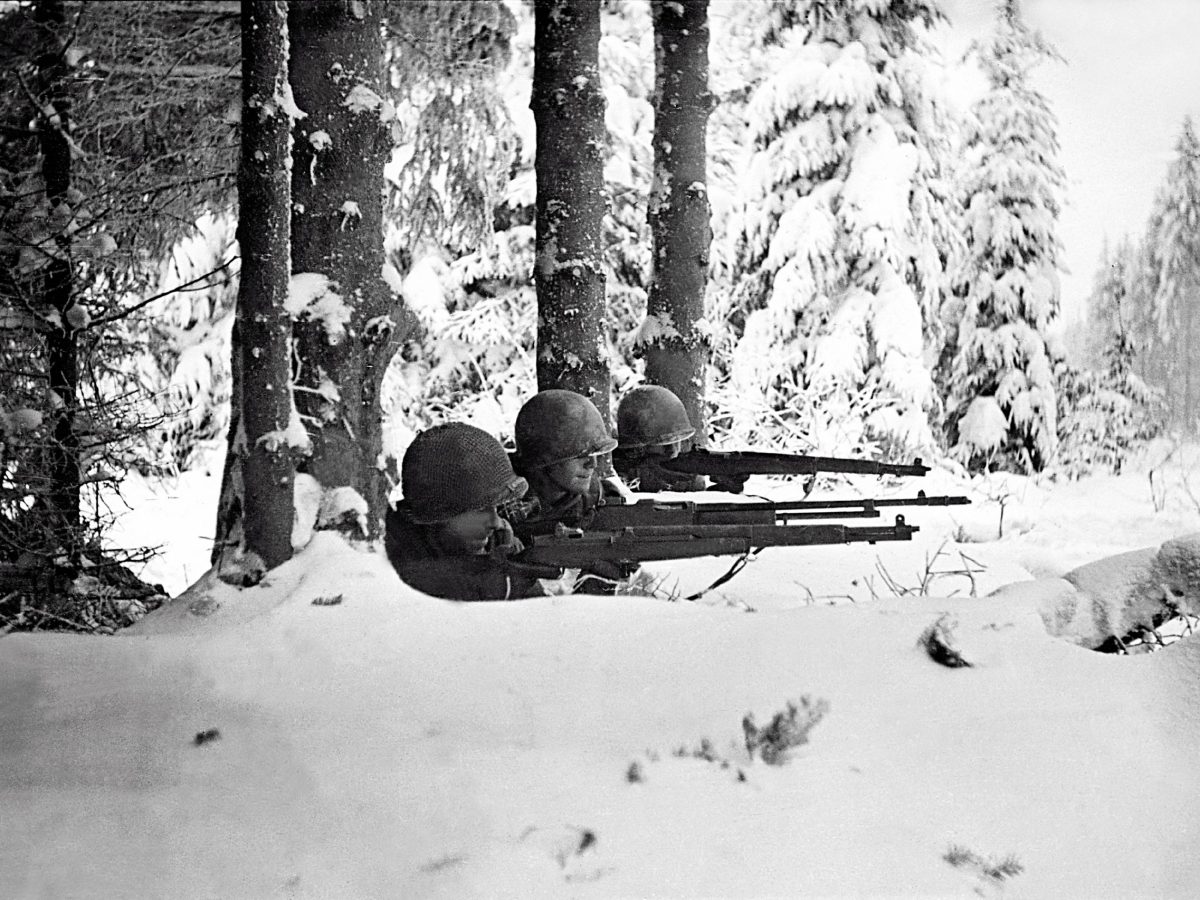
The 101st Airborne Division, surrounded and besieged, was holding the town precariously. Although the division and its supporting armored elements would be bottled up only for eight days, its airborne nature left it without heavy guns, and the tanks of Combat Command B of the 10th Armored Division were a lightweight counterpart to the panzer divisions surrounding Bastogne. Brigadier General Anthony McAuliffe, the 101st’s acting commander, knew that Patton’s forces were being alerted, but he had his doubts about how long the fragile 101st could endure. “Most of us,” he said later, rather ungenerously of Patton, “thought he never had a very good staff but he certainly accomplished miracles with it….Well, I mean the success of moving an unwieldy mass like that; to change your lines of supply, and everything, to turn that cumbersome, heavy-going outfit in the snow, in the fog and the rain, and turn them around so quickly as he did to get them going to the north, was really a remarkable task to accomplish.”
Patton had already thought hard about the operation, for he saw no other avenue for the relief of Bastogne. More than breaking a siege, the risky turnaround was essential to reducing the burgeoning Bulge. Yet the town was 125 difficult, wintry miles from the bulk of the Third Army. In two days and nights about a hundred thousand troops, with thousands of supply trucks, tanks, self-propelled guns, and other vehicles, had to slog over roads that barely existed beneath the mud, ice, and snow. Since blackout restrictions meant nothing in the poor visibility and lack of enemy air traffic, drivers kept their lights on. In the miserable terrain, communications teams had to lay and network nearly twenty thousand miles of wire.
To his wife, Beatrice, Patton wrote that “the staff of the Third Army, which consisted of myself and Sergeant [John L.] Mims [his jeep driver] visited two corps and five division commanders, and telephoned for the engineers, tank destroyers, extra tank battalions, etc.” It was over-the-top boasting, but Patton believed in hands-on oversight, whatever the hour or the weather. When he was discovered dining in style and enjoying vintage wines in a hotel in Luxembourg City, it had no bearing on where he had already been or would be going.
No admirer of Patton—the feeling was mutual—Montgomery sneeringly cabled his ostensible boss, Field Marshal Alan Brooke, chief of staff in London, that Patton’s attack “went off half-cock” and predicted that the Germans would be able to keep going. In his diary on December 22, Brooke wrote, “German offensive appears to be held in the north”—now under Montgomery, but with almost no British troops committed—“but I am a little more doubtful about the south. Patton is reported to have put in a counter attack. This could only have been a half baked affair and I doubt it’s doing much good.”
On the same day, Patton wrote to Beatrice that the Third Army had “progressed on a twenty-mile front to a depth of seven miles.” He had “hoped for more but we are in the middle of a snow storm and there were a lot of [enemy] demolitions. So I should be content which of course I am not….We moved over a hundred miles [since] starting on the 19th.”
To augment his forces, Patton extracted eight thousand men from rear-area service troops, including clerks and cooks and bandsmen. “If others would do the same,” he wrote to Beatrice—he knew how swollen support staffs were in Paris and Brussels and even in Luxembourg City—“we could finish this show in short order.” His combined attacking force, including Maj. Gen. Willard Paul’s 26th Infantry and Maj. Gen. Horace McBride’s 80th Infantry, numbered 108 armored, infantry, and artillery battalions, with 1,295 guns of 105mm or larger. “I don’t see how the Boche can take this much artillery,” he said.
Yet the Germans bent without buckling. In the snow on the 22nd, a battalion of the 4th Armored lost thirty-three tanks to German guns. Patton had urged the III Corps commander, Maj. Gen. John Millikin, to “drive like hell.” They were still twelve tough miles from Bastogne. Despite the cost, Patton goaded Millikin to get close enough to hear the bullets “whistle” and push on through the night, although the weather was as much the enemy as the Boche.
Decades later, Eisenhower recalled how Patton would telephone with frustrating progress reports, saying: “General, I apologize for my slowness. This snow is God-awful. I’m sorry.”
“George,” Ike would ask, “are you still fighting?” When Patton conceded he was, Ike answered, “All right, that’s all I’ve asked of you.”
If the weather was God-awful, the responsible party had to be invoked, and the devout yet off-the-wall Patton intended to go to the source. The Christmas gift that Patton desperately wanted—clearing weather, to better move his armor and to allow air support of his operations—was not the kind supplied by Santa Claus. He told his Third Army senior chaplain, Colonel James O’Neill, that he was going to reclaim a prayer that he had O’Neill compose earlier when rain was delaying the abortive attack into the Saar. “Do you have a good prayer for weather?” Patton had asked. “I’m tired of these soldiers having to fight mud and flood as well as Germans. See if we can’t get God to work on our side.”
“May I say, General,” O’Neill recalled years later that he ventured to say then, “that it isn’t a customary thing among men of my profession to pray for clear weather to kill fellow men.”
“Are you teaching me theology or are you chaplain of the Third Army?” Patton responded. “I want a prayer.” Well-read, including all of the Bible, Patton knew that there were many pre-battle appeals to the Almighty in Scripture.
Since Father O’Neill realized that Patton did everything over the top, he duly wrote something for the general, beginning piously: “Almighty and merciful Father, we humbly beseech thee, of thy great goodness, to restrain these immoderate rains with which we have had to contend. Grant us fair weather for battle. Graciously hearken to us soldiers who call upon thee that, armed with thy power, we may advance from victory to victory and crush the oppression and wickedness of our enemies, and establish thy justice among men and nations. Amen.”
The rains of early December had now congealed into snow, and the Saar offensive for which the supplication had been intended had been canceled. When O’Neill reminded him of that, Patton said: “Oh, the Lord won’t mind. He knows we’re too busy now to print another prayer.” Patton had the text set in type in Luxembourg City and distributed on a quarter million wallet-size cards, with a holiday greeting on the other side that wished “each officer and soldier,” incongruously in the circumstances, “a Merry Christmas.” Patton added: “I have confidence in your courage, devotion to duty, and skill in battle. We march in our might to complete victory. May God’s blessing rest upon each of you on this Christmas Day.”
Feeling fully engaged in God’s work, Patton apparently worked his idiosyncratic improvements on O’Neill’s prayer for further use. The text surfaced after the war and was published by the national tourist office of Luxembourg. “Chaplain,” he explained to O’Neill, “I am a strong believer in prayer….Between the plan and the operation there is always an unknown. That unknown spells defeat or victory, success or failure….God has his part, or margin, in everything.” Patton saw God’s intervention in the unknown “breaks.”
On December 22, although Bastogne was short of food and fuel, and its only hospital was the floor of the local riding academy, McAuliffe rejected an ultimatum to surrender with the since-familiar retort, “Nuts!” An advance German unit was twenty miles from the Meuse. The vanguard of Patton’s Third Army was about that distance from Bastogne but proceeding at a disadvantage. As Army Air Forces General Otto Weyland, responsible for the Bulge area, put it: “The weather was so terrible. It was white when you looked down, white when you looked up.”
In Luxembourg City the next morning, thirty-three miles to the southeast, Patton set out alone for the ancient Roman Catholic chapel in the Fondation Pescatore, the massive, steepled, castlelike structure where he made his headquarters. The chapel was now a home for the elderly. Under the crucifix above the altar, Patton, although an Episcopalian, removed his helmet with its three stars, sank to his knees, and prayed earnestly his widely quoted prayer for the Christmastime success of his troops. In Patton’s quirky concept, God was the ultimate commanding general:
Sir, this is Patton talking. The last fourteen days have been straight hell. Rain, snow, rain, more snow—and I’m beginning to wonder what’s going on in your headquarters. Whose side are you on, anyway?
Patton emphasized he was there “to annihilate the Germans and the godless Hitler” and he appreciated how “You supplied excellent weather for our armored dash across France.” He added:
But now, you’ve changed horses in midstream. You seem to have given von Rundstedt every break in the book and frankly, he’s been beating the hell out of us. My army is neither trained nor equipped for winter warfare. And as you know, this weather is more suitable for Eskimos than for Southern cavalrymen.
But now, sir, I can’t help but feel that I have offended you in some way. That suddenly you have lost all sympathy for our cause. That you are throwing in with von Rundstedt and his paper-hanging god [Hitler]. You know without me telling you that our situation is desperate.
Patton described the terrible weather preventing the resupply of Bastogne, hospitals full of frostbite cases, and wounded dying in the fields because they could not be brought back for medical care. He stressed his need for “close-in fighter-bomber support, and if my planes can’t fly, how can I use them as aerial artillery?” Without divine cooperation to improve the weather for reconnaissance, supply and battle support, he was stymied, he said, and, “Damn it, Sir, I can’t fight a shadow….You have just got to make up your mind whose side you’re on. You must come to my assistance, so that I may dispatch the entire German Army as a birthday present to your prince of peace.”
Patton claimed that he did not want to seem unreasonable or to ask for the impossible:
Give me four clear days so that my planes can fly, so that my fighter-bombers can bomb and strafe, so that my reconnaissance may pick our targets for my magnificent artillery. Give me four days of sunshine to dry out this blasted mud, so that my tanks roll, so that ammunition and rations may be taken to my hungry, ill-equipped infantry. I need these four days to send von Rundstedt and his godless army to their Valhalla. I am sick of this unnecessary butchery of American youth, and in exchange for four days of fighting weather, I will deliver you enough Krauts to keep your bookkeepers months behind their work.
After his “Amen,” Patton went back to work and hoped that God would attend to the modest requests enumerated—although the deity must have known that Patton had assumed unto himself an air force he did not command and an airborne division in Bastogne that was also out of his jurisdiction. He was appealing for the churched and unchurched alike.
That Saturday Colonel Harry Kinnard radioed from Bastogne that it was “getting rather sticky around here,” and that Patton’s 4th Armored “must keep coming.” Enemy tanks had broken through the southern perimeter. “Request you inform 4th Armored Division about our situation and ask them to put on all possible pressure.” Headquarters at the 101st estimated in Christmas terms that Bastogne had “one more shopping day.” Yet the weather was indeed changing. A “Siberian high”—whatever its source—was clearing the skies, and Allied aircraft again flew.
As fighter-bombers hammered German vehicles, Patton radioed John Millikin impatiently—and unreasonably. “There’s too much piddling around!” Patton complained from the safety of Luxembourg City. Tough German resistance, Millikin reported, had disabled eleven more American tanks. “Bypass those towns and clear them up later,” Patton ordered. “Tanks can operate on this ground now.”
Buoyantly, Patton credited his chaplain for the change in the weather. He later awarded the baffled Chaplain O’Neill a Bronze Star. Happily, if prematurely, Patton radioed to McAuliffe on the morning of the 24th, referring to Brig. Gen. Hugh Gaffey’s forward tanks: “Xmas Eve present coming. Hold on.” Preliminary Christmas presents had already begun to arrive, beginning at 1:30 p.m. on the 23rd. Bastogne’s citizens, hearing the throb of aircraft engines, climbed from their cellars to wave. Resupply was underway, by glider and color-coded parachute drops.
With Colonel Codman, Patton went to a candlelight Communion at the frigid Episcopal church in Luxembourg City, which, below the Bulge, had remained quiet. The church huddled in the shadows of an enormous Catholic cathedral. “It was very nice,” Patton wrote, “and we sat in the former Kaiser Wilhelm’s box.” In World War I, “Kaiser Bill’s” army had overrun Luxembourg.
By radio, Patton had already learned that his 318th Infantry, after a six-hour truck ride in a long convoy, had arrived behind General Gaffey’s tanks to help force the way north. The drive toward Bastogne had ground down. Patton blamed himself. After the battle he explained: “I had been insisting on day and night attacks. This is all right on the first or second day of the battle and when we had the enemy surprised, but after that the men get too tired.”
Blunting the Bulge would not be easy, nor would it be cheap. Patton had underestimated the desperate resilience of the enemy. Most Volksgrenadiers and Panzergrenadiers were not fighting for Hitler now, but for their homeland. Beyond the dead and wounded in battle, many others perished, more than the numbers given in the official figures.
A Belgian-manned troopship, Léopoldville, built to accommodate 360 passengers but loaded with 2,223 66th Division replacements, was torpedoed in the English Channel. In the darkness the crew saved themselves; 802 GIs were lost. The sinking was covered up for years. Allied prisoners by the thousands were shunted off to Germany with little food or water in freezing and nearly airless freight cars. Many did not survive.
On the morning of the 25th, Patton noted in his diary, “A clear cold Christmas, lovely weather for killing Germans, which seems a bit queer, seeing whose birthday it is.” Bastogne was still encircled. The guns of relief elements could be heard but not seen. Patton spent much of his day visiting units of his active divisions to ensure, where possible, that his orders that every soldier in the Third Army have a hot turkey dinner on Christmas Day were carried out. (For most, it was welcome but less-than-festive hot turkey sandwiches with gravy.) Boisterous and noisy to stir enthusiasm in the sharp frost, he turned up day and night, helmeted but unescorted, driven by the ubiquitous Sergeant Mims in an open jeep with extra-large mud flaps, Plexiglas doors, and a .30-caliber machine gun mounted on a post. “He’d stop and talk to the troops,” Mims recalled, “ask them did they get turkey, how was it, and all that.” On one inspection, Patton stumbled over the feet of a GI who was zonked out under his jeep. “God damn it!” the groggy soldier complained. “Can’t you see I’m sleeping?”
“At least one person around here knows what he’s doing,” cracked Patton, unidentifiable to the man below. His troops often swore at him, but also by him.
When Patton caught up with a column of the 4th Armored, still short of Bastogne, trucks and tanks were sliding off the icy roads—he called them bowling alleys—into ditches. “I only saw him once,” a GI told Beatrice Patton after the war. “We were stuck in the snow, and he come by in a jeep. His face was awful red, and he must have been about froze riding in that open jeep. He yelled to us to get out and push, and first I knew, there was General Patton pushing right alongside of me….He never asked a man to do what he wouldn’t do himself.”
As Patton neared the headquarters unit of the 4th Armored, an American plane strafed the area. He threw off his lap blanket and huddled in another ditch. By radio he heard from VIII Corps headquarters in the safety of Neufchâteau, to the west, that McAuliffe had called on Christmas Day to say that the finest present his troops could receive was their rescue, but that holding the Bastogne perimeter had its limits. When the 4th Armored failed to crash a corridor through by midnight, and, faced with German infantrymen riskily riding the backs of tanks and being toppled into the snow by small-arms fire from foxholes, McAuliffe called again to complain that the situation was desperate and he had been let down.
Patton was indignant—briefly. His troops were straining to their limits, and the Germans were giving up little ground. Using a favorite expression, he snapped, “There is no use getting into a pissing match with a skunk; so, unless they get too vituperative, I will leave it at that.”
Lieutenant Colonel Creighton Abrams’ tanks made it through late in the afternoon of the 26th. The 101st’s greeting party, by McAuliffe’s order, was well-dressed and cleanshaven, to show that they had everything under control. With an aide, McAuliffe rode a jeep over to see Patton’s troops for himself. Captain William Dwight, second in with his tank after 1st Lt. Charles P. Boggess, scrambled out, saluted, and asked, “How are you, General?”
“Gee, I am mighty glad to see you,” said McAuliffe, happy to be reconnected. The day after Christmas was not too bad. And for the enemy, if not for McAuliffe, it was still Christmas. In Germany das zweiter Weihnachtstag persisted.
“Just now at 1845,” Patton wrote to Beatrice, “Gaffey called to say we had made contact. Of course we did not do it with much, but we did it. My prayer seems to be working still as we have had three days of good weather and our air [force] has been very active. Of course they overstate [their results] at least 50 percent but they do scare the Huns.”
Several days later, arriving in Bastogne with Marlene Dietrich, who had been entertaining Allied troops there before the German attack and now returned, Patton saw white-clad enemy bodies frozen in the snow, now with a second coating of white. “Finest battlefield I ever saw,” she recalled him crowing in his high-pitched voice.
On the northern shoulder of the Bulge, Montgomery, temporarily in full command, reflected that Bradley, “such a decent fellow” but in over his head, had mistakenly permitted Patton “to go too far,” yet Monty had done little more than hold the line with American troops. The British counted about a thousand casualties, two hundred of them dead. Admitted American casualties were 80,987, including 10,276 killed and 23,218 missing, including prisoners of war and unrecovered dead. The German count was higher. Patton’s Christmas wish was that Eisenhower would not give in weakly to Monty’s “tidying up the lines” panaceas. “If ordered to fall back,” he wrote in his diary, “I think I will ask to be relieved.”
On December 27, Patton returned to offer a thank-you at the Pescatore chapel, anticipating that the Bulge was the enemy’s final counteroffensive—as it proved to be:
Sir, this is Patton again, and I beg to report complete progress. Sir, it seems to me that you have been much better informed about the situation than I was, because it was that awful weather which I cursed so much which made it possible for the German army to commit suicide. That, Sir, was a brilliant military move, and I bow humbly to a supreme military genius.
The Bulge was indeed the last chance for the Wehrmacht to create a situation that might have forced, through frustration and disillusion in the West, some form of negotiation that might have forestalled the invasion and destruction of Germany itself. That did not happen.
Pressing eastward as the Bulge was flattened, Patton passed through the Belgian town of Houffalize, above Bastogne. He was appalled by its utter destruction as the Germans withdrew after mutually costly fighting. “I have never seen anything like it in this war,” Patton wrote. Giving in to his profane streak, yet still close enough to Christmas to exploit a carol, he penned yet another verse:
O little town of Houffalize,
How still we see thee lie;
Above thy steep and battered streets
The aeroplanes still fly.
Yet in thy dark streets shineth
Not any Goddamned light;
The hopes and fears of all thy years
Were blown to hell last night.
At Oppenheim in Germany late in March, lost for words, Patton flamboyantly peed in the Rhine. Still, he seemed never lost for language that would plunge him into trouble. In defeated Germany he later explained to newspapermen pragmatically that to keep experienced civil servants working one needed to ignore their past Nazi Party membership that seemed to him mere “lip service.” Paying party dues to keep jobs had been “nothing but a form of blackmail….If we kick them out, all this bunch, we will retard the reorganization of Bavaria….”
It was not the first of his unwelcome postwar remarks, and the sum of them cost him his military governorship. Patton had an outsized genius for war, but not for peace. Transferred by Eisenhower to a paper-pushing post until he could return to the States, Patton got no farther than the American military hospital in Heidelberg. Critically injured in a staff car collision with an army truck on December 9, 1945, he did not see another Christmas. Patton died on December 21, 1945, and was buried in a cemetery in Luxembourg for Americans who died in the Bulge, six thousand of them from his beloved Third Army. It was Christmas Eve.
Stanley Weintraub, author of Silent Night: The Story of the World War I Christmas Truce (2001) and Iron Tears: America’s Struggle for Freedom, Britain’s Quagmire (2005), has recently published Eleven Days in December: Christmas at the Bulge (all published by Free Press/Simon and Schuster).