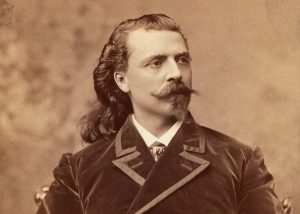

Because of his great contribution to the state’s early years, Granville Stuart is revered today as “Mr. Montana.” Among the first to prospect for gold in the vast wilderness that would one day become the state of Montana, he and his brother James are credited with igniting the great Montana gold rush of the early 1860s by describing their findings in a letter to another brother in Colorado. Granville was at the boom mining camps of Bannack in 1862 and Virginia City in 1863 and played a prominent role in the activities of the vigilante organization that put an end to the depredations of the outlaw gang led by the notorious Henry Plummer.
In the years following, he wore many hats, earning his living as a merchant, sawyer, gunsmith, butcher, horsetrader, blacksmith, banker, real estate speculator, rancher, diplomat, historian and writer. He still found time to serve two terms in the territorial council, once as its president.
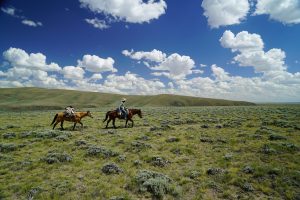
But it was as a cattleman that he is best remembered. He introduced cattle to Montana Territory as early as 1860. Entering into partnership with three others in the establishment of the DHS Ranch in 1879, Stuart assumed the duties of superintendent and general manager. He made his ranch headquarters on Ford’s Creek, about 20 miles northeast of Lewistown, Montana Territory. The military established Fort Maginnis (1880-90) on DHS land to protect Judith Basin settlers from Blackfeet and Sioux. By 1883 Stuart was ranging 12,000 shorthorns and making a nice profit for the firm.
But his herd tally at the fall roundup that year showed that cattle rustlers had taken a toll of at least 3 percent. Other ranchers experienced a similar loss.
Some of the shrinkage, Stuart knew, could be attributed to small, independent ranchers who routinely augmented their relatively minor cattle holdings by additions from the herds of the big stockmen. Stuart could find some humor in this type of rustling activity, as he wrote many years later: “Near our home ranch we discovered one rancher whose cows invariably had twin calves and frequently triplets, while the range cows in that vicinity were nearly all barren and would persist in hanging around this man’s corral, envying his cows their numerous children and bawling and lamenting their own childless fate. This state of affairs continued until we were obliged to call around that way and threaten to hang the man if his cows had any more twins.”
Of more concern to Stuart and the other big stockmen were the well-organized gangs of thieves operating in that wild and sparsely populated country without fear of interference by the law. These gangs, they knew, were responsible for most of the cattle theft. When members of the Montana Stock Growers’ Association met in Helena in October 1883, leading their agenda was the question of how to deal with this organized rustler threat. They debated the issue but, reaching no agreement, tabled the problem until the spring 1884 meeting.
Although no plan for decisive action was reached at that fall meeting, members did agree to gather as much identification information as possible about the rustlers, particularly their leaders, and their various headquarters locations.
At the April 1884 meeting, the stockmen, although united in their determination to solve the outlaw problem, could not agree on the proper course of action. As Stuart remembered:
Some of the members were for raising a small army of cowboys and raiding the country; but the older and more conservative men knew that would never do.
I openly opposed any such move and pointed out to them that the “rustlers” were strongly fortified, each of their cabins being a miniature fortress. They were all armed with the most modern weapons and had an abundance of ammunition, and every man of them was a desperado and a dead shot. If we had a scrap with them the law was on the side of the “rustlers.” A fight with them would result in the loss of many lives and those that were not killed would have to stand trial for murder in case they killed any of the “rustlers.” My talk did not have the conciliatory effect that I expected and seemed only to add fuel to the fire. The younger men felt that they had suffered enough at the hand of thieves and were for “cleaning them out” no matter what the cost.
The Marquis DeMores, who was a warm personal friend of mine and Growers with whom I had had some previous talks on the subject, was strongly in favor of a “rustlers war” and openly accused me of “backing water.” The Marquis was strongly supported by Theodore Roosevelt, who was a member of the Montana Stock Growers’ Association from Dakota. In the end the conservative members of the association carried the day and it was voted that the association would take no action against the “rustlers.”
It did not take long for word to reach the rustlers that the cattlemen had failed to agree on a coordinated plan of attack against them, and thus emboldened, they increased their criminal activities, concentrating now on the stealing of horses.
Stuart now became convinced that prompt and decisive action had to be taken against the thieves. Having received information from stock detectives about the main culprits and their hideouts, Stuart called a meeting at his ranch in June. It was attended by other concerned stockmen, their most reliable and gun-handy cowboys and the association stock detectives.
One gang captain was identified as a man named Jack Stringer, commonly known as “Stringer Jack.” Described as “a tall, handsome young fellow, well educated, and of a pleasing personality,” he was distinguished by “piercing gray eyes, white even teeth, and pleasant smile.” A former buffalo hunter before turning outlaw, he reportedly did not drink to excess but was an inveterate gambler. Stringer made his rendezvous on the Missouri River at the mouth of the Pouchette.
Sam McKenzie, described as “a Scotch half-breed” and ostensibly a wolf hunter, was actually an active horse thief. He stole horses in Montana Territory, drove them into Canada and sold them, then stole Canadian horses, which he brought back and sold locally. His Cree half-blood friends had aided him in dodging the authorities on both sides of the border.
While riding his range, Stuart himself had stumbled on the camp of a pair of outlaws, Charles “Rattlesnake Jake” Fallon and Edward “Long-Haired” Owen. The two men looked the part. He said:
[They were] as tough looking characters as I have ever met, especially Owen who had long unkempt black hair, small, shifty, greenish gray eyes and a cruel mouth. “Rattlesnake Jake,” despite his bad sounding sobriquet, was not quite so evil looking as his pal, although he was far from having a prepossessing appearance. Both men were armed, each wearing two forty-four Colt revolvers and hunting knife. When I rode into their camp, Fallon was sitting on a roll of blankets cleaning a Winchester rifle. Owen was reclining against a stump smoking and another Winchester lay on a coat within easy reach. Owen was self-possessed, almost insolent. “Rattlesnake Jake” was civil but nervously tinkered with the gun and kept his eyes on me all the time I was in their camp. I knew that they were a bad lot but had nothing to cause their arrest at that time, but decided to keep an eye on them while they were on the range.
Later Stuart learned that the two men were hard cases indeed. Owen was from Shreveport, La., where he had killed a man. Fallon, from Laredo, Texas, was wanted in New MexicoTerritory for burning buildings and shooting up a ranch. They had stolen horses in Wyoming Territory, where officers were looking for them.
Billy Downs, a wolf trapper, whiskey seller and sometime horse and cattle thief, had a place at the mouth of the Musselshell that was a hangout for outlaws. He was married, and the cattlemen, out of respect for the woman, warned him to cease his criminal activities, an admonition he ignored.
Other rustler gang members, some known only by their nicknames, included “California Ed,” “Red Mike,” Brocky Gallagher, “Dutch Louie,” “Old Man” James and his two sons, Frank Hanson, Bill Williams, Paddy Rose, “Swift Bill,” “Dixie” Burr, Orvil Edwards and Silas Nickerson.
Supplied with this information, Stuart and 14 determined fighting men mounted an expedition against the gangs. Recalling his early days at Bannack and Virginia City two decades before, Granville Stuart called the group a “Vigilante Committee,” but the band would forever be remembered in Western history as “Stuart’s Stranglers.”
Once the decision was made to crack down on the rustlers, Stuart moved fast. Splitting his force into squads, he sent them in search of their quarry.
On the Fourth of July, one party closed in on the hangout of Billy Downs and his pal California Ed on the Musselshell. There they found 26 horses in the corral, all bearing cattle ranchers’ brands. They discovered a large quantity of dried meat that Downs claimed was buffalo, but they all knew buffalo had not been seen in those parts for two years. In the stable were stacks of fresh hides, salted and prepared for shipment down river, all bearing the brand of the Fergus Stock Company. That was good enough for the vigilantes. Ignoring the entreaties of Downs’ wife, they took her husband and California Ed to a grove of trees and strung them up.
On that same Independence Day, folks at Lewistown contributed to the clean-up campaign by eliminating Rattlesnake Jake Fallon and Long-Haired Owen. In a drunken carousal, the two outlaws had disrupted the holiday festivities of the town and capped their rampage with the wanton killing of an innocent bystander. Townsmen went for their guns and riddled both desperados. When the smoke cleared, they counted nine bullet holes in Fallon and 11 in Owen.
Stuart’s party of vigilantes working the country around the mouth of the Musselshell rode to the headquarters of Red Mike and Brocky Gallagher at Rocky Point. The men they sought were gone, having crossed the river with some stolen horses. The vigilantes followed, captured Red Mike and Gallagher and recovered the horses. Stuart simply said that “both men plead guilty,” without further comment, but certainly the two thieves were soon dangling from trees along the river.
At Bates Point, 15 miles below the mouth of the Musselshell, was the home of Old Man James and the favorite hangout of Stringer Jack. Stuart described the scene and the dramatic fight that took place there after he and his vigilantes arrived:
There was a log cabin and a stable with a large corral built of logs, connecting the two buildings. One hundred yards from the cabin in a wooded bottom was a tent constructed of poles and covered with wagon sheets. At the cabin were old man James, his two sons, Frank Hanson and Bill Williams. Occupying the tent were Jack Stringer, Paddy Rose, Swift Bill, Dixie Burr, Orvil Edwards, and Silas Nickerson.
…The [vigilantes] were divided into three parties. Three guarded the tent, five surrounded the cabin and one was left behind with the saddle horses. They then waited for daylight. Old man James was the first to appear. He was ordered to open the corral and drive out the horses. This he did but refused to surrender, backed into the cabin and fired a shot from his rifle through a small port hole at the side of the door. This was followed by a volley from port holes all around the cabin and in an instant the whole party was in action.
Two of the vigilantes crawled up and set fire to the hay stack and the cabin. The men inside stationed themselves at port holes and kept up the fight until they were all killed or burned up. The cabin burned to the ground. The tent was near the river bank and almost surrounded by thick brush and it was easier to escape from it than to get out of the cabin. Stringer Jack crawled under the tent and reached a dense clump of willows from which he made his last stand.
Dixie Burr, his arm smashed by a rifle bullet, hid in an old dry well until dark and then made his escape. Rose, Nickerson, Edwards and Swift Bill also slipped out of the tent and got away in the dark. Every one of the outlaws in the gun battle at Bates Point was either killed or wounded with the exception of Edwards and Nickerson, who—for the time being—got away unscathed.
The next day, Burr joined up with Nickerson, Edwards and Swift Bill. The four fashioned a rude raft and started down river, but they were stopped by soldiers from Fort Maginnis, who turned them over to Deputy U.S. Marshal Samuel Fischel for delivery to White Sulphur Springs.
But, said Stuart, “At the mouth of the Musselshell a posse met Fischel and took the prisoners from him. Nearby stood two log cabins close together. A log was placed between the cabins, the ends resting on the roofs, and the four men were hanged from the log. The cabins caught fire and were burned down and the bodies cremated.”
Paddy Rose was the sole outlaw to make a complete getaway. Separated from his companions, he made his way to Fort Benton, where he had wealthy and influential relatives who assisted him in reaching the Canadian border.
News of the Stuart vigilante raids was slow to reach the outside world, partly because of the remoteness of the region and partly because, as the editor of the Mineral Argus of Maiden, Mont., complained, the press was “handicapped severely by the disinclination of the participants toward publicity.” Significantly, the Argus editor was unapologetic in his support for Stuart’s often bloody mission. “The most speedy and safe cure” for thieves, he opined, “is to hang them as fast as captured.”
One of the first dispatches to reach the national press came out of Salt Lake City, Utah, with a July 21 dateline:
News comes from Judith City, Northern Montana, that five horse thieves were captured and hanged in the vicinity of Rocky Point a few days ago. The hanging was done by a regularly organized gang of cow boys, who set out to round up the thieves that infest that section, and they are doing their work in good shape. They secured thirty-two stolen horses from the outlaws, and then made short work of them, hanging the whole lot to the nearest tree in the region between lower Judith and Mussel’s Hell [sic]. Within the last three weeks thirteen horse thieves have been lynched and it is probable the end is not yet.
By July 26, papers from as far away as Dunkirk, N.Y., were reporting: “The people of the cattle ranches of Montana territory have for some time been greatly annoyed by horse and cattle thieves, and have hanged or shot thirteen of the offenders within three weeks, five being captured and hanged at Rocky Point on the upper Missouri river.”
On the 30th, a Helena dispatch said that seven horse thieves were hanging from trees at the mouth of the Musselshell and “some twenty of Granville Stuart’s cowboys are out after another band….They go fully prepared for all emergencies, and if they overtake the horse-thieves there will be another hanging, as the settlers and stockmen are desperate over the loss of their horses. There have been over one hundred horses recovered within the past week. Fully fifty thieves were hanged or shot in the past month.”
Reports of the ongoing raid continued to filter out throughout the month of August.
August 3: “The stock raisers and ranchers of that Territory are carrying on a war of extermination against the horse and cattle thieves. From a letter found in the pocket of a thief recently captured and hanged, full particulars were obtained of the existence of an organized gang of from seventy-five to one hundred thieves, who had long and successfully defied the legal authorities, and had operated between the Missouri and Yellowstone rivers, below Benton. The cowboys are out in force rounding up the thieves….In all, it is estimated that twenty of the gang have been killed; many more have emigrated. It is claimed that the name and history of each thief is known to the cowboys, and that the war will go on until the horse-thieves are scarce in Montana as they are in heaven.”
August 5: “A courier has just arrived from near the mouth of Mussel Shell and reports that Granville Stuart’s cowboys have a large band of horse thieves secured. The band is too large to be taken but can be held until help comes. Reinforcements left Cottonwood Sunday. A hot time is expected.”
An August 8 dispatch from Helena repeated the story of the Bates Point battle, termed “another slaughter of horse-thieves,” with additional details. The attackers, identified as “Granville Stuart’s cowboys,” killed nine of the horse thieves, but five escaped. The cabin was set on fire and burned. “Never was there a period in the history of this or any other territory when so much horse thieving was going on. The citizens are determined to effectively stop it.” The story concluded with a greatly exaggerated assertion: “Fully fifty thieves were hanged or shot in the past month.”
August 16: “At Rocky Point. M.T., a few days ago a band of cowboys captured a gang of horse-thieves, recovering from them thirty-two head of horses. The five outlaws were then suspended from the nearest trees.”
August 22: “Near Helena, Montana, the other day, fourteen horse-thieves were attacked by cowboys and nine of them killed.”
These contradictory newspaper stories undoubtedly contributed to later confusion about the extent of the Stuart raider retribution, as many of the items were repetitions of previously reported incidents. In the end, estimates of the number of victims of the 1884 cattlemen’s campaign ranged from 19 to 75.
Some viewed this as unlawful wholesale slaughter by bloodthirsty vigilantes, and Granville Stuart as the leader came under severe criticism for his actions. He never apologized for the raid, however, and took full personal responsibility for what transpired. Veteran cowboy Teddy Blue recalled that he once heard a woman accuse Stuart of hanging 30 men. Raising his hat to her, Stuart said, “Yes, madam, and, by God, I done it alone.”
Because of the severity of the criticism heaped on Stuart, the identity of the other raiders was never publicly divulged. But in a letter to fellow cattleman Conrad Kohrs several years later, James Fergus revealed that two who rode with Stuart were rancher Reese Anderson and Fergus’ own son, Andrew. He praised the operation, saying that the service rendered the stock interest by the members of the Stuart party, “risking their lives against great odds to rid our country of organized bands of horse and cattle thieves,” should never be forgotten. “The vigilantes in all their time,” he said, “never did a braver, nobler, or more necessary act or one that paid better in its results.”
Others echoed this opinion. Ranch manager F.S. Stimson, shortly after the raid, told a newspaperman of Calgary, Canada, that he believed Stuart’s vigilantes accounted for 38 dead. “Some recently elected deputy sheriffs are raising a howl about it,” he said, “but the general opinion is that as far as stock interests are concerned, the hanging was a great success.”
The editor of the Mineral Argus scoffed at rumors of scores of victims, saying even an estimate of 17 was “placing the number a little too high.” He argued, nevertheless, that the raid had succeeded in its purpose: “Infrequent report of losses to date is tangible evidence of the horse thieves’ exodus to healthier climes. Suspicious looking parties have been seen descending the Missouri in small boats and adopting other means of flight.”
The Rocky Mountain Husbandman also defended Stuart and his men, saying the Montana rustler gangs “were the most efficient and thoroughly organized band of thieves that has probably ever existed in the west….Mob law is certainly to be abhorred, yet when we consider the great annoyances that the people have been subjected to, we cannot censure [Stuart’s vigilantes] for this summarily dealing out justice without awaiting the inefficient, slow action of the law.”
The Montana Stock Growers’ Association showed its appreciation and gratitude for the determined and successful accomplishments of Granville Stuart by electing him president of the organization that summer of 1884.
Western ranchers treasured the memory of Stuart’s rustler cleanup for years. Eight years after Stuart’s raid, members of the Wyoming Stock Growers’ Association attempted to emulate his success by scourging the Wyoming prairie of rustlers, but their effort backfired and they became the inglorious losers in the disastrous Johnson County War of 1892.
Granville Stuart got out of the cattle business after the disastrous winter of 1886-87. President Grover Cleveland appointed him minister to Uruguay and Paraguay in 1894. He died at Missoula, Mont., October 2, 1918.
Frequent Wild West contributor R.K. DeArment is a prize-winning author of many Western history books, including Ballots and Bullets: The Bloody County Seat Wars of Kansas (2007). Suggested for further reading: Forty Years on the Frontier As Seen in the Journals and Reminiscences of Granville Stuart, edited by Paul C. Phillips; Montana: High, Wide, and Handsome, by Joseph Kinsey Howard; and A Decent Orderly Lynching, by Frederick Allen.
This article was written by R.K. DeArment and originally published in the August 2007 issue of Wild West Magazine. For more great articles, subscribe to Wild West magazine today!