
When World War II ended in Europe in May 1945, most Western military leaders and analysts regarded Erwin Rommel as the war’s greatest German general. But that was not how most German military leaders felt. Instead, in their memoirs they argued that Rommel was at best an adequate tactician and not a bad leader of small units, that he had been an adequate division commander, but his command of corps, army and army groups was often flawed. Rommel, they asserted, had involved himself too much in the day-to-day details of the tactical fight and not enough in the operational and strategic issues that must concern those at the highest levels of command, and he paid too little attention to matters of intelligence and the enemy’s order of battle. Thus, his German critics allege, as the commander of the Afrika Korps, ‘the Desert Fox’ had won some spectacular victories but willfully ignored problems of logistics.
Of course, Rommel was no longer present to defend himself. His peripheral involvement in the July 1944 plot to assassinate Adolf Hitler had led the Gestapo to compel the field marshal to take his own life that October. The debate on Rommel’s ability was, therefore, left to be fought out among his contemporaries and was picked up by historians who continue this debate to the present day. Much of the criticism of Rommel’s suitability for high command is focused around his performance as the commander of Heeresgruppe (Army Group) B and its defense of northwestern Europe against the Anglo-American invasion in June and July 1944.
Rommel’s actions in that assignment can perhaps give the best indication of the validity of the charges that the field marshal was not up to positions of great responsibility. They can also provide insights into how German military leaders as a whole approached the strategic and operational problems of World War II and how well they understood the larger issues involved in the war.
Rommel’s Glory Years
For Rommel, the first three years of the war were spectacular. He had risen from the obscurity of a mere division command (one among approximately 140) to an army command with the rank of field marshal. His leadership of the 7th Panzer Division during the blitzkrieg in France had contributed considerably to his rapid promotion through the command hierarchy. One recent German account of the invasion of France asserts that Rommel played an even more important role in the breakthrough on the Meuse — which led to the Allied collapse — than Heinz Guderian did.
Fresh from the victory in France, in early 1941 the Oberkommando des Heeres (OKH — Army High Command) selected Rommel to command a small corps of German mobile and mechanized troops that was being sent to North Africa to prevent the collapse of the Italian position in Libya. Under strict orders to remain on the defensive once he arrived, Rommel instead hit the ground running and began attacking the British even before his entire force had reached the desert. In a series of spectacular advances, he consistently disobeyed the instructions of not only his titular bosses in Rome, the Italian Comando Supremo, but also his superiors in Berlin, the OKH. Unimpressed by the Afrika Korps‘ early victories, the chief of the German General Staff, the schoolmasterly Colonel-General Franz Halder, was instead soon moaning that Rommel had gone ‘mad’ in North Africa.
Whatever the criticisms issuing from the OKH, Rommel’s performance was brilliant. His mission was to keep the British out of Libya and to restore the Italian position in North Africa. He more than accomplished this. His masterstroke came in June 1942 when his outnumbered Afrika Korps wrecked the British Eighth Army on the Gazala Line immediately to the east of Benghazi. He then pursued his beaten foe all the way back to El Alamein, the Eighth Army’s last defensive position in Egypt before the Nile.
Along the way, he also took the fortress port of Tobruk. Some historians have criticized Rommel for not halting after his victory at Gazala so that German and Italian airborne and amphibious forces could assault Malta. However, given the performance of Italian forces up to that point in the war, Rommel had reason to be dubious about the success of such an operation — and he was probably correct. Certainly Hitler agreed with him. Rommel sensed that he had the enemy on the run, and that this was the moment of opportunity that could lead to the fall of Egypt. Impressed with what he had accomplished thus far, Hitler promoted Rommel — who had been only a major general at the start of the war — to field marshal on June 22, 1942. But things were about to change.
In August 1942 the British finally discovered a field commander, Lt. Gen. Bernard Law Montgomery, who would fight the Eighth Army in accordance with its actual abilities. More important for the men of this badly battered force, he would provide its units leadership with a capital ‘L.’ As he told the British and Commonwealth soldiers defending the Alma Halfa Ridge in September 1942, ‘they would stay there alive, or they would stay there dead.’ They stayed. The Afrika Korps was brought to a halt, and by the end of September, Rommel was suffering from exhaustion and a bout of jaundice that finally forced him to return to Germany for treatment.
Thus, Rommel was not even in North Africa when Montgomery’s opening blows in the second Battle of El Alamein fell on Axis positions in October. Not yet fully recovered, the Afrika Korps commander rushed back to the front, but by the time he arrived those in charge had already lost the battle. For the first time in North Africa, the Germans were up against a commander willing and able to take advantage of the overwhelming ground and air superiority the British possessed.
Rommel recognized that the Axis now faced a much different situation in North Africa, and he attempted to make the situation clear to Hitler and military leaders in Rome and Berlin. All he received in return were obdurate orders to hold fast. That he did, and as a result he came close to losing what was left of the Afrika Korps. At the last, he ordered his forces to pull out, a move that marked the point when his relations with the Führer began their rapid decline. When Anglo-American forces landed in Morocco and Algeria — Operation Torch — in November, Rommel urged the OKH to pull Axis forces out of North Africa entirely. Allied air and naval superiority, he told them, was such that German and Italian forces would inevitably go down to defeat. By this point, he had a very clear idea of what the Anglo-American naval, air and logistical superiority meant for German military power.
Interregnum
Upon his return to Tunisia, Rommel discovered that the German commander on the scene, Colonel-General Jürgen von Arnim, basically held an independent command — a mark of how low his own fortunes had fallen since the previous summer. He believed — quite rightly in retrospect — that there existed a window of opportunity to strike a significant blow at the Americans in central Tunisia before Montgomery’s forces arrived in the south. But Arnim was loath to lend his armor to support Rommel’s conception — after all the field marshal was not a general staff officer like himself. The result was a limited offensive in February 1943 that inflicted a significant, but not lasting, defeat on the Americans at Kasserine Pass.
In a perverse sort of way, the drubbing the Americans received at Kasserine Pass may have been beneficial. Recovering much more quickly than the Eighth Army had from its setbacks, the Americans learned from the defeat. Much of the transformation was driven by Maj. Gen. George S. Patton’s tough-minded leadership. Many senior British commanders, particularly Field Marshal Alan Brooke and Lt. Gen. Harold Alexander, regarded Kasserine Pass as proof that the U.S. Army was not a competent military force. They would hold to that judgment throughout the war. Rommel, on the other hand, did not make the same mistake. Instead, unlike Hitler and other German generals, he recognized how quickly the Americans had recovered from defeat and learned from it. He also did not underestimate their capabilities.
Rommel had not fully recovered from his exhaustion and jaundice when he returned to fight the second Battle of El Alamein. By now, four months of intense fighting as well as the pressures of the nonsensical orders issuing from the OKW (Oberkommando der Wehrmacht — the Armed Forces High Command) and Hitler had completely exhausted him. After a last, unsuccessful strike against Montgomery at Medenine on March 10, Rommel was evacuated and spent the next three months recuperating in Germany and Austria. In spite of his disobedience at El Alamein, he was too valuable a figure for Hitler to put on the shelf. In the summer of 1943 he found himself in charge of a planning headquarters, Heeresgruppe B, tasked with preparing to defend the Mediterranean. With Tunisia’s fall in early May, the obvious target for the Allies was Italy, but Anglo-American deception efforts strongly suggested a descent on Greece, and late July found the field marshal in that country because of the perceived Allied threat. At that point, a coup in Rome overthrew Benito Mussolini, and Hitler immediately recalled Rommel to Germany.
Italy was now the focus of both German and Allied attention, as the government of incompetents in Rome attempted to bail out of the war at the earliest opportunity while still clinging to power. The Germans, including Rommel, had no illusion that the new Italian government under the leadership of the decrepit Marshal Pietro Badoglio would remain in the war. Rommel’s new task was to feed units into Italy as smoothly as possible while planning to disarm the Italian armed forces the moment the Badoglio government tried to switch sides. In terms of the overall strategy for the defense of Italy, Rommel and Field Marshal Albert Kesselring, perhaps the most overrated German field commander of the war, were almost immediately at odds.
Rommel urged the abandonment of all southern and central Italy and the defense of a line in the north — similar to where the Gothic Line would hold the Allies in the last half of 1944. His arguments reflected his recognition of the overwhelming superiority the Allies would enjoy in sea and air power. Kesselring, always the optimist, believed the German army could defend south of Rome, and that the threat of Allied amphibious landings behind the lines was worth accepting. With the advantage of hindsight, Kesselring seems to have been right. Nevertheless, one should not forget that the Germans came close to losing their Tenth Army to the Allied ground offensive of May 1944. Only the egregious incompetence of Lt. Gen. Mark Clark, in his desire to lead American troops in liberating Rome, allowed the Germans to escape.
For Rommel the autumn of 1943 was frustrating indeed. Kesselring’s success in defending southern Italy against Anglo-American forces gradually returned’smiling Albert’ to the Führer’s favor, at Rommel’s expense.
In November 1943, Hitler made the momentous decision that the Reich could no longer place the defense of northwestern Europe at the bottom of its priorities — a theater where the lowest-grade Wehrmacht formations served, and where badly battered units from the Eastern Front rested and refitted before returning to the east. Even the densest German military leader could now see that the Anglo-American powers would soon make a major attempt to return to the European continent, from which the British had been expelled in such humiliating fashion in June 1940.
The Defense of France
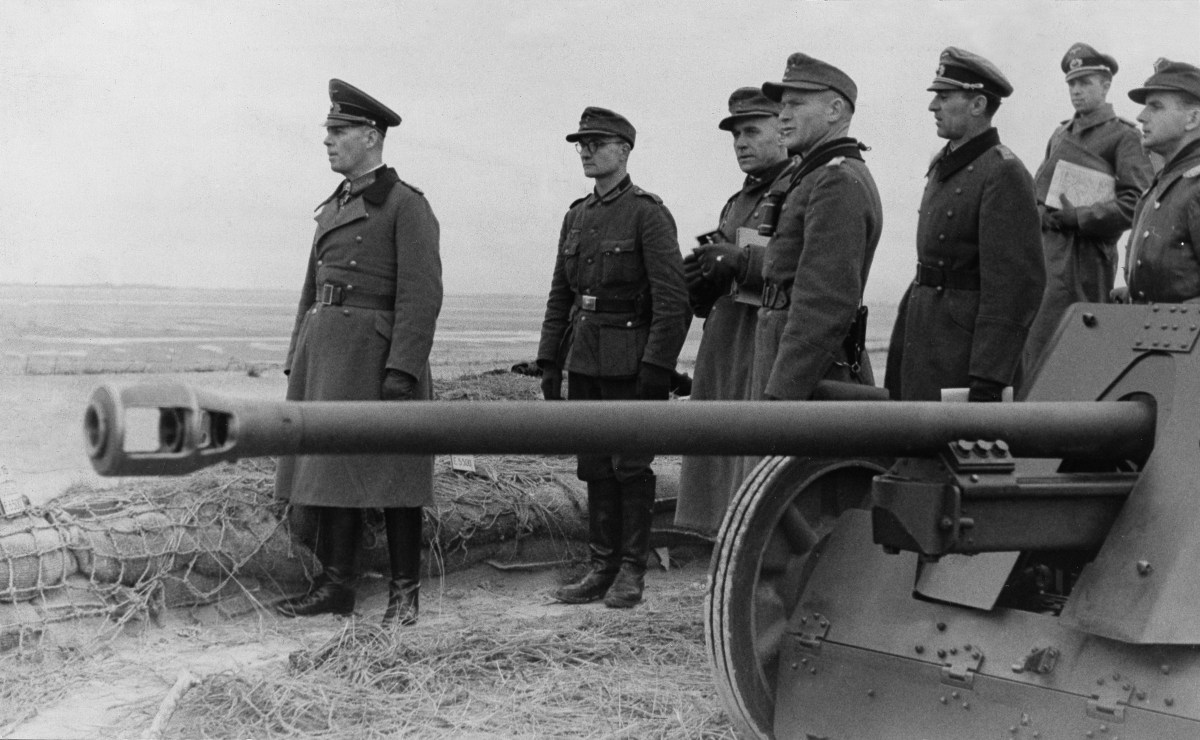
In Directive No. 51, Hitler ordered that the Western Front would now receive priority in the allocation of resources. To facilitate this renewed effort, Rommel received a special commission to inspect the defenses of ‘Fortress Europe’ from Denmark to the Bay of Biscay. What he found was depressing indeed — a real Potemkin village. His inspection quickly revealed that Josef Goebbels’ impregnable fortress existed only in the overactive imagination of the propaganda minister. The Germans had constructed a few fortifications along the Pas de Calais, where most German military leaders believed the Allies would land — a calculation that the Anglo-Americans delightedly confirmed through the means of a massive deception plan.
Rommel began his inspection on November 30, 1943, in Denmark. He was to report his findings to Hitler, while keeping the overall commander in the West, Field Marshal Gerd von Rundstedt, informed of his progress. Meanwhile, the staff of Army Group B now based itself at Fontainebleau in preparation for Rommel’s assumption of command of a northern army group that would extend from Belgium to Brittany. Army Group B’s responsibilities would include the presumed main threat areas of Pas de Calais and Normandy.
The weaknesses that Rommel found along the coast appalled him — especially the lack of preparedness in the immediate coastal areas. In effect, German troops in the West had been on vacation — certainly in comparison to what was happening on the Eastern Front.
Now that it was clear that he would assume command of the defense of northwestern Europe, Rommel had already developed his conception of how the Wehrmacht must conduct that defense. The German general best known for his lightning-quick armored advances across the desert now concluded that he would have to prepare the strongest possible positional defense. The most immediate need was to energize the forces along the English Channel and quickly marshal the resources necessary to build an effective system of fortifications along the coastal regions. For the next six months, he spent much of his time and energy pushing everyone within his area of responsibility to build field fortifications and bunkers, lay barbed wire, dig trenches and emplace beach obstacles between the low and high tide limits. Under his direction, the Germans also embarked on a massive program of mine laying. The field marshal’s aim was to have 12 to 15 million mines in place before the Allies landed — a goal that, fortunately for the Allies, the Germans fell well short of.
As late as it was, Rommel’s program of emplacing beach obstacles between high and low tide so alarmed Allied planners that they changed the timing of the landings from high to low tide, which considerably increased the vulnerability of those making the initial landing — especially on Omaha Beach. In dealing with the airborne threat, Rommel ordered telephone poles and concrete posts — nicknamed ‘Rommel asparagus’ — emplaced throughout the fields and meadows of the areas immediately behind the most obvious landing areas. Not surprisingly, all this activity caught the attention of senior Allied commanders, further complicating the already difficult task of planning for and then making a successful amphibious landing on the coast of France.
Unlike other senior army leaders, Rommel had had experience with the air power the Anglo-American powers would bring to the battlefield, as well as with their immense logistical capabilities. For other German leaders, especially Hitler, American and British military capabilities simply did not appear nearly as threatening as they did to Rommel. To a considerable extent, the memories of British defeats in the desert in 1941 and 1942 and the American defeat at Kasserine Pass clouded German judgment. Nor had the Allied campaign in Sicily and southern Italy looked particularly impressive. Yet Rommel understood that both the British and especially the American armies possessed steadily improving military capabilities.
Rommel’s experiences in North Africa as well as his recognition of Germany’s overall strategic situation had led him to very different conclusions as to how the Wehrmacht should defend northwestern Europe. From early 1944, Rommel argued that the Germans must defend against the coming invasion on the beaches. If the Wehrmacht failed to defeat the Allies at the water’s edge, the superiority of Anglo-American air power and logistics would inevitably enable them to build up their forces on the Continent more quickly than the Germans could. The result would be an inevitable defeat that would end whatever chance the Reich had to achieve a compromise peace.
But Rommel’s was an overwhelmingly minority viewpoint. His immediate superior, the venerable Gerd von Rundstedt, supported a completely different approach to the defense of northwestern France. The Wehrmacht‘s senior active-duty field marshal found his position strongly supported by the commander of German armored forces in the West, General Leo Geyr von Schweppenburg. The Rundstedt-Geyr von Schweppenburg operational solution basically posited that there was nothing they could do to prevent a successful Allied landing. Instead, they championed tactics much in consonance with German operational and tactical doctrine, as expressed in Die Truppenführung (Troop Leadership), the Wehrmacht‘s basic doctrinal manual. The two generals argued that German forces in the West should concentrate available armored forces for a massive counterattack against the Allies once they were ashore. From their perspective, the panzer forces should be held back from the coast; then once the Allies had landed, the panzers would concentrate and move forward to counterattack. German armor would also then be available to execute a mobile defense that would utilize superior Wehrmacht training, tactics and equipment.
In retrospect, Rommel had a far better understanding of the military situation than either Rundstedt or Schweppenburg, who failed to give sufficient weight to the power that the Allies’ air forces could bring to their attack. With the Luftwaffe deeply engaged in opposing the strategic bomber offensive over occupied Europe and in the East, it could do little to prevent swarms of Allied aircraft from destroying any large concentration of panzers the Germans were able to assemble. It would also prevent any sort of mobile defense. The inevitable result would be a huge Allied army advancing across Europe and the Reich’s final defeat. Moreover, Rommel believed imposing heavier losses on the Allies would only serve to make them eager to impose a harsher peace on a defeated Germany.
In the end, the Germans instituted neither defensive concept. They did not deploy their armored reserves close to the beaches — as Rommel had wished — or in a concentrated reserve as Rundstedt and Schweppenburg had advised. Instead, Hitler placed the panzer and Panzergrenadier divisions under the OKW; thus, only he could authorize their movement forward to meet the Allied invasion forces. And if the Führer was not available to make that decision, nothing was going to happen. Because neither Rommel nor Rundstedt was in command of the reserve divisions, the chance of rapid intervention against Allied landings by the available reserves had evaporated even before the first Allied troops waded ashore.
Two relatively small incidents, one in which Rommel’s superiors overruled him and the second where a subordinate deliberately disobeyed his direct orders, played a major role in the successful American landings on D-Day. In the first case, Rommel requested permission to move the fanatical Hitler Youth volunteers of the 12th SS Panzer Division Hitlerjugend to Carentan, which unknown to the field marshal was to lie equidistant between the American landing beaches of Omaha and Utah. In that position, the SS division would have been ideally placed to intervene against either of the American landing areas. Even if they had failed to stop the landings, the Germans would have made the linkup between the American beaches extraordinarily difficult. This request was not granted.
The second incident had to do with the commander of the 352nd Infantry Division, which had responsibility for the sector where the American 1st and 29th Infantry divisions and other supporting units would land on D-Day. One of the great myths of World War II has been that the 352nd Division’s presence in the area of Omaha Beach was a surprise to Allied intelligence. It was not. In fact, while the 352nd was responsible for defending the area to the north and northwest of Bayeux, the division commander, Maj. Gen. Dietrich Kraiss, held most of his infantry battalions back from the beaches as a counterattack force — an approach again in accordance with basic German doctrine.
When Rommel arrived in the area in early May, he was upset at the division’s dispositions and immediately ordered Kraiss to move more of his force up to defend the beaches. Supported by his corps commander, Lt. Gen. Erich Marcks, who had been one of the early planners for Operation Barbarossa, Kraiss ignored Rommel’s order. Of the 10 infantry and five artillery battalions that Kraiss had available, he placed only one artillery battalion and two infantry battalions along the Omaha Beach sector. This decision makes even less sense when one realizes that he deployed two-thirds of his force in reserve or in position to defend the western sector of his area of responsibility — where no amphibious landing could possibly take place.
Although the bloodshed on Omaha was appalling, the Americans there were indeed lucky that they only had to face two battalions of enemy infantry on June 6. Had Kraiss obeyed Rommel’s instructions, it is likely that the Omaha Beach landing would have failed — with considerable consequences for the Allies’ ability to link together the British and American beaches.
There was one matter that all the senior German commanders, including Hitler, did agree on, and that was a belief that the invasion would come at the Pas de Calais. For a short period, the Führer did consider that Normandy might be the landing area, but he soon lost that instinctive feel. It is here that one of the greatest weaknesses in the German military system came into play. The Reich’s intelligence services were among the most inept of any possessed by the major powers in World War II. Not only did the German intelligence services fail to give their operational commanders a feel for where the landings might occur, but they completely fell for Allied deception efforts that seemingly confirmed the Pas de Calais as the target site.
So effective was Fortitude — the code name for the Allied deception effort — that even after the landings had occurred, many senior German leaders, Hitler included, continued to believe the Normandy landings were a diversion and that the main blow would come at the Pas de Calais. Rommel was no more perceptive than his colleagues in this regard, although he did put considerably greater effort into preparing defenses in the areas outside Pas de Calais than had been the case before his arrival in command of Army Group B.
Rommel’s Longest Day
The early morning hours of June 6, 1944, found Rommel at home celebrating his wife’s birthday. He had returned to Germany also hoping for a persuasive visit with Hitler at his lair in Berchtesgaden to get greater direct control over the reserve divisions. The field marshal’s decision to go on leave at the very moment the invasion was about to begin resulted from the fact that the Germans did not possess weather-forecasting capabilities comparable to those of their opponents. While Allied forecasters discerned that weather conditions would improve sufficiently on June 6 to allow a landing, their German counterparts failed to recognize the possibility of a break in the weather. Predictions of bad weather caught others besides Rommel off guard. The Seventh Army, in charge of the defense of Normandy, had ordered all its senior commanders to a war game in Rennes, a southern Norman town far from where the airborne and seaborne landings were about to occur, on the day of the invasion.
Rommel was surprised, therefore, when he received a phone call from his chief of staff early on the morning of June 6. Major General Hans Spiedel told his chief that a major Allied landing was underway along the Norman coast. Rommel immediately started back to France, but it took until the early evening hours for him to reach his headquarters. By then the Allies had established themselves successfully on all five major landing areas. Moreover, British paratroopers of the 6th Airborne Division had seized the high ground east of the Orne River, while American paratroopers held much of the base of the Cotentin Peninsula.
Although it probably did not seem so to the GIs wading ashore on Omaha Beach, the German reaction to the landings had been lackadaisical at best, or simply inept. The two battalions holding on Omaha Beach inflicted heavy casualties on the attacking Americans and for a short period of time it even seemed they might defeat the landing there. Rather than ensuring that the Americans were stopped, however, Kraiss sent his reserves to meet the more successful British landings to the east. American pressure finally drove the Germans back and cleared the draws leading off Omaha.
At the higher levels of command, the performance was even worse. The OKW’s operations officer, General Alfred Jodl, refused to awaken the Führer or to release the panzer divisions being held in reserve. Not until early in the afternoon were the two nearest panzer divisions, the 12th SS and the Panzer Lehr, released to Army Group B so that they could begin their move toward the beachhead. Panzer Lehr had been ready to move at 0600 hours, but did not receive the move order until late in the afternoon. Neither would arrive on the scene until June 7.
The one tank unit in the area, the 21st Panzer Division, did not start moving toward the British and Canadian beaches until the afternoon. It managed to get a battle group between the Juno and Sword beaches, but British-crewed Sherman Firefly tanks equipped with high-velocity 17-pounder guns stopped the Germans cold, destroying more than a dozen tanks in a matter of minutes. By the end of the day, the Tommies had accounted for 70 of the 21st’s 124 tanks.
Stemming the Tide
Rommel now fought the Battle of Normandy with a number of disadvantages that made the results inevitable. To begin with, he had virtually no intelligence on Allied intentions, while Ultra and pervasive air reconnaissance had provided Allied Supreme Commander Dwight D. Eisenhower and his ground forces commander Montgomery with a clear picture of German intentions. Second, as Rommel had foreseen, the air interdiction campaign conducted by Anglo-American air forces imposed enormous logistical constraints on the conduct of operations by his forces. Only by way of barges down the Seine River were the Germans able to avoid a complete logistical collapse.
Third, the French Resistance was able to cause considerable delays to the German units trying to redeploy to the Normandy battlefield. As a result, the Allies easily won the battle of the buildup. Only the nature of the bocage country with its almost impenetrable hedgerows, the ferocious and tactically effective performance of German infantry and armored forces, and Allied tactical weaknesses provided Rommel with the means to knit together defenses that confined the Allies to their Normandy bridgehead for nearly two months.
As Rommel had warned before the invasion, the movement of German forces toward Normandy proved much more difficult than Rundstedt, Schweppenburg and their adherents had argued. First, there was the problem of the French Resistance. It took two weeks for the 2nd SS Panzer Division Das Reich to arrive in Normandy from its billets in the Limoges area of southern France. It was normally a journey that could have been made in two days. Driven to distraction by the Resistance, the troopers of Das Reich committed a number of atrocities along the way. The worst of these was the murder of 600 civilians at the village of Oradour-sur-Glâne.
But it was Allied air power that gave the Germans the greatest headaches. On June 7 Panzer Lehr began its move from Chartres to Normandy in daylight. Its commander, Fritz Bayerlein, who had also seen service in North Africa, objected but was overruled. As soon as the armored column was spotted it was savaged by Allied fighter-bombers. Bayerlein described the roads as being ‘a fighter-bomber race course.’ His division lost 150 trucks and fuel tankers, five tanks and self-propelled guns, as well as a number of halftracks and prime movers in a matter of a few hours.
Several days later, the location of General Schweppenburg’s headquarters for Panzer Group West, which was to direct the armored counterattack favored by Rundstedt, was discovered through Ultra intelligence. Schweppenburg had located his headquarters out in the open — a clear indication of how little he understood the danger of Allied air power. The predictable result was a devastating attack by fighter-bombers that killed 17 staff officers and wounded a number of others. More important, it took Panzer Group West out of the fight and robbed the Germans of their only command capable of directing a major mechanized offensive at the very moment it was most needed. Rundstedt himself was forced to acknowledge the overall impact of Anglo-American air superiority. The commander in chief of German forces in the West reported in a message that was intercepted by the British and passed along to Allied commanders: ‘In large-scale operations by thousands of bombers and fighter bombers, Allied air forces stifled German tank attacks and had harassing effect on movements. High losses in wireless equipment by fighter bomber attacks [I SS Corps had, for example, only four wireless troops, and Panzer Group West had lost 75 percent of it wireless equipment] were noticeable in making reporting difficulties.’
With the battle for the beaches already lost, Rommel’s immediate concern was to confine the growing Allied forces to the bocage country, which would maximize the potential of German tactical expertise. The arrival of the 12th SS Panzer Division Hitlerjugend at Caen prevented the Canadians and the British from gaining that key road center and ensured that the Allies would not be able to reach the more open country to the east.
While Hitler’s boy soldiers bought time with their lives, Rommel tried to patch together a coherent defense with whatever he could grab. Here, British ineptitude was a considerable help. On June 12 elements of the British 7th Armored Division swung east of Caen and drove deep behind the German lines to the village of Villers-Bocage. Advancing as if in a peacetime parade, the unsuspecting British ran into SS Captain Michael Wittmann, one of the great tank aces from the Eastern Front, and the Tiger tanks under his command. Almost single-handed, Wittman destroyed much of the British force and plugged the hole in German lines that threatened the defense of Caen. The British lost 25 tanks and 28 other armored vehicles, and the division commander, much to the disgust of his superiors, entirely abandoned the area around Villers-Bocage. General Miles Dempsey, commander of the British Second Army, quite rightly described the action as a disgrace.
Rommel’s efforts to hold back the British threat allowed the Americans to close off the Cotentin Peninsula and then capture the port of Cherbourg. But the Germans had so thoroughly damaged the port’s facilities that Eisenhower gained little in terms of the logistical infrastructure he so desperately needed to maintain the advance into the French interior. The Americans then ran up against their own lack of combat experience — exacerbated by Lt. Gen. Omar N. Bradley’s inept generalship — in battling south through the bocage country. The vicious fighting that took place as the Americans slowly advanced on St. L suggested that the western portions of the Normandy front represented less of a threat. Overall, the defense of Normandy was immensely frustrating to Rommel since it offered little chance for maneuver and was under the constant attacks of Allied fighter-bombers. But as the operational commander on the scene, he dealt with the situation as it existed, not as he would have wished it to be.
Despite the seeming success of the Wehrmacht in fencing the Allies into the coastal areas of Normandy, German commanders at all levels were increasingly pessimistic about their chances for holding out. At the end of June, Rundstedt and Rommel infuriated the Führer by submitting reports to the OKW that underlined the desperate nature of the situation in the West. They urged that Caen be abandoned. On June 29 Rommel met Hitler for the last time at Berchtesgaden. Hoping to make the Führer see reality, the field marshal attempted to raise the strategic question — that Germany was confronting the whole world and that perhaps political solutions should be considered. As was to be expected, Hitler would not countenance any discussion on such matters. For his part, Rundstedt soon got himself relieved of duty by bluntly replying to Field Marshal Wilhelm Keitel’s question of what was to be done: ‘Make peace, you idiots! What else can you do?’
The German defense now seemed to be adrift. Rundstedt’s replacement was Field Marshal Günther von Kluge, another senior general whose only experience had been on the Eastern Front. For two years he had commanded Army Group Center, but had been severely injured in an automobile accident and replaced in early 1944. He was now recovered, and he returned to active duty after a short period at Hitler’s headquarters. There, he had received a thorough dose of the Führer’s optimism as well as warnings about Rommel’s pessimistic assessments of the operational and tactical situation. On July 3 the two field marshals met and Kluge warned his new subordinate that he had better get used to obeying orders — a rebuke that not surprisingly infuriated Rommel.
It did not take long for Kluge, who was a competent officer, to draw the same conclusions that Rommel had arrived at long ago. On July 16 Rommel sent an especially gloomy report on the situation on the Western Front. Kluge was now of the same mind. But the field marshals were not to act together. On July 17 British fighter-bombers caught Rommel’s staff car on the open road and severely wounded him. As a result, he was in the hospital during the crucial days when the July 20 attempt on Hitler’s life occurred and when the situation on the Western Front began to irrevocably unravel in early August. One might suppose that Rommel, who seemed at his best when commanding fast-moving, hard-hitting mobile forces, was the only senior commander who might have obeyed Hitler’s orders in August and led what remained of Germany’s armored forces during their all-or-nothing counterattack into the Mortain pocket, but the Desert Fox never got the chance.
In The End
Rommel’s performance in Normandy, even though it eventually led to the defeat of German forces in that theater, underlines the validity of his being one of the outstanding commanders in World War II. Despite extraordinary obstacles, he maximized the potential of the defenders. He reacted to Allied moves with flexibility and imagination. He inspired his immediate subordinates as well as the troops on the sharp end. And he warned of the consequences that would occur should the Allies gain a successful lodgment on the Continent.
Viewed with suspicion and even scorn by his contemporaries, Rommel’s performance at every level of command from company to army clearly demonstrates that he is worthy of the praise heaped upon him by historians and professional soldiers in the years since his death. Having experienced the resolve, tenacity and might of the Western Allies firsthand, as the hour for the start of Operation Overlord approached, it was the Desert Fox more than any other German field marshal who understood what the Führer and his generals had to do if they were to have any hope of defeating Dwight D. Eisenhower’s mighty host. It is to his credit that unlike so many of those who criticized his strategic ideas, Rommel was unafraid to confront Hitler with the awful truth that Germany was now at the edge of the abyss. It was this independence of mind that made his death a certainty but also ensured that his legacy as one of Germany’s most outstanding commanders would stand the test of time.
This article was written by Williamson Murray and originally appeared in the June 2006 issue of World War II magazine. For more great articles subscribe to World War II magazine today!