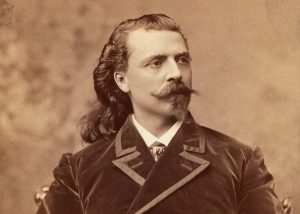

In his 1892 autobiography Forty Years a Gambler on the Mississippi, gambler-bunco artist George Devol described a brush he had with a celebrity in 1874. Devol was working in the Gold Room saloon in Cheyenne, Wyoming Territory, at the time. One day a strangely familiar gent, with blue-tinted spectacles and his hat pulled low on his forehead, sauntered up to a gaming table and placed a $50 bet, which he promptly lost. The fellow placed the same bet again and this time won. When the dealer handed over only $25, the stranger protested and was told, ‘the house limit’s 25.’ ‘But you took 50 when I lost,’ said the man. ‘Fifty goes when you lose,’ replied the dealer. Without warning, the furious player whacked the dealer and his partner over the head with his walking stick, toppled the table and began stuffing his pockets with the contents of the till. As he swung around to cover the room with two six-shooters, his hat fell off, revealing a mane of long, sandy hair and the familiar countenance of James Butler ‘Wild Bill’ Hickok.
Whether or not we believe the old gambler’s tale (a brush with the ‘Prince of Pistoleers’ would have sold copies in 1892, especially since Hickok was no longer around to refute it), the story illustrates what a player was often up against when he tangled with the king of all frontier gambling games; faro. Born in France, the game came to America in the 1700s. Its name often spelled ‘pharo’ or ‘pharaoh,’ derived from period French playing cards, whose backs sometimes bore the likeness of an Egyptian ruler. Some early faro cards and layouts also displayed a portrait of a Bengal tiger, inspiring such terms as ‘bucking the tiger’ or ‘twisting the tiger’s tail’ to describe playing the game. In later years, a framed tiger portrait hanging outside a gaming house announced the presence of a faro game within.
Faro was possibly the simplest gambling game ever devised. Players bet against the house, placing bets upon a green cloth-covered layout with painted images of 13 cards, ace through king. Spades were usually depicted, but suits didn’t matter; only face value counted. The dealer dealt two cards per turn from a standard deck of 52, and the object was for players to predict which cards would appear. The first card of each turn lost for the player, but won for the bank. The second card won for the player. Chips, or ‘checks’ (as serious players called them), placed upon a card’s image bet that card to win for the player. Players could bet a card to lose by placing a hexagonal token called a copper (pennies were used in earlier days) atop the checks. If a pair turned up, the house took half of any bet on that card, these’splits’ representing an honest bank’s only real advantage. Players could back any number of cards and, if their cards did not appear, could change bets between turns. A lookout often supervised the game to prevent cheating, and would pay and collect all bets.
Originally, players could only back single cards, or groups of cards called figures, pots and squares. In later years, ‘heeling’ and’stringing along’ permitted Byzantine wagers wherein a single bet could cover several cards, betting them to win, lose, or any combination. Players could also wager that the face value of either card turned up would be odd, even, or the higher of the turn. Winning bets paid even money, except on the last turn, when players could ‘call the turn’ by guessing the order of the final three cards and winners were paid 4-to-1.
Unique to faro was the casekeeper, an abacuslike frame with miniature cards matching those on the layout. From each card ran a spindle with four button-shaped disks, and the dealer’s assistant, also called the casekeeper, moved these buttons to record the cards dealt. Some houses even provided printed cards, called tabs, so players could keep a similar tally. In early faro, the dealer dealt from his hand, and sleight-of-hand cheating was commonplace. In 1822, Virginia gambler Robert Bailey invented a brass dealing box with a hole in the top, which allowed cards to be slid out one by one. Bailey claimed this device prevented any shenanigans by dealers, but because it concealed the deck, many houses were skeptical and barred it from their premises. In 1825, an Ohio watchmaker named Graves perfected an open-top, spring-fed box that held the deck face up to eliminate any suspicion of cheating. This box, usually made of German silver, was an instant success and would remain the standard throughout faro’s long reign. Since the top card was exposed in these boxes, it was a ‘dead’ card and could not be bet upon. The top card became known as the’soda card,’ and the last card, also dead, was called ‘hock’.
Although poker is better known today, it was fairly obscure until the late 1850’s and didn’t really catch on until the 1870s. Faro was the premier game; high-rolling gamblers liked the easy odds, and others enjoyed the quick action and the thrill of staking it all on the turn of a single card. One Colorado Gold Rush observer noted that faro was played by everyone ‘from the bonanza kings in their private clubs to the little bootblacks who buck the tiger in a shack on Carbonate Hill.’
Although it provided a colorful spectacle for both player and spectator, faro was a stately game, even amid the pandemonium of the typical gambling house. An Easterner observed in 1872 that ‘there is rarely a word spoken during the progress of a deal, for faro is the most quiet, and in that respect, the most gentlemanly of all games.’ But this same writer also warned that ‘faro honestly played is a game of pure chance, and sometimes favors the unfortunate who meddles with it.’ Players liked the seemingly favorable odds; bankers often liked the many opportunities for cheating. Chicanery was employed by players as well as dealers, but to be caught invited gunplay. Cheating was so prevalent in the States, however, that American editions of Hoyle’s rules began carrying disclaimers that honest faro could no longer be found. R.F. Foster, an early Hoyle editor, explained that ‘to justify this expenditure [of opening a faro bank], he [the dealer] must have some permanent advantage.’ He added that if no such advantage was inherent in the game, players were likely being cheated.
Mere months after Graves’ invention, crooked dealing boxes flooded the market, designed to allow dealers to predict and/or manipulate the order of cards dealt. These ‘gaffed’ boxes sold under such exotic names as ‘tongue-tell,’ ‘horse box,’ and ‘needle squeeze.’ Honest, or’square,’ boxes sold for around $30, while gaffed boxes went for up to $200. Graves cashed in on this development, designing many of these contraptions himself.
Close behind these boxes came an array of specially designed cards. ‘Sanded’ cards, roughened on one side, would cling together, and were used with ‘two-card’ boxes that allowed the dealer to slide out more than one card at a time. ‘Strippers’ were narrower on one end, or had curved sides, so a dealer could manipulate them during the shuffle to ‘put up’ splits. Since splits occurred naturally only about three times in two deals, there was an obvious house advantage in increasing the number dealt. A faro dealer’s salary often reached $100 to $200 per week, plus a percentage of the house take. Foster charged that these genets were not paid so amply’simply for pulling cards out of a box,’ and challenged bankers, as a good-faith gesture, to let him ‘put a typewriter girl in the dealer’s place.’ He apparently had no takers. Crooked games were called brace games, defined by Indiana gambler Mason Long as those ‘in which a man has no chance of winning unless the dealer breaks his finger, and that he never does.’ Brace houses sprang up nationwide, where ‘cappers’ posed as players and’steerers’ lured in unwary ‘gulls.’ Such organized and widespread cheating led reformed gambler Jonathan Green to write in 1853, ‘A man would act more rationally and correctly to burn his money than to bet it on faro.’
The worst of the gambling hells were the ‘wolf traps’-pure skinning dens where anyone with a $20 stake could buy a stack of checks and open a’snap,’ with the house providing the layout for 10 percent of the bank’s take. No casekeepers or lookouts were employed, and cheating ran rampant. Players often retaliated by ‘goosing’ or’snaking’ the dealer’s kit and tampering with his cards, or by ‘bonneting’ the dealer-throwing a blanket over his head and making off with his bank. The management didn’t care who skinned whom, but cashed checks for anybody with no questions asked. In tamer houses, players cheated in a more discreet fashion. Some used devices such as the horsehair copper-simply a copper with a strand of horsehair attached so it could be secretly yanked from a winning card.
Inveterate gambler Bat Masterson once so engrossed a dealer in a tale of his glory days that the fellow absent-mindedly shoved cards from a completed game back into a dealing box ‘without even the suspicion of a shuffle.’ The cagey Bat caught the error, and by checking his tab from the pervious game won turn after turn, losing only an occasional small bet ‘for decency’s sake.’ Toward the end, with Bat anxiously prepared to ‘earthquake’ the last turn, the dealer suddenly smelled a rat and turned over his dealing box, ending the game.
Redoubtable gunman Ben Thompson destroyed a Leadville, Colo., game after losing $3,000 in 1879, when the mining town boasted more than 100 gambling dens (most of them along State Street, nicknamed ‘Tiger Alley’ for its abundance of faro banks). On a later occasion in an Austin, Texas, saloon, Thompson idly watched a dealer named Lorraine clean players through several turns; then, without warning, Thompson cleared leather and began shooting stacks of checks off the layout. After also plugging the dealing box and the lamps above the table, Thompson explained to those few onlookers who remained, ‘I don’t think that set of tools is altogether honest, and I would like to help Mr. Lorraine buy another.’ Fueled by bug juice, the fiery shootist then bulldozed a neighboring saloon, taking out a keno goose, a few more lamps and several streetlights in his wake. The following morning, a sober and contrite Thompson reported to the mayor’s office and paid all damages. Such antics apparently did not faze Austin’s voting public, for Thompson was elected city marshal in 1880.Luke Short, one of the sporting fraternity equally skilled with a dealing box or a six-shooter, could not tolerate cheats. At a faro game in a Leadville saloon in 1879, a local hard case named Brown shifted one of Luke’s bets on the layout. When Brown rudely ignored his polite request to desist, Luke made his next request by way of a lead slug fired point-blank through the cheater’s cheek. Brown meddled no further with the dapper little gambler’s game.
In February 1881, an argument over a faro game in Tombstone, Arizona Territory, led to fatal gunplay between Short and gambler Charlie Storms, a clash witnessed by Bat Masterson. Masterson entered the Oriental Saloon and found the two, both friends of his, about to do battle. Bat persuaded the drunken Storms to go home and sleep it off, personally escorting him there. He had scarcely returned to the Oriental when Storms suddenly reappeared and yanked Short off the sidewalk. Before Masterson could intervene again, both men drew their guns. Short was quicker, and Storms fell dead with bullets through his neck and heart. Another witness, George Parsons, noted in his journal that after Storms’ body was carried to his room, ‘ the Faro games went right on as though nothing had happened.’
In 1875, a faro dealer named Tom McKey bucked the suckers at Babbitt’s House in Denver, working alternatively as dealer and lookout. He moved on in the summer of ’76 to Cheyenne, where he ran a bank in Ford’s Place. Presumably, no one who bet at the nimble-fingered McKey’s layout knew he was actually a Georgia-born dentist named John Henry ‘Doc’ Holliday. Doc found gambling more lucrative and satisfying than yanking molars, and it was a trade he plied across the West throughout his brief life. In 1880, Doc ran a bank at the Alhambra Saloon in Tombstone, a venture shared with perhaps the West’s best-known faro dealer, Wyatt Earp.
During his sojourn in Tombstone, Earp owned gambling interests in several saloons, sharing the green cloth with his brothers and a cadre of Earp allies, most notably Holliday, Luke Short and Bat Masterson. He not only dealt but also, like a true aficionado, avidly bucked the bank. After a falling-out with proprietor Milt Joyce, Earp gave up his one-quarter interest in the Oriental Saloon’s faro concession, only to learn that a new bank operating there was owned by his hated enemy, Cochise County Sheriff John Behan. Learning that Behan’s total capital was $5,000, Wyatt entered a game with the sheriff himself in the lookout seat, playing until his pile topped $6,000. When Wyatt announced he was cashing in, Behan protested, lamely offering to make good any further winnings. Earp tersely responded: ‘I’ll take mine in cash. Your credit with me doesn’t cover a white chip.’ Wyatt collected his winnings, and Behan’s bank folded for good. After the O.K. Corral fracas and its bloody aftermath, Wyatt Earp left for friendlier and healthier regions. He landed in Gunnison, Colo., and found work running the far games in Charley Biebel’s saloon, where, according to a local police officer named Riley, ‘he always wore two guns, high up under his arms.’ Wyatt apparently had little need of the guns, but maintained order with his reputation and the characteristic Earp cool.
Unlike many professions, gambling in the 19th century was not strictly a male domain. Many women, tired of Victorian society’s strict codes and prescribed roles, sought adventure in the gaming houses. Saloonkeepers quickly discovered that a pretty dealer boosted business, and many a faro bank featured a lady behind the dealing box.
Poker Alice, despite the nickname, was a skilled faro dealer. Born in England in 1851, she turned cards in Colorado boom towns like Leadville and Creede, as well as in Tombstone, and lived to be nearly 80. In contrast, Deadwood’s Kitty LeRoy, aptly nicknamed Kitty the Schemer, died at age 28, shot by her fifth husband. Doc Holliday reportedly once lost $3,000 to Lottie Deno, a redheaded Southern belle who dealt faro in Fort Griffin, Texas. Deno was nearly 90 when she died, the wife of a bank vice president.
Perhaps the best-known woman gambler was Frenchwoman Eleanor Dumont, nicknamed Madame Mustache for her downy upper lip. She appeared in California during the gold rush, opening a posh gambling house in Nevada City to the dismay of city fathers (who thought a woman gambler scandalous) and the delight of the rough-and-tumble miners (who felt it a privilege to have a pretty lady lighten their pokes). Her Vingt-et-Un (Twenty-One) gambling house had carpets and crystal chandeliers and served free champagne; patrons were required to clean up their boots (and their language) if they wished to enter and play at the madame’s tables.
When the Nevada city boom went bust, Madame Mustache followed the gold and silver, and for 25 years she dealt games in camps throughout the West, adding to her resume, as fortunes declined, a much older profession than gambling. Madame Mustache ended her days in Bodie, Calif, where she eked out a meager existence turning tricks as well as cards. One September night in 1879, a pair of sharpers broke the madame’s faro bank, and the next morning she was found dead in her lonely cabin, a poison bottle in her hand.
Throughout the latter 1800s, faro dominated Western gambling. From $10 snaps to rich banks in the gaudy houses of Denver and San Francisco, the tiger’s roar was loud. In 1885, 200 persons worked in Denver’s gambling houses, which boasted such colorful names as the Bucket of Blood, the Morgue, the Tivoli and the Chicken Coop. Of all the banks in Denver, only six were known to be square. So popular was faro there that the county sheriff once pawned his revolver for $20 to buck a game at the Denver House. When mudslingers charged that 1888 senatorial candidate Edward O. Woolcott had lost $22,000 at faro, he replied it was his own business if he did, adding ‘Besides, I had just won the money the previous day at the races.’ Colorado loved a sporting man; Woolcott won the election.
Despite support from sheriff’s and senators, however, faro’s golden age was nearing its end. As early as 1872, an Eastern chronicler had observed that ‘no vice has blighted so many lives, has illustrated so many epics of anguish, or has cost the productive industry so many millions of money, as faro gambling.’ As civilization’s roots spread, this sentiment gradually took hold nationwide, and by the 1890s, even confirmed gambler George Devol admitted, ‘If I had never seen a faro bank, I would be a wealthy man today.’
By 1900, one of gambling’s last bastions, Arizona Territory, still contained nearly 1,000 gaming establishments, but public pressure ultimately won out. A headline in the March 31, 1907, Prescott Journal-Miner read, ‘The Tiger is Dying!’ and by midnight, Arizona’s last turn had been called. As state after state followed suit, the tiger became an endangered species whose last stand was, predictably, in Las Vegas, Nev. With legitimized, regulated gambling in place, a game with faro’s checkered past was looked at askance. More important, casino operators learned what the old-time sharpers had known for centuries: Honest faro made no money for the house. Joe W. Brown’s Horseshoe Casino ran possibly the last bank in existence in 1955.
All that’s left of faro today is the colorful jargon it contributed to American speech. An example that perhaps best illustrates the Western gambler’s fascination with faro is attributed to George Devol’s longtime partner, notorious bunco artist ‘Canada Bill’ Jones. When a friend found Bill bucking the bank in a gambling hall along the Mississippi in the late 1850s, he warned Bill that the game was brace. ‘Yes,’ replied Bill wistfully, ‘but it’s the only game in town.’
This article was written by John R. Sanders and originally appeared in the October 1996 issue of Wild West.
For more great articles be sure to subscribe to Wild West magazine today!