
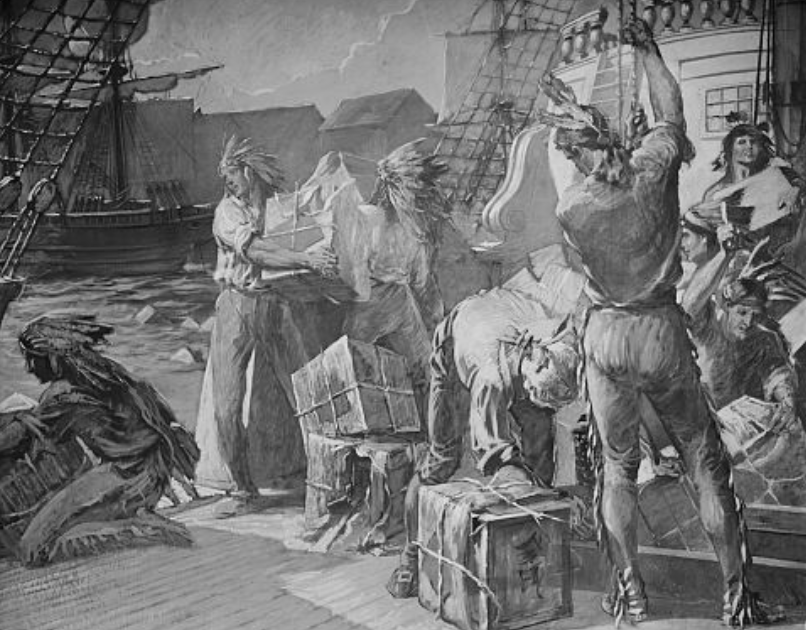
Many patriots viewed the destruction of the tea as an act of vandalism.
We all know and celebrate the climax to the Boston Tea Party. On December 16, 1773, several dozen men dressed as Mohawk Indians boarded three ships belonging to the East India Company, cut open 340 chests of tea and dumped the contents in Boston’s harbor. We fondly remember the carnival-like drama as a catalyst for the American Revolution, and over the years both liberal and conservative protesters have laid claim to its irreverent legacy.
Revolutionary-era Americans, though, didn’t celebrate the event. This might seem strange, since the patriots were the celebrating sort. They staged festive ceremonies to commemorate anniversaries—the first Stamp Act protest, the act’s repeal, the Boston Massacre, the Declaration of Independence—but the “action against tea” or the “destruction of the tea” (as they variously called it) went unheralded in public ritual. For a half century, Americans shunned the tale, and certainly did not call it a tea party. At first, they didn’t dare. Anyone who had anything to do with the event could face prosecution, or at least a lawsuit. Privately, some people knew who was behind those Indian disguises, but publicly, nobody said a word. Moreover, many patriots viewed the destruction of tea as an act of vandalism that put the Revolution in a bad light. Patriots also downplayed the tea action because of its devastating impact. That single act precipitated harsh retaliation from the British, which in turn led to a long and ugly war.

The Boston Tea Party is now an iconic event suffused with myth, but below the surface is the story of a true act of revolution, carried out in a context of power politics, with surprising parallels in the modern era.
Myth 1: The dispute was about higher taxes
The immediate catalyst was a tax break—not a tax increase—that effectively made imported tea more affordable for colonists. What irked the patriots was that they had no role in the decision.
The saga began with the British government’s bailout of a corporation deemed too big to fail. The giant East India Company not only enjoyed monopolistic privileges in south Asia and China under a royal charter granted in 1600; it effectively ruled large sections of the Indian subcontinent. But in 1772, the company was hard hit by the collapse of speculative banking schemes throughout Europe, and its stock tumbled. Unsold goods accumulated in warehouses, and company directors asked the British government for a loan to forestall insolvency. Members of Parliament—like American congressmen today—staged committee hearings in which they grandstanded against greedy company officials, who had returned from India with huge fortunes and declared large dividends despite the company’s overwhelming debts. Meanwhile, they tried to figure out how to get the company, and the empire, out of the mess.
As MPs debated the advisability of a government takeover, they also discussed schemes for unloading the company’s 18 million pounds of surplus tea. The European market was already saturated, but the American market was not. In theory, the East India Company could sell many tons of tea there if taxes were lowered. Two separate taxes were involved: one imposed on tea coming through Britain on its way from India and China to Western markets and another imposed when it arrived in America. Although cutting either one was an economically viable option, repealing the American tax would have had the added benefit of improving relations with colonists. That’s precisely why Lord North, the prime minister, rejected the idea.
In the Tea Act of 1773, Parliament left the American import duties in place but decreed that the East India Company would no longer have to pay any duties on tea landing in Britain and headed to America, nor would it have to sell the tea at British public auctions. It could deliver its product straight to American consumers, untouched by middlemen and almost untaxed, save for a modest American import duty. The only people who stood to incur financial losses from the arrangement were American smugglers who had been peddling duty-free tea from Holland.
Few in London thought the sweetheart deal was a matter of consequence to anyone but the East India Company, and it received little notice. Some relief would be granted to the struggling corporate giant, without political cost. And surely, Americans would not object to receiving tea at bargain prices.
British prognosticators were wrong. For the Americans, the fundamental issue was one of self-governance. Whoever levied taxes got to call the shots, including how to spend the money. Parliament insisted on taxing colonists to support—and command—colonial administration. Colonists countered that they were more than willing to tax—and rule—themselves. No more “taxation without representation” became their rallying cry, not “down with high taxes.”
Myth 2: Tea taxes were an onerous burden on ordinary Americans
Land taxes and poll taxes assessed by their own colonial assemblies, as well as long-standing import duties on sugar, molasses and wine, were a much greater burden. The tea tax was a relic of the Townshend Revenue Act of 1767, which also placed import duties on paint, paper, lead and glass. Parliament responded to widespread colonial protests and boycotts of the taxed items by repealing the Townshend taxes in 1770, except for the tea duty, which North kept to assert “the right of taxing Americans.” At three pence per pound, the tax on tea was barely felt by American consumers, who also had access to the smuggled competition.
Still, the tea tax maintained symbolic significance, and the boycott of tea involved complex overlays. Common folk might enjoy a sip or two of tea, but participating in the elaborate British ritual of teatime—with an array of fancy crockery and silver utensils—was prohibitively expensive for the vast majority of Americans. Calls for a continued boycott of tea dovetailed nicely with lower-class resentments. Tea was an easy target, a symbol both of Parliament’s arrogance and a crumbling social hierarchy.
Moreover, tea consumption was deemed suspect, even sinful, by a large segment of the American public. “That bainfull weed,” as Abigail Adams called it, was an artificial stimulant, what we would call today a recreational drug. Promoters of virtue, who had long been expounding the evils of tea, suddenly became patriots. One concerned writer, in a Virginia newspaper, claimed that ever since tea had been introduced into Western society, “our race is dwindled and become puny, weak, and disordered to such a degree, that were it to prevail a century more we should be reduced to mere pigmies.”
Pointing to his medical expertise, Boston’s Dr. Thomas Young declared authoritatively that tea was not just a “pernicious drug,” as some assumed, but a “slow poison, and has the corrosive effect upon those who handle it. I have left it off since it became political poison, and have since gained in firmness of constitution. My substitute is camomile flowers.”
Resistance leaders also launched a new wave of negative propaganda that played to anti-foreign sentiments: Tea from the East India Company was packed tightly in chests by the stomping of barefoot Chinese and was infested with Chinese fleas. In turn, a vast number of colonists vowed to protect American business from foreign competition, even if that business was smuggling. Beware of products from China, buy America, wage war on drugs, down with corporations—all these messages, as well as their better-known cousin, no taxation without representation—amplified the response to Parliament’s Tea Act of 1773.
Myth 3: Dumping British tea unified the patriots
The immediate effect was just the opposite. The morning after the tea action in Boston, John Adams penned a letter to his close friend James Warren. “The Dye is cast,” he wrote. “The People have passed the River and cutt away the Bridge: last Night Three Cargoes of Tea, were emptied into the Harbour. This is the grandest Event, which has ever yet happened Since the Controversy, with Britain, opened. The sublimity of it charms me.” But that opinion was far from universal among patriot leaders.
For Americans who called themselves patriots, the slogan “liberty and property” was a common rallying cry, shouted at least as often as “taxation without representation.” George Washington, among many others, chided Bostonians for “their conduct in destroying tea.” Benjamin Franklin was hardly alone when he argued that the East India Company should be compensated for its losses.
It was not the destruction of tea that pulled Americans together, but the punishments administered several months later through a series of laws dubbed the Coercive Acts (also called the Intolerable Acts by the Americans). Parliament closed the port of Boston and revoked the Massachusetts charter, denying citizens the rights they had enjoyed for a century and a half. The goal of the Coercive Acts was to isolate radicals in Massachusetts, but instead the 13 colonies formed the Continental Congress and agreed to mount a general boycott of British goods.
The destruction of tea had been a catalyst for events leading to independence, but its belligerent tone ran counter to the favored patriotic story line: The British were the aggressors, causing peace-loving Americans to act in self-defense. After the war was over and the nation was on its own, the saga posed another conundrum. “It was time to accept the new government, duly elected by the people, and strive to maintain law and order,” explains Tufts University historian Benjamin Carp. “Once this belief calcified into conventional wisdom, there was less room to celebrate a ragged group of mock Mohawks wielding hatchets in defiance of government.”
Finally, in the 1820s, Americans let down their guard, and a new generation of chroniclers toned down the truly revolutionary aspects of the action against tea and played up the carnival atmosphere. More than 50 years after the event was over, it was informally christened the Boston Tea Party. Once the story could be told playfully, it anchored every text intended for children, who liked to dress as Indians in any case. That’s still the version we see in our school texts, and in books for adults as well. Declawed and simplified, the event loses not only its revolutionary punch but also its political and economic context. A corporate tax break that lowered the price of tea in America? Too big to fail? Competition from cheap foreign imports? These don’t play well to children. But they do reveal that the action against tea was much more than a party.
Ray Raphael is the author of A People’s History of the American Revolution, Founding Myths and Founders.