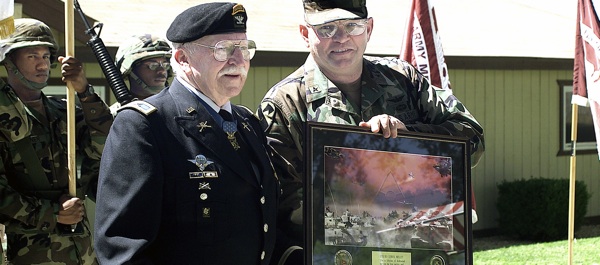
Colonel Lewis Lee Millett is a combat-decorated veteran of three wars: World War II, Korea and Vietnam. On February 7, 1951, then Captain Millett earned the Medal of Honor for leading two platoons in a desperate and savage bayonet charge to the top of a windswept, fortified Chinese-held hill in Korea. He made five combat paratroop jumps in his career and is the first officer ever to rappel from a hovering helicopter. He is the founder of the Army’s Recondo Schools.
His family has fought in many of this nation’s wars and conflicts, going back to 1675 when an ancestor died during an Indian massacre in Massachusetts Bay Colony and up to 1985 when his youngest son was among 347 Mideast peacekeepers killed in a plane crash in Newfoundland.
Lewis Millett joined the National Guard in 1938 while still in high school, because he wanted to fight. When war broke out in Europe in 1939 and President Franklin D. Roosevelt stated, “No American boys would be sent to fight in any European wars,” Millett deserted and joined the Canadian Army. He was sent to Britain, where he received intensive commando training that would later prove pivotal to his career. When the United States entered the war in 1941, Millett went to the U.S. Embassy in London and rejoined the United States Army. He served with distinction in the 1st Armored Division in North Africa, Sicily and Italy. When his court-martial papers for desertion finally caught up with him, he had already earned a battlefield commission and several decorations for bravery. The papers were quickly torn up and forgotten. When World War II ended, Millett temporarily left active duty, only to rejoin the National Guard.
With the outbreak of the Korean War, Millett was transferred to the 25th Infantry Division’s 27th Infantry Regiment, the “Wolfhounds,” where the wheels were set in motion that would lead to the Battle of Bayonet Hill and the awarding of his Medal of Honor. During that action, the Chinese soldiers were routed by American troops using seemingly outmoded bayonet-fixed rifles. Even though he was wounded during the assault, Millett refused to be evacuated until the hill had been made secure.
Colonel Millett went to Vietnam in 1960 and set up Ranger schools there. After graduating from the Command and General Staff School and the Army War College, he returned to Vietnam in 1970 as adviser to the II Corps Phoenix Program.
Millett retired from the U.S. Army in 1973. Now 86 years old, he recently spoke to Vietnam Magazine about his experiences in three wars.
Vietnam Magazine: On that hill in Korea in 1951, of all the weapons to use in a close assault upon a fortified enemy position, why use fixed bayonets?
Lewis Millett: The Chinese said that we Americans were afraid to use the bayonet, so I said, “I’ll show them!” I had the local Korean women sharpen our bayonets razor sharp on their grinding wheels, and we practiced bayonet drill techniques and hand-to-hand combat several times a day. I told the men that the next time we went into battle, we’d be attacking using fixed bayonets, and we did.
VM: What was your estimation of General William Westmoreland as a combat leader?
LM: I think he was a fine general. It was General Westmoreland who wanted me to organize the Recondo School after observing a raid that I led while still Stateside during a field training exercise. The idea was to provide advanced training to give the average soldier the knowledge to perform in the field at a level far above what they had learned in basic training and infantry school. Westmoreland said that most platoons didn’t know how to patrol correctly, so we started training the squad leaders first and then moved on from there. That’s how Recondo School got started.
VM: How did you get to Vietnam after your stint at the Recondo School, and what were your duties there?
LM: The Army needed men to go to Vietnam and I volunteered to go there. The Army wanted me to start a Recondo School for the South Vietnamese and Laotian troops. They wanted their training to incorporate the same tactics and principles that had been taught to our 101st and 82nd Airborne divisions. Initially I was based in Thailand and I later trained the Laotian commandos there.
VM: Did you accompany the ARVN Rangers on their combat patrols in the field and ever engage in any firefights against the Viet Cong?
LM: Yes, I oftentimes went out on patrol with the ARVN troops. The patrols usually lasted about three or four hours. We had some firefights, but I don’t recall any [details] offhand. [Laughs.] It was so long ago that I’ve forgotten.
VM: Were the ARVN Rangers effective soldiers?
LM: They were very good soldiers. They needed a lot of training, but they were very good soldiers once they went into action. You’d get them, train them and then send them off. I trained ARVN Rangers in their Recondo School for more than a year and spent seven years in Southeast Asia on and off between 1960 and 1972.
VM: Were they as good as their American counterparts?
The ones I trained acquitted themselves very well in the field and were every bit as effective as American troops.
VM: What sort of weapons did the ARVN Rangers carry?
LM: I carried an M-1 Garand [rifle] and a .45-caliber automatic pistol in the field. The ARVN Rangers carried a lot of Thompson submachine guns, M-1s and some carbines.
VM: Is the M-1 Garand a superior weapon to the M-14 or the M-16?
LM: I’m an M-1 man. The M-1 Garand is a great rifle, much better and more reliable than the M-16. I’ve still got an M-1 Garand.
VM: What was your opinion of the Army retiring the tried and true .45-caliber automatic pistol in favor of the 9mm M-9?
LM: The .45 pistol is a fine weapon, and the Army never should have gotten rid of it. I carried one throughout my time in Vietnam and never had any problems with mine.
VM: The CIA Phoenix Program has been derided as being nothing more than “CIA assassination teams,” whereas it was a highly effective tool that helped to crush the infrastructure of the Viet Cong in South Vietnam. How did you become involved in that program and what were your duties?
LM: The Army needed guys for the Phoenix Program, so I volunteered. I did a year with them. My primary role was in the gathering of intelligence. As a result [of the intelligence], we set up many ambushes and killed a lot of Viet Cong. What we would do is to put out ambushes to capture or kill the Viet Cong operatives as they left their village to make contact with other guerrillas. It was a very effective way of eliminating the enemy. We gathered intelligence through the use of interrogation. No torture!
VM: Did you find the CIA operatives competent and effective?
LM: The CIA operatives we worked with were very competent and effective officers who knew their stuff. They were good men. The Phoenix Program was a good program. It worked very well, and it never should have been stopped.
VM: In what area or province of Vietnam were you based?
LM: I was in the Central Highlands, from Dalat up to Pleiku and Kontum. I went out on patrols with the men [of the Phoenix Program teams]. We set up a lot of ambushes and killed a lot of VC.
VM: Later in the war, how was it that you agreed to offer yourself as a hostage during negotiations over the surrender of an entire NVA combat unit?
LM: They needed a volunteer to act as a hostage while negotiations were going on toward the surrender of an NVA battalion. They probably figured that they were going to be killed anyway, so they were eager to surrender. I only spent one day with them before they gave up, and more than 100 of them laid down their arms, along with their commanding officer.
VM: What happened to them?
LM: Many of them were later involved in the “Chieu-Hoi” (Open-Arms) program as Vietnamese scouts. We used them and treated them well. They proved to be good soldiers.
VM: What was your opinion of the quality of the Vietnam-era American soldier?
LM: The quality of the Vietnam War soldier was every bit as good as the men I served with in Korea or during World War II. They were great guys! Bottom line is, it all depends on leadership. If you can kick ass and take names and if you have good officers, you’re going to have good soldiers. It’s just that simple. And if you were an officer, if you did a good job, nobody bothered you. The only time I was reprimanded was when I was told to stop using fixed bayonets in Korea, and I got a medal for that.
VM: What does the Medal of Honor mean to you?
LM: That medal is more indicative of the men that I led into battle than about me.
VM: Do you think that it was necessary to commit our troops to Vietnam, or should we have just tried to train and build up the ARVN forces to fight in that guerrilla war?
LM: We should have committed our troops against the Communists in Vietnam while doing everything that we could to build up the ARVN forces to a higher standard of fighting proficiency. That was no guerrilla war. They wanted to destroy Vietnam and they wanted to destroy America. My greatest regret was that we didn’t win in Vietnam. You don’t go to war to lose. I don’t! When the Communists violated that treaty in 1975, we should have kicked their ass and bombed them back into the Stone Age.
VM: What is your opinion about the treatment that returning Vietnam War veterans received when they returned home to the United States?
LM: I thought it was horrible how badly Vietnam War soldiers were treated by their fellow Americans after returning back to the States. Just terrible! The American public wants you to go out and die for them, but they don’t do anything for you when you return.
VM: How would you sum up your colorful career?
LM: I had a hell of a good time during my career. I did a lot of things. I traveled a lot and went to many different countries. I met a lot of good people. I had fun and pretty much did whatever I wanted to do. It was exciting.
EDITOR’S NOTE: This interview originally appeared in the June 2008 issue of Vietnam Magazine. Colonel Millett died in a veteran’s hosptial in Loma Linda, California, Nov. 14, 2009. Another interview with Colonel Millett appeared in the February 2002 issue of Military History magazine.