
The son of a well-known French steel and arms manufacturer, Jacques Schneider was an aviation enthusiast who believed that floatplanes and flying boats were the most practical military and civilian design, since they could fly to any country with a coast, a river or a lake without requiring the construction of expensive airfields. On December 5, 1912, he declared a competition in which he appealed to manufacturers of marine aircraft to develop the world’s fastest airplane. The trophy, which he called the ‘Coupe d’Aviation Maritime Jacques Schneider, consisted of a silver sea wave 22 1/2 inches across, with the figures of Neptune and his three sons, over which was poised the winged, female personification of the spirit of flight, all set on a marble pedestal. In addition, the winner received 1,000 pounds sterling. The race — which soon came to be known simply as the Schneider Trophy — became one of the most prestigious annual competitions in history.
The distance flown had to be at least 150 miles over a triangular route, but prior to that Schneider expected all entries to cover a distance of 547 yards in contact with the sea. In later contests the aircraft were supposed to sit in the water for six hours to test the integrity of their floats or hulls — and to race weighed down with whatever liquid they had accumulated if they developed leaks during that time. The ultimate stake in the contest was permanent possession of the trophy, which would go to the country or pilot that could win three consecutive races within five years.

Aviation was viewed at that time as one of the most exciting developments in the Western world, and seven countries — Belgium, France, Britain, Italy, Spain, Switzerland and the United States — applied for entry in the first Schneider Trophy race, which was held at Monaco on April 16, 1913. Although it was a gala affair, only four aircraft turned out for the actual race — all of them French, land-based airplanes with floats temporarily installed. The first to set out on the 6.4-mile course at 8 that morning was a Deperdussin, a midwing monoplane with a monocoque fuselage of three-ply tulipwood veneer, powered by a 160-hp, 14-cylinder Gnôme rotary engine, and flown by Maurice Prévost. After flying 28 laps at an average speed of 61 mph, Prévost taxied the last 500 yards before crossing the finish line, only to learn that he had been disqualified for not flying over it. An hour after Prévost took off, American pilot Charles Weymann had begun his run in one of two Nieuports entered in the race. He closed rapidly on Prévost’s overall time thanks to the Nieuport’s superior maneuverability, which allowed it to make tighter turns at each lap than the Deperdussin. Prévost was offered second place if he flew one more lap, but he petulantly refused.
Meanwhile, the other contenders were having their own problems. Roland Garros’ Morane-Saulnier bounced on the waves, throwing water over its fuselage until it finally slowed to a halt with a waterlogged engine. Louis Gaudart’s Nieuport repeatedly went 10 feet into the air only to come down again, until the plane finally plunged nose-first into the water and sank. That left only Weymann — until his oil line burst and he was forced to land just four laps short of victory. At that point Prévost changed his mind and flew the remaining lap. The 58 minutes that had elapsed between his false finish and the official one were added to his time, lowering his average speed to 45.71 mph, but he had won by default, and the trophy was proudly displayed in the headquarters of the Aero Club of France…for the first and last time.
The 1914 competition was held at Monaco again, with considerably more exhilarating results. The winning plane this time was British, Thomas O.M. Sopwith’s Tabloid floatplane, powered by a 100-hp Gnôme 9V rotary engine, flown by Sopwith test pilot C. Howard Pixton at an average speed of 86.83 mph. The trophy was moved to the Royal Aero Club.

Soon afterward, World War I broke out. For the first — but hardly the last — time, a Schneider-winning racer would evolve into something more bellicose. With its floats replaced by a wheeled undercarriage, the Tabloid’s simple wood, wire and canvas structure and compact configuration served as the basis for a succession of fighters, including the famous Sopwith 1 1/2-Strutter, Pup, Triplane, Camel, Dolphin and Snipe.
The next Schneider Trophy race was not held until after World War I ended on November 11, 1918. The world was still war-weary, and only three British, three French and one Italian airplane competed at Bournemouth, England, on September 10, 1919. The race was by no means well organized. Speeds could not be measured efficiently because of dense fog that endangered the contestants and made the aircraft difficult for spectators to see. The only plane to actually complete the race was an Italian Savoia S.13bis flying boat, powered by a 250-hp, 6-cylinder Isotta-Fraschini engine and flown by Guido Gianello — and he was disqualified because he had rounded a reserve boat anchored in a cove southwest of the starting point, mistaking it for one of the three official marking boats. The outraged Italian delegation was only partially mollified when the Fédération Aéronautique Internationale, which controlled the race, invited the Royal Aero Club of Italy to manage the next year’s race.

When Venice hosted the 1920 Schneider Trophy between September 19 and 21, the Italians found themselves unopposed, and Luigi Bologna completed the 230.68-mile course in a Savoia S.12bis powered by a 500-hp Ansaldo V-12 engine, flying at an average speed of 105.97 mph. Venice was also the setting for the next race, on August 6 and 7, 1921 — and again it was dominated by the Italians. France entered only one plane, whose takeoff was canceled when its floats were damaged. The winner, Giovanni de Briganti, flew a Macchi M.7bis flying boat with a 280-hp Isotta-Fraschini V-6A engine through the 244.9-mile course at an average speed of 117.85 mph.
At that juncture, if Italy could win one more Schneider race, it would keep the silver trophy. The next event was held in Naples between August 10 and 12, 1922. France sent two flying boats. The Italians entered the Macchi M.17bis and a new biplane flying boat, the Savoia S.51. Britain fielded only one entry, the Supermarine Sea Lion II, also a biplane flying boat, powered by a 450-hp Napier Lion II engine. In the course of the race the S.51 crashed, killing its pilot. Adding to the Italians’ setbacks was the narrow victory won by the Sea Lion, flown at an average speed of 145.72 mph by Henry C. Biard.
Britain had only a year in which to savor its victory, however, because when the next race was held at Cowes, on the Isle of Wight, on September 27 and 28, 1923, it saw another upset victory — this time by the U.S. Navy. The American entries were part of a public relations campaign being waged by both the U.S. Army and Navy at a time when funding for the military was being rapidly reduced. To counter that trend, both branches of service had financed the development of racing aircraft. Turning its attention to the prestigious Schneider Trophy, the Navy commissioned the Wright Aeronautical Corporation to produce a biplane for the race, the NW-2, but during preliminary testing its 650-hp Wright T-2 engine exploded and the plane crashed into the sea. Its pilot miraculously survived the catastrophe.
Hedging its bets, the Navy also converted its well-established Curtiss CR-2 landplane into a floatplane, raised the tailplane a few inches and enlarged the radiators to cover nearly the entire surface of the upper wing. The result, designated the CR-3, was powered by a 450-hp Curtiss CD-12 5PL engine, and Lieutenant David Rittenhouse flew the aircraft at an average speed of 177.279 mph to win the race. Second place was won by another CR-3, flown by Lieutenant Rutledge Irvine at 173.347 mph, while Biard, flying a Sea Lion III — essentially the same plane he had flown the previous year with a more powerful engine — came in third with a speed of nearly 160 mph. Although the English public warmly applauded the Americans’ feat, the London Times commented critically on the unsporting manner in which the U.S. Navy had prepared for the event, remarking that British habits do not support the idea of entering a team organized by the State for a sporting event. Perhaps, but those habits were about to change.
The Schneider Trophy moved to the Western Hemisphere for the first time in 1925. It had been scheduled for Baltimore, Md., between September 19 and 21, 1924, but neither Britain nor Italy had any aircraft ready at that time, so the Americans sportingly postponed the race until October 23–26, 1925, to allow their European rivals to compete. Italy shipped two Macchi M.33 flying boats to Baltimore, while Britain pinned its hopes on the new Supermarine S.4 floatplane, a monoplane powered by a 700-hp Napier Lion engine. During a high-speed trial flight, however, the S.4 developed aileron flutter and pancaked into the Chesapeake Bay. Though its pilot, Henry Biard, bobbed to the surface, the British were left with only a Gloster III biplane. This time the U.S. Army Air Service fielded the principal American contender, a Curtiss R2C-2, powered by a 610-hp Curtiss V-1400 engine, and 1st Lt. James H. Doolittle piloted it to victory, averaging 232.573 mph over the 217-mile course. Second place went to Britain’s Hubert Broad in the Gloster III, with an average of 199.16 mph.

At that point, the United States had not only surprised Europe with the performance of its Curtiss seaplanes, but it stood only one victory away from permanent possession of the trophy. The next race was scheduled for October 24, 1926. Yet at that same time, America was turning away from racing in favor of a more profitable venture, air transport, while the U.S. Congress was losing interest in allotting taxpayers’ money to building military racing planes. In Europe, however, the holiday atmosphere traditionally surrounding the Schneider Trophy race was acquiring an earnest undercurrent, as national governments became involved — especially that of Fascist Italy. While U.S. Army and Navy funding was being reduced and the British and French still depended primarily on the aircraft manufacturers and commercial or private sponsors for financial support, Italian aircraft firms had the enthusiastic backing of Benito Mussolini, who had decreed that the Schneider Trophy would be won by Italy in 1926, no matter what difficulties had to be overcome.
Accepting Il Duce’s challenge was Mario Castoldi, chief designer for Aeronautica Macchi, who abandoned flying boats in favor of the twin-float configuration and adopted Tranquillo Zerbi’s new 882-hp Fiat AS-2 V-12 engine. This was modeled after the D-12 wet sleeve monoblock engine that Charles B. Kirkham had designed and Curtiss had built, but with several added refinements, including the ingenious use of magnesium alloys. Castoldi shipped four of his racing red M.39s to Norfolk, Va., for the 1926 race, but the new planes proved tricky to fly, as the high torque and heavy floats gave them a tendency to lean dangerously during takeoff. Moreover, one of the new engines caught fire during a trial run, while another broke a connecting rod and then failed a second time after Italian mechanics had spent a sleepless night trying to repair it.
The 1926 race was delayed until November 11, but even by then Supermarine’s chief engineer, Reginald Joseph Mitchell, had not yet completed Britain’s entry, while the U.S. Navy had simply provided more power to the Curtiss R3C-2 airframe by installing a new 700-hp Packard 2A-1500 engine in the R3C-3 and a Curtiss V-1500 in the R3C-4. The Americans suffered a tragic setback when one of the Navy contestants, Lieutenant Frank Conant, died after crashing his Curtiss on the way to Norfolk. Then, on the day before the race, one of the R3C-3s crashed during landing, though its pilot, Lieutenant William G. Tomlinson, survived.
During the first six laps of the race, Navy Lieutenant George T. Cuddihy broke Doolittle’s record with an average speed of 239.191 mph, but in the seventh he had to drop out with a broken fuel pump, just within sight of the finish line.
Lieutenant Charles F. Schildt of the U.S. Marine Corps flew his Curtiss to a maximum of 231 mph, but he ended up settling for second place when Regia Aeronautica Major Mario de Bernardi averaged 246.5 mph, in spite of having to climb his M.39 to 600 feet in order to cool his overheating engine. Soon after crossing the finish line, de Bernardi sent Mussolini a cable announcing, Your orders to win at all costs have been carried out, and then returned home to riotous celebrations. His victory left Jimmy Doolittle as the last American to win the Schneider Trophy, and the last man to do so in a biplane. The 1927 race was held in Venice between September 25 and 26. In addition to an upgraded version of the M.39, Italy entered four Macchi M.52s, the wings of which were of shorter span than the M.39’s and had moderate sweepback. Power for the M.52s was provided by a high-compression 1,000-hp Fiat AS-3 V-24 engine. Again, the new engines proved to be dangerously unreliable — one Italian pilot was killed during test flights, leaving only three pilots available once the race began: Frederico Quazetti, Arturo Ferrarin and de Bernardi.

The American Kirkham Product Corporation had been secretly preparing a plane to take part in the race, to be powered by a 24-cylinder, 1,250-hp X-2775 engine that was expected to give it a maximum speed of 300 mph. But the engine was not ready as time for the competition drew nigh, and the United States withdrew, leaving the race essentially a contest between Italy and Britain.
Britain’s entries included the Short Crusader, a biplane powered by an 860-hp Bristol Jupiter 9-cylinder radial engine. Also present were two Supermarine S.5 monoplanes and three Gloster IV biplanes, all powered by 875-hp Napier Lion VIIB V-12 engines.
The 200,000 spectators who crowded Lido beach were in for a disappointment, as all of the Italian contenders dropped out of the race due to engine failure. The winner was Royal Air Force (RAF) Flight Lt. Sidney N. Webster in a Supermarine S.5, with an average speed of 281.65 mph, followed by Flight Lt. O.E. Worsley. Mario Castoldi had met his match in Supermarine’s Reginald Mitchell, and from then on the Schneider Trophy races would be essentially a competition between those two designers.

The 1927 race also turned the Schneider Trophy into the most prestigious aerial competition in the world. Webster had outpaced most land aircraft, demonstrating that the long, streamlined floats of Schneider contenders created less drag than the wheeled landing gear of many conventional aircraft. The point was brought home further when de Bernardi test flew an M.52 at 297.83 mph — a little more than two miles per hour short of the 300 mph mark.
In 1928 Jacques Schneider died and the race was canceled for the year, to resume on September 7, 1929, in the waters off Portsmouth, England. France built three aircraft for the 1929 race, but they did not stand a chance and were not entered. Germany had begun to take an interest in the competition, but the one design it had in mind never got beyond the model stage.
The principal Italian entry, Castoldi’s Macchi M.67, was similar in general layout to the M.39, but its structure had been beefed up to take a much larger engine, the 1,800-hp, 57.26-liter Isotta-Fraschini Asso 1000 V-18. The Italian public was highly vocal in its concern that the hot new engine had not undergone sufficient testing before being committed to the 1929 race. But the government — especially Mussolini’s ambitious Air Minister Italo Balbo — favored the M.67 as its best bet to win. Three M.67s were built for the race, and no fewer than 27 of the Asso engines were made available for the event, some of which exploded during testing. Another unusual aspect of the M.67’s design was that one float carried more fuel than the other, so that its weight would counter the torque of the M.67’s three-bladed propeller — an arrangement that proved dangerous when the plane was struggling to take off. During a trial run over Lake Garda in August 1929, Captain Guiseppe Motta reached a maximum speed of 362 mph but suddenly fell into a dive and crashed. Motta did not survive.
Fiat planned to enter one C.29 floatplane, powered by a 1,000-hp AS-5 engine, but that aircraft also crashed during testing. Savoia-Marchetti’s S.65 mounted two 1,000-hp Isotta-Fraschini engines in tandem, with the tailplane supported by a pair of booms and extended rear floats. Finally, there was the Piaggio-Pegna Pc.7, a shoulder-wing monoplane whose most remarkable feature was that instead of floats it had a set of hydroplanes. The plane’s 1,000-hp AS-5 engine was connected by a long metal shaft to a two-blade propeller with automatically adjustable pitch — and, by means of a second shaft, to a smaller propeller, similar to that of a motorboat, under the tail. Before takeoff, the Pc.7 floated up to its wings on its watertight fuselage. For takeoff, the pilot started the engine, then a clutch engaged the tail screw and the plane started to move. It was raised above the water’s surface almost instantly by the high-incidence hydroplanes. At that point, the pilot opened the normal carburetor air intake and gave full power to the engine, at the same time engaging the flight propeller, which automatically went from feathered to flight pitch. Then the pilot, straining to see through the spray from the hydroplanes, would take off. Freed of the drag and weight of floats, the Pc.7 was supposed to reach a projected maximum speed of 434.7 mph. There were allegedly some takeoff attempts, but the drive train was plagued with problems, and many pilots were unwilling to fly the Pc.7.
Ultimately, both the Pc.7 and the twin-engine S.65 were excluded from the race. When the Royal Aero Club refused to postpone the contest to allow more time for Macchi to iron out the M.67’s problems, General Balbo announced that the Italian team is going to England merely to perform a gesture of chivalrous sportsmanship. Privately, he no doubt hoped against hope that one of the two M.67s might function properly just long enough to recover the trophy for Italy. Almost as an afterthought, Italy also entered a slightly redesigned Macchi M.52, the M.52R.
Britain fielded two Gloster IVs, powered by 1,320-hp Napier Lion Mk.VIID engines, and two of Reginald Mitchell’s newest design, the S.6, powered by a new 1,920-hp engine developed by Rolls-Royce. Sir Henry Royce, scorning Isotta-Fraschini’s attempt to gain extra power by adding more cylinders, had sat on the beach near his home with three Rolls-Royce engineers and drawn his concept for a new V-12 engine in the sand with a stick. Essentially, it was a refined version of the Curtiss D-12, but instead of taking the risky step of raising cylinder compression, as the Italians had done, Royce proposed adding a supercharger — a mechanism that would force more air-fuel mixture into the cylinders than atmospheric pressure would normally admit. The first such engine, completed in May 1929, had produced 1,545 hp at 2,750 rpm before self-destructing in 15 minutes. After a dozen more disastrous failures, Rolls-Royce’s 14th R engine managed to sustain 1,850 hp for 100 minutes. On August 5, Mitchell’s first S.6, with Rolls-Royce’s new engine, took to the water off Calshot Castle, near Portsmouth, to begin trials.
More than a million people crowded the beach, Calshot Castle, yachts and the decks of the battleship Iron Duke as the 1929 Schneider Trophy race opened on September 7. Italian aviation enthusiasts sat transfixed beside their radios, knowing that Lieutenants Remo Cadringher and Giovanni Monti were risking their lives, as well as Italy’s honor, in the cockpits of their M.67s. Cadringher started the first 217.48-mile race with a thrilling burst of speed, but as he made the first turn, smoke and fumes suddenly poured into his cockpit, and the Macchi skidded wildly as its pilot, half-blind and choking, fought to regain control. Cadringher came out of a high-speed spin to find himself over land, but he courageously brought his plane back on course and completed one 33-mile lap at 284 mph before giving up and landing. At that point, his windscreen was so hazy from the smoke that he could not see the pylons marking the turns.
Monti averaged 301.5 mph on his first circuit, but as he began the second lap a pipe in his radiator burst, filling his cockpit with steam and boiling water. With his arms and legs scalded, Monti somehow managed to land and was taken to the hospital.
In contrast to the M.67s, both Supermarine S.6s behaved perfectly. Flight Lt. Henry R.D. Waghorn took the trophy with an average speed of 328.63 mph. Flying Officer R.L.R. Atcherley averaged 325.54 mph but was disqualified from second place when the judges ruled that he had cut inside a pylon in the first lap. Italy’s M.52R took the second prize by default, but Warrant Officer T. Dal Molin’s average speed was an embarrassing 44.458 mph less than the winner’s. Britain now stood one race away from permanent possession of the Schneider Trophy.
We have finished playing our part as sportsmen, Balbo declared during a postrace banquet. Tomorrow our work as competitors will begin. Based on the experience of the 1929 race, the authorities agreed to allow two years for the contenders to develop new aircraft. Once again, the 1931 race would be a duel between Britain and Italy, Supermarine and Macchi, Mitchell and Castoldi. And again it would be held in England, near Portsmouth.
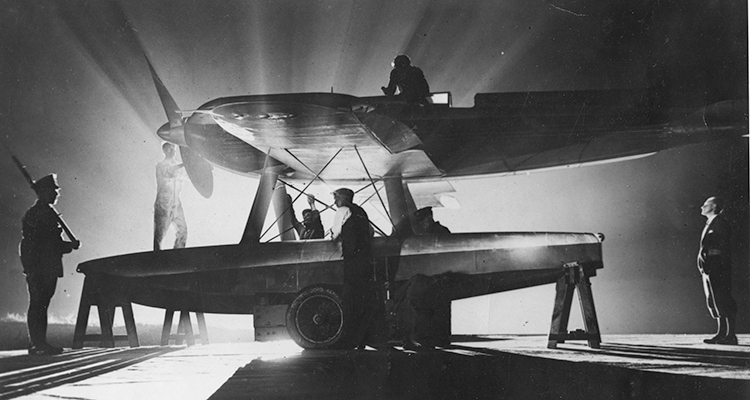
With the backing of the Mussolini government, Balbo established a flying school, designated the Reparto Alta Velocita (High Speed Section), on Lake Garda in 1930. Its sole purpose was to put seven specially selected pilots through 18 months of training for the 1931 race. Castoldi designed his next entry around Zerbi’s new Fiat AS-6 V-12 engine — or rather, two of them coupled in tandem, generating a total of 2,800 hp — which could be raised to 3,100 hp for short spurts. The engines were connected by double reduction gears and concentric shafts to two contrarotating duralumin propellers. The arrangement eliminated the torque that had made takeoffs so hazardous in the past. Each of the engines was 11 feet long, weighed 2,083.7 pounds and had two Marelli magnetos per valve.
Cooling the engines required radiators on every available surface on the plane — wings, fuselage, the front of the floats and even the struts that supported the floats. The oil tank was in the lower front cowling, and two pumps circulated the oil in two stages. Four oil coolers with filters were placed on the rear of the floats. Fuel was housed within the floats and was independently drawn to each engine, which generated power for both of the fuel pumps. The cooling system was complex and expensive, but it worked.
The Macchi racer’s structure was of steel tubing covered with sheet duralumin forward of the wings, and wood with plywood covering aft, including the tail surfaces. Plywood was used for the lower part of the floats and duralumin for the upper part.
Castoldi’s new contender was designated the Macchi-Castoldi M.C.72 in his honor, and five were to be produced. Three were completed in 1931, but the development program suffered a tragic setback when the first one, after reaching a speed of 375 mph, crashed, killing Giovanni Monti. The Italians petitioned for the race to be postponed, but Britain refused, effectively eliminating Italy and France — whose entry was not ready, either — from participating in the 1931 race.
Meanwhile, Reginald Mitchell had refined his S.6 further to use a new version of the Rolls-Royce R, which could generate 2,350 hp without a significant gain in weight over the 1929 model. But at first it looked as if Supermarine would not have his S.6B ready either, for the firm was low on funds, and the Air Ministry refused to spend any more money on a racing event. At that point, however, Lady Lucy Houston intervened, contributing 100,000 pounds sterling to ensure that Britain did not win the race merely by default — and to give herself a forum to castigate Britain’s Labor government. Even Mussolini himself could scarcely have surpassed Lady Houston’s rhetoric. Every true Briton would rather sell his last shirt than admit that England could not afford to defend herself, she declared.
Originally scheduled for the second Saturday in September, the 1931 Schneider Trophy race was held up for one day due to bad weather, but the following day, September 13, turned out sunny and clear. The two contestants, both Supermarine S.6Bs, prepared to take off from Lee-on-Solent to begin the 217.48-mile course before an audience of nearly a million, crowding the coast of Portsmouth and the Isle of Wight. As his blue and silver S.6B, S1595, was pushed off its barge near Calshot Castle, Flight Lt. John N. Boothman speculated on whether he would complete the triangular 33-mile laps seven times as planned. Even with five long fluted radiators down each side of its fuselage, he feared that his plane would be unlikely to last more than 90 minutes before the engine, which had hitherto never run longer than 27 minutes, started to melt on its mountings.
Taking off at 1:02 p.m., Boothman ran the first lap in 5 1/2 minutes, averaging 343.1 mph and reaching nearly 380 mph in the straightaways. From then on, however, his average speed gradually went down, until his seventh lap average was 337.7 mph. By that time, uneven fuel consumption had altered the trim, causing his plane to list to the left, but that was not enough to stop him from streaking over the finish line and then making a triumphant circling turn over Calshot Castle to the sound of a cheering crowd and ships’ bells and whistles.

The Schneider Trophy race had ended with a bang rather than a whimper after all — in only 47 minutes, Boothman had averaged 340.08 mph, establishing the Supermarine as the fastest airplane in the world. Later that month, Royce installed an engine capable of producing 2,600 hp for short sprints in S1595, and on September 29 Flight Lt. George H. Stainforth flew it on five straight 1.9-mile runs over Southampton Water, averaging 407.5 mph and at one point hitting 415.2 mph. The S.6B was the first airplane to pass the 400 mph mark.
Although Italy’s ambitions were dashed in regard to the Schneider Trophy, Castoldi continued to work on his M.C.72, in which Warrant Officer Francesco Agello finally completed a successful test flight over Lake Garda on April 10, 1933. A series of increasingly fast flights reached their climax on October 23, 1934, when Agello flew four laps in the M.C.72, at a maximum of 442.081 mph and an average of 434.7 mph, setting an absolute speed record that would not be broken until April 29, 1939, when a specially redesigned Messerschmitt Bf-109V-1 reached 469.22 mph, and an official seaplane record speed that would stand until October 1961, when a jet-powered Soviet Beriev Be-10 flying boat flew at 547 mph. Trophy or no trophy, the Italians had the last word on the subject of speed.
Over the 18 years of its existence, the Schneider Trophy race did much to influence progress in aviation, most dramatically in the increase in speed — from 45.71 mph in 1913 to 340.08 mph in 1931. A.F. Sidgreaves, managing director of Rolls-Royce, declared that it had compressed 10 years of engine development into two years. And yet the heated competition did not really fulfill the original hopes of Jacques Schneider, who had envisioned it as a means of accelerating the development of reliable flying boats for rapid air transport around the world. Instead, by becoming a quest for speed alone, the race had cost the lives of three British, two American and seven Italian pilots, and it ultimately led to the creation of more warlike aircraft than its founder had had in mind. Mario Castoldi applied the lessons he learned from the race to fighters, including the radial-engine M.C.200 Saetta, the sleek M.C.202 Folgore and the superlative M.C.205 Veltro. Rolls-Royce continued work on the engine it had built for the race, which evolved into the Merlin. Among the many great warplanes that would be powered by the Merlin was one that Reginald Mitchell, like Castoldi, evolved from his S.6B seaplane racer — a racy looking fighter that, against his personal preference, was christened the Spitfire.
This article was written by Radko Vasicek and originally published in the September 2002 issue of Aviation History.
For more great articles be sure to pick up your copy of Aviation History.