
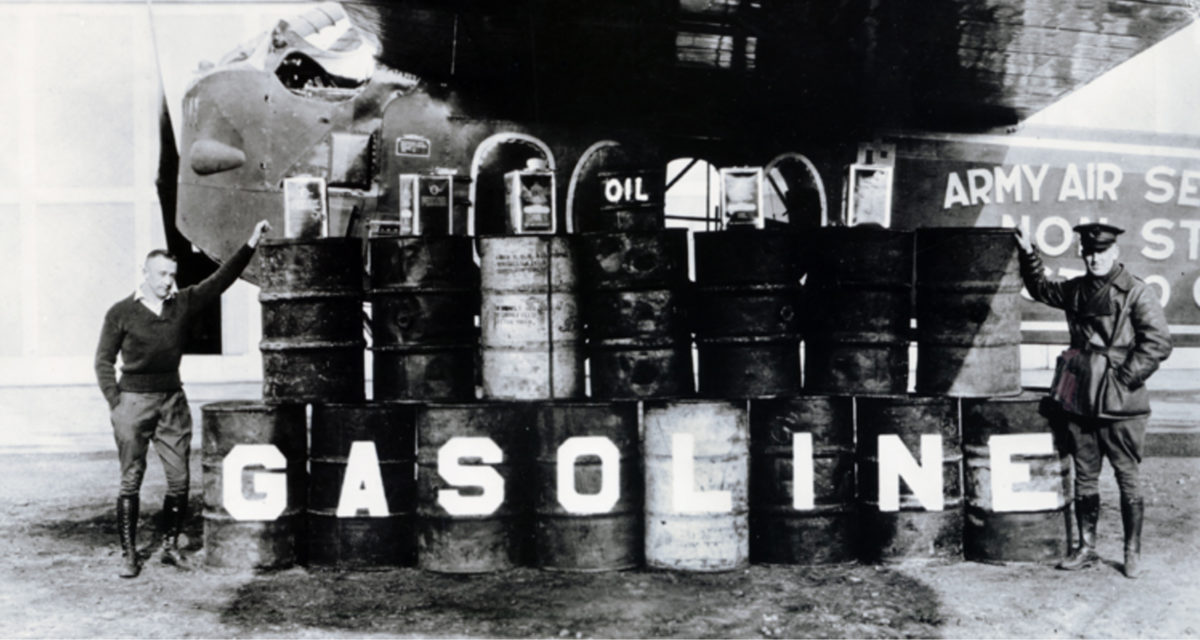
On May 3, 1923, First Lieutenants Oakley Kelly and John Macready landed at Rockwell Field, San Diego, California, where they had lunch with Major Henry H. ‘Hap Arnold, the field commander. Hardly a notable occasion–on the surface.
What was remarkable about this event, however, was that the young lieutenants had just become the first aviators to fly nonstop across the continental United States. It was the culmination of 1 1/2 years of dedicated work by the lieutenants, their mechanics and engineers, and the U.S. Weather Bureau.
During the years immediately following World War I, the fledgling Army Air Service had to fight for its very life. Although the Air Service was convinced of the need to develop aviation, many politicians and citizens of the day saw aviation as a luxury, an unnecessary frill.
The Air Service’s pilots knew that their livelihood depended on their ability to showcase their skills. This period of Air Service history has been called the stunt era.
It was in this atmosphere that two aviators were given the support they needed to fly nonstop across the United States. The story begins in late 1921, when Kelly and 1st Lt. Muir Fairchild first proposed to fly across the continent nonstop. Their fellow aviators immediately declared the plan preposterous. No plane or pilot was capable.
The two aviators were convinced, however, that if they could find the right airplane, they could successfully make the trip. After evaluating all the airplanes in the Army inventory, they found that the Fokker F-IV (Army designation T-2) had the characteristics they were looking for.
The T-2 was a huge, passenger airplane with a wingspan of 74 feet 10 inches. It held eight passengers in an enclosed metal-tubing-and-fabric-covered fuselage and seated one pilot in an exposed cockpit in front of the large, cantilevered, wood-covered wing. The wing was similar to some featured on Anthony Fokker’s most successful fighters of World War I. The Army had recently acquired two of these airplanes to be used as testbeds for the Liberty 12 engine. The T-2 carried 130 gallons of fuel, but for a transcontinental flight, additional fuel would have to be added.
One of the Army’s T-2s (A.S. 64233) was made available for the flight, and 1st Lt. Earnest Dichman, the team’s chief engineer, began to modify it for the flight. He placed a fuel tank in the cabin, bringing the total fuel capacity up to 725 gallons. Other necessary modifications included additional water and oil tanks in the cabin, larger and stronger wheels, auxiliary water and oil radiators, a door between the cockpit and the cabin, and a second set of flight controls in the cabin.
The pilots had to decide from which coast to start their planned nonstop, cross-country flight. The Weather Bureau strongly recommended flying from west to east, to take advantage of the prevailing 20-plus-mph westerly wind during August and September, and the pilots agreed to the California-to-New York route.
On September 24, 1922, the airplane arrived at Rockwell Field on North Island, Calif., where final preparations for the flight were made. An overhauled Liberty 12 engine was installed; the back of the pilot’s seat was hinged to allow easier access between cockpit and cabin; and a continuous-cord message system was installed to allow the pilots to communicate while in flight. Macready had replaced Fairchild, who was recovering from an unrelated accident.
At last, all preparations were complete. The Weather Bureau gave the go-ahead. And on the morning of October 22, 1922, the T-2 was placed at the end of the 10,000-foot runway.
As the two airmen approached the T-2, they tossed a coin to see who would have the honor of starting the flight in the cockpit. Kelly won the toss and climbed into the cockpit. Once the preliminary checks and engine run-up were completed, the wheel chocks were removed, and the plane slowly, hesitatingly, rumbled forward. With a gross weight of 10,695 pounds (an astonishing weight for that era) the plane made its way down the runway, then slowly lifted off. As the plane headed east, Point Loma loomed ahead. At an altitude of only 100 feet, Kelly had to turn downwind to avoid it. The Fokker began to sink lower and lower, until it was skimming along a bare 10 feet above the waves.
The heavily laden plane slowly continued to gain altitude. About 50 miles into the flight, the pilots encountered light fog. Since the Weather Bureau had not indicated bad weather in the mountains, the aviators disregarded the fog and flew on. When the pilots reached Banning, however, they found the tops of the hills covered in fog. After wasting 1_ hours looking for a break in the fog, they decided to turn back. Even if they could find a route through the fog, they had by now used up too much fuel to complete the trip to New York.
The pilots returned to Rockwell Field. As they flew over the field, they dropped a note to the ground saying that they had decided to abandon the transcontinental flight. Instead, they would stay aloft and try to break the world endurance record.
A plane took off from the field with a message hurriedly painted on the side. When it closed on the T-2, the pilots read: Message received. Drop messages on marker at start of runway.
The pilots circled Rockwell Field for the rest of the flight.
After just over 35 hours aloft, the T-2 touched down, to the cheers of a thousand well-wishers. It set an endurance record, but it was declared unofficial by the Aero Club of America because the proper arrangements had not been made prior to the flight. Nonetheless, the flight proved that the T-2 and its pilots could stay aloft long enough to make a nonstop transcontinental flight. All they needed was favorable weather.
The aviators hoped to make a second transcontinental attempt in a few days. However, maintenance problems and unfavorable weather caused a longer delay than expected.
On November 3, after only 3_ hours of sleep, the pilots rose at 3:30 a.m. and headed for the airfield to prepare the plane for the flight. By 5 a.m., they were ready to go. All they had to do was wait for adequate light to safely take off.
Kelly once again took the controls for takeoff. He flew as straight a course as he could out to sea, while still avoiding Point Loma. He kept all his initial turns gradual, minimizing loss of altitude. After twice circling North Island, the T-2 headed east, toward New York.
No fog hampered the fliers this time, and they gained enough altitude to fly through the mountains in California without any difficulty. Across the Colorado River, Macready took the controls, and they continued on through the mountains.
As they approached the Continental Divide, Kelly doubted his ability to fly over it. However, with each gallon of fuel burned, the plane rose a few feet. Eventually, Kelly coaxed the struggling Fokker to an altitude of 150 feet. But just as they reached the divide, a sudden downdraft forced the plane to within 20 feet of the ground. Only Kelly’s quick action averted disaster. With airspeed near the stall point, he barely missed a large mound and turned to fly back down the mountain. He flew like this for 10 miles, expecting to crash at any minute. As the plane burned fuel, the gradual loss of weight enabled Kelly to nudge the plane high enough to cross the Continental Divide. After 40 minutes and two attempts, they crossed with 30 feet to spare.
The many delays so far had left the flight behind schedule. Crossing the divide at dusk, Kelly found night rapidly closing in and no moon yet risen. For 1_ hours, the plane bored onward in total darkness with no visible landmarks for guidance.
As the pilots later wrote, if they could reach Tucumcari, New Mexico, the long night’s flight could be commenced from a known starting point and over comparatively good country. Thankfully, they were soon able to see the city’s lights in the distance.
As the plane headed east, clouds began forming, sometimes blocking the moon and forcing Kelly to fly close to the ground so he could follow his iron compass–the Southern Pacific Railroad tracks.
Their intent was to follow the railroad tracks through the night. However, the bad weather made this difficult, at best. When Macready lost sight of the tracks, he would have to follow the compass and estimate the amount of his drift. Whenever the headlights of a train appeared, Macready would regain his bearing and make any necessary adjustments to his flight path. As they flew on, thunder and lightning rumbled and flashed on every side.
Once they had reached Pratt, Kan., they deliberately left the railroad and followed a compass course. Macready planned to double-check his course when he crossed over the lights of a small town. This proved to be more difficult than anticipated. He later said, The people of Kansas and Missouri apparently retire early and no lights appear after ten or eleven o’clock. Adding to their problems, Macready said, was a crosswind approaching the proportions of a gale, causing considerable drift.
Macready continued on toward the Missouri River. At the KansasMissouri border, Kelly took over the controls, and after they passed St. Louis, they saw the sun rising ahead of them. Both pilots thought that practically all the troubles of the long trip were over.
About 400 miles into the flight, the pilots had discovered a cracked cylinder jacket. But the engine was not yet losing cooling water, so the problem was not considered serious and they continued on. As Kelly passed over Terre Haute, Ind., however, he sent a message to Macready in the cabin of the plane, telling him to plan for an emergency landing. The cracked cylinder jacket had worsened, affecting some of the other cylinder jackets, and they were rapidly losing coolant. Macready took over the controls and immediately found that water was shooting from both sides of the engine in small streams.
About 50 miles from Indianapolis, Ind., Macready noticed that the water temperature was rising and prepared to land. Meanwhile, in the cabin of the plane, Kelly was pouring coffee, broth and any other liquid he could find into the water tank. This lowered the water temperature enough to allow the stricken T-2 to continue on to the Indianapolis Speedway, where they intended to land.
The pilots landed in the center of the field–then immediately jumped from the plane in order to avoid the danger of fire which seemed probable, as a dense cloud of white smoke was pouring from the engine, as they later recalled.
The airplane did not catch fire. Had they continued on any farther, however, or if they had needed to fly around the field one more time, the plane probably would not have made it. The pilots were safe due to their incredible skill, sound judgment and quick thinking. They certainly knew their exact limits, as well as the plane’s.
When Kelly and I stepped out of the T-2 in Indianapolis, Macready later wrote in National Geographic magazine, we did not do much talking about transcontinental non-stop flights. We were through. Any man who was foolish enough to want our job was welcome to it. Never, never again for us! Neither one said much, but we did a lot of thinking, and decided in our own minds that transcontinental non-stop flights were good things to keep away from. We were entirely willing for someone to take our place. We wanted to forget it.
The pilots did not know just how lucky they were to have made it through the night until they read the newspaper the next day. The storms they had flown through the previous night included a tornado that had left 12 dead and 80 injured.
After a few days of rest in Dayton, Ohio, Kelly put a map of the United States up on the wall. Without much discussion or ceremony, he and Macready were soon planning another attempt at a nonstop, transcontinental flight.
The pilots re-evaluated their previous plans. If they flew from east to west, they reckoned, they could immediately throttle back after takeoff and stay at lower altitudes until they reached the western mountains. By this time, they would have burned enough fuel to allow an easy climb over the mountains. In discussions with the Weather Bureau in Washington, D.C., the pilots learned that during the last two weeks in April, there was usually a shift in the continental weather pattern, producing two or three strong, east-to-west wind currents that they could utilize.
Once again the T-2 was prepared for a nonstop transcontinental flight, this time in the spring of 1923. While setting an official endurance record, Kelly and Macready missed two periods of favorable winds. Still optimists, they flew to New York and hoped for one more good wind.
On the evening of May 1, 1923, they received a weather report that showed favorable conditions developing. They were up at 4 a.m. and made the final preparations for takeoff from Roosevelt Field on Long Island, N.Y.
Roosevelt Field sits on a mile-square plateau, with Hazelhurst Field, the same size but 20 feet lower, adjacent to it. Macready described the takeoff from his perspective back in the cabin: The big monoplane bounced and bounced but did not rise. It was still on the ground when we came to the 20-foot drop-off from Roosevelt to Hazelhurst Field….Over we went and settled down, but not quite to the earth.
The heavily loaded plane could hardly maintain itself in level flight. For 20 minutes over Long Island our climb was hardly appreciable. In fact, for the first few miles we barely cleared the poles and wires.
Over Pennsylvania, Kelly noticed the voltage regulator was indicating discharge, which meant the plane was flying on the battery. They could only last for a few hours like this. Turning the controls over to Macready, Kelly spent the next half hour removing the voltage regulator, repairing it and putting it back in place. With the regulator now reading charge, Kelly took over the controls and flew on.
As dusk approached, the T-2 reached Dayton, Ohio, and Macready moved to the cockpit to begin his stint in front. As they flew west, clouds began to gather. Macready said, Flying into this murky night was about the same as plunging into ice-cold water with a long swim ahead.
When they reached St. Louis, its lights, barely discernible through the mist, told Macready he was still on course. He followed the Missouri River until he reached Jefferson City, Mo. Then the clouds thickened. As they flew over the Ozarks, they could no longer see ground lights. Once again, they would have to struggle through total darkness.
With the airplane pointed toward New Mexico, Macready followed a compass course across five states. He said, Kelly and I take great pride in having remained directly on our course throughout the blackness of the night.
Shortly before midnight, Macready found the clouds thinning. He could see the ground once again. At this point, they were 1,200 miles into their flight. Kelly took over the controls near Spearman, Texas, and used his compass to stay on course for the next six hours.
Macready took over at 6 a.m. They were then over Santa Rosa, N.M., and two-thirds of the way through the flight. Once he reached the Rio Grande, Macready knew he was seven hours away from San Diego, with nine hours of fuel left on board. If he could just get over the upcoming mountains, the flight surely would be a success.
The T-2 was struggling for altitude, gaining a few feet with each gallon of fuel burned. Once more, Kelly and Macready were confronted with the Continental Divide. And once more, they were unable to push the Fokker high enough to clear the mountains. As before, they had to look for a new route, a gap in the divide.
Macready flew slightly to the south of the proposed route and found the opening he needed. With all of 100 feet to spare, they cleared the highest point of the flight.
Kelly took over near Wickenburg, Ariz., and followed the Santa Fe Railroad until they reached the Colorado River. The Imperial Valley lay below. All that stood between them and the Pacific Ocean was one last mountain range. They were on time and on course. Success was near.
Since Macready was a native of San Diego, he took the controls once the Pacific Ocean was in sight. The goal was to reach San Diego in less than 27 hours total flight time. Macready brought the big airplane down from 8,000 feet, leveling off to pass over the housetops at 100 feet. The T-2 touched down at Rockwell Field 26 hours and 50 minutes after leaving New York. The exhausted pilots had flown into history.
Macready later recalled his thoughts about the end of the flight: Everyone was excited but Kelly and myself. We had been working in grease and dirt, without rest, for such a long time previous to the flight that we had not had an opportunity to think about it from the standpoint of an accomplished act.
It seemed to us that we had just finished a hard test flight, and we were mighty glad that it was over.
The pilots received congratulatory telegrams from President Warren Harding, General John Pershing and hundreds of other well-wishers. A banquet was held in their honor, and they became the darlings of the press. The Air Service needed this type of publicity.
Kelly and Macready hoped to take an extended leave once they got to San Diego, especially since Macready had gotten married a few days after they landed. Instead, the fliers were soon ordered to report to Washington, D.C., with the T-2. There, the airplane was donated to the Smithsonian Institution, where it is now on display at the National Air and Space Museum.
This article was written by Joseph B. Haymor and originally published in the March 1997 issue of Aviation History. For more great articles subscribe to Aviation History magazine today!