
The daring German airborne operations in Norway and the Low Countries in the spring of 1940 forcibly introduced the world to a new form of warfare. They also altered the widely held prewar conceptions of many senior Allied leaders that parachute operations were little more than just a stunt. In the aftermath of the German aerial onslaught, the Allies began to consider a paratroop arm, largely at the behest of fiery British Prime Minister Winston Churchill. However, even his influence was initially muted.
Churchill’s military commanders resisted vehemently, in part due to their conservatism but also because they were facing the immediate crisis of defending England and rebuilding a British army capable of fighting a modern war. Most of the commanders felt that airborne forces would be of little use in the war against Germany. As a result, Churchill initially agreed to a parachute corps of five hundred men instead of the five thousand he had originally envisioned. The Americans were also content with establishing a test platoon.
The startling success of German paratroopers in the conquest of Crete in May 1941 enraged Churchill. On May 27, he declared, “We ought to have 5,000 parachutists and one Airborne Division on the German model.” Four days later, the British general and air staffs agreed to press forward as quickly as possible with the airborne program. A brigade of twenty-five hundred fully trained parachutists was to be formed by July 1, 1941. Even before this was achieved, army staff began to plan for a division-sized organization. On an almost parallel track, the Americans also ramped up their efforts on the same scale, converting their 82nd Motorized Infantry Division to an airborne role on June 26, 1942.
Although the German success in Crete was clearly a catalyst in changing the Allied philosophy toward airborne forces, there were other factors, including public perception. By the summer of 1942, the tide of the war was beginning to shift, and the public demanded heroes. Tough, fearless paratroopers could satisfy that need. “It builds our morale, it stiffens the spine and braces the backbone of the public to hear talk about the independent type airborne operation,” said Lt. Gen. E.M. Flanagan. After years of Allied defeats, the public hungered for options to strike back, as Flanagan elaborated, with a force able “to deal a lethal blow to the enemy, deep in his backyard.”
It wasn’t long until Field Marshal Bernard Law Montgomery could say, “When the maroon beret [signifying a paratrooper] is seen on the battlefield, it at once inspires confidence, as it is well known that its wearers are good men and true and have the highest standards in all things.”
The public appeal of the paratrooper was an unexpected benefit of a revolutionary form of warfare. The stunning German victories in the Low Countries in 1940 gave the public a weapon that was perceived as transcending the stifling death, futility, and lethargy of World War I’s trench warfare. The paratrooper was portrayed as the leading edge, the “tip of the spear” of modern war. Airborne forces were seen as special troops with a highly hazardous mission. Senior military leaders described the embryonic British Parachute Corps as an elite unit fulfilling the toughest job in the British army. Moreover, the senior military officers described paratroopers as “super-soldiers.” Their task was defined as nothing short of facilitating the general advance of the army by seizing key installations and terrain on the enemy’s flanks and in his rear. Furthermore, the paratroopers were to create “alarm and despondency” as well as confusion in the enemy’s safe areas at the most critical moments of attack. Justified or not, paratroopers came to be considered a necessary prerequisite for military success.
The media assisted in defining the modern paratrooper’s role. Numerous newspaper articles described the parachute volunteers as “hard as nails,” the toughest and smartest soldiers in a country’s army. “They are good, possibly great soldiers,” wrote one journalist, “hard, keen, fast-thinking and eager for battle.” According to Larry Gough in the American magazine Liberty, “In the first place, [parachutists] are perfect specimens. They have to be, because their work is rough, tough, and full of excellent opportunities to get hurt. Mentally they’re quick on the trigger, again because their job demands it, because split seconds can make the difference between instant death or a successfully completed job.” Yet another writer insisted they were the most “daring and rugged soldiers…daring because they’ll be training as paratroops: rugged because paratroops do the toughest jobs in hornet nests behind enemy lines.” Soon it would have been impossible for military leaders to ignore this advancement in modern warfare.
Although conservative military staff officers and commanders were not as easily convinced, directives from their seniors, as well as an evolution in the conceptualization of possible airborne roles, also prompted the change in Allied thought. Until 1941, conventional thinking gave parachute troops two rudimentary primary functions. First were major operations that employed paratroopers to capture a specific target of vital importance. The second function entailed dropping small numbers of airborne soldiers to conduct raids against headquarters, infrastructure, or small targets of tactical, operational, or strategic value. In many circles, airborne operations were considered almost suicide missions.
By 1942, the emphasis on airborne operations as a tactical-level instrument disappeared. In fact, the pendulum had swung to the opposite extreme. The U.S. War Department’s 1942 book of strategy clearly stated “…one cannot possibly hope to succeed in landing operations unless one can be assured of the cooperation of parachutists on a scale hitherto undreamed of.” Paratroopers were now regarded “as the pivot of success of the entire operation.”
By 1943, the Allies assigned paratroopers three major functions. The first emphasized ousting the Axis from occupied territory. Airborne troops were responsible for assisting conventional forces in joint operations by attacking the enemy rear and assisting with the breakthrough of the main forces. In this capacity, they were also expected to delay enemy reserves by holding defiles between them and the bridgeheads, or conversely to destroy any enemy attempting to withdraw. In addition, paratroops were also assigned the possible tasks of capturing enemy airfields, creating diversions, and capturing or destroying belligerent headquarters, to paralyze the enemy’s capability of providing a cohesive defense.
“In almost every case,” explained Maj. Gen. Richard Gale, while commanding the British 6th Airborne Division, “Airborne Forces will lead the way and be the spearhead of the attack.” Elaborating, he explained, “The sort of tasks you may have to do are: capture a position in the rear of the enemy, cut his communications, and isolate him from his reinforcements; attack the enemy in the rear, while our main forces attack his front; capture airfields in enemy country; assist sea or river crossings by making a bridgehead; [and/or] raid special objectives.”
The second major function assigned to paratroopers was to work independently. Borrowing from the German model, strategists envisioned airborne forces capturing islands or areas either not strongly defended or not capable of being reinforced, as well as positions that could undermine the enemy’s stature internationally and domestically and possibly destroy public morale. Moreover, this could tie down enemy reserves that might be used elsewhere. In addition, paratroopers working independently might seize vital installations, such as oil refineries and centers of government. Paratroopers were also given the possible task of assisting guerrilla forces by providing a nucleus of trained soldiers. In essence, paratroop units were to act independently to pin down enemy resources or require the enemy to invest a large amount of equipment and manpower to ensure the security of his rear areas.
The third paratrooper function was harassment. Strategists envisioned airborne troops operating in small numbers, often at a great distance from the area of major operations. Paratroopers within this function would be assigned the tasks of harassing communications and destroying aircraft, transport, signal stations, railway trains, locks, bridges, and factories. In addition, they would also be responsible for destroying enemy fuel, supplies, and equipment, as well as causing panic among civilians.
Despite the growth of paratroopers and their widespread public appeal, conventional military leaders did not warmly accept establishing distinct airborne units and formations. Airborne detractors continued to argue that parachuting was just another means to the battlefield. Some felt there was no need to create a special airborne force. When the need for parachute troops arose, they felt designated regular units could easily be trained.
However, this line of reasoning and philosophical bent clearly indicated a wholesale lack of understanding of airborne warfare. The airborne battlefield was substantially different—much more demanding and unrelenting. Without question, it required warriors of a special ilk. Paratroopers needed to be carefully selected, meet special psychological requirements and possess a physical stamina beyond that of the average soldier. Their training was markedly more difficult, if not grueling. Only intrepid, resilient, self-reliant individuals could survive the devil’s cauldron that was the airborne battlefield.
Clearly, any soldier who engages in combat faces a formidable challenge. However, the distinct airborne battlefield presented specific ordeals the normal soldier did not face. First, paratroopers are remarkably vulnerable during deployment to the objective. The aerial armada in flight consists of large lumbering transport aircraft, as well as airplanes towing gliders. These were inherently slow, inviting targets to both anti-aircraft fire and enemy fighters. Controlling the entire “air corridor” was crucial and demanded air supremacy or, at a minimum, local air superiority along the entire route.
Moreover, the flight was often physically taxing. Airplanes bucked and lurched, tossed about in the wash of preceding aircraft, and the pilots’ attempts at avoiding flak created additional stress for the airborne soldiers. Research has shown that airsickness due to turbulent flying conditions in itself creates fatigue. The paratrooper might be exhausted on landing from the battering in the air, compounded by anxiety and tension, and from carrying equipment that might weigh a hundred pounds or more.
The next challenge lay in the accuracy of the drop itself. Even if the aircraft reached their destination, pilots found it difficult to drop the paratroopers on target. Simple navigation errors created problems, as did high winds and poor weather. Poorly trained and inexperienced aircrews often could not maintain formation and released their paratroopers at too high an altitude or too great a speed. For example, during Operation Husky, the invasion of Sicily in July 1943, Allied pilots were supposed to drop their charges from six hundred feet from C-47 Dakota aircraft. Pilots were also to slow down their airplanes almost to stalling speed, which was one hundred miles per hour. Instead, the paratroopers were flung out at fifteen hundred feet while aircraft raced along at nearly their top speed of two hundred miles per hour. Added to navigational problems and heavy winds, the pilots’ failure to maintain the proper dropping posture resulted in 3,405 American paratroopers being scattered over a sixty-mile swath of southeast Sicily.
On the same botched drop, Colonel James Gavin, a regimental commander in the 82nd Airborne Division, found himself in enemy territory for the first few hours of the landing with a force of only nineteen of his soldiers. He later estimated that only 12 percent, or about 425 of the 3,405 men, actually landed somewhere in front of the beachhead as planned.
Twenty-four hours after his drop, Colonel Reuben Tucker, the regimental commander, could account for only a quarter of the two thousand men who had left Africa. Similarly, during the same operation, only twenty-seven of an intended force of two hundred British paratroopers (or 14 percent) landed near enough to their objective to join the fight for the Ponte Grande.
Almost a year later in Normandy, of the sixty-six hundred men of the American 101st Airborne Division that dropped in the early hours of D-Day, thirty-five hundred were still missing by the end of the day. As a further example, on August 15, 1944, five thousand Allied paratroopers of the 1st Airborne Task Force dropped in the area of Le Muy, in southern France, as part of Operation Dragoon. Approximately 60 percent of the American paratroopers and 40 percent of the British landed too far from their drop zones for it to be considered a successful drop.
Brigadier James Hill, commander of the British 3rd Parachute Brigade during the Normandy invasion, warned his troops about the potential confusion they might face with these words: “Gentlemen, in spite of your excellent training and orders, do not be daunted if chaos reigns. It undoubtedly will.”
Although poorly trained and inexperienced aircrews were one reason contributing to poor drops, they were certainly not the only cause of parachutists not hitting their targets. The pilots faced dangerous assignments. Of 144 aircraft that left Africa carrying the U.S. 504th Parachute Infantry Regiment to Sicily, twenty-three never returned, thirty-seven sustained significant damage, and half the planes required major repairs before they could fly again. Flak and enemy air activity often caused pilots to take evasive action that created enormous difficulties for airborne soldiers and frequently resulted in missed drop zones. “As we approached the drop zone, the aircraft took violent evasive moves,” recalled nineteen-year-old paratrooper Bill Lovatt. “As I approached the door, I was flung back violently to the opposite side of the aircraft in a tangle of arms and legs.”
On the evening of September 24, 1943, during the Russian Dnieper River offensive, Soviet pilots panicked when they reached the front lines and began to receive heavy anti-aircraft fire. Their drops were widely dispersed and off target. Of the 4,575 paratroopers and 666 cargo containers dropped, a total of 2,017 men (or 44 percent) and 590 cargo containers (89 percent) failed to reach their intended drop zone. Germans reported downing only three aircraft and one glider from a total of 296 sorties flown. This low kill rate strongly indicates that Soviet pilots overreacted and failed to push on to their objectives.
This, however, was not only the Soviet experience. “We lost a number of people over the sea [on D-Day] from evasive action, who fell out,” revealed American Captain Richard Todd. A Canadian, Sergeant John Feduck, was slightly more fortunate. “Before the light changed, the plane suddenly lurched,” he remembered. “I couldn’t hang on because there was nothing to hang on to so out I went—there was no getting back in.” Luckily, he was over the coast of France.
Inexperienced aircrews were also the reason for the disastrous drop of twelve hundred German paratroopers under the command of Baron von der Heydte during the Battle of the Bulge in December 1944. The crews were unable to maintain course or formation due to enemy fire. They released their Fallschirmjäger over such a large area that only a tiny fraction of the force was able to regroup. Not enough gathered to cut off American reinforcements coming south from Belgium to relieve the pressure created by the surprise German offensive in the Ardennes.
Airborne soldiers faced still more challenges while parachuting to the battlefield, and paratroops are extremely vulnerable on landing. Individual soldiers, weapon systems, radios, and other equipment essential to the mission must all be brought together at a rendezvous point. This takes time. How long it takes depends on the accuracy of the drop. The greater the dispersion, the longer it takes to regroup, to assemble combat power.
Clearly, there is a direct correlation between the time needed to assemble and the degree of surprise and shock the jump achieved. “The hardest part of the job wasn’t the fighting, although that was hard enough at times,” conceded Canadian Lt. Col. G.F.P. Bradbrooke, “but getting ourselves organized after we hit the drop zone.”
The location of the drop in relation to the enemy’s position could also dramatically affect its success. “Those [Fallschirmjäger] dropped on the central sector fell right on top of my gun position,” observed a British Royal Artillery officer serving at Heraklion on Crete in May 1941, “with the result that my small party of twenty-five men had to deal with vastly superior numbers of parachutists. However, they did more than deal with them,” he bragged. “They almost completely destroyed them.”
In the end, he concluded, “If an immediate attack can be made on parachute troops the second they leave the plane and touch the ground, they are almost powerless to resist.” Through World War II, army planners assumed that one-third of any airborne force setting out would fail to participate effectively in operations.
The vulnerability of airborne soldiers on landing was further exacerbated by their lack of mobility. Once on the ground, paratroopers were limited to how far and how fast they could move with what they had. This restricted the objectives and missions that could be assigned. Failure to recognize this had dire consequences. Parachutists dropped too far from their target contributed to the failure to quickly capture the bridge at Arnhem in September 1944. German defenders acknowledged that they had time to mobilize their defense and respond to the threat.
Paratroopers lacked firepower. Often airborne forces were dropped behind enemy lines, beyond the range of friendly artillery or naval gunfire. They relied on only what they themselves could bring to the battle. Human capacity ruled out most heavy weapons. Equipment loss and damage during bad drops exacerbated the predicament. “With the planes not slowing up below 125 or 135 miles an hour,” complained one veteran of the Tagaytay Ridge mission in the Philippines in February 1945, “most of us experienced the hardest physical opening shock in our lives. The result of the shock was that most of us lost helmets, packs broke free from web belts, suspenders broke, and in the wind which was 20 to 30 miles an hour…many had hard landings.”
Bruises and scrapes aside, it was the loss of equipment in a bad landing that was most sorely felt. Not surprisingly, paratroopers lamented their vulnerability in the difficult weeks following D-Day in Normandy, “when attacks by enemy infantry and sometimes tanks and self-propelled guns had to be met with an inferior weight of fire power.” A little more than three months later at Arnhem, the 82nd Airborne Division was unable to communicate with headquarters fifteen miles away because both of the outfit’s large radio sets were damaged in the drop.
Resupply also limited what assignments airborne forces could take on. Every airborne operation depended on eventually linking up with ground forces, generally within forty-eight to seventy-two hours. Isolated troops could be supplied by airdrops, but resupply drops suffered from all the same parachute limitations as the original drop—and required even greater accuracy.
Despite this constraint, paratroopers have set admirable records by holding out for great lengths of time even when surrounded by superior forces. Large Soviet airborne formations operated behind German lines at Moscow for periods of four to six months during the winter of 1940-41. Allied paratroops held out for eight days in Holland during Operation Market-Garden in September 1944—four times longer than expected. Both cases involved vicious close-quarters combat against superior firepower. In each case, the parachute units were severely mauled and virtually ceased to exist.
The numerous limitations airborne forces face are offset by capabilities that give parachute troops an edge in their distinctive battlefield. The greatest advantage is their strategic mobility. Army planners described them as “highly mobile shock troops [that] can be projected at short notice into an enemy area which might otherwise consider itself immune from attack.” A large number of paratroopers and equipment can be deployed quickly over large distances, regardless of difficult terrain and obstacles.
Moreover, airborne forces are the only troops capable of engaging in combat operations on short notice, without first securing airfields, ports, beaches, or other points of entry. Strategically employed, they can seize ground and fortifications hitherto thought impregnable. On May 10, 1940, a mere fifty-five German parachute engineers rendered ineffective the key Belgian fortress of Eban Emael with its twelve-hundred-man garrison, guarding the strategic Albert Canal.
A group of 129 Fallschirmjäger landed near Vroenhoven, Belgium, to capture a key bridge. Within minutes of landing, they had overwhelmed the Belgian garrison and disarmed explosives on the bridge. Thirty minutes later, German panzers were crossing the bridge. Approximately a year later, Fallschirmjäger seized the Corinth Canal in Greece, capturing approximately ten thousand Allied soldiers at a cost of sixty-three killed and 174 wounded.
The strategic mobility inherent in airborne operations can surprise both the military and the public. Surprise and psychological dislocation as a result of knowing that even rear areas are no longer safe can create confusion, fear, and even panic. Moreover, the mere threat of attack by airborne forces requires defenders to take costly countermeasures.
The German landings in Holland in 1940 resulted in a wave of panic throughout Europe, as well as in England. “One thing is certain,” wrote Captain F.O. Miksche, “there was a parachute obsession everywhere. Everybody saw them being dropped. Everybody was suspect, and even Allied officers and men, sometimes bearing important orders, were arrested by the French military authorities.” In Britain, troop dispositions were tailored to counter a perceived airborne invasion and vast amounts of scarce war materiel were invested to this end. The government adopted a policy in 1940 to safeguard the country by ordering all open spaces (meaning virtually every park and playing field) throughout Britain seeded with long spiked poles, concrete blocks and other obstacles that would impede paratroopers.
Later the threat of an Allied airborne invasion caused the same waves of insecurity to writhe through the Axis populations. The attack on the Tragino aqueduct in Italy on February 10, 1942, by a small group of parachutists resulted in minimal physical damage, but the Italians became so unnerved by the attack that they diverted valuable manpower and resources to protecting every vital point in the country.
The Bruneval raid on the coast of France a little more than two weeks later, also conducted by British paratroopers, was more significant. This raiding force seized components of the German Würzburg radar, a coup that proved significant for British radar development and electronic countermeasures.
The mere threat of a large-scale airborne assault creates enormous difficulties for an enemy’s command structure; an actual assault compounds those difficulties. For instance, during the invasion of Sicily in 1943, the German 6th Army headquarters was paralyzed by widespread reports that paratroopers were dropping all over the southern part of the island. These false reports left German leaders unable to respond coherently and decisively. Radio Rome broadcast that 60,000 to 120,000 paratroopers had jumped into Sicily. In reality, approximately seventy-three hundred Allied parachutists and glider men actually participated in the operation over a two-day period.
In the spring of 1944, Field Marshal Erwin Rommel specifically adapted his plan for defending the Normandy coast to protect against airborne soldiers. He took valuable troops from frontline duty and positioned them in the Contentin Peninsula primarily to protect against airborne assault. He also ordered explosive-tipped spears, dubbed “Rommel asparagus,” placed in likely landing areas.
Remarkably, the ability of airborne forces to inflict surprise and psychological disruption was so great that even small-scale drops or those by a nearly vanquished enemy still caused consternation and panic. In December 1944, the poorly executed German parachute operation during the Ardennes offensive set off an airborne scare that was felt all the way to Paris. General Dwight D. Eisenhower, the supreme Allied commander in Europe, became a virtual prisoner in his own headquarters.
The sudden appearance of enemy troops in areas normally considered safe gives airborne forces a decisive advantage, particularly as the enemy military leaders remain unable to discern the paratroopers’ objectives or true strength. Overwhelmed by inaccurate reports from alarmed commanders, the leaders typically wait to determine the major threat before committing forces, delaying any response. In September 1944, for example, during Operation Market-Garden, Colonel-General Kurt Student acknowledged, “I could not tell what was happening or where these airborne units were going.”
In the end, the paratroopers must quickly regroup before carrying on with their mission, but the defenders must first determine how many have landed, where they’ve landed, what their objective might be, and what troops are available to counter the attack. “It is a unique characteristic of airborne operations,” insisted one German commander, “that the moment of greatest weakness of the attacker and of the defender occur simultaneously. The issue is decided by three factors: who has better nerves, who takes the initiative first, and who acts with the greatest determination.”
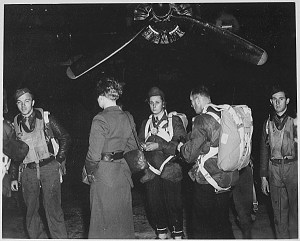
These limitations and strengths define the distinct airborne battlefield. Clearly, the challenges are great. The paratrooper’s struggle starts long before he closes with the enemy. Airborne soldiers normally arrive tired and exhausted. They have endured the process of dressing and waiting fully kitted for long periods. It was not uncommon for individuals to be weighed down with a hundred pounds of equipment, not including their parachute assembly. Air crewman Martin Wolfe recalled pushing paratroopers with up to 125 pounds of gear into his aircraft. “With our gear,” asserted Colonel Ivan Hershner, “the average man weighed about three hundred pounds that night [June 6, 1944].”
That exhausting burden could have an enormous impact on the actual jump. “I got a good opening, tore a few sections in my chute, which was not unusual when you were loaded up with equipment,” recalled Edward J. Cole of his drop onto Tagaytay Ridge in February 1945. “[I] reached up to grab my risers and hit the ground,” he explained. “I didn’t have a chance to release my jump rope…we had jumped at about four hundred fifty feet with full equipment.” With the enormous weight and low jump altitude, his descent was rather quick, and his experience was common.
Once on the ground, the paratrooper had to ignore exhaustion as well as numerous abrasions and bruises, if not more serious injuries such as sprains or fractures. The battle on the ground now began, and ordinarily the paratrooper was the first to fight. His mission behind enemy lines often placed him in direct contact with the enemy before he was fully prepared. The airborne insertion of the Poles at Arnhem in September 1944 placed them directly into a raging battle. As a result, both sides fired on them.
As the drone of the aircraft engines faded away, paratroopers were normally on their own. They had no rear, no sanctuary they could return to, no pipeline connected to ships or friendly lines. There are “very special dangers that are a combat paratrooper’s particular lot,” said General Matthew B. Ridgway, wartime commander of the 82nd Airborne Division. “The quick leap out of the plane into the buffeting prop wash, the slow float down, hanging helpless in the harness, the drop into the darkness where armed enemies wait behind every bush and tree.” Similarly, Brig. Gen. Richard Gale, founder of the British 1st Parachute Brigade, insisted that the paratrooper “is aware, too that once on the ground his future lies in his own skill. The gun that he carried down in his drop and the small supply of ammunition on his person are his only weapons for support in either attack or defense. His water and food are what he can carry when he jumps. His sense of direction, his field-craft and in map reading and his physical strength must all be of a high order. He may be alone for hours, he may be injured, and he may be dazed from his fall. But it is his battle and he knows it.”
“A parachutist fights a lonely battle,” British Lt. Gen. Sir Michael Gray stressed. “He has no real front or rear, he often feels he is fighting the battle on his own.”
Drops were widely dispersed and scattered, and units were faced with the task of completing their missions understrength and lacking important equipment. Within this devil’s cauldron, it is not surprising that airborne soldiers suffered a higher ratio of casualties than other combat troops. “Jumping out of airplanes was romantic as hell,” critiqued one detractor, “but also dangerous and wasteful of lives; what it did was put a very high premium on bravery of a certain kind.”
Casualty statistics tell the tale. Of two thousand German airborne troops (22nd Infantry Division–Airlanding) assigned to capture The Hague in the Netherlands on May 10, 1940, 40 percent of the officers and 28 percent of the men were killed. That same day, the Fallschirmjäger that attacked the Belgian fortress of Eban Emael suffered 30 percent casualties. Almost a year later, German paratroopers suffered 58 percent casualties during their invasion of Crete, with a full quarter of the participants killed. “We paid dearly for our victory,” Adolf Strauch concluded. “Our victory was no victory.”
The British parachute commando action at Tragino, Italy, cost them the entire raiding force. Soviet paratroopers suffered 71 percent casualties during their desperate battles around Vyazma and Moscow from January to March 1942. The German Waffen SS Paratroop Battalion suffered 62 percent casualties in its raid on Tito’s headquarters in Yugoslavia in May 1944, and approximately 80 percent of the British 1st Airborne Division was lost during Operation Market-Garden in September of that same year. The 82nd Airborne Division incurred 27 percent casualties in Sicily and 46 percent in Normandy.
In the overall American experience of World War II, over 30 percent of all airborne personnel became casualties. This compares to only 10 percent among regular infantry formations.
That the airborne battlefield exacts a higher price can be easily understood. On this battleground the situation is often unclear. A paratrooper frequently finds himself totally alone, and is never fully sure who or how many will actually arrive on the objective in time to assist in the battle. Only an exceptional combat soldier survives in these ambiguous, hostile surroundings. Neither rank nor position hold privilege.
For example, during the assault on Sicily, many gliders crashed into the Mediterranean Sea. One survivor clinging to the wreckage of his stricken aircraft was British Maj. Gen. George F. Hopkinson, commander of the 1st Airborne Division. Similarly, during the invasion of Normandy, the U.S. 1st Battalion, 501st Parachute Infantry Regiment, was not only badly scattered but its commanding officer was killed, the battalion second-in-command was captured, and all four company commanders were missing. “The scattering had an operating influence on the whole battle,” disclosed paratroop veteran Dan Hartigan. “We lost more than fifty percent of our officers on D-Day, fifteen of twenty-seven.”
Required to act independently, all airborne soldiers had to be prepared to carry on the mission by themselves. “When its [airborne division] people hit the ground,” declared General Ridgway, “they are individuals, and a two-star general and a Pfc are on exactly the same basis.” Elaborating, he stressed the complexity of operating alone: “You have no communications whatsoever for some little time, particularly when you have jumped at night. You don’t know where you are. You don’t know who’s around you, friend or foe.”
Without question, the airborne battlefield required an aggressive individual with courage, initiative, and tenacity, as well as mental alertness and exemplary combat skills. Paratroopers had to be capable of adapting to unforeseen situations, and above all else they had to be self-reliant.
To identify these individuals, airborne forces used special selection processes and rigorous training methods. In the end, the formidable entrance requirement and grueling training designed to weed out all but the fittest and most aggressive created a distinct airborne mentality: no mission too daunting, no challenge too great.
In summary, Brigadier James Hill simply described parachute troops as the best fighting material in the world. Hill stated that he believed “the parachutists have shown themselves magnificent infantry, pre-eminent in physique and steadiness of nerve, born guerrilla fighters, mobile and tireless, tremendous marchers, and of an undefeated spirit.” Even George C. Marshall, the American army chief of staff, declared, “The courage and dash of airborne troops has become a by-word and is a great inspiration to all others.”
These accolades were well earned. Paratroopers proved themselves as aggressive, resilient, tenacious fighters capable of overcoming adversity. For example Cornelius Ryan wrote, “When tracer bullets began ripping through his canopy, Private Edwin C. Raub became so enraged that he deliberately side-slipped his chute so as to land next to the anti-aircraft gun. Without removing his harness, and dragging his parachute behind him, Raub rushed the Germans with his Tommy gun. He killed one, captured the others, and then, with plastic explosives destroyed the flak-gun barrels.”
In another example of tenacity over adversity, Sergeant Bullock, from the British 9th Parachute Battalion, and a handful of others were dropped almost thirty miles inland in Normandy. They reported to their units four days later with evidence to show that they had killed numerous enemy troops, including twenty senior German officers. Yet another example of the airborne spirit is the famous incident of Royal Engineer Captain Eric Mackay relaying his CO’s refusal at Arnhem to surrender despite the fact they were cut off, completely surrounded, and had suffered horrendous casualties. “Get the hell out of here,” he yelled at the German Waffen SS soldier who had come forward to offer terms. “We’re not taking any prisoners.”
The prowess of airborne forces lay in their ability to transcend the brutality and unforgiving nature of the airborne battlefield. “The mainspring of these forces,” insisted renowned American soldier and military historian S.L.A. Marshall, “lay in the spirit of the men. They moved and hit like light infantry and what they achieved in surprise more than compensated for what they lacked in fire power.”
General Richard Gale came to the same conclusion. “In the end,” he extolled, “it all boils down to the individual and it is he that counts. Be alert, be vigilant and be resourceful. What you get by stealth and by guts you must hold with skill and determination.”
Military historian Clay Blair wrote that the 82nd Airborne Division emerged from Normandy with the reputation of being “a pack of jackals; the toughest, most resourceful and bloodthirsty infantry in the ETO [European Theater of Operations].”
It was their ability to overcome their daunting environment that set parachutists apart. “Their duty lies in the van of the battle; they are proud of this honour and have never failed in any task,” wrote Field Marshal Montgomery. “They have the highest standards in all things…[and] they have shown themselves to be as tenacious and determined in defence as they are courageous in attack.” They are, he concluded, “men apart—every man an Emperor.”
Only those hardened to adversity, resilient to the stress of the unknown, and capable of adapting to ever-changing circumstances could survive in the devil’s cauldron that was the airborne battlefield.
This article by Bernd Horn was originally published in the Summer 2006 issue of MHQ Magazine. For more great articles, subscribe to MHQ magazine today!