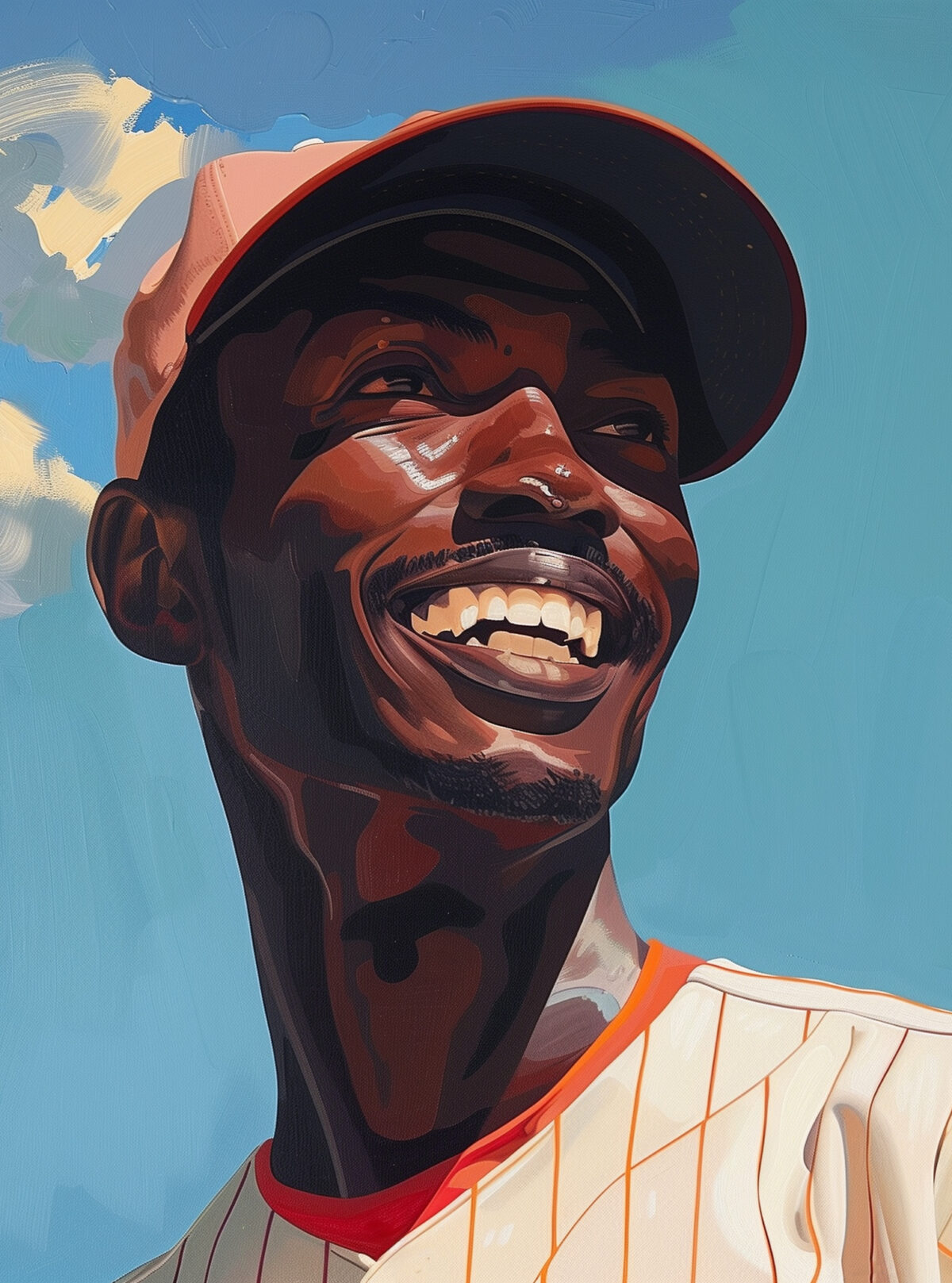
Imagine major-league baseball without such stars as Albert Belle, Ken Griffey, Jr., or ‘Mo Vaughn, three of the best players in the game today. Deprived of the tremendous skills that they and many of their African-American colleagues display, this country’s national pastime would be a mere shadow of the game loved by so many. Yet, had Jackie Robinson not broken baseball’s color line in 1947, these players—simply because of their race—might never have gotten the chance to play. Indeed, for many of the nation’s best ball players before 1947, this unfortunate scenario was the reality.
Segregated baseball lasted sixty years, from 1887 when Adrian Cap Anson, the Babe Ruth of his day, tried to order a black opponent off the field, until 1947 when Jackie Robinson took his place in the infield at Ebbets Field in Brooklyn. During that time, many of the most gifted players ever to grace a baseball diamond pitched, hit, and ran their way into baseball immortality, with much of America unaware of their existence.
Some of these great players—men like Satchel Paige, Roy Campanella, and later, Henry Aaron—having benefited from Robinson’s historic move to the big leagues, followed him there. However, many other black standouts, including Josh Gibson, John Henry Lloyd, Smoky Joe Williams, James Thomas Cool Papa Bell, and Oscar Charleston missed out.
African Americans have played baseball since the game’s beginnings in the mid-nineteenth century. They can trace their professional ties within the sport to John Bud Fowler, who was born, appropriately enough, in Cooperstown, New York, in 1854. Fowler played briefly for a white professional team in New Castle, Pennsylvania, in 1872, but was eventually forced to admit that My skin is against me. The second black professional, Moses Fleetwood Walker, a graduate of Oberlin College, played for Toledo in the American Association in 1883. When the Association became a major league for one year in 1884, Moses and his brother Welday became the first two black big-leaguers, beating Jackie Robinson by 63 years.
Following Walker’s lead, several other black players quickly joined minor-league teams. A diminutive second baseman, Frank Grant, played with Buffalo in the International League from 1886 to ’88, batting .340, .366, and .326 in his three seasons there. Grant drew a lot of walks, as pitchers tended to aim at his head rather than at the catcher’s mitt. The International League also produced pitcher George Stovey, a black Canadian who won 33 games for Newark one year, while losing only 4. When the white leagues passed a rule ousting black players, Grant and Stovey joined the Cuban Giants, the first black, major-league-caliber professional team.
In 1902, Andrew Foster, a preacher’s son from Texas then pitching for the black Philadelphia Cuban X-Giants, defeated the Philadelphia Athletics’ star pitcher, Rube Waddell in an exhibition game. That feat earned Foster the nickname Rube, which he carried the rest of his life. By 1905, the Pittsburgh Pirates’ star shortstop, Honus Wagner, was calling Rube the smoothest pitcher I’ve ever seen. Foster later went on to form one of the great teams of all time, the Chicago American Giants. And in 1920, he assembled eight teams into the Negro National League, the first successful black baseball league and the model for the Negro Leagues that flourished for many years.
In an age of unlettered, rough-neck ballplayers, a gangling shortstop from Florida named John Henry Lloyd, whose foulest oath was Gosh bob it!, was the gentleman of black baseball, much as Christy Mathewson was the model gentleman of white baseball at that time. Lloyd scooped up ground balls, dirt and all. He cradled his bat in the crook of his elbow and hit stinging line drives to all fields. His lifetime average of .350 was the third highest in the history of the Negro Leagues, and during games against white big-leaguers he batted .306. Inevitably, Lloyd was dubbed the black Wagner, leading Honus to reply softly that he was proud to be compared with such a great player.
Another of the early black stars was Joe Williams. In 1917, he bested Walter Johnson, the greatest pitcher in white baseball, by a score of 1-0. During his career, he also beat Grover Cleveland Alexander and five other Hall of Famers. In the fall of 1917, Williams struck out twenty of John McGraw’s New York Giants in ten innings, while giving them only one hit. A Giant player approached Williams after the game and told him, That was a hell of a game, Smoky; from then on, the pitcher was known as Smoky Joe.
Oscar Charleston, another renowned black player, was a tough ex-soldier who hit with Babe Ruth’s power, ran with Ty Cobb’s slashing speed, and played a tremendous center field. Twice he led the Negro National League in both home runs and stolen bases. Reportedly strong enough to loosen a baseball’s cover with one hand, and fearless enough to snatch the hood from the head of a Ku Klux Klansman, Charleston was sometimes called the black Cobb. But those who saw both men disagreed. Cobb, they said, was the white Charleston.
Because accurate statistics are often lacking, it is difficult to say how good many of these black players were, but based on their exhibition play against their professional white counterparts during the pre-Robinson years, it is clear that they were exceptional. Black teams opposed white professional teams in more than four hundred barnstorming games between the 1890s and 1947, and came away winners sixty percent of the time. White stars like Babe Ruth, Ty Cobb, Bob Feller, Honus Wagner, Jimmie Foxx, and Christy Mathewson were glad to make extra money in games against blacks, and their testimony attests to the considerable skills of their opponents.
Cuba had formed a professional baseball league as early as 1879, and American big-league teams eventually began to schedule exhibition games against black and Cuban teams each October. In the fall of 1910, the Detroit Tigers, led by Cobb, traveled to the island for a series with the Havana Stars, who had borrowed John Henry Lloyd from the Leland Giants. Cobb sat in the dugout before one of the games, ostentatiously filing his spikes and pointing to Lloyd as if to say, This is for you. The first chance he got, Cobb dashed for second on a steal attempt, but Lloyd, who was wearing a pair of cast-iron shin guards under his socks for protection, simply knocked the surprised Tiger aside. In five games, the frustrated Cobb was held without a stolen base.
By 1924, Rube Foster’s Negro National League was being challenged by the new Eastern Colored League, and black baseball was enjoying huge success. That year, the Philadelphia Hilldales and Kansas City Monarchs met in the first Negro Leagues World Series. But by 1930, the Great Depression that followed the stock market crash of the previous year threatened to kill the Negro Leagues, and perhaps the white minors as well. In desperation, the Kansas City Monarchs’ owner, a gentle, kindly white man named J. L. Wilkinson, sank his life savings into a set of revolutionary portable lights. On April 6, five years before the first major-league night game, Wilkinson, to the delight of a crowd in Enid, Oklahoma, set up his lights, and the umpire yelled Play ball!
Three months later, under the lights at Pittsburgh’s Forbes Field, the Homestead Grays’ catcher suffered a broken finger when he lost a pitch in the shadows. A teenager named Josh Gibson, famous locally for his mammoth home runs on the sandlots, was asked by Grays’ owner Cum Posey to fill in for the injured catcher, and thus a star was born. Over the next 17 seasons, the powerful Gibson built a reputation as the Negro Leagues’ most feared slugger.
During his rookie campaign, Gibson smashed a ball over Forbes Field’s center field fence, 457 feet away. Only three other men—Oscar Charleston, Mickey Mantle, and Dick Stuart—ever duplicated that feat. Later, in New York’s cavernous Yankee Stadium, Gibson blasted a five-hundred-foot line drive off the back of the left field bullpen between the grandstand and the bleachers. The pulverized ball came within two feet of being the only fair ball ever hit out of the house that Ruth built.
By 1932 Gibson, along with fellow future Hall-of-Famers James Cool Papa Bell and Satchel Paige, had signed with the Pittsburgh Crawfords, forming perhaps the greatest Negro League team of all time. Bell was so fast on the basepaths that, according to Paige, he could turn off the light and jump in bed before the room got dark. Once, while batting against the great St. Louis Cardinals pitcher Dizzy Dean, Bell scored from second base on a Gibson sacrifice fly, and it was not unknown for him to score all the way from first base on a bunt. For his part, the witty Paige, gifted with a great fastball and excellent control, was surely the best known black player in America; he and Gibson formed one of the best pitcher-catcher batteries in baseball history.
Gibson hit many of his home runs in two of the toughest parks for a right-handed hitter—Forbes Field, which measured 365 feet down the foul line, and Washington, D.C.’s Griffith Stadium, whose left-field fence stood 408 feet from home plate. And Gibson did not simply feast off easy pitching. In 15 games against white big leaguers, he batted .415 and averaged one home run every three games. There is no telling what records he might have set had such small parks as Boston’s Fenway Park or Brooklyn’s Ebbets Field been on his playing circuit. In 1942, word spread that several major-league clubs were talking about signing black players. Gibson, along with Paige and Campanella, were mentioned, but in the end, nothing came of it.
That October, Gibson faced Paige in the Negro Leagues World Series. It marked one of those magic moments that would have lived forever in legend if it had happened in the majors. Gibson had told a reporter that he hit Satchel just like any other pitcher, so Paige gave him the chance. With the game and the series on the line, he deliberately loaded the bases in order to pitch to Gibson; then he taunted him. You been talkin’ about how you can hit me, he called to Gibson at the plate. I ain’t gonna trick you. I’m gonna throw you fastballs at the knees. Let’s see if you can hit one. Paige then threw three sidearm fastballs, all of which Gibson took for strikes. The flamboyant pitcher strutted off the mound, reveling in what was for him the biggest day of my life.
In 1945, the Monarchs’ Wilkinson signed ex-Army lieutenant Jackie Robinson to a contract. The rookie set the league on fire that season, hitting at a .387 clip over 47 games. When rumors spread that big-league scouts were watching him, old-timers in the league worried that Jackie, then a shortstop, did not have the range or the arm for that position. They feared that if he missed his chance in the majors, it would be many years before another black athlete would get such an opportunity. In addition, they felt that Jackie, although gifted with raw speed, needed to learn the tricks involved in stealing bases. Veterans like Cool Papa Bell, too old to make the majors themselves, coached Robinson on technique and convinced him to shift to second base. Meanwhile, Oscar Charleston, who had been hired by Branch Rickey as a scout, urged the Brooklyn Dodgers’ president to sign Negro League catcher Roy Campanella.
Back in 1920, Rube Foster had predicted that if the Negro Leagues maintained a high caliber of performance on the field, the players would be prepared to answer the call when the major leagues were ready to open their doors. By 1947, despite the fact that most of the major-league teams were not ready to accept blacks, Jackie Robinson made his historic walk onto the Dodgers’ Ebbets Field, breaking the color line for good.
Three months before that historic day, a broken-hearted Gibson, having longed for a shot at the big leagues, died suddenly at the age of 36 from a drug overdose. That October, in an exhibition game against a big-league all-star team in Los Angeles, Cool Papa Bell walked, and Satchel Paige followed with a sacrifice bunt. Bell, his 42-year-old legs in bandages, streaked for second and on to third. The third baseman came in to field the ball, and the catcher ran to third to cover that base. Bell brushed past them both to score all the way from first. It was a symbolic moment for the two talented veterans, and perhaps the last hurrah for the old Negro Leagues.