
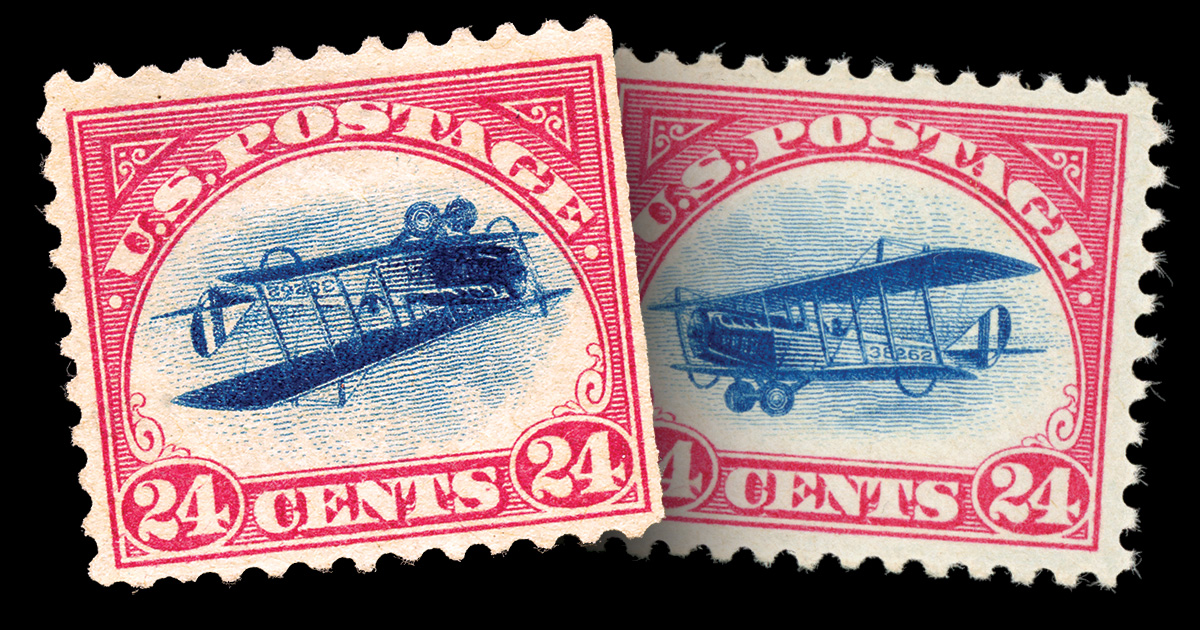
On November 8, 2023, a collector paid more than $2 million for a postage stamp. It was not just any stamp—it was an example of the famous “inverted Jenny” issue from 1918.
The story begins with a hurriedly issued U.S. Post Office press release stating that special 24-cent airmail postage stamps would be issued in Washington, D.C., on May 13, 1918, and the next day in Philadelphia and New York City. They depicted the Curtiss JN-4 “Jenny” and would be available for use in connection with the first and subsequent airmail flights.
On the 13th, William T. Robey, a stock brokerage clerk and an ardent stamp collector, went to the window of a post office in downtown Washington, D.C., near his office and was issued a full sheet of 100 of the new stamps, for which he had just withdrawn money from his savings account.
Robey took one look as the clerk slid the sheet toward him, and, as he later recalled, his “heart stood still.” For a stamp collector, he was experiencing the thrill of a lifetime. The entire sheet of two-color stamps with an airplane in the center had the engraving of the airplane upside down!
Without acknowledging what he had just received, Robey asked for three more sheets, but all were printed correctly. “I handed them back to the clerk,” Robey said in a 1938 article, “and then showed him the sheet that I had purchased and drew his attention to the fact that the airplane was upside down. Without any comment, he left the window and ran for a telephone. Needless to say, I left that office in a hurry with my sheet of inverts tucked safely under my arm.”
Robey returned to his office and told a friend. The friend immediately set out to find similar sheets in other post office branches but was unsuccessful. During his inquiries, the friend mentioned Robey’s name and where he worked. Within a short time, Robey was visited by two postal inspectors who offered him a sheet of “good” stamps for his sheet of inverts. It was an offer Robey had no trouble refusing. He knew that he had a valuable find and that there was no law which said he had to give his sheet back. The only thing he did not know was just how valuable his acquisition was.
Robey went to New York City and made the rounds of stamp collectors to get appraisals. He received offers varying from $2,500 to $15,000 for the entire sheet and finally sold it for the latter figure to Eugene Klein of Philadelphia for a profit of $14,976. Klein sold the sheet later for $20,000 to Colonel E.H.R. Green, a well-known collector. Green later decided that he would break up the sheet of 100 so that other collectors could obtain some of the coveted stamps. Besides, as he predicted accurately, breaking up the sheet would enhance the value of the stamps.
The Post Office Department, as might be expected, did not enjoy the publicity given its most notorious printing error. The unsold sheets in the three post offices that distributed them originally were called in and the printing plate was altered so that the word “top” was added for the benefit of the printers who had to run the stamp through red and blue printings. Only a limited issue of this stamp was made.
Public interest in sending mail such a short distance by air decreased quickly. In July 1918, the price of an airmail stamp was lowered to 16 cents and a green stamp was issued. In December, a 6-cent airmail stamp was distributed for sale.
The value of the famous upside-down stamps has escalated rapidly over the years. A block of four (there are seven such blocks known to exist), which is the largest multiple of this stamp, was purchased in the 1960s for $100,000; singles sold for about $4,000. In 1989, after an auction at Christie’s in New York, a block of four inverts resulted in this headline in The New York Times: “$1 Million Stamp Sale Is Record for U.S. Issue.” It was the highest price ever paid for an American philatelic item. On November 8, 2023, collector Charles Hack paid more than $2 million for one. Hack had previously purchased two, but his most recent acquisition was the only one of the 100 still unaccounted for when it emerged in 2018. It had been stored in a safe-deposit box for a century and was in mint condition. Hack tried to buy it then, but his bid fell short. That wasn’t the case this time.
Just as they have copied priceless paintings, money, and other man-made items that have a high value, counterfeiters have made copies of this famous philatelic mistake. Stamp dealers and collectors, however, are wary of such efforts and so far have been able to spot the fakes without too much difficulty.
Although millions of airmail stamps have been printed by the United States and other nations over the years, the original 24-cent airmail stamp of 1918 is considered by most collectors to be the outstanding airmail stamp of all time. It was not only the first airmail stamp printed in the United States and the Western Hemisphere but also the world’s first “definitive” airmail stamp (i.e., based on a regularly scheduled airmail service). There were other firsts, too—first stamp to depict an airplane and first stamp to be printed in two colors. But it’s that other first that makes the 1918 24-center most memorable: the first airmail stamp to be printed and distributed with a mistake.