Paleontologists Edward Drinker Cope and Othniel Charles Marsh were great rivals, and their mutual animosity fueled the search for fossils in theAmerican West.
By Tom Huntington
In the latter half of the nineteenth century, scientists as well as society at large were fascinated by the ancient, often enormous, fossils that were being unearthed in great quantities from North America. Many of the most exciting finds were due largely to the efforts of two men, Edward Drinker Cope and Othniel Charles Marsh, who stood at the forefront of vertebrate paleontology. Between 1870 and the late 1890s, the two men classified 136 new species of North American dinosaurs. Scientists had previously known of only nine.
The extinct animals that Cope and Marsh introduced to science include many dinosaurs commonly known today, such as Triceratops, Allosaurus, Brontosaurus, Diplodocus, and Stegosaurus. They also named and catalogued innumerable, long-vanished species of mammals, fish, and birds. Today, more than a century after their great discoveries, the names Cope and Marsh–like Lewis and Clark or Stanley and Livingstone–remain linked together in history books. Unlike these other famous duos, however, Cope and Marsh hated each other with a passion.
As their intense competition to uncover dinosaur bones raged across the fossil fields of the American West, Cope and Marsh quarrelled continuously in the press and amid the government circles of the nation’s capital. As a result, not all of the animals that they described became permanent additions to the roster of extinct species. Their race for preeminence sometimes caused the two paleontologists to give different names to the same species and announce discoveries of new animals without having adequate evidence. Yet while their mutual hatred often expressed itself in petty ways, it did spur activity in the field and greatly increased man’s knowledge of extinct creatures.
Born in 1831, Othniel Charles Marsh inherited at age 21 a dowry that his rich uncle, George Peabody, had provided for Marsh’s mother. He used the money to attend preparatory school where his advanced age earned him the nicknames “Daddy” and “Captain.” After graduating valedictorian, Marsh decided to pursue a career in the sciences, and he persuaded his uncle to finance his education at Yale College. He earned an undergraduate degree there in 1860 and a master’s degree from Yale’s Sheffield School of Science two years later. The scholar then traveled to Europe to study, and while visiting his uncle in England Marsh approached him with the idea of awarding money to Yale for a museum of natural sciences, which Marsh could run as a professor. After some negotiation–Peabody preferred Harvard–Marsh got his way. In 1866 he became the first professor of paleontology in North America.
Unlike Marsh, Edward Drinker Cope was an early achiever. Born in 1840, at the tender age of six he recorded his impressions of a fossil known as Icthyosaur. When Cope was 18 he published a scientific paper on salamanders, the first of some 1,400 writings he would produce in his lifetime. Like Marsh, he was attracted to the natural sciences, but Cope’s education consisted of briefly attending the University of Pennsylvania, studying abroad, and working at the Academy of Natural Sciences in Philadelphia. Cope’s Quaker father sent his son to Europe not only to study, but to keep the volatile young man from signing up to fight in the Civil War. Both Marsh and Cope were attending Germany’s Berlin University in 1863 when they met and initially became friends. A year later Cope returned to the United States and joined the faculty of Pennsylvania’s Haverford College as professor of zoology and botany. In 1867 he left Haverford and moved to Haddonfield, New Jersey, to study fossils found there.
At that time, the study of dinosaurs was relatively new. British scientist Richard Owen had coined the word “dinosaur” (from the Greek word for “terrible reptile”) in 1841. Discoveries made in the United States, however, soon revised Owen’s hypothesis of low-slung, lizard-like creatures. In 1855 fossil-hunter Ferdinand Hayden found some Iguanodon-like teeth in Montana that were the first North American fossils determined to be from dinosaurs. But it was Joseph Leidy’s study of the fossils found in Haddonfield in 1858 that changed the conventional view of the creatures. These bones from a dinosaur called Hadrosaurus showed that the animal must have walked erect rather than on all fours like a lizard. The find attracted both Marsh and Cope, and the two men spent a week together in 1868 exploring the fossil fields there.
perhaps marsh and cope were fated to clash. Both men were notoriously flawed personalities competing in a relatively exclusive field. Paleontologist William Berryman Scott sided with Cope but was forced to admit that “Despite his greatness–in some measure, indeed, because of it–he had some unfortunate personal peculiarities, was pugnacious and quarrelsome and made many enemies.” Scott had even worse to say about Marsh. “Indeed, I came nearer to hating him than any other human being that I have known,” he wrote. Marsh, who never married and had few if any intimate friends, earned the nickname “The Great Dismal Swamp” at one of his clubs. Throughout his life his detractors said that he was autocratic and petty; that he appropriated the work of his assistants and published it under his own name; and that he was a tightwad who never paid his employees on time.
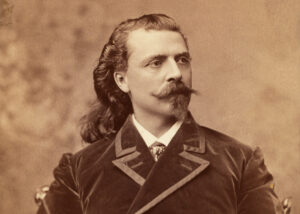
Marsh and a dozen students set out on his first Yale-sponsored expedition in August 1870. He picked up an army escort in Nebraska and explored portions of Kansas and the territories of Wyoming and Utah. (For one day his guide was “Buffalo Bill” Cody.) The expedition returned to Yale in December with 36 boxes of specimens, which included a hollow bone fragment that appeared to be from the wing of a flying reptile known as a Pterodactyl. Marsh himself had found the fossil in a narrow canyon in western Kansas. He calculated that the creature must have had a wingspan of 20 feet, “truly a gigantic dragon even in this country of big things, where hitherto no Pterodactyl large or small had yet been discovered.”
As the race to discover extinct species intensified, Cope and Marsh began to clash. In 1872 Cope attempted to search for fossils in a part of Wyoming Territory that Marsh considered his turf. “Thus began the intense rivalry in field exploration and the bitter competition for priority of discovery and publication, which led to an immediate break in the previously friendly relations between Cope and Marsh,” wrote Henry Fairfield Osborn in his biography of Cope. By 1873 the two were exchanging heated letters. Marsh was particularly incensed when Cope temporarily lured away one of his field collectors, Sam Smith, and then somehow gained possession of Marsh’s fossils. “The information I received on this subject,” Marsh wrote to Cope, “made me very angry, and had it come at the time I was so mad with you for getting away Smith I should have ‘gone for you,’ not with pistols or fists, but in print . . . . I was never so angry in my life.”
The dinosaur rush began in earnest in 1877 after a mining teacher named Ar-thur Lakes wrote to Marsh about fossil bones he had discovered near Morrison, Colorado. When Marsh did not reply, Lakes sent some samples to Cope. That move galvanized Marsh, and he quickly sent $100 to Lakes, who dutifully asked Cope to send the bones on to his rival. Marsh then dispatched one of his field collectors, Benjamin Mudge, a professor at the Agricultural College of Kansas, to look over Lakes’ find. “Satisfactory arrangement made for two months,” Mudge cabled back, adding that “Jones”–code for Cope–“cannot interfere.” Within a few weeks Mudge and Lakes shipped a ton of bones back east. The shipment included the first remains of a Stegosaurus.
At about the same time that Lakes made his discovery, another Colorado teacher, O.W. Lucas, found fossil bones near Cañon City, Colorado, and contacted Cope. Unlike Marsh, Cope responded quickly. Among the first specimens Lucas sent to him were the vertebrae of a huge animal that Cope named Camarasaurus (chambered reptile) after its hollow bones. Yet Lakes had come upon portions of the same species of creature, and Marsh had already named it Titanosaurus. Marsh had published first, and according to scientific tradition he won the right to name the animal. Cope declared that Marsh’s designation was already taken, and Marsh changed the name to Atlantosaurus.
Taken all together, Cope’s Colorado fossils were preferable to Marsh’s, because they were larger and easier to remove from the surrounding rock without breaking. In the spirit of underhanded competition that would characterize the relationship, Marsh asked Mudge to woo Lucas over to his side, but the schoolmaster remained loyal to Cope. For his part, Cope would try several times to win over Mudge, to no avail.
Marsh got his chance to trump Cope in July 1877, when he received a letter from William Reed and W. E. Carlin, two railway workers from the Como, Wyoming, station, who wrote that they had discovered “a large number of fossils.” Marsh sent collector Samuel Williston to check out their find. Williston cabled back, “They tell me the bones extend for seven miles and are by the ton . . . . The bones are very thick, well preserved, and easy to get out.” Perhaps even more important, he added, “I think for three months the matter can be kept perfectly quiet & by that time I hope you will have the matter all your own.”
The site at Como Bluff proved to be a mother lode of dinosaurs from the Jurassic Period, a stage in the Mesozoic Era that ended 135 million years ago. In the first year of digging alone, Marsh’s men shipped 30 tons of bones east, including those of Allosaurus, Diplodocus, Stegosaurus, Camptosaurus, and many others. From Como came another dinosaur, Brontosaurus (“thunder lizard”), which Marsh had the privilege of naming. Although perhaps the world’s best known dinosaur, the designation Brontosaurus was eliminated on a technicality. After Marsh’s death paleontologists determined that his Brontosaurus was really another example of a dinosaur Marsh had earlier named Apatosaurus.
Digging for dinosaur remains wasn’t easy. The men working for Cope and Marsh had to carefully extract the fossil bones from the surrounding rock, laboring through searing summer heat or frigid winter cold. They toiled in the West during a time when hostile Indians were a very real threat.
Cope and Marsh made occasional visits to the digs but usually continued their feud by proxy. After the discovery at Como Bluff, Reed became one of Marsh’s best collectors while Carlin transferred his allegiance to Cope. The competition between the rival camps grew in intensity and animosity. If Reed accumulated more bones than he could use, he smashed them so Carlin wouldn’t get them. Marsh’s man Samuel Williston was so paranoid about Cope that when a man arrived at his camp one day in 1878, Williston contrived to obtain a handwriting specimen to determine if the man was really Cope in disguise.
One day a year later, Cope really did show up at a Marsh dig and managed to charm his rival’s men. Lakes wrote in his journal that Cope “entertained his party by singing comic songs with a refrain at the end like the howl of a coyote.” After Cope’s departure, Lakes wrote, “I must say that what I saw of him I liked very much his manner is so affable and his conversation very agreeable. I only wish I could feel sure he had a sound reputation for honesty.”
While Cope displayed genius in his work, Marsh had a financial advantage in the support he received from Yale and later the U.S. Geological Survey, which allowed him to hire many collectors. Some of them, like Williston and John Bell Hatcher, eventually went on to make their own names in paleontology. Williston, forbidden by Marsh from publishing in any competing fields, became an expert on extinct flies! Hatcher made his name recovering wonderful specimens of horned dinosaurs known as Ceratops, collecting portions of 50 of them between 1889 and 1892. The best-known example of these is a three-horned creature Marsh named Triceratops. Hatcher discovered it after some cowboys showed him horns they had broken off a huge skull embedded in the side of a canyon. They had tried to dig out the rest of the skull, which had “horns as long as a hoe handle and eye holes big as your hat,” but the fossil broke free and tumbled to the bottom of the canyon. Hatcher found and recovered the shattered skull.
In later years the Cope-Marsh battlefield shifted to Washington, D. C. Marsh proved himself an able power broker, and Cope saw his own prospects decline, helped along by poor investments that dried up his funds. In 1882 John Wesley Powell, director of the newly formed U.S. Geological Survey, named Marsh the survey’s vertebrate paleontologist. When the government cut off Cope’s funding for publication of work from an earlier survey, he suspected that Powell and Marsh were behind the decision. He haunted government offices in an attempt to get Congress to restore his funding. “A great deal depends on official position,” he wrote bitterly to his wife. “It regulates everything, especially society. It makes less difference what a man knows than what office does he hold. Hence inferior men like Powell and Marsh may have great influence, simply because they have gotten position. It makes little difference how this was done.”
For Cope, the last straw came in December 1889 when the secretary of the interior ordered him to turn over some of his specimens to the government. Cope, who had collected the specimens at his own expense, was outraged, and he went on the attack, using the press as a weapon. “I don’t think writing private letters of a critical kind to such hardened sinners as Marsh and Powell does the least good; especially in the case of Marsh,” he wrote to another paleontologist. “But when a wrong is to be righted, the press is the best & most Christian medium of doing it. It replaces the old time shot gun & bludgeon & is a great improvement.”
On January 12, 1890, the New York Herald printed the first of a series of articles about the feud. Cope had been preparing his attack for years, and he let loose with everything he had. “Unable to properly classify and name the fossils his explorers secured,” Cope said, Marsh “employed American and foreign assistants who did the work for him and to which he has signed his name.” After citing a number of works that Marsh had allegedly either plagiarized or had his assistants write, Cope did give his rival credit for one work–“the most remarkable collection of errors and ignorance of anatomy and the literature on the subject ever displayed.”
Powell counterattacked in the same article. Cope, he said, was what he considered a “species fiend,” one who would “ransack the earth for leaves or bones or fragments of shell and then rush into print that their names may be quoted as the discoverers.” The fact that Marsh was equally culpable apparently didn’t trouble him. Powell wrote that “. . . Professor Cope’s mental and moral characteristics unfit him for any position of trust and responsibility. In addition to his great vanity, which leads him into vicious species work, he is inordinately jealous and suspicious of every other worker, and these two traits combined give him that hysterical temper and gift of voluble denunciation rarely found in persons of his sex.”
Marsh’s comments appeared a week later. “If my language may seem severe,” he wrote in a tone of pained resignation, “it should be remembered that for ten years I have suffered these attacks in silence, because it seemed to be due to the positions I have held to abstain from all personal controversy.” He went on to describe his first meeting with Cope in 1863, claiming that even then he had “some doubts as to his sanity.”
He saved his most damning story for last: the tale of the Elasmosaurus. In the 1870s Cope had written extensively about this large aquatic reptile, and he had set up a reconstructed skeleton at the Philadelphia Academy of Sciences. When Marsh examined the skeleton, he told the Herald, he noted that Cope had transposed tail and neck. “When I informed Professor Cope of it,” Marsh reported, “his wounded vanity received a shock from which it has never recovered, and he has since been my bitter enemy.” Furthermore, Marsh contended that Cope then attempted to recall all the copies of his scientific paper with drawings of the incorrect restoration. “I returned to Professor Cope at his request the one he sent me,” Marsh said, “but have two others, which I since purchased.”
The newspaper battle petered out on January 26. According to William Berryman Scott, who was quoted in support of Cope, the Herald series “was not even a nine days’ wonder; it fell completely flat.” But Cope’s attack may have merely taken time to hit home. In 1892, Congress, eager to cut government spending, pounced on Marsh’s work for the Geological Survey as an example of waste. Some congressmen thought the professor’s book about extinct birds with teeth, called Odontornithes, was particularly disgraceful. It was irrelevant that Marsh had paid for the publication himself, or that Charles Darwin commented that the book “has afforded the best support to the theory of evolution, which has appeared within the last 20 years.” The phrase “birds with teeth” became a catch phrase for government waste, and paleontology became the perfect place to start trimming the budget. As a result, Powell sent Marsh a telegram on July 20: “Appropriations cut off. Please send your resignation at once.” With the Survey’s financial support gone, Marsh was forced, for the first time in his career at Yale, to accept a salary. He died in 1899.
Cope had died two years earlier and had willed his body to science as an anatomical specimen for students to study. But that wasn’t the end of his story. In 1993 a National Geographic photographer named Louis Psihoyos obtained Cope’s skull from the University of Pennsylvania and took it with him as he traveled around the world interviewing paleontologists for a book. He referred to the skull as “Eddie.” Later, he and paleontologist Robert Bakker tried to have the skull named as the “type specimen”–the standard of a species to which all others are compared–for Homo sapiens. “In all branches of Natural Science, type specimens are the lights that mark the present boundaries of knowledge,” wrote one scientist in the nineteenth century. “They should be, therefore, not will-o-the-wisps, leading unwary votaries of science astray, but fixed beacon lights to guide and encourage investigators in their search for new truth.”
Those words were written by Othniel Charles Marsh, and it’s safe to assume he wouldn’t have wanted them applied to his hated rival. In any event, the effort to turn Cope into a type specimen was a futile one. It turned out that Swiss botanist Carolus Linnaeus, the man who created the scientific naming system that classes specimens based on genus and species, had received that honor in 1959. Edward Drinker Cope had been trumped one last time.
Tom Huntington is editor of American History and Historic Traveler magazines.
[ Top ] [ Cover ]