
General Creighton W. Abrams returned to the United States in the summer of 1972 to become Army chief of staff, bringing with him certain highly classified materials relating to his service in Vietnam. When, in the autumn of 1974, Abrams died in office, his successor ordered that these materials be sequestered, with both their existence and their location classified top secret. For two decades they reposed in a vault at Carlisle Barracks in Pennsylvania, unknown to all but their Army custodians. Eventually, however, I learned of these materials from sources in the Army hierarchy who were friendly to my work, and subsequently I was granted access to them.
The heart of the collection turned out to be 455 tape recordings made over the four years of General Abrams’ tenure in command of MACV. It took almost exactly a year of weekdays to listen to the tapes, which contained an estimated 2,000 hours of recorded material, and to transcribe selected portions. These amounted to nearly 3,200 pages of single-spaced handwritten notes, most of them verbatim records of what was said — about 835,000 words in all — culled from the literally millions of words on the tapes. Recently just over half of that material has been published by Texas Tech University Press as Vietnam Chronicles: The Abrams Tapes, 1968-1972.
The result may be something unique in the field of military history, a contemporaneous account that enables us to listen in on periodic councils of war, and on the briefings and discussions that took place when high-level visitors came to Vietnam. It is as though, in an earlier era, we could have heard Napoleon and his marshals plotting their strategy, or George Washington and his generals laying plans for battles of the Revolutionary War.
The historical record of the Vietnam War is very rich, but only on these tapes do we get to hear senior participants and their supporting staffs interact on a continuing basis as they seek to deal with the challenges of the war in its every aspect. These participants are a collection of fascinating personalities, many of them larger than life — Abrams, Ellsworth Bunker, William Colby, Earle Wheeler, Melvin Laird, Stanley Resor, John McCain, Thomas Moorer, Fred Weyand, Sir Robert Thompson, plus a collection of usually anonymous and often brilliant briefers and analysts.
The topics with which they wrestle are equally interesting — a diverse and comprehensive picture of the war in all its aspects. Thus a number of engrossing stories run through the tapes and the years they reflect.
These include changes in concept of the nature of the war and of strategy and tactics for its conduct, development of South Vietnam’s armed forces, the pacification program and neutralization of the enemy infrastructure among the rural populace, progressive withdrawal of American forces, intelligence breakthroughs in monitoring infiltration down the Ho Chi Minh Trail, interdiction of traffic on the trail, combat incursions into Cambodia and Laos, major battles culminating in the 1972 NVA Easter Offensive, land reform, enemy adaptations to changes in their battlefield fortunes, maturation of South Vietnam’s leadership, resumption of the air campaign against North Vietnam, political-military relations in Washington as they affected American leaders in Saigon, increasingly difficult budget strictures, the impact of negotiations in Paris on conduct of the war and, of course, the interplay of colorful and sometimes volatile American and Vietnamese personalities. In short, the tapes reveal new secrets, resolve old arguments and provide fresh insights into the latter years of America’s participation in the Vietnam War.
INTELLIGENCE
 |
|
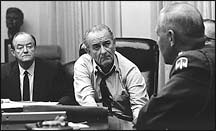
General Abrams was called home for consultations with President Lyndon B. Johnson and Vice President Hubert Humphrey (left) before being named commander of U.S. MACV in 1968. After Abrams took command, President Johnson instructed him to ‘follow the enemy in relentless pursuit’ (LBJ Library).
|
The single most prominent topic pervading the material through all four years is intelligence. Major General Phillip B. Davidson had the interesting experience of being MACV J-2 during the last year General William C. Westmoreland commanded American forces in Vietnam, then continuing in that post for the first year General Abrams was in command. Davidson was thus in a position to offer some interesting comparative insights into the importance accorded intelligence and its use in the early and later periods of American involvement.
In early October 1968 Davidson told a high-level visitor, ‘I think the intelligence is many times better than it was six months ago.’ He attributed this to several factors: ‘In the first place, the breakthrough that we got on infiltration gave us a great lead on the enemy we never had before.’ Davidson was referring to an extremely important development in signals intelligence, the newly acquired ability to intercept and decrypt message traffic detailing enemy movements down the Ho Chi Minh Trail so that, as General Abrams once remarked, they could ‘arrange a proper reception for them.’
And, said Davidson: ‘For the first time, there are agents placed in the right places, and they are giving invaluable information. I think our analytic capability has increased immeasurably over the last few months.’ He also acknowledged that the benefits of MACV’s computer capability were just beginning to be felt.
A couple of weeks later Davidson told a regional conference on intelligence collection, ‘The commander is pleased with his intelligence, acts upon it, and has forced the staff to act upon it — that is what has changed in the last four or five months.
‘I think,’ Davidson continued, ‘unquestionably one of the things that’s caused success is communications intelligence, perhaps the biggest.’ But also, he said, ‘I think the most dramatic proof has been the breakthrough in the high-level agents. The COSVN guy, the A-22, Superspook, 23, 24 — the guys that are really giving it to you the way it is!’ Someone commented, ‘That’s something ARVN’s done,’ to which Davidson responded, ‘That is an ARVN contribution first rate, you’re right.’
When General Charles Bonesteel, then commanding U.S. forces in Korea, visited Saigon, Abrams emphasized that having good intelligence was crucial to his success. Bonesteel asked, regarding intelligence, ‘Which is — what — half the game over here?’ Replied Abrams: ‘We-e-ell, sometimes I get it up around 90 percent. But I’ve never gotten below 50! This is your lifeblood. It’s your lifeblood! When I look back on my service, and especially my times in the Pentagon, I wish I had seen this as clearly. And I regret it.’
But, added Abrams: ‘I think the intelligence corps, the branch, and the quality has really been functioning. We’re getting some fine talent. Another place that I think they’re strong — there’re some warrant officers in these radio research units that are really first-class professionals. Been at it a long time, and they’re dedicated to it….The field is far more up on the step on intelligence than they were then [in 1967, when Abrams first arrived] — far more.’
In a session with his senior subordinate commanders, Abrams stressed: ‘Everything good that happens seems to come from good intelligence. A lot of this galloping around produces nothing because the intelligence [is lacking].’
And in a conference with General Cao Van Vien, chief of the Vietnamese Joint General Staff, Abrams said of the application of air power: ‘I think the targeting keeps improving. That’s very important. If the targeting is of good quality, then it lands on the enemy or his supplies. No good to land in the jungle, you know — nothing but monkeys or elephants. That’s all intelligence — it’s the only way.’
NATURE OF THE WAR
General Abrams brought to his post a markedly different outlook on the conflict and how it ought to be conducted than his predecessor. He pronounced it ‘One War’ in which combat operations, improvement of South Vietnamese forces and pacification were all of equal importance and priority. During the earlier period, the emphasis had been almost exclusively on large-scale combat operations intended to inflict crippling casualties on the enemy, on the premise that that would eventually cause him to cease aggression against the south.
Week after week and month after month, Abrams sought to educate his commanders. ‘Our people have got to realize what this war is about,’ he stressed. ‘It isn’t that you lay around in your base camp waiting for somebody to sight a division marching down the road, and then you sally forth and take the division on. This war is a far more complex thing than that.’ As Abrams told Joint Chiefs of Staff Chairman General Earle Wheeler, it’s the people — ‘That’s what both sides are struggling for.’
Abrams continued: ‘On our side, instead of talking about offensives, we’ve got to put a lot of effort up there so that pacification continues to march and continues to consolidate. That’s the nature of the beast! Instead of toying around about whether you ought to move another brigade of the 4th Division, something like that. That’s not the real answer!
‘This war, if you’re really going to understand it and really get with it — he runs it, the enemy runs it, at about five or six levels,’ said Abrams. ‘The levels are his infrastructure, guerrilla structure, local force structure, main force structure, his political effort, his propaganda effort. In order to play in that game effectively, you’ve got to operate at all those levels yourself.’
Emphasizing the need to work against the entirety of the enemy system, Abrams told his commanders: ‘What we’ve been doing is sort of on a treadmill. We have focused on these main units, and they’re always getting ready to hit Saigon or Tay Ninh, whatever it is, Ban Me Thuot — and so we go after that and we’re whacking them with B-52s, tacair and artillery, and dumping in on them and piling on and that sort of thing. And the history of that is that we go ahead and mash it all up, but then he sends a lot more guys down and builds it back up again and we mash it all up again and just — you know, cause a lot of casualties and so on. Now the way to put a stop to it, the way to get off the treadmill, is to go after this other part which always seems to survive….This is the way to run the war! Our war!’
Large-scale operations conducted primarily in the deep jungles now gave way to large numbers of small-unit ambushes and sweeps sited to deny the enemy access to the population, with’search and destroy’ operations replaced by ‘clear-and-hold’ tactics. Such operations were designed to protect the people, especially those in South Vietnam’s rural hamlets and villages, and to root out the covert enemy infrastructure that had long dominated the rural population through terror and coercion.By early 1969, a senior commander commented: ‘We have a lot of battalion operations going on, but when I say battalion — in many cases it’s companies, and the companies are broken down in platoons and so on. But basically putting out many LRRPs or armed equivalents — 30 from the 4th Division, 12 from the 173rd Airborne Brigade.’
Even Lt. Gen. Julian Ewell, widely known for his devotion to body count, would say, ‘I’m perfectly willing to admit pacification’s my primary mission.’
They were in essence implementing the principles of the PROVN Study — ‘A Program for the Pacification and Long-Term Development of Vietnam’ — developed under General Harold K. Johnson’s direction when he was chief of staff. That study held, in its central finding, that ‘the critical actions are those that occur at the village, district and provincial levels. This is where the war must be fought; this is where the war and the object which lies beyond it must be won.’
Very early on, Abrams made it clear that in such a conflict body count was no longer the primary measure of merit. ‘There’s a lot of evidence to go around of a developing disinterest in body count per se,’ he told his nominal boss, Pacific Theater commander Admiral John S. McCain Jr. ‘Weapons are important.’
To his field commanders, Abrams said: ‘I don’t think it makes any difference how many losses [the enemy] takes. I don’t think that makes any difference.’
Then, again to the field commanders: ‘I know body count, you know — it has something about it, but it’s really a lo-o-o-ong way from what’s involved in this war. Yeah, you have to do that, I know that, but the mistake is to think that that’s the central issue.’
And yet again: ‘Now I know the fighting’s important. But all of these things in the pacification — building the village and the hamlet, and really building a base there and so on. I really think that, of all the things, that’s the most important. That’s where the battle ultimately is won.’
Finally, to regional ambassadors meeting in Saigon, Abrams’ comment was, ‘In the whole picture of the war, the battles don’t really mean much.’
WAR STORIES
General Abrams, Ambassador Ellsworth Bunker and occasionally others would tell an old war story to make a point. One example was illustrating how difficult it is to adapt to new and different circumstances. As Abrams once remarked, ‘We’re all the victims of our own experience.’
This came up during a briefing for the visiting General Earle Wheeler, when Abrams said it reminded him of his first regimental commander. ‘I was his communications officer,’ said Abrams. ‘I had these four pack radios on horses. And I was never allowed to be near the regimental headquarters with them. He was opposed to radios, and he used mounted messengers for all of his communications. So one day we were out on a maneuver, and I was about 10 miles back. They sent somebody back to get me, and I galloped up, reported to the regimental commander, and he said, `Can you send a message to the brigade commander?’ I said, `Yes, sir.’ `All right,’ he said, `send this message: ‘Compliments of Colonel Herr. I have no communications left. Send back my messengers.” That small vignette from Abrams’ service as a lieutenant of horse cavalry at Fort Bliss was used — as was often the case — to illustrate a point of contemporary relevance.
TERRITORIAL FORCES
Regional Forces and Popular Forces, which remained in place in their home areas, were what put the ‘hold’ in General Abrams’ ‘clear-and-hold’ operations. By 1970 they had grown to some 550,000 men and, integrated at that time into the regular armed forces, constituted more than half the ARVN’s total strength.
As early as January 1969 William Colby, newly installed as deputy to General Abrams for pacification support, noted the rapid buildup of the RF and PF and the improved training and armament being provided to them, with about 100,000 then having M-16s, which they didn’t have a year earlier.
Abrams had, soon after taking command, deliberately channeled the new rifles to those elements. ‘The RF and PF, a year ago,’ he said in August 1969, ‘received the highest priority of anybody. That’s where the first M-16s went, before [the] ARVN.’
As the RF and PF improved in capabilities — and performance — Abrams wanted to see them get credit for what they were accomplishing. ‘One thing I’ve been chafing under,’ the general said to his staff, ‘[is that] when we brief visitors, the role of the RF and PF in this war is substantially submerged. There’s a tendency to talk about the ARVN, and for some time now the RF and PF have borne the brunt of casualties and this sort of thing, and the toll that they’re exacting from the enemy is substantial….if we get talking about the security of the people, this is a big part of this whole thing. This is where it is.’
At the end of 1969, commenting on redeployment of allied forces, Abrams noted that the’slack has been taken up by the Territorial Forces. And this has happened since August.’ Someone observed, ‘It’s the nature of the war.’ Abrams replied: ‘Yes, that’s right. But it’s also — you know, I was always wondering about what the hell would we get for that investment in those 300,000 M-16s — you know, all that? Well, it’s commencing to show.’
They were hanging on to those weapons, too. As Colby pointed out in July 1970: For the Territorial Forces the weapons gained/lost ratio was about three enemy weapons taken for every friendly weapon lost; five years previously just the opposite had been the case. Abrams’ comment: ‘Territorial Forces?…Ah, these rabbits are coming along good!’
And finally, said Abrams at a commanders conference in October 1971, ‘It’s been [the case] for a long time, the RF and PF are carrying the major burden of the war.’
WEATHER
As everyone who served in Vietnam knows, extremes of weather there are almost the norm. Weather briefers led off every meeting, and often the news was not good.’By and large,’ Abrams once remarked, ‘the fellow covering that thing first on Saturday, his pitch has always been about the same, `The roads are drying out…pretty good surface, the enemy is bypassing road cuts.’ It always kind of irritated me,’ said Abrams, ‘because he seemed so happy about it — the enemy is doing good and so on.’
Weather spectaculars were common. In October 1968 the briefer reported that for the past week ‘we forecast one to two inches of rain in I Corps and got 36 and 67/100 inches.’ In October of the next year General Wheeler was visiting. ‘They had some rainfall yesterday up in I Corps,’ Abrams told him; Hue got 1412 inches, ‘a new all-time record high,’ and Dong Ha got 7.2 inches. Wheeler’s response to this: ‘Practically a drought at Dong Ha.’
Even so, that was next to nothing compared to Hue Phu Bai at the same season. During the first nine days of the month, reported the briefer, rainfall there totaled 59 inches, ‘greater than any monthly total ever recorded over the past 30 years at any station in Vietnam.’ On one day alone, 22 inches of rain fell. By the end of the month, Hue Phu Bai ‘wound up with 75.06 inches of rain. And,’ added the briefer, ‘it didn’t rain at all on 14 days of the month.’
On one Saturday morning about three years into General Abrams’ service as COMUSMACV, the weather briefer gave a detailed description of the monsoon seasons and their effects. ‘I want to thank you for a very good presentation,’ said Abrams at the conclusion. ‘In all the time I’ve been here I’ve never heard this explained in as much depth. I guess you [finally] decided to take us into your confidence.’
THE WIEU
Sessions called Weekly Intelligence Estimate Updates were the source of a high percentage of the tapes in the collection. (The acronym WIEU was pronounced ‘woo’ on the tapes.) Typically these sessions took place at MACV on Saturday mornings, with General Abrams and his senior associates on the MACV staff as the participants. Usually Ambassador Bunker also attended.
Once a month, the senior field commanders from around the country joined in. Besides that, high-level visitors often attended these meetings — people such as Admiral McCain from CINCPAC and General Wheeler, chairman of the JCS. During his tenure, Abrams continually pressed for the agenda of the monthly meetings to be broadened to include much more than just military aspects of the war, and of course more than just an intelligence update. In addition to the usual agenda, as Abrams once told a visitor, ‘We try to generally have one or two things that have been done in depth over a period of time, trying to challenge what we think.’ Abrams liked to use briefings as springboards to wide-ranging professional discussions.
These were viewed by most participants as the best parts of the WIEUs, second only to what some called ‘Abrams eruptions.’ On one occasion, after such a debate had gone on for 20 minutes or so, the briefer provoked uproarious laughter by interjecting, ‘Sir, if I might just add one comment — .’
The de facto master of ceremonies for the WIEU was the MACV J-2, Maj. Gen. William E. Potts. He was serious about the job. Officers who served with him can remember the punctilious Potts, sitting with a stack of papers in front of him, compulsively straightening them, side to side, then top to bottom, over and over and over again. And they remember Potts with a small notebook of particularly sensitive information that he consulted guardedly, close to his chest, much like W.C. Fields taking a peek at his cards during a high-stakes poker game.
Asked in one meeting when the last enemy battalion-size attack had taken place, Potts responded without an instant’s hesitation: ‘You’ve had 11 since the first of July. One this past week was reported as battalion-size, but after the reports all got in, it was a company-size.’
That was vintage Potts, as was another occasion when General Abrams wondered what it would look like if certain data were displayed in graphic rather than tabular form. ‘Put up backup Slide 5,’ said Potts, and there it was, as though by magic, shown the other way. Even Abrams was impressed.
At another WIEU, the matter of intelligence reports on suspected enemy tanks was raised. ‘I think I have a report on that,’ said Potts. ‘Step out, please.’ Instantly a new briefer appeared and gave a complete rundown on the subject. When Abrams asked for a comparison of enemy input and throughput during his logistics offensives for the past two years, Potts said to the projectionist, ‘Put up Slide 206, please.’ Then, to Abrams: ‘We had this updated for you last night, sir.’
Indeed Potts often seemed almost capable of reading Abrams’ mind. ‘Bill, do they have the — ?’ began Abrams. Before he could finish the sentence, Potts inserted ‘ — bar graph?’
Abrams: ‘Yeah, can they show that?’ Instantly, Potts instructed, ‘Slide 201, please.’
None of this was accidental. Unhappy with the response time on one occasion, Potts gathered his staffers to give them some guidance after the session. ‘See,’ he explained, ‘when the COMUS has his briefings, anything he’s heard for the last six months he’ll call for.’
Potts prescribed intensified rehearsals with the slide list. ‘Call for 209,’ he instructed. ‘See if it can go up within two seconds. You just have to drill, drill, drill.’
Potts himself seemed to have mastered every fact and detail of the complex events confronting MACV. When, for example, Abrams asked a question about Chinese manufacture of the T-59 tank, Potts responded with a detailed and very well-informed discussion of eight models of the T-54, the last being designated the T-55, and the Chinese version or copy, the T-59, ‘only one of which has been spotted so far.’
Not surprisingly, Abrams told Potts that he was going to be MACV J-2 for as long as Abrams continued in command, and so he was — outlasting, in the process, five MACV chiefs of staff, seven J-3s and six J-4s.
LAST DAYS
The final tape in the collection is the last staff meeting during General Abrams’ tenure as COMUSMACV, and the last segment of that tape consists of remarks by Ambassador Bunker, saying goodbye to Abrams and thanking him for their five years of shared service. Those years were, Bunker said, ‘the most rewarding of a fairly long career that began with the horse artillery in 1916.
‘Certainly the armed forces of the United States have shown determination and will and steadiness in a most difficult situation,’ Bunker went on. ‘I think it’s clear — it’s certainly clear to me — that without your leadership, and without what your colleagues have done here, there wouldn’t be any Republic of Vietnam today. And this has been due to your leadership, to not only highest intelligence and professional skill but to sensitivity, effectiveness, with what the Yankees call plain common sense.
‘And I think you know — I don’t have to tell you — that you leave with not only the great admiration but the greatest affection of all of us.’
To that, General Abrams responded characteristically: ‘Thank you, Mr. Ambassador. Gentlemen, let’s go to lunch.’ Thus ends the last tape in the collection.
Noted military historian Lewis Sorley served in Vietnam and retired from the U.S. Army as a lieutenant colonel. He is a frequent contributor to Vietnam Magazine. For additional reading, see his A Better War: The Unexamined Victories and Final Tragedy of America’s Last Years in Vietnam and Vietnam Chronicles: The Abrams Tapes, 1968-1972.
This article was originally published in the December 2005 issue of Vietnam Magazine.
For more great articles be sure to subscribe to Vietnam Magazine today!