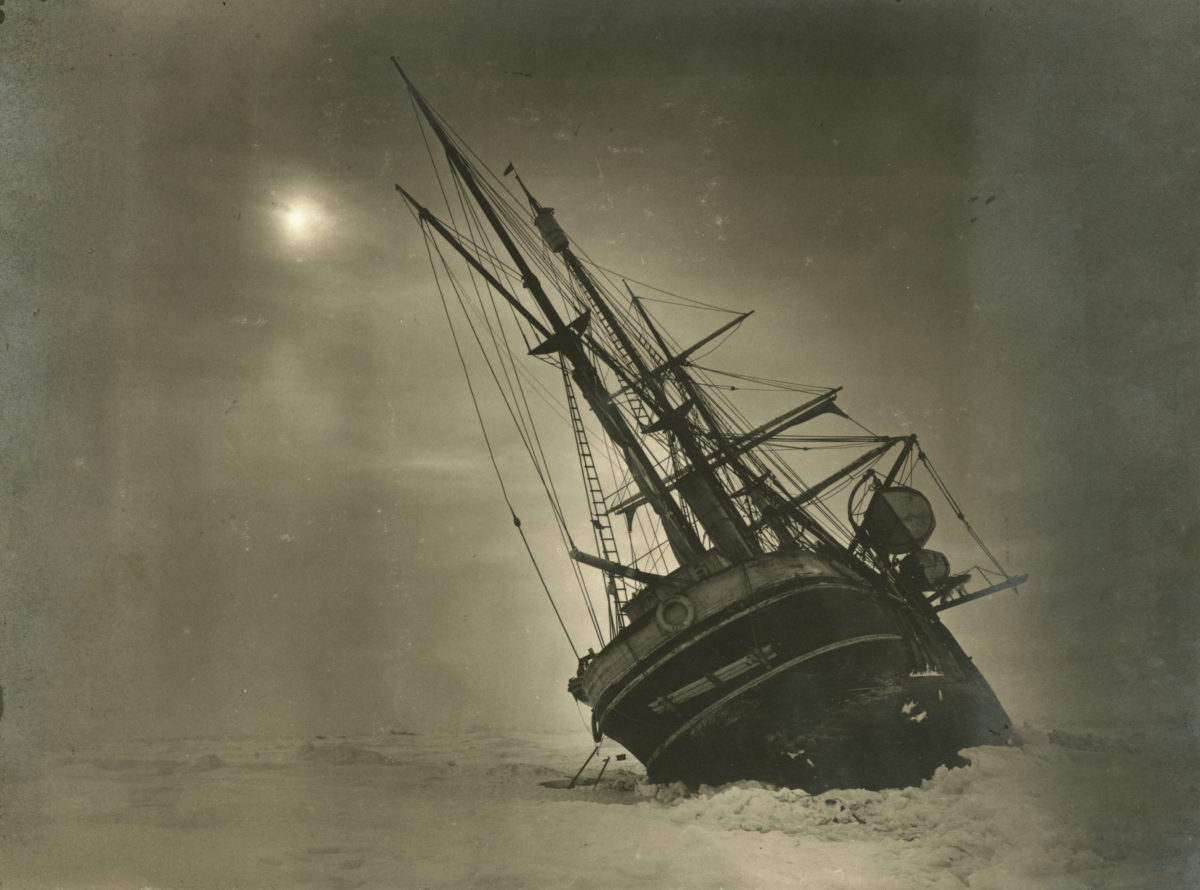
The following account describes Sir Ernest Shackleton’s expedition to the Antarctic in 1907-09, which followed Captain Robert F. Scott’s earlier (1902-03) attempt to reach the geographic Pole. This year marks the 90th anniversary of the Shackleton expedition.
Just as the race to explore space captured people’s imaginations in the latter part of this century, the quest to conquer the frozen and mysterious lands of the Arctic and Antarctic consumed explorers during the first part. Those who ventured into the vastness of the Polar regions were the popular heroes of the day. Like today’s astronauts—or athletes—they commanded awe and respect. The Antarctic was Earth’s final frontier. Certainly the race for the South Pole was as dramatic and competitive as any race has been.
Ernest Shackleton wanted to be part of something that would bring honour to the British Empire. His interest in the South Pole began at age 16 when he left school to ship out to sea, much to his father’s annoyance. By 24, he was certified to command a ship anywhere on the seven seas. The romance of the sea and the adventure led him to volunteer for Scott’s 1902 National Antarctic Expedition, during which he served as Third Mate.
On that first voyage to the Antarctic, a rift between the Royal Navy officers, including Captain Scott, and Merchant Navy volunteers, such as Shackleton, led to dissension over the chain of command and over the mission’s goals. Shackleton, in particular, disliked formality. Whether whaling seamen or Royal Navy captains, all were men of the sea to him. Stripes—or the lack of them—made no difference.
Despite the personality and rank differences, Scott selected Shackleton to take part in the trek towards the Pole. Shackleton would always be grateful to him for that, considering the men from whom he had to choose. The third member of the team was Dr. Edward A. Wilson, who became Shackleton’s great friend.
The team members encountered numerous problems on that expedition with dogs, transport, diet, and weather. None of them knew how to use dogs and sledges. Physically, all of them had problems, which Wilson diagnosed as scurvy. They did not have the proper type of food to prevent this scourge, and, in the end, they did not bring enough to go around. Blizzards and whiteouts hampered their movement, and eventually they had to abandon their goal of reaching the Pole.
At the same time, this foray yielded many positive results. They all reached 82 degrees, 15 minutes South. Scott and Wilson went on one mile further on 30th December, reaching the “furthest South,” while Shackleton stayed behind, as he was too ill to proceed.
Ultimately, Wilson and Shackleton pressured Scott into abandoning the trek to the Pole. He seemed bent on carrying on, but the Pole was still far off, the three men had already eaten most of their food, and fatigue had taken a heavy toll on their strength. In addition, Shackleton developed scurvy. Had Shackleton not become ill, Scott might not have agreed to return as he did. As it was, they rushed from depot to depot. As ill as Shackleton apparently was, he still assisted with the sledging, although at one point he had to be carried briefly on the sledge. Afterwards, he claimed that he was never as ill as Scott made it appear in his account, The Voyage of the “Discovery.” On 3rd February, 1903, they returned to the ship, just over three months and 960 miles after they began the journey.
Scott then sent Shackleton home, ostensibly to recover from his illness, but Scott may simply have wanted to rid himself of a rival. Shackleton arrived in London on 12th June, 1903. After stints as a journalist, secretary to the Royal Scottish Geographical Society, and an unsuccessful bid for a seat in Parliament, he announced plans for another Antarctic expedition in the March 1907 Geographical Journal. His objectives included geographical exploration and an attempt on the Pole, as well as collecting meteorological, geological, and biological data. But this second voyage also grew out of a personal need to prove to himself–and to sceptics–that he was capable of leading and completing an expedition.
He tackled the time-consuming and difficult tasks of acquiring financing, selecting a crew and ship, and arranging for stores. Thanks to the generosity of many who believed in his work, he soon felt ready to better Scott’s record, and he next set his thoughts to selecting the companions who would accompany him on the shore party.
Shackleton’s first choice, his chum from the Discovery, “Billy” Wilson, declined Shackleton’s invitation. Wilson later perished along with Scott while returning from the famous Terra Nova Antarctic expedition of 1912. Nevertheless, Shackleton assembled a first-rate shore party for the “British Antarctic Expedition, 1907”: Lieutenant James A. Boyd, R.N.R.; Sir Philip Lee Brocklehurst, assistant geologist; Bernard Day, motor mechanic; Ernest Joyce, in charge of the dogs; Alistair Forbes Mackay, second surgeon; Eric Marshall, chief surgeon, photographer, and cartographer; George Marston, artist; James Murray, biologist; Raymond Priestley, geologist and photographer; William Roberts, cook; and Frank Wild, in charge of provisions.
More on shackleton
The ship Shackleton had originally set his sights on proved financially out of the question; he had to settle for an older vessel, the Nimrod. He considered his vessel’s name, taken from a mighty hunter described in the biblical book of Genesis, to be a good omen. Once again, though, he had to make do with second best after his first choice for captain of the Nimrod did not accept his offer. If he had been superstitious, he might have heeded these signs. But, as Shackleton had already contracted for a dozen Manchurian ponies, dogs, sledges, and a pre-fabricated hut, and a benefactor had arranged a specially-built motor car, an Arroll-Johnston—he determined to proceed.
With the benefit of hindsight, many people today look back with amazement on the team’s dependence on the motor car and Manchurian ponies. In fact, Shackleton spent time in Norway before the expedition, consulting two of the most illustrious Polar explorers, Fridtjof Nansen and Otto Sverdrup, who advised Shackleton against using these modes of transportation. In the end, however, he rejected this expert advice. The car, he reasoned, had been specially prepared for Antarctic conditions. And the ponies, Shackleton believed, could haul far more sledge weight than dogs. At the very least, he knew that his team could man-haul the sledges if necessary.
If Shackleton lacked good judgement in his choice of transportation, he made better decisions when it came to shelter. The expedition’s hut, prepared by a firm in Knightsbridge, was prefabricated for ease of assembly, rather than transported whole, as Scott’s had been. Scott’s cumbersome hut had taken up precious cargo space on Discovery. Constructed of fir, Shackleton’s hut was insulated with felt and shredded cork. This habitat of 33 x 19 feet would have to house 15 men in close proximity for many months.
With great anticipation, Shackleton and his men set sail from London for Torquay in the south-west of England on 7th August, 1907. On their way, they received a command to meet King Edward VII, Queen Alexandra, and other members of the Royal Family at Cowes. His Majesty conferred the Commander of the Victorian Order on Shackleton, as he had on Scott some five years earlier. Her Majesty handed Shackleton a Union Jack to place at the Pole. Later at Torquay, he bade farewell to his wife, Emily, his children, and his brother, Frank, a ne’er-do-well, who had recently been linked to the theft of the Irish crown jewels.
Shackleton took care of other business, rejoining Nimrod in Lyttleton, New Zealand. Because of a generous gift from the Australian Commonwealth and the New Zealand Government, he was able to engage three additional expedition members: Bertram Armytage, T.W. Edgeworth David, and Douglas Mawson. They set sail again on New Year’s Day, 1908.
The ship Koonya towed them south to the Ice Barrier, allowing them to save coal they would badly need during their tenure in the Antarctic. They headed south through rough seas for some two weeks, dodging icebergs before passing through the Ross Sea ice into open water.
Shackleton’s original plan had been to establish a base camp in King Edward VII Land, but due to the sea ice conditions, the team couldn’t reach it. Also, the topography at the Bay of Whales had changed, so he decided not to chance a landing. Nimrod had only a short while before it would become frozen in the ice, and Captain England was nervous that his ship would become stuck fast before Shackleton found a place to land his stores, animals, motor car, and shore party.
After wrestling with his conscience, Shackleton made a controversial decision to revoke an agreement he had made with Scott in order to keep his men alive. Prior to Shackleton’s departure, Captain Scott wrote and strongly suggested that Shackleton not use his 1902 Hut Point base or venture into McMurdo Sound, which Scott deemed “his territory.” At the time Shackleton received this “suggestion,” he had no thought of landing there, so he agreed to Scott’s request.
[In an interview last year Shackleton’s granddaughter, The Honourable Alexandra Shackleton, asserted, “Scott should never have asked Grandfather to make such a commitment; and Grandfather should never have given it. Scott considered it a personal betrayal and never forgave Grandfather. The absolutes were different then; it was life or death. The Establishment considered it a most dishonourable action, but it should have been understood that he had no choice.”]
Shackleton’s team finally offloaded near Cape Royds, about 20 miles north of Hut Point. It took them about 15 days to turn their hut into cramped but liveable quarters. In order to make the best use of their small living space, they arranged the dining table so it could be pulled up to the ceiling. The men settled into a routine, trying not to get on each other’s nerves.
Paired off, they moved into their 6 x 7-foot cubicles, which had names reflecting the occupants: “Rogues’ Retreat” was Joyce and Wild’s; “The Pawn Shop” reflected David and Mawson’s untidy habits; Adams and Marshall’s quarters were dubbed “No. 1 Park Lane.”
Wild and Joyce, having had a crash course in printing in London, set about printing the first book published in the Antarctic, Aurora Australis [the Southern Lights], with etchings by Marston. They had to keep a candle burning under the inking plate to prevent it from freezing.
A number of the expedition members captured historic moments on film. Shackleton later used these to prove how much they had accomplished, despite the fact that they did not reach the South Pole. Many of the photographs were reproduced in his book on the expedition, The Heart of the Antarctic.
They hoped to achieve several things that spring. First, the quartet of Adams, Marshall, Wild, and Shackleton would attempt to reach the South Geographic Pole, a 1,708-mile journey, with ponies pulling sledges. David, Mawson, and Mackay would trek to the South Magnetic Pole, a journey of some 1,200 miles. David’s party used the motorcar to relay supplies to two depots, but it became mired in the soft snow of McMurdo Sound and soon was of no use.
Prior to the trek to the Poles, Shackleton assigned Adams, Brocklehurst, David, Mackay, Mawson, and Marshall to undertake the ascent of the volcano, Mount Erebus. All, except Brocklehurst, reached the summit on 10th March, 1908. Getting there had been a tremendous physical struggle. Having no mountaineering gear, as there had been no plan to attempt the climb, they man-hauled all their provisions to the 13,000-foot peak and were the first to ever look into the jaws of the volcano. Through extraordinary resourcefulness, courage, and dedication, the team achieved a triumph.
To the south pole
The team of Shackleton, Jameson Boyd Adams, Eric Marshall, and Frank Wild struck out for the Pole on 29th October, 1908. Even while travelling through the harshest environment on earth, they maintained a semblance of civilization, taking along reading material (including Shakespeare and Dickens), jam and cocoa, and especially tobacco.
The Polar party experienced difficulties with their ponies and the weather right from the outset. The explorers had planned to use the ponies to haul supplies, as well as for meat, but the animals had difficulty walking in deep snow, often sinking up to their bellies. In a strange role reversal, the explorers found themselves having to carry their own provisions as well as fodder for the ponies. As if that were not enough, the ponies became snow blind. The death of all but four of them from eating volcanic sand, while distressing to Shackleton, may have been a blessing in disguise.
The white landscape affected the explorers as well as the ponies. At times they couldn’t distinguish the horizon; the sky and the ice melded into one. The temperature dropped to 52 degrees Fahrenheit. But despite the harsh conditions and unexpected setbacks, the party surpassed Scott’s “Furthest South” almost a month after setting out.
By 1st December, 1908, only one pony, Socks, remained. Then a week later, he disappeared down a crevasse, almost taking Wild with him. The unexpected loss deprived the expedition of a source of meat but freed up the supply of pony fodder, which became part of the team’s daily ration.
The four explorers plodded on, hauling 1,000 pounds through forbidding terrain on below-minimum rations. To lessen the danger of falling through crevasses, they roped themselves together. By 9th December, they were measuring their progress not in miles but yards.
It was gruelling, arduous labour. Because they could not transport all their supplies at once, the party had to constantly backtrack to retrieve what had been left behind, so that every advance of six miles required 18 miles of walking. In his journal, Shackleton described each passing day as “the most difficult we had endured.”
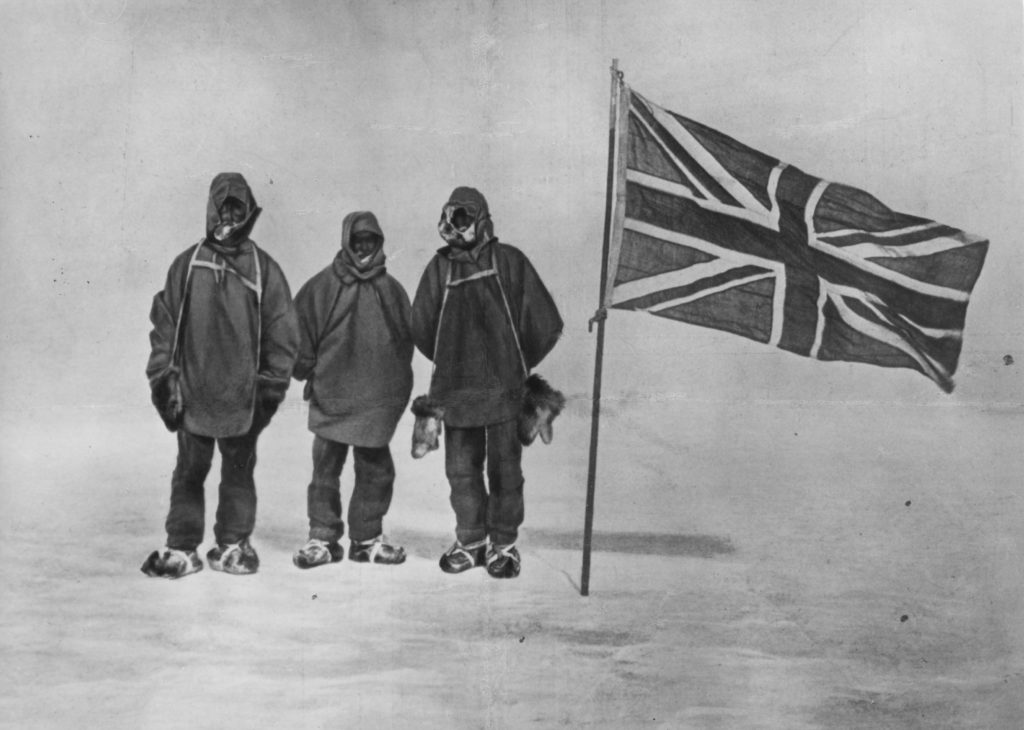
While Shackleton’s team headed for the South Geographic Pole, another party set out for the Magnetic Pole. On 16th January, 1909, this second team reached their goal. They recorded their achievement by taking a photograph of themselves standing by the Union Jack they brought with them. The same day they trudged 24 miles back to their supply depot to rest and then began their journey back to meet their ship, Nimrod.
Midsummer’s Day, 21st December, found Shackleton’s team frost-bitten and hungry. Condensation from their breath froze on their beards, then melted and seeped under their shirts, only to freeze again inside their clothes.
After an 11-hour march on Christmas Day, they rewarded themselves with a splendid Christmas dinner. According to Shackleton’s notes, they feasted on Oxo and pemmican (dried meat pounded into paste with fat and made into patties) boiled with some of the pony food, and plum pudding with a splash of liqueur. The meal ended with a much-welcomed cigar.
As the year’s end approached, wind and snow, less-than-adequate provisions, and the effects of altitude were taking their toll on the explorers. Their body temperatures had dropped to about 94 degrees–not a good indication of their physical state. Although Shackleton resisted the temptation to admit defeat, after 1st January, 1909, he began to realize that he might not achieve his objective. Their food simply would not last long enough.
The expedition leader decided that 6th January would be their last day out. Despite soft snow and biting cold, they advanced another 13 miles. Then, for the next two days a raging blizzard kept them in their tents.
When the storm broke on 9th January, Shackleton reversed his earlier decision and dashed south once more, reaching 88 degrees, 23 minutes south longitude, 162 degrees east latitude. They had gone farther south than anyone ever had, stopping just 97 nautical miles from the Pole. There the party planted the Union Jack and the Queen’s flag, and Marshall photographed the scene. Then, reluctantly, they headed home, a decision Shackleton called the most difficult he ever made. “Whatever regrets may be, we have done our best,” he wrote in his diary.
Even after turning back toward Cape Royds, the Polar party faced great danger. They had eaten most of their food and exhausted much of their energy, and time and the season were running out. However, the wind blew at their backs, helping the team to make runs of 15 to 20 miles for several days.
Food remained their greatest worry. Shackleton continually reduced the daily ration of biscuits, cocoa, and tea. In late January, the party marched for 20 hours with little food and even less rest. With 300 miles to go, they had very nearly reached the limits of their energy. The food ran out on 26th January, and Marshall went on alone to the next depot to bring back pony meat. Shortly thereafter, they all came down with dysentery, which Marshall attributed to bad meat.
Throughout the return trip, the explorers battled difficult terrain, incredible cold, and lack of food. Then the unusually fine weather turned bad and a blizzard struck. By Shackleton’s 35th birthday, on 15th February, they reached another supply depot. To keep up spirits, they imagined the culinary delights awaiting them upon homecoming.
By now, time was running as short as food. Before setting out on his journey, Shackleton had left orders for Nimrod to sail on 1st March, whether the Polar party had returned or not. Now, after trudging and sledging for 126 days and for more than 1,700 miles, it looked as if Shackleton might not be able to meet that deadline.
To quicken his pace, Shackleton left Marshall, who had become very ill, in Adams’ care and set off with Wild and one day’s provisions for the final dash to Hut Point. They arrived to find no ship, just a message indicating that all the other parties had returned safely. Shackleton and Wild spent a sleepless, cold, and anxious night in the hut. Unexpectedly, Nimrod reappeared the next morning, intending to land a rescue party or at least recover the bodies of the missing explorers.
As soon as he had satisfied his hunger, Shackleton set out with a relief party to rescue Marshall and Adams. After marching about 19 hours, he arrived at the camp where he had left his two companions and then led them back to Hut Point.
By about midnight on 4th March, 1909, they were all back on board Nimrod, heading out towards open sea and away from danger.
With the approach of the Antarctic winter, speed was essential, and Shackleton abandoned much of the expedition’s equipment and personal belongings rather than risk being trapped in the ice for another year, as had happened to Captain Robert Scott’s Discovery.
After reaching New Zealand, Shackleton made a brief phonograph record recounting the trek; then he sailed on to Dover. His wife, Emily, met him in mid-June, 1909, and they rode by train to London. The couple arrived at Charing Cross Station to a warm welcome.
A round of parties, lectures, dinners and receptions followed. On 28th June, 1909, Shackleton made a presentation to the Royal Geographical Society Fellows and guests, including Captain Scott. It was the culmination of all he and his companions had achieved. The Prince and Princess of Wales attended and presented the explorer with a medal from the Society. Later that year, he was knighted.
Shackleton died of a heart attack in 1922, just before his 48th birthday, and was buried in South Georgia in the Falkland Islands.
It was left to Roald Amundsen to reach the South Pole on 14th December, 1911. Captain Robert Scott and four companions duplicated the feat a month after Amundsen; but all of them perished on the return trek. Eight months later their bodies were found and remain there still.
Ninety years on, Shackleton would be astonished to learn that management theorists use him as an example of the best of leadership qualities. Such techniques as maintaining a positive outlook, organizational and marketing skills, providing a support system for colleagues, and the importance of loyalty were among Shackleton’s skills. His fame came not so much from what he did–or didn’t–achieve but from his ability to carry on under circumstances that would try abilities of lesser men.
Shackleton’s granddaughter paraphrased the comments of one of her grandfather’s companions when she said, “When all is lost, when there is no hope, pray for Shackleton. He will get you through.”