The dark clouds of civil war gathered over the nation as two aggressive factions–the Wide-Awakes and the Minutemen–plotted to gain political control of Missouri and its most important city, St. Louis.As is often the case, political power began at the end of a gun.
On April 15, 1861, three days after the Confederates fired on Fort Sumter, President Abraham Lincoln issued a proclamation calling for 75,000 militiamen to serve for 90 days against “combinations too powerful to be suppressed by the ordinary course of judicial proceedings.” In the border states of Kentucky, Maryland, Delaware and Missouri, Lincoln’s proclamation met with a decidedly mixed reaction. Governor William Burton of Delaware reported that his state had no militia and therefore could not comply, while Governor Thomas Hicks of Maryland replied that his state would only furnish troops for the defense of Washington. Governor Beriah Magoffin of Kentucky issued the fiery statement, “Kentucky will furnish no troops for the wicked purpose of subduing her sister Southern states.” The most incendiary reply of all was sent by Governor Claiborne F. Jackson of Missouri: “Your requisition is illegal, unconstitutional, revolutionary, inhuman, diabolical, and cannot be complied with.” Jackson’s stance would be the backdrop against which the struggle for Missouri and her greatest asset to both sides, the city of St. Louis, would be played out.
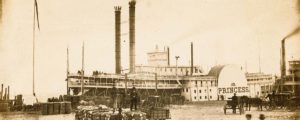
In the early days of the war, Missouri’s strategic importance was well-realized by both governments. If the state remained in the Union, the Federal government would have a perfect staging area into the heart of the Mississippi Valley. The great river port of St. Louis would be a base of operations for a thrust down the river to Memphis and points farther south. It would also allow the vital town of Cairo, at the southern tip of Illinois, to be garrisoned and provisioned, opening the Ohio and Tennessee rivers to Federal incursions. Conversely, if Missouri seceded, the Confederate government would have a large salient into Northern territory, the state of Illinois would be threatened, the Mississippi Valley would be secure, and the Ohio and Tennessee rivers would be protected. In addition, both sides coveted Missouri’s rich farmland and her large population of military-age men.
Internally, Missouri was truly a state divided. The majority of the population held to the view of “conditional unionism.” According to this rather impractical concept, slavery should be left to popular sovereignty within a state, but, conversely, there should still be a strong Federal government. Many Missourians hoped to remain neutral in the conflict. However, two small minorities–unconditional union men and pro-secessionists–existed within the state, and it was around these two factions that the struggle for Missouri would increasingly revolve.
The two most prominent pro-secession leaders were the newly elected Governor Claiborne Jackson and former Governor Sterling Price. Jackson was a pro-Southern fire-eater who had been attempting to align Missouri with the Confederacy since the day of his election. Price, a well-respected Mexican War veteran, prosperous slave-owning tobacco planter and former congressman, had initially supported conditional unionism but had switched allegiance to the pro-secessionists when Jackson convened a state convention in February 1861 to address the question of secession. The pro-secessionists failed miserably in their attempts to take the state out of the Union, as the majority of delegates elected were conditional-union men. Price wrote in a letter to a friend after the convention’s decision: “It is now inevitable that the general government will attempt the coercion of our southern states. War will ensue. I am a military man, a southern man, and if we have to fight, will do so on the part of the South.”
Francis P. Blair and Brig. Gen. Nathaniel Lyon headed the unconditional-union faction. Blair, scion of the politically powerful Blair family (his brother Montgomery was Lincoln’s postmaster general), insisted on the full support of the Federal government and declared that any talk of secession was treason. Lyon, a pugnacious 43-year-old New Englander who had once declared, “I was born among the rocks,” commanded Jefferson Barracks, the Federal garrison at St. Louis, and was an ardent abolitionist. When word of Governor Jackson’s reply to Lincoln’s call for militia reached their ears, both men regarded it as the strongest sort of treason. Blair immediately set about organizing the “Home Guards” from St. Louis’ strong German immigrant population, while calling for reinforcements from Illinois, Iowa and Kansas. Lyon assisted by arming the groups with weapons from the arsenal. Jackson and Price, in turn, formed the Missouri State Guard. The stage was set for a violent clash; its focus would be the city of St. Louis.
Missouri contained two Federal arsenals, one at St. Louis and the other at Liberty, in the western part of the state. The small arsenal at Liberty had been seized almost immediately by pro-secession elements. The contents–1,000 muskets, four small brass cannons and a small amount of ammunition–were nothing to compare with the prize of the arsenal in St. Louis, which was said to contain 60,000 stands of arms and 25 fieldpieces. Price and Jackson immediately began plotting to seize the arsenal, and at the same time, Blair and Lyon took steps to defend it.
The rank and file composing the companies of the pro-Union and pro-secession camps within the city were divided by nationality as much as by ideology. For the most part, the Unionists were German immigrants. They had seen Germany suffer lawlessness and depredations for centuries because of the lack of a strong centralized government, and had no wish to endure the same in their adopted country. In their view, the absence of a strong central government put one at the whim of whatever petty prince had control of the area, with no recourse available for the common man. Accordingly, they recognized the value of a strong government. The city’s secessionists, for the most part, were composed of Irish immigrants. Long abused under English crown rule, they had an innate distrust and fear of strong central government; arbitrary use of political power had prompted their emigration.
Side by side with both militias, there existed shadowy political organizations. The pro-Union group was known as the “Wide-Awakes,” and the pro-secession men were known as the “Minutemen.” The secessionists believed they were fighting the second American Revolution against tyranny, and they took the name Minutemen from the Colonials at Lexington and Concord. The Unionists chose to be called Wide-Awakes to show that they were alert and ever vigilant in defense of the Federal government in Washington. The two groups spent most of their time attempting to win the hearts and minds of the local populace by organizing demonstrations, posting signs and publishing pamphlets extolling the virtues of their respective causes.
The first open clash between the two sides occurred on March 4, 1861, Lincoln’s inauguration day. Around midnight of the 3rd, the leaders of the Minutemen–Rock Champion, Basil W. Duke, Arthur McCoy, Colton Greene and James Quinlan–climbed the dome of the Federal courthouse on Market Street and removed the national flag, replacing it with the state flag. Above the Berthold mansion, headquarters of the Minutemen, a banner was raised that Greene described as “a nondescript conceit–a red field, emblazoned with a white cross, star and crescent–made by Arthur McCoy’s wife.”
Toward dawn on March 4, the official in charge of the courthouse lowered the state flag and replaced the national colors without incident. However, at the Berthold mansion the situation was quite different. At midmorning, a curious crowd began to gather around the mansion and the streets leading to it. Minutemen circulated among the crowd promoting their point of view. The Wide-Awakes lost no time in assessing the situation and determined not to allow this affront to the Federal government to go unchallenged. David Dickey, a native Pennsylvanian, led a band of militant Wide-Awakes toward the area. Minutemen guards spread the alarm, and soon 100 or more sympathizers assembled around the mansion. A small swivel gun was placed at the entrance, and men with muskets and fixed bayonets took up positions along the mansion wall fronting Fourth Street, with strict instructions to use their bayonets if violence should erupt.
While Dickey and his band of Wide-Awakes moved toward the area, another small group approached the mansion in an attempt to resolve the matter peacefully. Basil Duke received them cordially but firmly declared there would be no compromise involving the removal of the homespun standard. Dickey and his band arrived shortly afterward, and for several hours both sides engaged in name-calling, blustering and threats. The Minutemen who had been circulating among the crowd remained there with instructions to create diversions should the need arise. Finally, the Wide-Awakes could stand it no longer, and a small group attempted to force the Fourth Street wall. The Minutemen repulsed the foray with bayonets, and Greene gleefully recorded: “The crowd…pressing through the narrow alley…was assailed in the most ludicrous manner with the contents of an odorous vessel and other household missiles freely thrown down from the windows by the Irish servant girls (encouraged by the ladies within).”
Dickey did not take kindly to the setback and led the remaining Wide-Awakes against the front entrance of the mansion. The Minutemen attempted unsuccessfully to fire the brass swivel gun placed at the doorway, and Duke grappled with Dickey on the front steps, the little match ending with Duke holding a knife to Dickey’s throat. Muskets and revolvers were brandished on both sides. The Minutemen in the crowd began to brawl with anyone within reach, and the situation soon began to deteriorate, with men who had no strong political feelings trying to find shelter as quickly and as far away from the mob as possible. The affair ended when, as Greene wrote, “Irish from the Biddell Market quarter joined with us in the melee and we were masters of the ground.”
Following the events at the Berthold mansion, both sides regrouped, organized their forces and engaged in verbal recriminations. Most significant, the respective sides redoubled their efforts to bring outside aid into the state. Both the Federal and Confederate governments had been handling the situation in Missouri with kid gloves. Neither government seemed willing to commit to complete involvement, for fear that overt support would antagonize St. Louis citizens and drive the state into the opponent’s hands. James Buchanan’s lame-duck administration kept to the same waffling stance it had taken whenever the notion of secession came up. Meanwhile, the nascent Confederate administration in Montgomery, Ala., was too disorganized to move effectively even if it had so desired.
Blair, Lyon and other Wide-Awakes renewed their efforts in Washington to coax effective Federal help to the city. Again, the focus was the arsenal, commanded by Major William H. Bell, whom Blair strongly suspected of holding pro-Southern sympathies. He was correct.
In January, Jackson and Price had moved the small battalion of state militia, comprising roughly 500 men, from the southwest area of the state to St. Louis. Originally formed to combat Kansas Jayhawkers during the years of “Bleeding Kansas,” when internecine raiding and skirmishing had
occurred almost daily across the border between the two states, the militia had been languishing at Carthage for the past year. Brigadier General Daniel M. Frost, a Mexican War veteran and an 1844 West Point graduate, commanded the small force. Although born in New York, Frost was thoroughly Southern in both his sympathies and politics. Jackson had hoped the people of the state would vote for secession, allowing him to take the arsenal without the use of force, as other seceding states had done. When the state convention voted overwhelmingly to remain in the Union, Jackson charged Frost with taking the arsenal by force when he deemed it expedient to do so.
Accordingly, Frost had requested a conference with Major Bell, and wrote Jackson on January 24 of the result. “I have just returned from the arsenal,” he reported. “I found the Major everything you or I could desire. He assured me he considered Missouri had, whenever the time came, a right to claim it as being on her soil. He asserted his determination to defend it against any and all irresponsible mobs, come from whence they might, but at the same time gave me to understand that he would not attempt any defense against proper State authorities.” Blair became aware of Bell’s sympathies and the meeting with Frost through Isaac H. Sturgeon, assistant treasurer of St. Louis. Sturgeon had the confidence of the prosecessionists while secretly working for Blair and the Wide-Awakes.
Blair immediately began lobbying Washington for Bell’s removal, but the Buchanan administration would not comply. Finally, Blair was able to bypass the administration and persuade General-in-Chief Winfield Scott to replace Bell with Major Peter V. Hagner. Hagner was an old-line Regular Army officer and was not predisposed to surrender the arsenal to either side without proper military orders from Washington. While not exactly a victory for Blair, the appointment of Hagner at least prevented Bell from turning the arsenal over to the Minutemen.
Blair was not completely satisfied; he still coveted the arms in the arsenal for his Wide-Awakes, not all of whom were armed yet. He also wished to deny the arms to the Minutemen, and to both these ends he began lobbying both Buchanan and General William S. Harney, the military commander of the district, to assign Nathaniel Lyon as arsenal commander. What had prompted Blair and Lyon to take this course of action was the firm refusal of Hagner to release any arms to the Wide-Awakes without explicit orders from Washington.
Once again Blair and Lyon appealed to Scott, who responded by ordering 200 men from Jefferson Barracks to garrison the arsenal. The general showed further support by sending an additional 500 men to the arsenal garrison a few days later. Scott, however, did not give Hagner direct orders to release any of the arms, and the major remained steadfast. Lyon grew increasingly exasperated with Hagner and wrote Blair that Hagner’s stance was “either…imbecility or damned villainy.” Lyon vowed, if necessary, to “pitch him in the river.” After Lincoln took office on March 4, Blair had his brother Montgomery, now postmaster general, use his powerful influence to persuade the president to appoint Lyon commander of the arsenal. Lincoln did so promptly, and Lyon set about fortifying the arsenal and the city by placing artillery on the surrounding heights and approaches to the area.
While Blair and Lyon went through their machinations, Frost, Jackson, Price and other Minutemen were not idle. Frost deemed it inexpedient to interfere forcibly during Bell’s and Hagner’s tenure, hoping the Unionists would fail in their attempts to place Lyon in command. After Lyon secured the arsenal and emplaced artillery, however, Frost wrote Jackson with a plan of action. He advocated dispatching emissaries to Alabama to lobby the Confederate government for mortars and siege guns. At the same time, he asked Jackson to order him to establish a militia camp at St. Louis, with full authority to begin military instruction and recruit more men into state service. Frost also wanted permission to begin placing artillery and building fortifications of his own, and he advised Jackson to convene an extra session of the legislature as soon as possible for the purpose of again addressing the question of secession.
Jackson moved with admirable swiftness. He sent Basil Duke and Colton Greene to Montgomery to ask the Confederate authorities for the mortars and siege guns necessary to reduce Lyon’s fortifications and immediately authorized Frost to form a camp at St. Louis and begin to recruit and train men for state service. Then Jackson called a special session of the General Assembly and ordered the state militia commanders of the various districts within the state to go into camp by May 3 and await further instructions.
Before Duke and Greene left for Montgomery, a meeting was held in St. Louis at the O’Fallon residence on Fifth Street. Attending were Frost, Duke, Greene and Lt. Col. John S. Bowen, a wealthy merchant and militiaman from the town of Carondelet, just south of the city. At the meeting, Frost gave Duke and Greene a list of the exact types of artillery and arms needed from Montgomery. Bowen proposed that the camp ordered by Jackson be positioned just south of the arsenal on the banks of the Mississippi River, where he suggested that Frost emplace his artillery while pretending to instruct the militia in the art of building field fortifications.
Duke and Greene found a warm reception in the Confederate capital, although the Southern cabinet was divided. Secretary of War Leroy Walker was the biggest opponent. President Jefferson Davis, Attorney General Judah Benjamin and Secretary of State Robert Toombs were the strongest supporters. Davis made vital suggestions as to the exact placement of the cannons; he was intimately acquainted with the area, having served at Jefferson Barracks while in the U.S. Army. Davis gave Duke and Greene a letter to present to the Confederate commander at Baton Rouge, La., where a Federal arsenal already had been seized. The letter authorized the release of six 24-pounder cannons, one 32-inch mortar, six Coehorn mortars, 800 muskets and the fixed ammunition to accompany them. At Baton Rouge, the arms were packed in boxes marked “marble” and addressed to leading Republican leaders in St. Louis to allay suspicion. The materiel made it safely to St. Louis on May 9, and Major James Riddle Shaler of the state militia moved it by wagon to Frost’s camp.
For their part, Blair and Lyon had not been idle. They had known about the entire secessionist plan from the outset. Well-placed informers in the Minutemen ranks had kept them advised of all the activities of the group. Accordingly, the two Wide-Awake leaders began formulating a plan of their own to quash Frost and Bowen before the arms arrived from Baton Rouge. They had been unceasing in their efforts to have Harney removed from duty. Finally, Lyon was able to obtain direct authority from the War Department to release 7,000 stands of arms from the arsenal to the Unionist Home Guard and to begin active recruiting for the organization, bypassing Harney completely. In this way, Lyon was able to form five regiments to augment his small complement of Regular Army troops.
Frost and Bowen had not been shy about founding their military camp. They christened it Camp Jackson in honor of the governor, and the camp streets were named “Beauregard” and “Jefferson Davis.” The Confederate flag flew openly. Lyon and Blair immediately responded to the threat. Their first step, on May 8, was to remove all the arms from the arsenal, moving them under cover of darkness across the Mississippi to Alton, Ill., just north and east of St. Louis. The following day, when the weapons and cannons arrived from the Confederate government, Lyon undertook a reconnaissance of Camp Jackson. (Legend has it that he dressed as a woman selling pies to gain access to the camp, although how he disguised his flame-red beard has never been properly explained.)
Blair took Lyon before the Committee of Public Safety, the ruling body of the Wide-Awakes, to relate his findings. Lyon urged the capture of Camp Jackson forthwith, but the committee was hesitant to act, fearing open warfare in the streets. The committee also objected to such extreme measures as being in violation of state laws and insisted that any U.S. property held at the camp be recovered by due legal process. Blair and Lyon were equally insistent, and they managed finally to convince the committee to lend its support, with the understanding that a U.S. marshal would head a column of regular U.S. troops and Home Guards and demand the surrender of U.S. property. The combined troops, commanded by Lyon, would stand by to aid the marshal should Frost and his men resist. Plans were made to move against the camp the next day, May 10.
Frost was not without his own spies among the Wide-Awakes, and he had been kept fully abreast of developments. During the preceding two days, he had received numerous reports of a planned move against his men and received positive confirmation on the morning of the 10th. Frost took the initiative of dispatching Bowen to Lyon that morning with a letter stating that neither he nor any part of his command had any intention of overt hostility toward the United States, its property or any of its representatives. Lyon flatly refused to receive Bowen and never read the letter. Instead, he put his column into motion and arrived at the camp about midafternoon.
May 10, coincidentally, was the day the state militiamen were scheduled to go home, and they had passed the day bragging about what they would have done to the “Dutch,” given half a chance. When Lyon arrived with four regiments of Home Guards and a battalion of regulars, he surrounded the camp on all sides, placed artillery in position to rake the camp and demanded its immediate and unconditional surrender. Frost, seeing he was outnumbered 3-to-1, recognized the folly of resisting and promptly surrendered.
As the Home Guards and U.S. troops marched the prisoners through the city, a crowd began to line the route, and soon cries of “Hurray for Jeff Davis!” and “Damn the Dutch!” filled the air. Clods of dirt and stones accompanied the taunts. The catalyst for what happened next remains unclear. After the war, Southern historians claimed that the Home Guards fired into the crowd in response to the thrown missiles, while Northern historians claimed a member of the pro-Southern mob fired first and mortally wounded a German Home Guard officer.
There is no doubt about ensuing events. The Home Guards fired several volleys, and some members of the crowd drew their own weapons and returned the fire. Twenty-eight people were killed or wounded; among the dead were three of the prisoners, two women and a small child. Dubbed the “Camp Jackson Massacre,” the conflict raised tensions to a fever pitch throughout the city. On the evening of the 10th, a regiment of Home Guards, returning to its barracks from guard duty at the arsenal, halted momentarily on the corner of 6th and Walnut streets. Someone fired a pistol, and the Home Guards’ muskets blazed again, killing eight more civilians. The next day, another Home Guard regiment was accosted on 6th Street, between Pine and Olive streets, and fired into the crowd lining the sidewalks, killing or wounding several more.
Although Blair and Lyon had saved the arsenal for the Union, their tactics resulted in a strong backlash amongst the citizenry. Thousands of Missourians immediately declared for secession. Many felt their loyalty to the Federal government had been badly strained, and in outlying towns armed bands formed with the expressed intent of marching on St. Louis to rescue its inhabitants from the “bloodthirsty Dutch,” who, “drunk with beer and reeking of sauerkraut,” were alleged to be running rampant through the city. The Unionists had almost driven the Federal cause to the edge of catastrophe.
Sterling Price was a witness to the Camp Jackson events, and he denounced the affair as an “outrage” before a large crowd gathered in front of his St. Louis hotel on the evening of May 10. Saying that he regarded it as an affront to Missouri’s sovereign rights, Price departed the next morning for Jefferson City, the state capital, to confer privately with Jackson.
Blair and Lyon, for their part, wanted to march immediately on Jefferson City. Harney, as the highest ranking Federal military commander in the area, refused to grant permission for such a move and threatened to remove Lyon from command should he do so. Meanwhile, the city police and elected officials appealed to Harney for aid in quelling the unrest within St. Louis, and he swiftly replied, sending two companies of infantry and two artillery batteries from Jefferson Barracks to the city to protect the peace, property and lives of the citizens. The situation quieted, and the high tide of secessionist sympathy passed.
At Jefferson City, Jackson called for an immediate emergency session of the state Legislature, and on May 11 a bill was passed authorizing the recruitment of the Missouri State Guard, dividing the state into eight military districts and empowering Jackson to appoint eight brigadier generals and a major general of all state forces. The bill also appropriated all the money in the state treasury, some $82 million, for the purchase of war materiel, and gave Jackson almost dictatorial powers to repel invasions and crush “rebellion.” On May 12, Price was offered the major generalship of the state guard. He promptly accepted.
The Legislature adjourned on May 15 after putting the state on a warlike footing. Both sides attempted to play for time while organizing for war within the state. To avoid further bloodshed, Price and Harney agreed to meet in St. Louis on May 21. From that meeting arose the so-called Price-Harney Agreement. In it, Harney agreed to recognize Jackson’s authority over the state, and Price agreed to use his state guard troops to maintain order within the state’s borders, thus giving Harney no reason to advance into the interior.
If the local papers of the day were indicative of general reaction to the Price-Harney Agreement, the majority of Missourians hailed the document as ensuring compromise. Many still held the belief that the state could remain neutral in the coming conflict. Extremists on both sides, however, looked askance at the agreement. Jackson already had dispatched Lt. Gov. Thomas Reynolds to the Confederate government in Montgomery to ask for more troops and materiel for the state, and after the agreement was released to the public, Reynolds renewed his negotiations with Davis and his cabinet. In turn, Blair and Lyon renewed their efforts to remove Harney from military command. Lincoln finally relented and removed Harney, replacing him with Lyon in early June. Instantly, Lyon made preparations to move into the interior of the state and confront Jackson’s pro-Southern legislature at Jefferson City. Reynolds received permission to ask Confederate Brig. Gen. Ben McCulloch, who was assembling forces at Fort Smith, Ark., to enter Missouri with regular Confederate troops. But McCulloch wavered and only advanced as far as the Missouri border in northwest Arkansas.
As a final effort to avoid armed conflict, influential citizens in St. Louis persuaded Blair, Lyon, Price and Jackson to meet face to face and attempt to resolve their differences. Blair and Lyon agreed under the condition that the meeting be held in St. Louis; they promised Jackson and Price safe conduct. The conference was held on June 11 at the Planter’s House Hotel. Blair would speak for the Union side and Price for the Southern. The Union men asked that the state assist in suppressing rebellion, that it permit Federal military occupation of the state, and that it allow the further organization of Home Guards units. Price and Jackson insisted that the Federal government disband the Home Guards and not occupy any additional state territory. In return, they offered to maintain peace and order within the state and keep out Confederate troops.
The positions were mutually exclusive, and the meeting broke down after four hours. Finally, Lyon pushed Blair aside and thundered: “Rather than concede to the State of Missouri the right to demand that my government shall not enlist troops within her limits, or bring troops into the State whenever it pleases, or move troops at its own will into, out of, or through the State; rather than concede to the State of Missouri for one single instant the right to dictate to my government in any matter, however unimportant, I would see you, and you, and you, and you, [pointing to each man in the room] and every man, woman, and child in the State dead and buried. This means war. In an hour one of my officers will call for you and conduct you out of my lines.” After the fiery speech, Lyon turned on his heel and strode out of the room.
After the Planter’s House meeting, St. Louis, the key to the entire state, would never again be threatened by pro-Southern forces. Her loyalty to the Federal government, guaranteed by Blair, Lyon and their fellow Wide-Awakes, would keep the entire state in the Union. The bloody battles of Wilson’s Creek and Pea Ridge would decide the issue militarily, but never again would Missouri’s loyalty be in doubt after the tumultuous spring of 1861.
St. Louis native Anthony Monachello is a first-time contributor to ACW. Further reading: Turbulent Partnership: Missouri and the Union, 18611865, by William E. Parrish; or Rebellion in Missouri, by H.C. Adamson.[ Top | Cover Page ]