
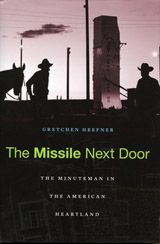
The history of the Cold War is usually writ as a clash of big ideas (communism vs. democracy) and outsize personalities (Kennedy vs. Khrushchev, Reagan vs. Gorbachev).
But Gretchen Heefner, a Connecticut College historian, finds an intriguing story in the margins. In the 1960s, the U.S. Air Force buried 1,000 Minuteman missiles in silos scattered, as Heefner writes, “like buckshot” across the Great Plains. These were the first intercontinental ballistic missiles, or ICBMs, the backbone of America’s nuclear deterrence for decades to come. The weapons were housed in two-mile-square plots carved for the most part out of privately owned land. Ranchers and farmers ceded the land with little resistance, if any.
Why did the good people of America’s Heartland let the government put 1.2-megaton nuclear warheads in their backyards? Why didn’t they balk at living hard by missiles that the Soviet Union would target with its own nukes?
Those are the questions that drive Missile Next Door. Judging by Heefner’s arch tone, she’s no fan of nuclear weapons. But her work offers a fascinating look at the American mindset in the early 1960s, when the country came to embrace the seemingly illogical notion that to keep the world safe, we had to stockpile weapons to destroy it.
Thanks to Sputnik and the hyped missile gap with the Soviets, Americans at the time lived in a state of high anxiety. This softened up patriotic farmers and ranchers for visits from military officials who wanted to transform fields of cattle and alfalfa into militarized zones. The public also thrilled at the whiz-bang quotient of the Minuteman, which could deliver a nuclear bomb over the North Pole and onto Moscow in 30 minutes—“as quickly as you could have a pizza delivered to your door,” Heefner writes. Push-button weapons promised to make war clean and bloodless, at least for the good guys. As a rancher explained to Heefner, a missile next door might mean he wouldn’t have to send his son off to battle.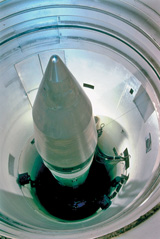
Heefner also expends considerable energy—and venom—outlining the government’s PR campaign to sell the public on the virtues of nuclear weapons strewn about the country. Among the intriguing tidbits she uncovers: While most missile systems were named for gods of mythology—Titan, Zeus, Atlas, and the like—the ICBM was shrewdly called Minuteman to wrap it in the sacred aura of the Revolutionary War. ICBMS were pitched to Americans as the modern equivalent of the country’s first heroes, Heefner writes—“defensive soldiers, living within their communities and ready to emerge, armed, when called upon.”
Much of Heefner’s book deals with a small protest by South Dakota ranchers. The brushfire they lit died quickly, but as Heefner demonstrates, their fight illuminates a great deal about how average Americans came to grips with the nuclear age.