In 1945, Warner Brothers released a movie titled Pride of the Marines, based on a book by Roger Butterfield, starring John Garfield, Eleanor Parker and Dane Clark. Both the book and the film were based on the life and experiences of a unique American hero, Marine Sergeant Albert “Al” Schmid. Al Schmid fought at Guadalcanal, and when he came home, he fought another battle, for sanity, health and happiness.
Born in 1920, the son of Mr. and Mrs Adolph E. Schmid, Al grew up a cheerful, freckle-faced kid in Burholme, Pa., a Philadelphia neighborhood. After his mother died, Schmid was on his own. He worked on farms and other odd jobs. In 1940, he became an apprentice burner at the Dodge Steel Company in northeast Philadelphia, near the Delaware River.
Since he could not afford his own place, Schmid lived with fellow Dodge Steel worker Jim Merchant and his wife, Ella Mae, in a row house on Tulip Street near the Tacony-Palmyra bridge. While living with the Merchants, Schmid met Ruth Hartley, a friend of the family, who worked at a Sears department store in Philadelphia. In time, Schmid fell in love with Ruth, whom he called “Babs.”‘
On Sunday, December 7, 1941, Schmid was sprawled out on the floor of Jim Merchant’s house, looking at the paper and trying to get up the energy to get dressed for a date he had with Ruth that night.
Then, all of a sudden, the radio stopped playing dance music; a voice relayed the startling news that the Japanese had attacked Pearl Harbor.
Thinking it was a joke, Schmid tuned in another station. Pretty soon they said the same thing. “All this time,” Schmid remembered, “I was lying there like a dumb cluck, not thinking of it; finally I called to Jim, and said, ‘Hey, Jim, the radio keeps saying there is a war with Japan—where the hell is Pearl Harbor?'” Then he got dressed and took Ruth ice skating. Ruth did not learn about Pearl Harbor (Schmid didn’t tell her) until she came home later that evening.
For a day or so, Schmid could not see how the war affected him. Then things changed. He talked to Ruth about enlisting in the Marines, but she didn’t take him seriously; he was always talking big. On December 9, 1941, he told her, “I’m in. I went down to the Custom House and signed up.”
Schmid left Philadelphia on January 5, 1942. After recruit training at Parris Island, S.C., and further training at New River, N.C., he returned to Philadelphia on a short leave before heading for “destination unknown.” He collected a bonus from Dodge Steel for his work during 1941 and used the money to buy an engagement ring for Ruth.
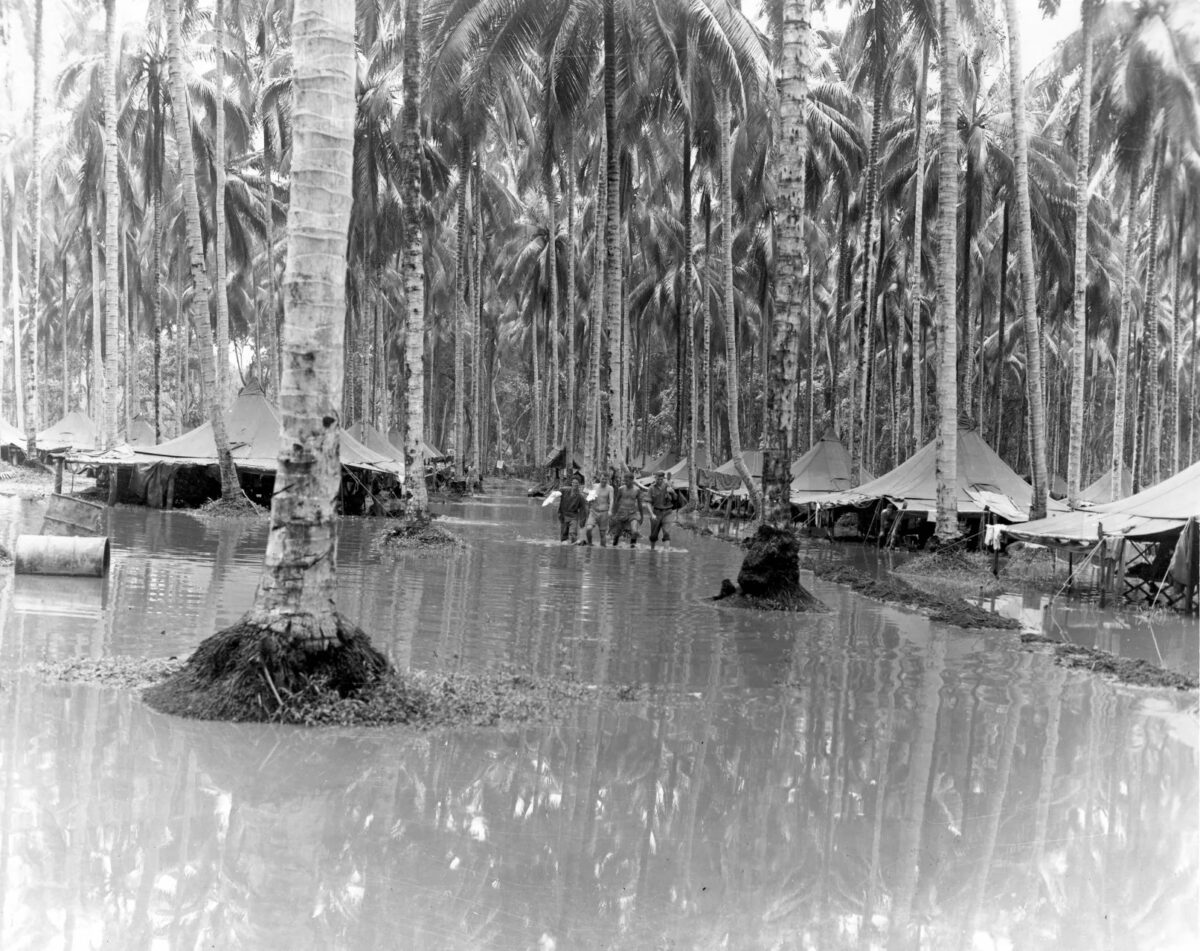
Soon afterward, Schmid boarded the troop transport George F. Elliot as part of the 11th Machine Gun Squad, Company H, 2nd Battalion, 1st Regiment, 1st Marine Division. On August 7, 1942, the 10,000 men of the 1st Marine Division, under Maj. Gen. Alexander Archer Vandegrift, the largest Marine force ever engaged in landing operations up to that time, assaulted Guadalcanal, beginning the first American offensive against the Japanese.
The Marines had expected a counterattack the moment they landed, but encountered no real opposition during their first two weeks. Then the Japanese sent a crack army regiment commanded by Colonel Kiyono Ichiki from Rabaul to retake Guadalcanal. Ichiki landed his elite troops on Guadalcanal on August 18, then marched west toward Marine positions along the Ilu River (mismarked on the American maps as the Tenaru). Lieutenant Colonel Edwin Pollock’s 2nd Marine Battalion was waiting.
H Company’s machine-gun squad was there also. Schmid and two other Marines, Corporal Leroy Diamond and Pfc John Rivers, manned a .30-caliber water-cooled machine gun inside a sandbag-and-log emplacement camouflaged with palm fronds and jungle greenery. The position was on the west bank of the Ilu, which was 50 yards wide at that point.
At 3 a.m., August 21, 1942, Ichiki, confident of victory, attacked by the sickly green light of flares. The Japanese yelled, jabbered and fired machine guns, trying to force the Marines to reveal their positions. The Marines held their fire.
Across the river from their nest, Schmid saw a dark, bobbing mass at the edge of the water. “It looked like a herd of cattle coming down to drink,” he remembered. Fifty Japanese crossed the river yelling, “Marine, tonight you die,” and “Banzai,” firing their rifles as they came.
Johnny Rivers opened up on them, and the mass broke up. Screams of rage and pain came from the other side as the Japanese concentrated everything they had on Schmid’s position and on another machine-gun position 150 yards downstream. Bullets whined past the Marines’ heads, throwing mud and wood chips around them. Schmid’s heart pounded rapidly.
The machine gun on their right stopped firing, put out of action. Then a dozen bullets tore into Rivers’ face, killing him. His finger froze on the trigger, sending 200 rounds into the darkness. Cold rage rising in him, Schmid shoved Rivers’ body out of the way and took over the gun. Corporal Diamond got in position to load it for him.
Every time Schmid raked the attacking Japanese he heard them yelling as bullets ripped into them. He heard one particular Japanese officer “screeching and barking commands at the others; he had a nasty shrill voice that stood out over the others.” Schmid fired a burst at the voice, but failed to silence it. It would haunt him for years.
Diamond then was hit in the arm, the bullet knocking him partially across Schmid’s feet. He could not load anymore, but while Schmid fired the gun, Diamond stood beside him, spotting targets. Schmid would fire across the river to the left, feel Diamond hitting him hard on the arm and pointing to the right, swing the gun and hear Japanese yelling as his bullets hit them.
Schmid now was both loading and firing the machine gun. When he got close to the end of a 300-round belt of ammunition, Diamond would punch his arm. Schmid would fire a burst, rip open the magazine, insert a new belt and resume firing. At one point a Japanese soldier put a string of bullets through the .30 caliber’s water jacket. Water spurted over Schmid’s lap and chest; the gun crackled and overheated but did not jam.
Schmid continued loading and firing the machine gun for more than four hours, with and without help. Somehow a Japanese soldier got through the body-choked stream and got close enough to throw a hand grenade into Schmid’s position.
“There was a blinding flash and explosion,” Schmid recalled. “My helmet was knocked off. Something struck me in the face.” When he put his hand up, all he felt was blood and raw flesh. Then he felt pain in his left shoulder, arm and hand. He could see nothing. He collapsed on his back in the nest. “They got me in the eyes,” he muttered to Diamond, who lay beside him.
The Japanese were still pouring bullets into the machine-gun position; Schmid reached around to his holster and took out his .45. Diamond heard him fussing with it and yelled, “Don’t do it, Smitty, don’t shoot yourself.”
“Hell, don’t worry about that,” Schmid said. “I’m going to get the first Jap that tries to come in here!”
“But you can’t see,” Diamond reminded him.
“Just tell me which way he’s coming from and I’ll get him,” Schmid replied.
Both men were helpless in the hole, and it was getting light. A sniper in a tree across the river was firing almost straight down at them. The only thing protecting them was the shelf where the machine gun stood, about 2 feet in diameter.
Although his sight had not come back, Schmid took his position between the spread rear tripod legs of the machine gun, squeezed the trigger and, with Diamond yelling directions in his ear, resumed firing at the Japanese across the river.
Private Whitey Jacobs, one of the squad’s members, braved the continuous Japanese gunfire, jumped into the nest and staunched Schmid’s and Diamond’s wounds. The next thing Schmid knew, they were taking him out on a blanket. He had the .45 automatic in his hand. Hearing his lieutenant’s voice, Schmid held out the gun. “I guess I won’t need this anymore, sir,” he said. Then Schmid passed out.
All night the Japanese continued their assaults, but the Marines’ anti-tank guns, machine guns and artillery cut Ichiki’s men down. At dawn, when it was clear the position would hold, Vandegrift sent a reserve battalion across the river to attack the Japanese from their flank and rear. Of the 800 Japanese who attacked across the Ilu on August 21, only 14 wounded were picked up, and one was captured unhurt. The rest were killed. Ichiki burned his regimental colors and committed suicide.The number of bodies counted within range of Al Schmid’s machine gun ran into the hundreds. The other Marines who were there that night credited him with killing at least 200 Japanese.
Schmid was put on a hospital ship and sent back to the United States. He was admitted to the naval hospital at San Diego, Calif., on October 20, 1943, where he endured many operations to remove shell fragments from his face and eyes. His recovery was helped by the care and understanding of Virginia Pfeiffer, a Red Cross worker in the hospital, who wrote a four-page letter to Ruth explaining Schmid’s wounds. “Today he told me he might as well let you know,” she wrote. “He has lost one eye, and the other is seriously damaged. The doctors will not know for several months whether he will have any sight in that eye.” Virginia encouraged Ruth to keep writing to Schmid. On February 18, 1943, Schmid received the Navy Cross “for extraordinary heroism and outstanding courage.” He went to Washington, D.C., and was commended by President Franklin D. Roosevelt and the Joint Chiefs of Staff.
In Philadelphia, a parade was given in Schmid’s honor, and the Philadelphia Inquirer presented him with its Hero Award and $1,000. In New Orleans, Schmid received the key to the city. Articles about him appeared in Life and Cosmopolitan magazines, and a book, Al Schmid–Marine, was written by Roger Butterfield. In 1944 Warner Brothers studio began production on a movie based on Butterfield’s book, Pride of the Marines, starring John Garfield.
Before he began the movie, Garfield went to Philadelphia, met the real Al Schmid, became his friend, lived in his home, and studied him. Garfield also spent two weeks at the San Diego Naval Hospital, studying the characteristics and mental attitudes of blind casualties. Pride of the Marines was released in 1945 and became an instant hit.
Schmid never thought of himself as a hero. “When I came back I was the most disgusted man you ever saw. I didn’t want to bother to do anything. I could see people looking away from my ugly scars. They wouldn’t want to associate with me. I even told my girl it was all over.”
Ruth would not take no for an answer. She and Schmid were married in April 1943. In June 1944, she gave birth to a son, Albert A. Schmid, Jr. The publicity generated by the marriage had brought a flood of requests for war bond, hospital and charity appearances.
Although he didn’t want to go, Schmid accepted all of the invitations. “I wanted to help the boys, and at the same time I was helping myself,” he explained. “I got used to people again. Any time anyone wanted me, I was there, whether there was a little profit or all for charity.”
Schmid was honorably discharged from the Marine Corps Reserve on December 9, 1944. After an unsuccessful bid in politics, he and his family moved to Florida so he could be close to Bay Pines Veterans Hospital in St. Petersburg. Schmid regained partial eyesight in his remaining eye and spent his years pursuing his hobbies of organ-playing, ham radio and fishing. One of his proudest moments was catching a 130-pound tarpon off Long Boat Key.
Al Schmid died of bone cancer on December 2, 1982, in St. Petersburg. He was buried with full military honors in Arlington National Cemetery.