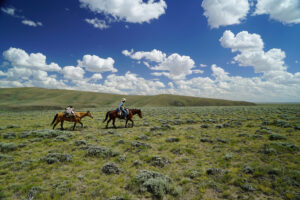

My two sons were hard to see through the blinding rain. We were working our way into the eastern edge of the treacherous and beautiful black lava beds called the Malpais (‘badlands’), south of Grants, New Mexico. It was the summer of 1983. I had read Louis L’Amour’s outstanding Western Flint, and I was now able to see for real the landmarks mentioned in the novel. I had discovered I could follow the book’s action on topographic maps. It all seemed appropriate: 1983 was probably the centennial of the events in the story.
We had decided to trail L’Amour to the Flint hideout. After taking the trail south from the railroad at McCartys, east of the Malpais, to Cebolleta Mesa, the rain let up a little and we discovered the hideout and pasture in a kupuka (island of vegetation) in the lava beds. We hiked in and had a soggy overnight camp in Jim Flint’s hideout. It was much as L’Amour had described it: a grand, isolated island of vegetation–including some tall ponderosa pines — that was sunk 50 feet in an old lava flow. Despite the rain, we did not doubt at that moment that New Mexico was truly the ‘Land of Enchantment.’ Thus began an intense and fascinating journey in which I explored the New Mexico detailed in the novels of L’Amour, who wrote more than 80 Westerns before his death in June 1988.
L’Amour can be trailed through both time and space, for his history and geography are genuine. ‘When I say there is a rock in the road in one of my books, my readers know that if they go to that spot and look they’ll find that rock,’ L’Amour told author Robert Weinberg. Well, I reckon I wanted to find that rock.
My interest in the Wild West began before I knew of Louis L’Amour. I grew up with the Western serials of the 1930s and came to admire John Wayne. Wayne was 40 and I was 20 in 1947, when I had a summer job working on director John Ford’s Fort Apache in Monument Valley, Utah. Six years later, Wayne would star in Hondo, based on Louis L’Amour’s landmark book of the same name. L’Amour was born in 1908, the year after Wayne, and I’d have to say that those two men did as much as anybody to bring the feel, sound and soul of the Old West to the American people in the second half of the 20th century.
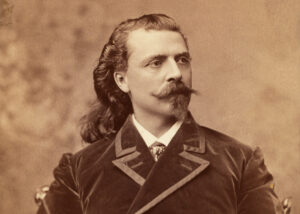
Louis L’Amour’s early life was filled with the same type of adventures that he wrote about. Due to economic problems and an adventuresome spirit, L’Amour left his Jamestown, N.D., home when he was 15 and spent the next several decades tramping the West and sailing the world. He worked at just about everything that would keep him alive. The late 1920s and 1930s were hard times. Young L’Amour worked at skinning long-dead cattle, haying in the Pecos Valley of southeastern New Mexico, mining, and sailing before the mast in all parts of the world. He was a big man, and his father had taught him to box. This skill served him well in the rough-and-tumble places he found during his wanderings. Interested in his genealogy, he traced his ancestors way back, noting that one had been scalped by Indians. His parents had instilled in him a great love of education and literature. Plenty of times during his travels he found food hard to come by, but there were always books in his pack.
L’Amour’s first publication, Smoke From This Altar, a book of poetry, was published in Oklahoma City in 1939. He also published a number of articles and book reviews just prior to World War II. L’Amour was 34 when the war started. After he graduated from Officer Candidate School at Fort Hood, Texas, L’Amour trained troops in survival and later fought in the European theater in tank destroyers. As a company grade officer, he undoubtedly learned much about land navigation and map reading in order to conduct small-unit missions. With his inquiring nature, it seems likely that he also learned all he could about navigation from the maritime officers under whom he served before the war. Given his background of sea and land navigation, his wanderings throughout the West and his historical curiosity, he had a good base for writing his marvelous novels.
Everything L’Amour wrote reflected his interest in details, both from his research and his own experience. ‘When I do research, I am saturating myself in the time, the place and the feeling,’ he says in his memoir, Education of a Wandering Man. ‘But reading is never enough. One must know the land. In every story of the westward movement the land itself is often the most important aspect. No one could move without knowing something that lay ahead. What are the landmarks, if any? Where will I find water?’
As a sailor, L’Amour knew how far the curvature of the earth would permit observations, and he probably knew how to calculate that distance. His fictional character Flint observes the famous ‘Inscription Rock,’ El Morro, to the west from the 8,200-foot Cebolleta Mesa. El Morro’s elevation is about 7,200 feet, and it is 30 miles from Cebolleta Mesa. Using the formula for the curvature of the earth, the square root of the elevation difference divided by about 0.6, allows you to determine that you can see approximately 50 miles with a 1,000-foot difference in elevation. So, indeed, you can see El Morro from Cebolleta. Did L’Amour see it himself, I wondered, or did he calculate that it was possible to do so from maps?
From his Army discharge in 1946 until 1950, L’Amour wrote many adventure short stories and some police fiction. Westward the Tide, set in South Dakota, was published in London by World Works in 1950; it was his first Western novel. He moved to Hollywood and began to be published steadily. He wrote four of the books in the Hopalong Cassidy series, using the name Tex Burns. When Collier’s magazine published his story ‘The Gift of Cochise’ in July 1952, his career took off. That story was developed into the 1953 book and movie Hondo, and Hondo brought the author national recognition that ultimately led to his receiving the Congressional Gold Medal and the Presidential Medal of Freedom. At his death in 1988, he had perhaps 200 million copies of his books in print. He produced almost three books per year for the last 30 years of his life, and wrote 100-plus books in all. More than 30 were made into movies.
Almost 40 of his novels are set in Arizona, Utah, Colorado and New Mexico. These four states join at the Four Corners. L’Amour lived on a ranch just west of Durango, Colo., near where the states join, and naturally he often put that fantastic Western country into his writing. The majority of his books are set in the 19th-century West. In 1960 he started the momentous task of telling the story of the development of America through the lives of three families; the Sackett family was the subject of 20 of these books. The Sackett saga begins with The Daybreakers, which concludes with the settlement of the Sacketts in Mora, N.M., in 1867.
The annexation of Texas in 1845 by the United States initiated the war with Mexico. The next year, General Stephen W. Kearny marched down the Santa Fe Trail into New Mexico on his way to California and declared New Mexico a territory of the United States. In his command was Lieutenant William Hemsley Emory, who led a group of topographic engineers. Emory’s group was the first to actually locate by latitude and longitude many of the Southwestern landmarks, including Santa Fe and Tucson. When Emory went on with Kearny to San Diego, he detached a group of topographic engineers to continue mapping New Mexico. In the novel Flint, heroine Nancy Kerrigan’s father had been a military engineer and had found a ranch site near the present town of Grants during his duty in the Mexican War.
As part of the American military operation, Colonel Philip St. George Cooke was detailed to develop a wagon road to California from the Rio Grande. He built west along what was later to be the Butterfield Stage route near Deming, N.M., and turned south through Guadalupe Pass, close to the common corner of Arizona, New Mexico and Mexico. This route was to figure in several L’Amour novels. The other early trails that were active during the time period of his novels included the Santa Fe Trail, the Old Spanish Trail, the Camino Real from central Mexico up the Rio Grande to Santa Fe, and the Ore Trail from the mines at Santa Rita (the Silver City area) down to Janos and south to Mexico’s interior. New Mexico Territory, which also included Arizona until 1863, was a magnificent stage for the L’Amour novels from the bringing of cattle into the Plains of San Agustin in 1858 to the end of the Apache wars in 1886. That nearly 30-year period encompassed the wildest times of the old Southwest.
New Mexico geology also contributes in a major way to the stage on which the Louis L’Amour novels were cast. The Colorado Plateau in the northwest, for instance, is where his Showdown at Yellow Butte occurs. The Plains of San Agustin, west of Socorro, is where the 1858 cattle drives from Texas ended, as described in Killoe. The continued development of ranching on the plains through the 1860s and early 1870s is covered in L’Amour’s Conagher. Today the Plains of San Agustin hold the Very Large Array telescope, with its huge electronic ears listening for alien transmissions from space. The basin and range area in the extreme boot heel of southwestern New Mexico is the setting of Shalako.
The Rio Grande Rift, a long trough running from Colorado to Mexico and now containing, literally, a ‘great river,’ cuts the state essentially in half north to south. East of the Rift Mountains, which include a southern extension of the Rocky Mountains, are the plains drained by the Canadian and Pecos rivers. The Rio Grande Rift has experienced a great deal of vulcanism, and the Jemez Caldera is featured in the L’Amour story Radigan. To the west, along the same lineament, vulcanism created the jagged, tumbled rocks and caves of the Malpais, which is the setting for Flint.
Fights over land, a major theme of The Daybreakers, continue in Showdown at Yellow Butte, located near Farmington, N.M. Radigan includes a land fight between Anglos and describes high-mountain ranching in the area of San Ysidro and Los Alamos in the early 1870s.
Of Louis L’Amour’s seven novels written primarily about New Mexico, Killoe, which was published in 1962, covers the earliest time period. It tells the story of a family and their friends who migrate from West Texas in 1858, up the Pecos River to Delaware Creek, through El Paso to the Mimbres area, and then north into the Plains of San Agustin. The Daybreakers, the first Sackett novel, came out in 1960 and treats the time around 1867. It traces some of the Sackett brothers as they venture west from their home in the Tennessee Mountains on a cattle drive and then settle in the town of Mora. There, they become involved in the land grant fights. Conagher, published in 1970, tells about the rustlers that were attracted to the lawless open-range ranching of that time. It is also an 1870s love story about a widow with two small children trying to make it on a dirt-poor ranch on the Plains of San Agustin. The development of the stagecoach lines, which provided crucial communication and transportation in the Old West, is an important part of the novel. Showdown at Yellow Butte was written under the name Jim Mayo and copyrighted in 1953. It was probably L’Amour’s second Western novel, after Westward the Tide and before Hondo, and the time is not as well defined as in his other novels. But it is certainly postCivil War and involves land scams and land fights in northwestern New Mexico.
Two New Mexico novels are set in 1882-83, just after the Atchison, Topeka & Santa Fe Railroad was built through New Mexico and created Grants Camp, which became simply Grants. In Flint, Grants is referred to as Los Alamitos, which means ‘little cottonwood,’ and indeed it was named that prior to the railroad’s being built. One of Louis L’Amour’s finest novels, Flint tells the story of an orphan boy who, after being raised by a Western assassin, becomes a successful Eastern business tycoon and then goes back to the West when he expects to die. It is a love story, as well. It also explores railroad land scams and looks at the early history of Grants and the Malpais to the south.
Shalako, whose action unfolds over a five-day period in southwestern New Mexico, tells of the historic Apache meute from San Carlos and their joining with the bands out of the Mexican Sierra Madres in the early spring of 1882. Shalako Carlin is a soldier of fortune who had served in the Civil War. He encounters the Apache, the U.S. Army, and a European royal hunting party. The movie of the same name came out in 1968, with Sean Connery and Brigitte Bardot playing the leads.
Like Shalako, Captain Tom Kedrick of Showdown at Yellow Butte is a soldier of fortune and a veteran of the Civil War and the Franco-Prussian War. They both had other military experiences in Africa and Asia. L’Amour was able to draw on his own wartime experiences in creating these characters. During and just after World War II, L’Amour wrote letters published in Rob Wagner’s Script, a weekly for Beverly Hills, Calif., residents. Many of the letters were from Europe. They described experiences that are hauntingly like those of his fictional characters.
Of course, it is not just terrain that L’Amour knew. Accurate details support the action in all his books. When Flint goes West in 1882, for example, he carries Smith & Wesson Russian .44 cartridge revolvers. His wife had found a Navy Colt percussion revolver in his abandoned safe. Although L’Amour does not say it directly, in 1867 the Navy Colt would have been Flint’s weapon of choice, and he would have carried several of them for more firepower (since percussion revolvers had slow reload times). Smith & Wesson came out with cartridge revolvers in the late 1850s, but they were of small caliber and not sturdy. Not until after 1870 did metallic cartridge revolvers become widespread in the American West. Smith & Wesson made the elegant Russian .44 in 1871, and Flint would have switched to that large-caliber revolver when it became available.
The migration of Americans into Apache-haunted, sparsely settled New Mexico is well told through the experiences of the Sacketts in The Daybreakers. The start of the cattle industry is covered in Killoe, Conagher and Radigan, together with the troubles related to land and water rights that still plague Westerners today. Showdown at Yellow Butte also brings 19th-century land fights to life. Transportation — stagecoach and railroad — is spotlighted in both Conagher and Flint, and the prelude to the end of the Apache troubles is the focus of Shalako. All told, L’Amour’s New Mexico novels — especially when the reading is augmented by map study–provide an understanding of New Mexico from the 1846 annexation by the United States to the end of the frontier era.
But as Louis L’Amour himself said, reading is never enough. Visiting some of the New Mexico places that L’Amour writes about can be a highly rewarding experience. In addition to hiking into and camping in the Flint hideout in the Malpais south of Grants (Los Alamitos in the book), my sons and I have hiked the area of the hunters’ camp between the ‘Big and Little Hatchets’ in the novel Shalako. My wife and I have traveled to tiny Reserve (called the Plaza in Conagher, and indeed there were originally three separate towns in the area — Upper, Middle, and Lower San Francisco Plaza), a place that still calls to mind the wild days of the cattlemen in the 1870s.
Except for parks and tourist attractions, the country is remarkably unchanged from the time of L’Amour’s stories. Many of the areas that once saw travelers on foot and horseback seldom see people today; sites where you would formerly have seen wagon camps and riders now lie deserted. These lonesome places wait in silence. Some can be reached by unimproved roads, and some you must find by foot or horseback. If you wear a pack, be sure to leave room for maps and a few good Louis L’Amour books.
For more great articles be sure to subscribe to Wild West magazine today!