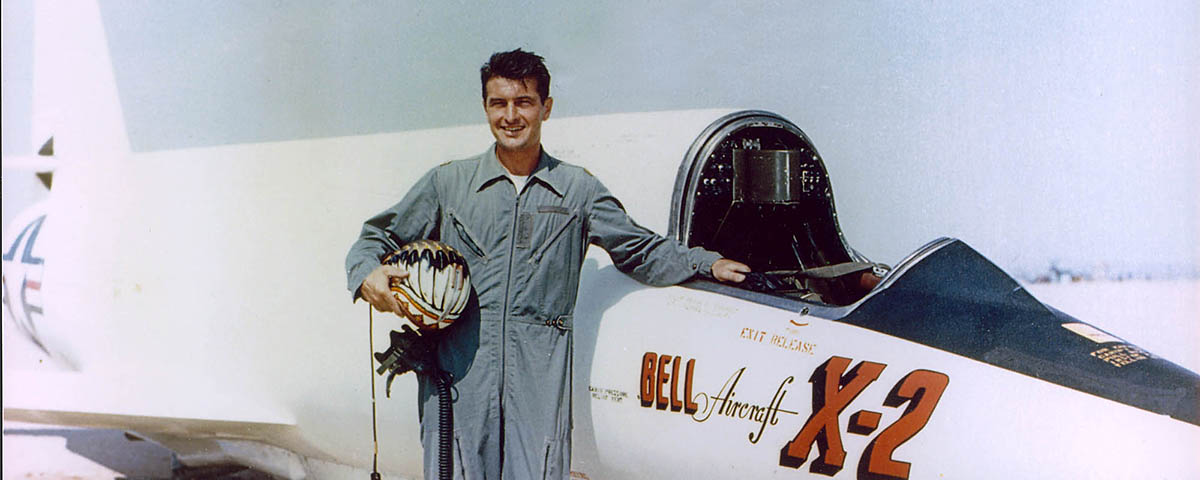
“Pete” Everest became the fastest man alive when he flew the X-2 to a record speed of Mach 3.
“You flew very, very gently and did the best you could while flying like a bat out of hell.” That’s how Frank K. “Pete” Everest described test-flying the Bell X-2, a rocket-powered research plane in which he would light the fuse and go–nearly to 2,000 mph.
From 1950 through 1956 Everest flew an average of eight newly designed aircraft per month as a U.S. Air Force test pilot. Jet aircraft production and design had reached an all-time high, and with the breaking of the sound barrier in 1947 by Chuck Yeager, experimental research aircraft became commonplace in the hangars of Muroc Flight Test Base (which later became Edwards Air Force Base). Airplanes such as the Bell X-1A, X1-B, X-1D, Northrop X-4, Douglas 558-II Skyrocket, Bell X-5, Convair XF-92A and the Douglas X-3 all contributed to significantly to aerodynamic research.
Everest’s crowning achievement came with his record-breaking flights in the Bell X-2 when, in July 1956, he became the world’s fastest test pilot, pushing the speed envelope to Mach 3 (1,900 mph). For this effort, Everest won the Harmon International Trophy, the “Oscar” of aviators. Everest is extremely proud of the work he has done as a test pilot. Thinking back to the time of constantly flying in the latest airplanes to roll off the production line, he says, “It was the heyday of flight testing.”
Frank Kendall Everest, Jr., was born in Fairmont, W.Va., in 1920. It was not until 10 years later that he would see his first airplane, a Curtiss Jenny flying over his parents’ home. From that day on, “Pete” (a nickname given to him by his father) set his goal on becoming a pilot one day. When World War II broke out in Europe, he had the opportunity to realize his goal. The government, anticipating the need for new pilots for the war effort, set up a civilian pilot training program (CPTP) at colleges and universities throughout the United States. The University of Virginia was among the schools selected for the pilot training program, and Pete Everest was in the very first class.
Everest learned to fly in a Piper J-2 Cub and progressed to Waco and Stearman trainers. Shortly after, he was accepted to the Aviation Cadet Training Corps. At first he flew the Curtiss P-40 Warhawk on more than 100 combat missions. He would have to wait until 1945 to get the chance to fly that most prestigious WWII fighter plane, the North American P-51 Mustang.
Everest was requested to transfer over to the Chinese-American Composite Wing Group in Hunan, China. There, both Chinese and American fighters flew raids and bombing missions against Japanese-occupied portions of China. While on a combat mission near Hankow, Everest flew in low over a Japanese supply ship column and ended up with his airplane riddled with enemy machine-gun fire. In the harrowing moments that ensued, Everest left the crippled P-51 over the side of the cockpit only to find to his dismay that his parachute had become caught on the plane. As the airplane plummeted toward the ground, Everest tried to make his way back into the cockpit and, as he did, somehow he freed himself. His chute opened, and he landed safely–but in an area of China held by the Japanese.
Shortly afterward, Everest was captured and brutally treated at a prisoner of war detaining area. After several sessions of intense interrogation by Japanese officers, he was warned that if he did not provide some substantial information regarding the size and location of his squadron, he would suffer severe consequences. After refusing to give information other than his name, rank and serial number, Everest was shackled and brought out to a courtyard where he saw a large block of wood covered with blood stains. There, he was made to kneel and place his head on the block. As a Japanese officer raised his sword, Everest told him, “Stop,” and said that he might be able to provide some information after all.
Reluctantly, the officer had him dragged back to the interrogation area. Everest remembered what intelligence officials in the Army had told him: “If you’re in a life-threatening situation, you can discuss the aircraft you flew.” The Japanese were always interested in information regarding enemy aircraft, but Everest doubled the statistical data on such areas as speed of the aircraft, armament and bombload. The gamble paid off, and his life was spared. Three months later the war in the Pacific ended, and Pete Everest went home.
In 1946 he put in for a new assignment, hoping to be selected for a job at the Wright Field Test Flight division in Dayton, Ohio. Out of 800 officers who applied, Everest and three other pilots were chosen for the job that would eventually make him famous as a test pilot.
It was at Wright Field that Pete Everest began flying the latest developments in jet aircraft, but it wasn’t until 1950, when he was transferred to Muroc Flight Test Base in Southern California, that his name would enter the history books.
Barry E. DiGregorio recently interviewed Everest for Aviation History Magazine to learn firsthand what it was like to fly “like a bat out of hell.”
Aviation History: In 1949, you were asked by the chief of Flight Test Operations at Wright Field if you would be interested in doing some altitude tests in the Bell X-1. What was the altitude record at that time and how high did you hope to go?
Everest: The altitude record was actually held by a balloonist at about 72,000 feet. We wanted to break that record.
Aviation History: After Chuck Yeager broke the sound barrier in 1947, he continued flying the X-1 until the end of the program. What was Yeager’s altitude record prior to your flight?
Everest: He had taken the X-1 to about 60,000-65,000 feet.
Aviation History: What altitudes was the Bell X-1 capable of reaching safely?
Everest: We hoped to get up to 74,000 feet.
Aviation History: Since high-altitude flight was still in its infancy in 1949, how much was actually known about the atmosphere above 60,000 feet?
Everest: We made altitude chamber tests and knew almost everything that would happen. We knew that you would not be alive very long above 60,000 feet without protection if the cabin pressure failed, because your blood would expand and boil in the extremely low atmospheric pressure. We made tests in the altitude chamber with “partial” pressure suits and tested them very thoroughly before we made the attempt to go to high altitudes. They were designed to keep your body from expanding in the rarefied atmosphere in an emergency that caused a loss of normal cockpit pressurization.
Aviation History: Would you describe the early X-1 pressure suit?
Everest: It was a portable “torture chamber”! That was one real tight suit. Every suit was tailor-made for each individual and had capstans [flexible, expandable air pipes] running along each arm and leg and down the back. You attached the helmet to the suit where there were restraining wires to hold it on–if you didn’t and the suit was pressurized, the helmet would pop up and probably choke you or even pop off your head. The helmet itself had capstans running around the inside along your forehead, behind your ears, under your neck and back around the other side. If the suit had to be operated, all these capstans expanded so they retained your body so that it didn’t expand in the low pressure and in turn allow your blood to boil. It was very uncomfortable even without being expanded. When it did expand, it became a torture chamber, as the capstans tightened the suit up. It was so tight that you burst a lot of the little capillaries under your skin tissue. You ended up looking like you were in a fight with two or three wildcats–that’s how badly the suit would scratch you.
Aviation History: Do you recall the first time you met Chuck Yeager?
Everest: He was at Wright Field the same time I was. We were both West Virginia boys, and we did a lot of flying together. My impression of him was that he was a damn good fighter pilot and shot down quite a few enemy planes in Europe during World War II. He was shot down himself later on in the war. After his return, [General Dwight D.] Eisenhower requested that he be put back in combat again because that’s how Chuck wanted it. I thought that was pretty much what you would call the “right stuff.” We were good friends then and still are.
Aviation History: Jack Ridley worked exclusively with the Bell X-1 program as its chief flight test engineer. What kind of person was Jack?
Everest: He was a great guy, too. We were neighbors at Edwards Air Force Base and lived two doors away from one another. We saw a lot of each other and played lots of golf. He was one of the finest Air Force engineers. He was reassigned for some reason to Japan, where he was killed in an accident. It’s too bad, because Jack could have done more good for the Air Force with a different assignment.
Aviation History: As I recall, you had numerous problems with the Bell X-1; some were life-threatening. Do you remember what some of those problems were?
Everest: I had engine problems on my third flight and an engine explosion on my fourth flight, when one of the rocket tubes blew up due to a propellant leak. On my seventh flight, the canopy cracked and I lost cabin pressure at 69,000 feet. That was the first time a pressure suit had been used in an emergency.
Aviation History: You also had problems with the rocket igniters, correct?
Everest: Yes, but that’s not a serious problem. If they didn’t ignite, you just wouldn’t go.
Aviation History: How would you describe an altitude flight in the Bell X-1?
Everest: You accelerated so fast that it was tough to follow the flight plan to give you the proper Mach number to climb at and the proper angle to climb. This is because you couldn’t see very well in the little X-1, as it had a flat canopy. So you tried to pick the proper nose-up angle to maintain the established Mach number. When you reached a certain altitude, you’d try to make sure you didn’t end up with the airplane vertical; otherwise, it would be an out-of-control flight. Obviously, at high altitudes your elevator controls were no good, so you used the movable horizontal stabilizer to try and keep the proper attitude on climb, while also trying to maintain the proper climb Mach number. It wasn’t an easy thing to do at high altitudes because the X-1 didn’t respond that fast in a thin atmosphere.
Aviation History: What consideration was given to an emergency exit from the X-1 in flight?
Everest: That would have been a tough job, because the door was on the side of the aircraft. If you did get out, you’d have to contend with avoiding the wings as well as the horizontal tail surfaces. Jack Ridley had a flight in the X-1 and had a small electrical fire inside. Apparently some wire behind the instrument panel shorted out, and he was getting lots of smoke. He started to get a little concerned about bailing out. Yeager was flying in the chase plane that day, and he heard Ridley yell: “I got a fire in here. Something’s burning!” Yeager’s response to him was, “As long as you’re not burning, Jack, don’t worry about it.” Ridley was able to land OK.
Aviation History: None of the X-1 pilots gave serious consideration to bailing out?
Everest: Not really.
Aviation History: Are you saying that if some catastrophe occurred on board the X-1 that the pilot intended to stay with the plane until it crashed?
Everest: Of course not. If you lost control or the airplane blew up or had a serious fire in the cockpit, then obviously you’d try to get out of it. But that never occurred. It was a nice little airplane and very easy to fly except when it was loaded with propellants. It became sloppy then.
Aviation History: Was this because of the propellants sloshing around in the tank and their weight?
Everest: Yes. Once the propellants were halfway gone, the X-1 flew like a decent airplane. When the propellants were completely used, the X-1 flew more like a glider.
Aviation History: In 1950, when Muroc was renamed Edwards Air Force Base in honor of Captain Glen Edwards, you became assistant chief in the test flight section. How long would a pilot be assigned there?
Everest: Most Air Force assignments only lasted three or four years, but at Edwards you would stay there for about six. It was the heyday of flight testing, with all the different airplanes being developed. We all wanted to stay at Edwards as long as we could.
Aviation History: How did you become assigned to different research projects?
Everest: In my case, I selected my own. Although I came out as an assistant, I shortly took over as chief test pilot. So I was doing all the assignments.
Aviation History: What kinds of aircraft were being tested at the time?
Everest: All the new jets were coming out; the Lockheed F-80s and T-33s, North American F-86s, Lockheed F-90s and F-94s; and with the new bombers you had the Boeing B-47 Stratojet. Then you had all the cargo airplanes and all types of different helicopters. During the six years that I spent at Edwards Air Force Base, I think I averaged flying about eight different airplanes per month. We also did bomb ballistic tests, rocket tests and gun tests. It was a very busy and exciting period.
Aviation History: How would the various phases of a test program be arranged upon the arrival of a new aircraft?
Everest: When a plane went into production, early copies were sent to the Edwards test center, and a bunch of the “using” agency command pilots were brought in. If it was a fighter, the user was the Tactical Air Command. If it was an interceptor, then that’s Air Defense Command. We flew them as long and hard as we could to see what weaknesses they had, if any, and to try to help correct problems before the manufacturers produced too many of them. For example, the early North American F-100 Super Sabre had a problem with inertia coupling. If you were pulling high Gs with a high roll rate, the opposing forces on the airplane would overcome the stabilizing effect of wings and control surfaces, causing the pilot to lose control. We lost a lot of airplanes and pilots that way when aircraft tumbled out of control. We soon discovered that the F-100 did not have a large enough vertical tail fin surface. The manufacturer then redesigned it–built a larger vertical tail, which eliminated that particular problem. We continued with that approach with the new production airplanes. It worked out well for the Air Force.
Aviation History: One of the next generation of new research aircraft at the time was the Convair XF-92, which had a delta-wing design. Since this was one of the many research aircraft you tested, could you describe the XF- 92’s flight characteristics and handling capabilities?
Everest: Unfortunately, the XF-92 was built for wind tunnel studies only. There was an argument among the engineers–some felt that it could never fly. So Convair, to make it fly, stuck an engine in it, and we started flying it. It wasn’t a very stable airplane because they didn’t attempt in those days to run stability tests on it, per se. Then Convair decided it wanted to get the XF-92 to go supersonic. Since it didn’t have an afterburner on it, we dove it like you would an F-86 and other early jets to break the sound barrier. But we just couldn’t get it to go supersonic. Convair then took it back to the factory and put an afterburner on it. We then were able to dive it supersonic. There was another argument that’s still going on between the pilots and engineers. The engineers figured the XF-92 was going supersonic in level flight. But we pilots said it couldn’t have, because we never saw any indication on the Mach meter or saw the airspeed indicator jump. Normally, you get a reading on your instruments when you go supersonic. One of the deficiencies of the XF-92 was that it had only one flight-control system–a single hydraulic flight-control system. One of the last flights made in that aircraft was by me. I took off from Rogers Dry Lake and shortly after the takeoff the master caution warning light came on. I looked down and saw I was losing the flight control system’s hydraulic pressure. I then turned around to land on the lake bed, and the controls froze just as I touched down. We stopped flying that bird. We had done everything with it we had really wanted to, and felt there wasn’t any sense in taking a chance on losing both pilot and plane in further testing.
Aviation History: Was the XF-92 designed for altitude testing?
Everest: No. It was just for the delta-wing investigations.
Aviation History: What was the maximum altitude it could achieve?
Everest: About 50,000 feet, so we didn’t even need a pressure suit in it.
Aviation History: Another research aircraft you tested during this time was the Douglas D-558-II Skyrocket. There were actually two versions of this experimental aircraft, the D-558-I Skystreak and the D-558-II Skyrocket. What were the major differences between these aircraft?
Everest: The difference was that the D-558-I Skystreak was a jet airplane. The D-558-II Skyrocket had a rocket engine.
Aviation History: What was the purpose of the D-558-II Skyrocket program?
Everest: The purpose was to investigate it as an airplane. It gave me more experience in rocket flight. NACA (National Advisory Committee for Aeronautics, now NASA) was running the program at the time, and I asked them if I could fly it and they said yes.
Aviation History: How many flights did you make in it?
Everest: Just one.
Aviation History: Was the D-558-II dropped from a B-29, the same way as the X-1?
Everest: Yes, it was. For a short time the Skyrocket held a speed record, but Yeager broke it in the Bell X-ID.
Aviation History: The most exotic-looking research aircraft had to be the Douglas X-3, also known as the “flying stiletto.” Was that airplane as much fun to fly as it looked?
Everest: No. Actually, it was pretty bad. It was designed to take off from a runway, but it was so underpowered we had to take off from the more roomy dry lake bed, and we wouldn’t break ground (lift off) until we got to 200 knots. Because of that, we started throwing a lot of rubber off the tread of the tires. So then we took all the tread off so we wouldn’t damage the airplane. The X-3 was underpowered because it had a small engine in it. When they were designing an engine for the X-3, it got bigger and bigger until finally when it was finished it just wouldn’t fit in the airplane. They ended up putting in a smaller, underpowered engine.
Aviation History: How did the X-3 perform?
Everest: On takeoff, it was dangerous because you could blow a tire easily. Also, there was such high wing loading (aircraft weight to wing area ratio) that you had to be careful when you came in for your landing, because if you were underpowered or below proper approach speed, then you had a hell of a time getting back up to proper airspeed. On my first flight in the X-3, I came in at 10,000 feet and tried to make a “peel-out” landing approach over the runway like most fighter jets did. I then put the landing gear and flaps down and was coming in for final approach, when suddenly I got too low on speed and had to go to afterburner to get back on speed again. You had to be extremely careful with the X-3 because of its high wing loading and being underpowered.
Aviation History: Was the Douglas X-3 capable of high-altitude flight?
Everest: No. It wouldn’t go anywhere! We did, however, use a lot of the information we got on it about high wing-loaded aircraft to use on the Lockheed F-104 Starfighter. The F-104 was a stubby-winged aircraft as well, and engineering data from the X-3 was incorporated as it was developed.
Aviation History: Wasn’t the F-104 used as a simulator for other types of aircraft?
Everest: No. You must be thinking of the NF-104 that had a rocket engine installed in it and was used at test pilot school to simulate very high-altitude flights. Yeager was there at the time; in fact, he tried to set a record in it and got into trouble. He lost control of it and had to punch out (bail out). The ejection seat rockets set his pressure suit on fire and burned him badly.
Aviation History: There was an amazing number of new aircraft designs coming out at that time. Did the test pilots at Edwards see that as a burden, or was each aircraft eagerly anticipated?
Everest: For the most part, eagerly anticipated, though we weren’t excited by some of the aircraft, such as the X-3; it was no big deal. The Bell X-5, though, was interesting because we could sweep the wings back and forth, so we definitely anticipated projects like that.
Aviation History: In the six years you spent at Edwards AFB, 13 test pilots were killed in accidents involving aircraft. How did you and your fellow test pilots manage to keep an optimistic attitude and enthusiasm with that many disasters?
Everest: Maybe half of the losses were due to pilot error. The rest were due to aircraft glitches. Of course, you’re sad when you lose a good friend and fellow test pilot, as well as sad for the wives and children they left behind. However, I don’t think there was any loss of enthusiasm. The accidents were a reminder to be more careful. If it was something the pilot did that caused the accident, we wouldn’t repeat it, or if it was due to something in the airplane that couldn’t be controlled, then we’d try and fix that before we went any further. We all loved our work and were all volunteers for it. We never lost enthusiasm.
Aviation History: What were the major differences between the Bell X-1, the X-1A, X-1B and X-ID?
Everest: The X-1A, X-1B and X-ID all had canopies instead of the windshield the first X-1 had. Later on, they put ejection seats in; they also had more fuel capacity and better stability. Also, they could go higher and faster and in general were just follow-on airplanes to the Bell X-1.
Aviation History: What happened to the X-1C?
Everest: There was an X-1C, but the program got canceled. It was going to be an armored aircraft with guns on it, used for testing only.
Aviation History: Chuck Yeager nearly lost his life in the Bell X-1A. Do you recall what caused him to lose control of that aircraft?
Everest: The X-1A was not too stable at the higher Mach numbers, so on one flight he lost control and started tumbling and spinning. Fortunately, he regained control and got back down safely. It wasn’t anything unexpected; it was just something we found out from going too fast with a bird that shouldn’t go that fast.
Aviation History: You also flew the Northrop X-4, another hybrid sweptwing research airplane. What contributions did the X-4 make to aviation history?
Everest: It was a little, tailless, subsonic airplane. You could only get it up to about Mach .8 or it would come unglued on you. We investigated with it mainly for stability and control, and how that applied without having a tail on it. It was fun to fly, but there wasn’t much to it.
Aviation History: What are your comments on flying the Bell X-5?
Everest: It had about the same performance as an F-86, but it was only built to check out the variable-sweep angles on the wing. We did various maneuvers with different sweep angles. You could sweep the wings from 20 to 60 degrees.
Aviation History: How would sweeping the wing effect the X-6’s performance?
Everest: The more you sweep the wing, the less aerodynamic drag you have and the faster you go. It would only go supersonic in a dive, similar to an F-86, so it wasn’t very fast. For the most part, it was just used for stability and control tests to find out what happened when you changed wing-sweep angles; then, hopefully, a designer would apply that information with later aircraft and figure out which was best for the particular airplane he was going to design and build.
Aviation History: You are most closely identified with the work you did in the Bell X-2. What new information was to be gained from the X-2 program?
Everest: Like the X-1, the X-2 was designed for speed and altitude, only it could go higher and faster. Test pilot Ivan Kincheloe set the altitude record in it–126,000 feet.
Aviation History: What altitude did you reach in the X-2?
Everest: About 67,000 feet.
Aviation History: Were the pressure suits used in the X-2 different from the “torture chamber” suits used in the X-1?
Everest: No, they were the same ones. That’s all we had in those days.
Aviation History: One of the unique features of the Bell X-2 was the pilot ejection system. You could literally blow off the front nose portion of the cockpit to escape, right?
Everest: Yes, you could. It was Captain Milburn Apt who was the only pilot to ever use it. Apt was killed in the last flight of the X-2 program. He ended up in an inverted spin during descent, and we knew that when you blew the front cockpit section off, you’d get a 14-G pressure. The tiny X-2 cockpit was so small that your helmet was touching the canopy on both sides, while your legs and feet were straight out in front of you on the rudder bars; your shoulders touched the canopy rails on both sides. So when Captain Apt was in the inverted spin and blew the nose section off, the 14 or even 15 negative Gs knocked him out. The parachute on the cockpit section worked, but it was just used to slow your descent to a lower altitude so you could pop the canopy off and climb out to use your regular parachute. Unfortunately, Apt recovered consciousness when it was too late to bail out. He managed to get the canopy off but he was then too low to use his regular parachute.
Aviation History: The X-2 was launched or dropped from a Boeing B-50 Superfortress as opposed to the B-29 that would normally launch the Bell X-1. Why was that?
Everest: We started using the B-50s to drop the X-1 later on in the program, as well as the X-1A, X-1B and X-ID, because it could go higher and faster than the B-29. So we then continued to use it to launch the X-2.
Aviation History: In 1953, during a captive test flight over Lake Ontario, Bell Aerospace chief test pilot Skip Ziegler and Bell scanner Frank Walko were killed in an explosion and fire while the X-2 was still mated to the B-50. What went wrong?
Everest: Because everything fell into Lake Ontario, no one knows for sure what happened. Investigators surmised that it might have been an overpressurization of some of the propellant tanks in the X-2. Some early X-1s had a similar problem.
Aviation History: On your third powered flight of the Bell X-2, you broke a previous speed record you had set earlier in the Bell X-1B, reaching a speed of Mach 2.5 as opposed to 2.3. What was the maximum speed the engineers felt the X-2 was capable of?
Everest: About Mach 3.
Aviation History: Will you give a description of what it’s like to make an altitude flight profile in the Bell X-2?
Everest: Well, a lot was expected of you. The flights themselves cost about one million dollars each, so you wanted to be careful and not pull some bonehead stunt like getting off your speed or off your altitude. After the X-2 and B-50 have been mated and you have gone through your preflight checks, at this point you top off your propellants in the X-2 and you’re ready for takeoff. You (the X-2 pilot) would be waiting in the nose of the B-50 during climb-out, because it took about an hour to climb to altitude. At about 9,000 or 10,000 feet you get in the cockpit of the X-2 by first going through the bomb bay section of the B-50. Then the crew puts the canopy on and locks it down. After you’re strapped in, you wait for another half-hour or 45 minutes while the B-50 continues climbing. You then go through a series of checks while pressurizing your tanks. You make sure the propellant tanks are up to snuff and make sure the jettison systems work, so you can jettison the propellants if a problem occurs. You then tell the B-50 crew you’re ready, and they make a turn toward the base and start a dive to try and get up to about 250 mph, which was the drop speed for the X-2. You then start your countdown from 10 to 1 and call “Drop!” The B-50 crew pulls a lever that releases the shackles to the X-2 and you’re off on your own. As soon as you are dropped, you hit your switches to get the rockets going. Once they’re going, as I described with the X-1, you’re hanging on and trying to fly a prescribed flight path to give you the best performance. This isn’t easy to do, because you have to climb and try to get to about 60,000 feet, then level off and perhaps dive a little to try and get the maximum Mach number out of the airplane. You do this until your propellants are exhausted and then head home. Because you’re still at 60,000 feet you make a very gentle turn back because you don’t want to lose control, and you don’t have much control at that altitude. You are still a good distance away from base, past Bakersfield, and as you are gliding back you talk with the chase plane pilots, explaining where you are, so they can pick you up visually and “get on your wing.” After they locate you, they fly close to you, looking you over to make sure no damage was made to the airplane. You then set up your landing pattern and glide on in for a touchdown. All the flights were basically about the same.
Aviation History: I imagine that as a test pilot in the X-2, your reflexes must have to be incredibly fast.
Everest: Things happen so darned fast! It’s just hanging on and trying to do the best you can. If you got up to an altitude where you wanted to “push over” (a maneuver in which the airplane is quickly put into a dive by pushing forward on the elevator control) to get maximum speed, your altimeter was such that its indication was lagging behind, so you started the push over at about an indicated 5,000 feet below where your real altitude was, to compensate. You didn’t want to push over too suddenly because you would unport the tanks where they feed into the rocket engine (negative Gs lift the fuel in the tanks away from the fuel-line port, and fuel stops flowing to the engine). If you unported those and got air into the fuel system, the rockets would shut down. That occurred several times. So you flew very, very gently and did the best you could while flying like a bat out of hell!
Aviation History: How and why did the X-2 program end?
Everest: The program ended after Captain Apt’s fatal flight. The North American X-15 was going to be coming out soon, so there wasn’t any sense to building another X-2. Also, we had achieved what we wanted to with it–we had gone to the airplane’s highest altitude and highest speed. There was more work to be done in areas such as stability to get more data, but there wasn’t enough reason to build another X-2 just for that purpose.
Aviation History: Chuck Yeager went on to head the Air Force Aerospace Research Pilots School to train military astronauts for programs like the Manned Orbiting Laboratory and the X-20 project (Dyne-Soar program). Did you want to be a part of that program?
Everest: No.
Aviation History: Why not?
Everest: I just wasn’t that interested in it. Had I known that we would advance as far as the space shuttle I might have. The early astronaut programs like Mercury were not appealing because you could use a monkey as well as an astronaut to make the flights.
Aviation History: Were you interested in getting into the X-15 program?
Everest: I would have liked to, but it was still several years away from flying and I wanted to do other things.
Aviation History: What did you do after leaving Edwards Air Force Base in 1957?
Everest: I went to school at the Armed Forces Staff College in Norfolk, Virginia. Then I went to Europe as an F-100 squadron commander in Germany. I was then promoted and sent to Tripoli in Libya at Wheelus Air Force Base, where I became commander of a gunnery group. It was basically a training base for dropping bombs and shooting rockets and machine guns.
Aviation History: What makes a great test pilot, in your estimation?
Everest: You have to love to fly, have a sense of adventure, be an excellent pilot and want to do things that are dangerous.
Aviation History: You are quoted as having once said that it was your dream to be the first man on the moon.
Everest: Yeah.
Aviation History: Did many other test pilots during the time you spent at Edwards have the same dream?
Everest: I think so…we never talked about it in that light.
Aviation History: You didn’t see Mercury or Gemini as stepping stones to the moon?
Everest: In a way, yes, particularly when they started putting more funds in for the Apollo program. I would have been interested in Apollo, but by that time I was getting a bit old for that stuff.
Aviation History: Do you think today’s test pilots are the same as they were during your generation?
Everest: They would have to be. Of course, it’s so much more sophisticated, but the computers and engineering knowledge they have make it a much easier job. The engineers today, with their design abilities and computers, know just about everything before the airplane ever takes off. Most of the airplanes today are so unstable that if you didn’t have computerized stability augmentation, you couldn’t fly them–planes like General Dynamics’ F-16 and McDonnell Douglas’ F-15 and F/A-18.
Aviation History: What would happen if the computer stability augmentation system failed due to a computer error?
Everest: It would probably destruct, but they usually have three stability augmentation systems in them. I’m not aware of all they have done to check out what the airplane would do if you lost all three of those systems. However, there’s a very good redundancy.
Aviation History: Of all the hot airplanes flying today, which would you prefer to fly and why?
Everest: I love the little F-16. The F-15 was a big airplane, and the F-16 compared to it is like a Republic F-105 compared to a McDonnell F-4. When I flew the F-15, it seemed so large that I couldn’t get enthusiastic about it. When you get into an F-16, however, you feel like you put it on instead of getting into it. It’s a real performer, too.
Aviation History: What do you do to keep busy today?
Everest: I play golf, fish and do lots of traveling.
Author Barry E. DiGregorio is a freelance aviation writer as well as a rock music songwriter/musician. For further reading, he suggests: The Fastest Man Alive, by Frank M. Everest; and Supersonic Flight, by Dr. Richard P. Hallion.