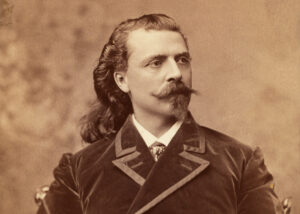

The legend of Wyatt Earp casts a shadow far beyond Tombstone, covering more ground than wandering Wyatt did while alive. And the “Frontier Marshal” really did get around, hitting dozens of hot spots and cold spots between Nogales and Nome, though rarely as any kind of lawman. Among the countless gunfighters, gamblers and good sports eclipsed by Wyatt’s long shadow are his brothers, especially Virgil and Morgan, who are never the focus of that celebrated march down Allen Street to square off with the Cowboys near the O.K. Corral. Virgil wore the big badge that day, but no matter. It was Wyatt’s day of reckoning, with an assist from Doc Holliday. Right or wrong, most of us view Virg and Morg as brotherly sidekicks. In the lead-poisoning aftermath of the gunfight, one lost the use of an arm and the other his life. But even those family tragedies are primarily viewed from Wyatt’s perspective; they inspired vengeance in the main man—Wyatt Earp’s Vendetta.
In December 2009’s Wild West cover story, Wyatt Earp biographer Lee A. Silva examines Wyatt’s overshadowing of Virgil. On paper at least, Virgil Earp was a powerful man on October 26, 1881, the day of the Tombstone street fight. He was both deputy U.S. marshal and Tombstone’s chief of police (in effect “city marshal,” which is what most people called him). As the man in charge, Virgil had deputized Wyatt to help control Ike Clanton and other rowdy Cowboys. History singles out Wyatt as the man of the hour, though Virgil biographer Don Chaput asserts, “There is little in the contemporary record to back up such an elevated role for Wyatt.”
So why is it Wyatt whenever we think Tombstone or the Earp brothers? For starters, Wyatt already had built a solid reputation as a lawman in Kansas cow towns, particularly Dodge City. Second, in the fierce half-minute gunfight, Virgil, Morgan and Doc were wounded, Billy Clanton and Frank and Tom McLaury were killed, and Ike Clanton ran for his life. Only Wyatt escaped with his body and/or reputation unscathed. Third, in the post-fight action, Virgil was shot from ambush and not only put out of commission but also removed from the scene (to California). Morgan was shot dead in a subsequent ambush. Wyatt, meanwhile, led a vigilante posse against various Cowboys and emerged an indestructible hero, albeit one who had gone beyond the law. The youngest Earp brother, Warren, was not in Tombstone for the gunfight but saw some vendetta action. The oldest of the full brothers, James Earp, was a saloon man in Tombstone but didn’t do any fighting; he accompanied Morgan’s body to Colton, Calif., where their parents, Nicholas and Virginia Earp, lived. Only half-brother Newton Earp (born to Nicholas’ first wife, Abigail, in 1837) was completely removed from the Tombstone scene.
“No matter what lawmen titles the Earp brothers had or didn’t have, I believe Wyatt was calling the shots in Tombstone,” Silva says. “Virgil was more laid-back and just followed along no matter what happened. Wyatt had the dominant personality.” That point is debatable, because the Earp boys kept their feelings close to the vest. No group hugs but plenty of brotherly support is evident. Silva thinks Warren, not always a straight shooter (he was shot down in Wilcox, Arizona Territory in 1900), was envious of Wyatt and that Morgan was Wyatt’s favorite brother. But the two most famous Earps, Wyatt and Virgil, got along just fine, too. Virgil never complained that Mom liked Wyatt best or that Wyatt got more attention from newsmen and historians. Virgil’s wife, Allie, apparently resented Wyatt for stealing some of her husband’s Tombstone thunder, but that’s OK. Virgil was the Earp who hugged her with his one good arm after the December 1881 ambush and the Earp with enough true grit to still be serving as a deputy sheriff when he died of pneumonia in 1905.