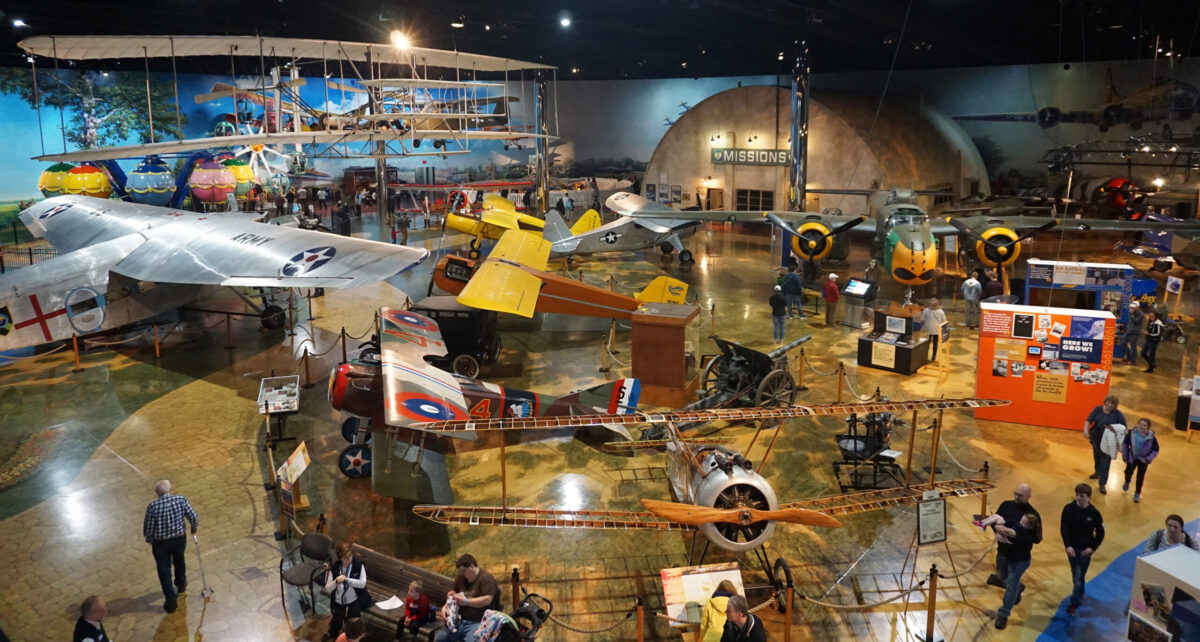
A small aviation museum in Kalamazoo, Michigan, was incorporated in 1977 with the express purpose of “preserving the legacy of World War II aviation, for the restoration and display of WWII aircraft, both flying and static.” An additional purpose was to enhance the public’s knowledge about the history of WWII aviation and about the maintenance and operation of the planes of that era. The Kalamazoo Aviation History Museum has grown in size over the past 20 years, and its mission has expanded to include military aircraft from all eras. What began as a collection of seven vintage airplanes has matured into an array of more than 45 classic aircraft. The aircraft are displayed in 43,000 square feet of exhibition space (only 2028 aircraft can be displayed at any one time), with an additional 1215 planes in the new Flight/Restoration Center.
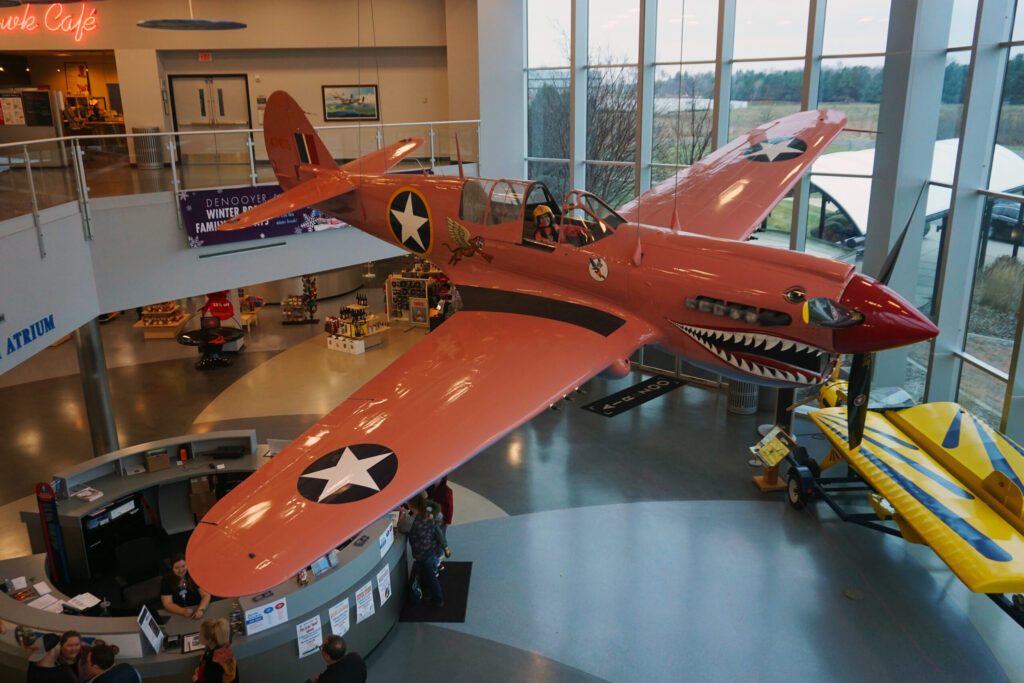
The Kalamazoo “Air Zoo” derived its nickname from the animal-named aircraft that formed the nucleus of its collection in the early years: the Curtiss P-40 Warhawk, the Douglas C-47 “Gooneybird,” and three Grumman “cats,” the FM2/F4F Wildcat, the F8F Bearcat and the F6F Hellcat. The museum has gained a reputation for a quality of restoration seen in few other museums in the United States. Honorary Flying Tiger Don Lopez, deputy director of the Smithsonian Institution’s National Air and Space Museum (NASM), has commented that he has “never seen any airplanes, anywhere, better maintained than at the Kalamazoo Air Zoo.”
Jack Hilliard, now with the San Diego Air and Space Museum and formerly curator of the U.S. Air Force Museum, wrote that the Kalamazoo Air Zoo is “the premier flying collection in the country from our point of view.” And though these testimonials hearten the staff and volunteers at the Air Zoo, the comments of ordinary visitors to the museum are what mean the most. Many of them quite favorably compare the museum to the NASM, the San Diego Air and Space Museum, and the U.S. Air Force Museum. The Air Zoo is not as large as those other museums, but the same love and devotion to the exhibits is apparent.

The Air Zoo has kept up its remarkable level of quality in restoring aircraft such as the award-winning Republic P-47 Thunderbolt, the Goodyear FG-1D Corsair, the North American B-25 Mitchell and the Grumman F7F Tigercat.
The P-47 that is owned by the Kalamazoo Air Zoo never saw combat but became part of the Peruvian Air Force after WWII. It was recovered by Ed Jusist of Vintage Aircraft International Inc., who tells a story that includes a poisoning, a kidnapping and his skin-of-the-teeth escape from the South American country. Another from-the-ground-up rebuild completed by the early museum staff was the inverted gull-wing FG-1D Corsair, Goodyear’s version of the famous Chance-Vought fighter.
The museum’s Mitchell spent little time overseas during World War II, but it has been painted to represent a similar bomber flown by the “Air Apaches” in the South Pacific. The 345th Bombardment Group of the Fifth Air Force was known by that nickname because its men and bombers went on a warpath across the Pacific. As with the P-47, the Mitchell’s life involved a bit of cloak and dagger, with rumor suggesting it had been used for smuggling contraband from South America into the United States.
The Tigercat is one of only about 10 existing in the world today, but several F7Fs are being restored, so this number should grow. Although it never saw combat during World War II, the Tigercat was used on photoreconnaissance missions in Korea. Later it went through its nine lives in several types of civilian operations, including one in which it was used as a fire bomber.
The Air Zoo’s restoration crew is not totally absorbed by the refurbishment of well-known WWII combat planes, though. Recently, one of the restoration staff members, assisted by a dozen or more volunteers, rebuilt a Laister Kauffmann TG-4A glider trainer. They are now deeply involved in restoring a very rare Waco CG-4A glider like the ones used in the 1944 D-Day invasion. Another group is involved in restoring one of the most important aircraft in WWII history, a Douglas SBD-3 Dauntless dive bomber, on loan from the National Museum of Naval Aviation. This airplane had been on the bottom of Lake Michigan for 50 years.
In addition to the aircraft on display at the main complex, a new Flight/Restoration Center has been opened. This vintage complex has been completely renovated and holds more aircraft. It also has a large art gallery. Visitors can see restoration and maintenance work in progress.
The Air Zoo took possession of an F-14A Tomcat on loan from the National Museum of Naval Aviation on May 18, 1995. It is thought to be only the fourth museum in the world to have that fighter in its collection. Other than the Pensacola museum, the Kalamazoo Aviation History Museum is the only known museum to have all of the Grumman cats when Art Wolk’s Panther is in residence. These are the FM-2 (F4F), F6F, F7F, F8F, Wolk’s F9F, TF9J, F11A and F-14A.
The Kalamazoo Air Zoo, like most nonprofit institutions, could not survive without its dedicated volunteers. They do everything from maintenance and gift shop sales to tour escort and security. Tour guides explain the role various aircraft played in the history of the United States. More than half of the aircraft in the collection are airworthy, and many more are flown on a regular basis.
There almost always is a lot happening at the Kalamazoo Air Zoo. Close to 60,000 visitors come to the museum annually, and though the wear and tear of that many people should take a toll on the building, it is as pristine as the planes it holds. The floor glows with the reflections of aircraft like the camouflaged Supermarine Mk.IX Spitfire, the navy-blue Douglas AD-4 Skyraider, the silver Vultee BT-13 Valiant, and the purple Hispano HA1112 Buchon–the Spanish Messerschmitt.
Colorful banners with aviation insignia and geometric shapes brighten up the main exhibition area. Collections of artifacts representing everything from ration stamps to weapons are displayed. There is an assortment of more than 200 model aircraft, including a replica of “The Guff,” the first radio-controlled aircraft built by Kalamazoo’s Good Brothers–the original is in the Smithsonian. There is also a large display of aviation art and photographs.
But there is plenty more to see and do at the Air Zoo than just visit old aircraft and memorabilia. Visitors can experience the exciting “Corsair Challenge” flight simulator, in which riders are physically and visually tricked into thinking they are actually flying in an F4U Corsair fighter. The virtual reality technique overloads the riders’ minds with so much sensory input that it causes them to believe they are flying.
May to September finds the Air Zoo holding its Flight of the Day (weather permitting), when one of the warbirds takes to the air to perform for spectators. Those interested in the “real thing” can actually fly in a vintage aircraft. From May to October, the museum sells seats for flights in its classic Ford C-4 TriMotor. Flying in the TriMotor gives passengers a taste of aviation’s golden age. This aircraft was built in 1929 and was one of the five original Tri-Motors purchased by Northwest Airlines.
Perhaps one of the most important offerings of the museum is the mini-museum it houses within itself. This is the Guadalcanal Memorial Museum, which is maintained by the Guadalcanal Campaign Veterans Association. It consists of artifacts, pictures and three realistically constructed dioramas of key battles on Guadalcanal during World War II.
The Michigan Aviation Hall of Fame took up residence at the Air Zoo on September 23, 1995. This collection of artifacts and information of such august aviation figures as Charles Lindbergh, Eddie Stinson, William Boeing, Henry Ford, and Harriet Quimby celebrates those personages who made outstanding contributions to the aerospace heritage of the United States and who were born in Michigan or spent a significant portion of their careers in that state. Each of them has a fascinating story to be discovered by museum guests.
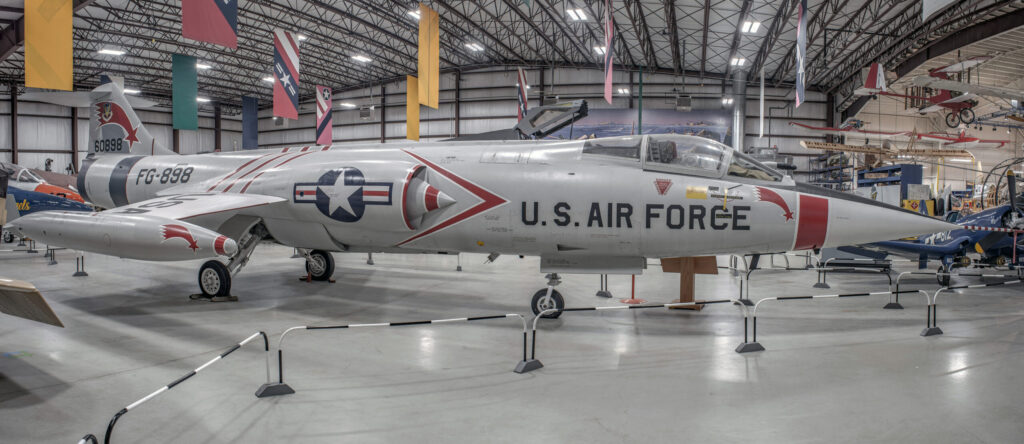
Along with the Michigan Aviation Hall of Fame, the Air Zoo has newly expanded to provide its visitors with a hands-on activity room in which children can get inside the cockpits of an F-80 Shooting Star, a KC-135 Stratotanker, an F-106 Delta Dart, a CH-53 Super Stallion and a half-scale Corsair fighter. Other hands-on activities are available.
The motto of Kalamazoo’s Upjohn pharmaceutical company is “Keep the Quality Up.” The staff and volunteers of the Air Zoo have adopted this maxim, applying it to the facility, the planes they display, and the service they provide to the museum’s patrons. It even shows up in the recently renamed High on America Air Show–voted best in the nation in 1991 by World Airshow News.