
This year marks the 200th anniversary of the birth of Florence Nightingale, a revolutionary British nurse and humanitarian credited with establishing the cornerstones of modern nursing practices.
Nightingale distinguished herself for bravery and ingenuity while caring for wounded soldiers during the 1853-1856 Crimean War. Her efforts saved countless lives. Her wartime experiences shaped the practices she established as a medical professional.
The Crimean War was a bloody and disorganized international conflict involving the militaries of the United Kingdom, France, the Russian and Ottoman Empires, and Sardinia. The war is perhaps most distinguished in modern consciousness by Alfred Lord Tennyson’s stirring poem, “The Charge of the Light Brigade,” recounting a valiant but doomed action by British cavalrymen during the Battle of Balaclava in October 1854:
“Theirs not to make reply,
Theirs not to reason why,
Theirs but to do and die.
Into the valley of Death
Rode the six hundred.”
Disease and neglect, however, claimed the lives of British soldiers faster and more relentlessly than enemy guns or sabers. By late 1854, frontline soldiers in Turkey were ravaged by cholera, dysentery and fevers. According to an 1885 naval and military magazine, British troops were deprived of bedding and tents and compelled to lie on cold, wet earth. Ambulances were in disrepair. Injured and ill men often died from lack of food and medicine. Furthermore, healthy soldiers suffered from extreme exhaustion as they attempted to take on the extra duties of their ill or fallen comrades.
“In the olden times, the suffering soldier was left to the tender mercies of the hospital dressers and servants, and his recovery was more due to chance than to care,” Joachim Stocqueler wrote in his 1856 book, The British Soldier: An Anecdotal History of the British Army.
That dire situation changed radically after the arrival of 34-year-old Florence Nightingale, accompanied by a group of 38 intrepid women, at the British military hospital in Scutari, Turkey.
While Nightingale is known for her gentleness, she had a very strong and resolute character. Born in 1820 to wealthy parents in Florence, Italy, she forged a determined path to become a nurse—defying social conventions and her own family, as the nursing profession was then viewed as “not respectable” for genteel women. She trained as a nurse in Kaiserswerth hospital in Germany in 1851 and later cared for cholera patients in London as the superintendent of a hospital in Harley Street.
“Her general demeanor is quiet and rather reserved; still I am much mistaken if she is not gifted with a very lively sense of the ridiculous,” wrote Sydney Godolphin Osborne in Scutari and Its Hospitals in 1855. “In conversation, she speaks on matters of business with a grave earnestness that one would not expect from her appearance,” he wrote, adding that Nightingale had “trained herself to command.”
Nightingale was appointed by Secretary of State for War Sidney Herbert to lead a “task force” of nurses deployed to the Scutari military hospital to assist with improving conditions there.
“Miss Nightingale consented to undertake the management of the expedition, and to place herself at its head. Not a moment was lost in unnecessary delay; she herself had counted the cost, and shrank not from its payment,” according to an 1862 article by Frank Leslie.
Nightingale and her stalwart troop of women were not initially welcomed by the hospital’s hard-edged military surgeons. The women, banned from the cholera wards, were literally thrown into action when masses of wounded men arrived from the battlefields of Balaclava and Inkerman. Multitudes of suffering soldiers quickly overwhelmed the hospital. Nightingale swiftly mobilized her group and took charge.
“Under her management, the utter confusion reigning in the vast hospitals at Scutari were quietly and rapidly reduced to order, and at last the soldier, when he saw that ladies could leave home to come out there to him in his misery, began to believe that the people at home really cared for him,” said Dr. Charles J.B. Williams in an 1862 lecture to London’s Royal College of Physicians.
Miss Mary Stanley, a member of the volunteer nursing task force, described Nightingale’s heroism in an 1856 book, Eastern Hospitals and English Nurses:
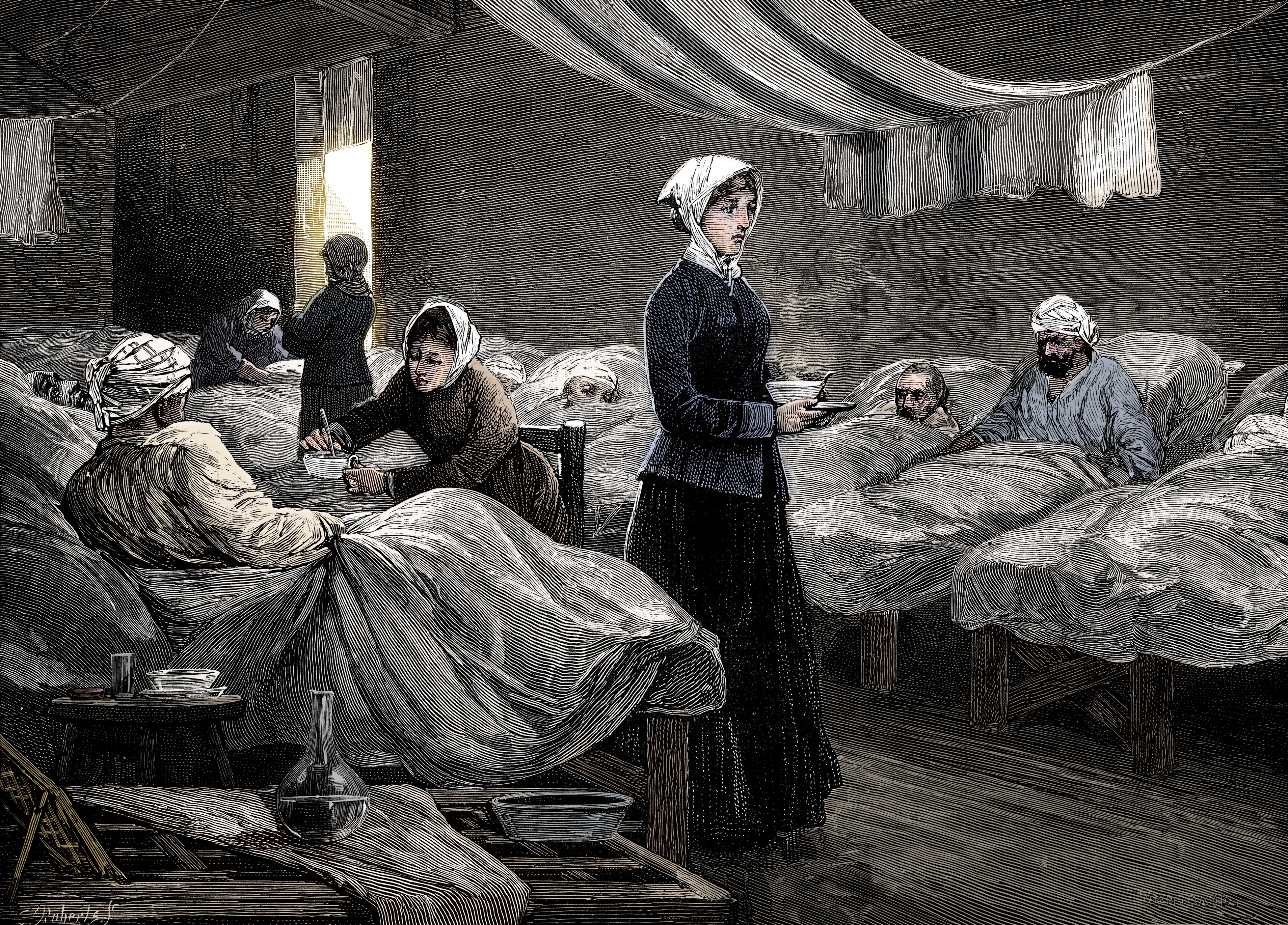
“Two days after my arrival, Miss Nightingale sent for me to go with her round the hospital (Miss Nightingale generally visited her special cases at night)…It seemed an endless walk, and it was one not easily forgotten,” Stanley wrote. “As we slowly passed along, the silence was profound; very seldom did a moan or cry from those multitudes of deeply suffering ones fall on our ears. A dim light burnt here and there. Miss Nightingale carried her lantern, which she would set down before she bent over any of the patients. I much admired Miss Nightingale’s manner to the men—it was so tender and kind.”
The image of Nightingale materializing quietly beside suffering soldiers with kindness and a glowing light has been memorialized in works of art and has led to her to become known as the “Lady with the Lamp.”
The soldiers derived both emotional comfort and physical relief from the care of the nurses. Recovery rates improved. “We had, in the first seven months of the Crimean campaign, a mortality of 60 percent per annum from disease alone,” Nightingale wrote, according to an 1858 article published in Dublin University Magazine. “We had during the last seven months of the war, a mortality among our sick greatly less than that among our healthy men at home…Is this not the most complete experiment in army hygiene?”
Despite her proven successes during the war, Nightingale and her team of nurses were not without critics and detractors. “Of course, the officials prophesied all sorts of evils from this shocking innovation,” according to Williams. “But instead, there came more nurses…The work of these noble women foreshadowed the Red Cross.”
Following her experiences during the war, Nightingale established a first-of-its-kind scientific school of nursing in 1860 and in 1907 became the first woman to receive the Order of Merit.
During the Crimean War, she saved the lives of countless soldiers who would otherwise have been written off as casualties. Distinguished by both gentleness and valor, Nightingale was not only a healer, but a soldier in her own right.
Williams wrote: “With a vigilance untiring, a rare intelligence, and a memory never failing, this gifted lady saw and comprehended all the multitudinous wants and requirements in the army, in hospital, in camp and in barrack; in war and in peace, in sickness and in health.”