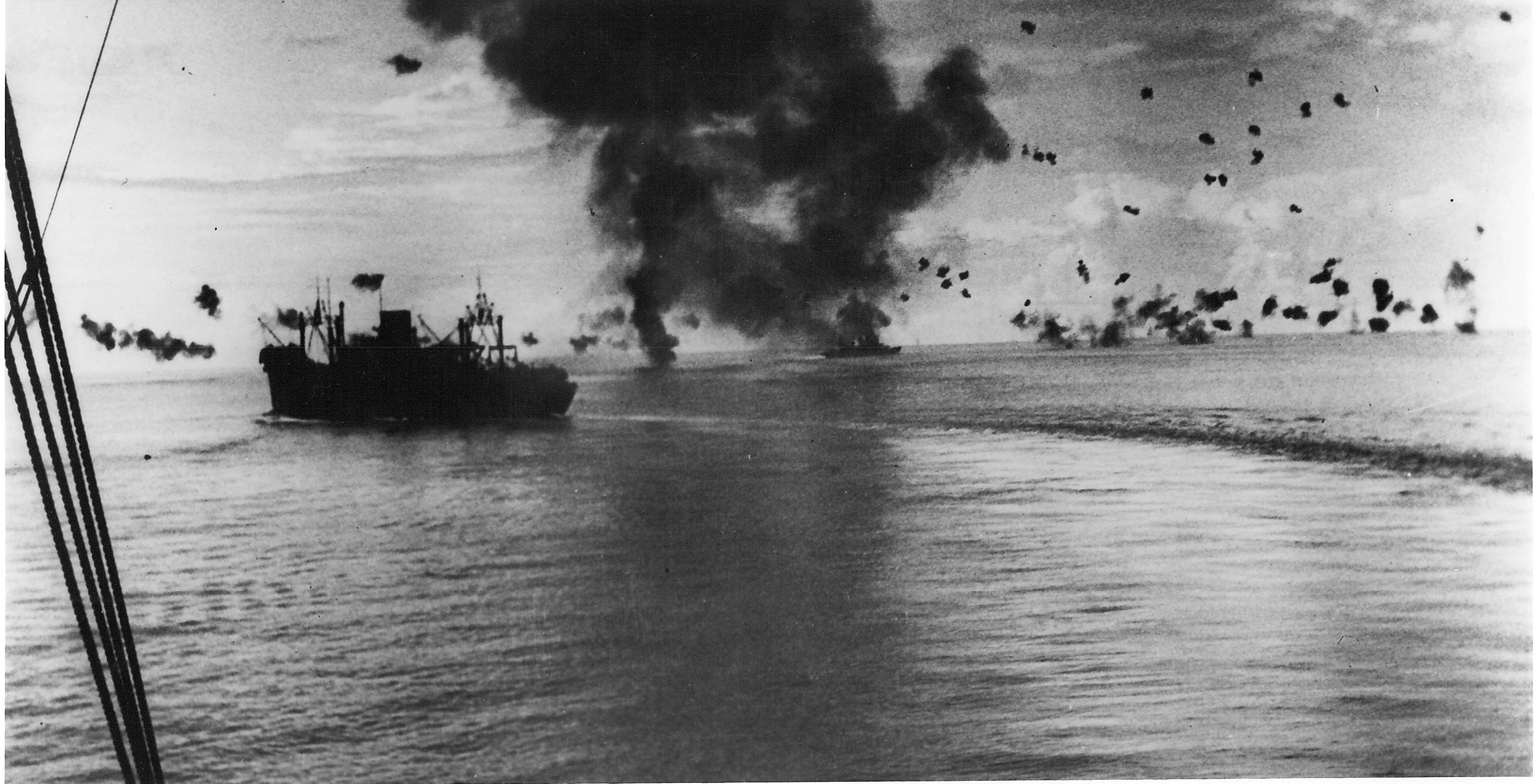
War-worn and weary, Commander Tameichi Hara stumbled off the bow of his destroyer Amatsukaze. The Japanese destroyer skipper had just fought the hard Battle of Santa Cruz. He desperately needed some rest. Instead, he would face his greatest ordeal yet.
By October 1942, Japan and the United States had worn each other down in the South Pacific. United States Marines held Guadalcanal’s vital Henderson Field but were ringed in by Japanese soldiers. Both armies were devastated by malaria and supply shortages.
At sea, the picture was equally grim. Japan had just lost 74 planes at Santa Cruz, but the United States had lost the aircraft carrier Hornet, and her sole remaining flattop, Enterprise, was badly damaged. American planes ruled “The Slot” and Ironbottom Sound off Guadalcanal by day, but Japanese ships dominated them by night. Both sides were stalemated, gasping for breath.
In his spartan sea cabin aboard the super battleship Musashi at Guam, Japan’s Admiral Isoroku Yamamoto, commander of the Combined Fleet, spewed out a stream of orders intended to allow the fleet to regain the initiative with typical daring.
Since Yamamoto had only one available carrier, Junyo, he turned to his crack battle-cruiser force. The plan was simple enough: A convoy of troops, backed up by his battleships Hiei and Kirishima, would steam down The Slot to Guadalcanal. The troops would land and reinforce the army there, while the warships would shell Henderson Field, smashing the air base and its planes.
Kirishima and Hiei were fine ships. Built in 1912 and 1914, respectively, they displaced 37,000 tons and were among Japan’s oldest yet fastest battlewagons, able to race along at 30 knots. When Emperor Hirohito went to sea, he always rode aboard Hiei.
Key to the plan were special 14-inch shells loaded in the magazines of Hiei and Kirishima–Type 3 shells, originally designed for anti-aircraft work. Each shell’s casing had a bursting charge that would scatter 470 individual incendiary submunitions across an area. These could shatter the parked planes on Henderson Field, but were useless against steel warships. One heavy cruiser and 10 destroyers, including Hara’s Amatsukaze, would take part.
Soon after Musashi‘s mimeograph machines cranked out the orders, Rear Adm. Hiroaki Abe hoisted his flag aboard Hiei. Abe, a veteran destroyer skipper, had escorted Japan’s elite carriers from Hawaii to the Indian Ocean. But he had a reputation for timidity. And his hard-working crews were exhausted. Still, the Japanese had key advantages–well-trained crews, coordinated tactics, and the Type 94 Long Lance torpedo, which outranged American fish.
Hara was aware of all these factors as he returned to his 2,490-ton destroyer. Amatsukaze left Truk on November 9 and met up with Abe’s force near the Shortland Islands on the 12th. The force headed south in tight formation.
Meanwhile, the Americans were not idle. Japan had changed its naval codes, but U.S. code-breakers quickly went to work. Yamamoto had cut his orders on November 8. On the 9th, those orders, decrypted and translated, were on Vice Adm. William F. Halsey’s desk in Noumea, French New Caledonia. America’s aggressive commander of the South Pacific theater moved with his usual speed. Figuring that the best defense was a good offense, Halsey countered Yamamoto’s reinforcements with troops of his own, the 182nd Infantry Regiment, and a strong naval escort. Then he handed the ball over to Rear Adm. Richmond Kelly Turner, the equally aggressive deputy in direct command at Guadalcanal.
Early on the morning of November 12, the Americans won the race to reinforce Guadalcanal when eight U.S. transports steamed into Ironbottom Sound. The Japanese hit back at once. Their land-based 11th Air Fleet flew down The Slot and into a wild battle. The sky was filled with color–yellow flame, black smoke and white spray–as Japanese planes pressed home their attacks. In eight minutes of action, the Japanese lost 11 bombers and one fighter. The Americans lost three fighters, took a hit on the destroyer Buchanan and another hit on the heavy cruiser San Francisco–resulting in 5 dead and 7 wounded on Buchanan and 24 dead and 45 wounded on San Francisco.
Meanwhile, Abe’s ships plowed south at 25 knots. Thick clouds gathered rapidly and unleashed a tremendous downpour. The fleet slowed to 18 knots, a high speed for such rain. Japanese crews found it exhausting. Hara thought it the worst rainstorm he had seen in his long career.
At 10 p.m. on the 12th, the Japanese closed in on Guadalcanal. On Hiei, Abe pored over charts. He needed to pop out of the rain to bombard Guadalcanal, so he ordered a simultaneous 180-degree turn by five destroyers. Two destroyers did not get the word. The order was repeated. The ships made the turn, and the Japanese formation broke up. The van arc of five destroyers was now divided into a section of two and another of three, a poor grouping.
Hara wondered why Abe did not form a battle line. Then, just after 11 p.m., Hara’s lookout shouted, “Small island, 60 degrees to port, high mountains dead ahead.” Hara peered out from his bridge. The rain had just cleared. Ahead lay the mountains of Guadalcanal, barely visible against a dark background of clouds. Hara, shaking with excitement, sounded general quarters.
The Americans had had a busy day, too. Turner, drawing ships from his own convoy escorts, organized a scratch team of five cruisers and eight destroyers to face the Japanese. Turner next had to choose between Rear Adms. Norman Scott and Daniel J. Callaghan, the two senior officers present, to lead Task Force 67.4, the new force. Scott had commanded an American task force at the Battle of Cape Esperance and had won that battle. Callaghan had spent the campaign pushing paper at Noumea. But Callaghan was senior in rank to Scott by 15 days, so Turner gave command to Callaghan, with Scott serving as a supernumerary.
Around 10 p.m. on the 12th, Callaghan’s force moved northwest in single column, the destroyers Cushing, Laffey, Sterett and O’Bannon leading. Next came the light cruiser Atlanta with Admiral Scott aboard, then Callaghan’s flagship, San Francisco. The cruisers Portland, Helena and Juneau followed.
Behind Juneau sailed four more destroyers, the brand-new Fletcher bringing up the rear. Callaghan’s formation was poor. His ships with the newest and best radar systems were in the formation’s center or rear.
Callaghan, an austere and deeply religious officer, apparently planned to cross the Japanese “T.” Or he may have planned to have his rear and van destroyers make flank attacks. Whatever his plan was, he did not tell his subordinates.
Meanwhile, the Japanese formation was a mess. The destroyers Yudachi and Harusame led the way. Behind them was the cruiser Nagara and the battleships. To starboard were the destroyers Inazuma, Akatsuki and Ikazuchi. To port sailed Yukikaze, Amatsukaze and Teruzuki. Behind the force, maneuvering to port were three more destroyers, Asagumo, Murasame and Samidare.
The clock turned over at midnight, and on ships all over Ironbottom Sound watch officers wrote in the new date on their deck logs: Friday, November 13.
A few minutes after 1 a.m., Abe, hearing no contact reports from his scattered ships, ordered his battleships to prepare to shell Henderson Field. Gunners, already at action stations, pulled levers, and Type 3 shells came rumbling and squealing up ammunition hoists into the breeches of the 14-inch guns.
At that moment, the Americans were closing in on a nearly reciprocal course at 20 knots. At 1:24 a.m., Helena‘s SG radar picked up the enemy from 13.5 miles (27,100 yards) away, heading right for them. Helena was not the lead ship, Cushing was, and her less efficient SC radar had not picked up Abe’s ships.
Callaghan turned his ships due north. His radar picture was not clear. He called Helena on voice radio to find out what was going on, but the frequency was jammed by ill-disciplined chatter from other ships.
At 1:42, Cushing saw Yudachi and Harusame to port, just 2,000 yards off, and events spun out of control. Cushing swung to port, and Commander Thomas M. Stokes, commanding the destroyer group that Cushing headed, asked Callaghan, “Shall I let them have a couple of fish?” Callaghan was indecisive. He ordered Stokes to stand by to open fire, then to head north. The three destroyers behind Cushing veered left, and so did Atlanta. Callaghan asked Atlanta, “What are you doing?”
“Avoiding our own destroyers,” answered Atlanta‘s Captain Samuel P. Jenkins. Then Cushing turned north again and picked out Nagara. Now the Americans were about to pass around and between two Japanese battleships.
The Japanese were having their own difficulties. Hiei and Kirishima were ready to open fire on Guadalcanal when Yudachi signaled Abe: “Enemy sighted.”
Abe roared, “What is the range and bearing? Where is Yudachi?”
The admiral’s own lookout answered, reporting that he saw four black objects ahead to starboard and 9,000 meters away.
Yudachi was in trouble, too. Her captain, Kiyoshi Kikkawa, later admitted he was being overcautious after a fiasco in an earlier battle. This night, Abe’s moves left Yudachi out of position and lost. Kikkawa blundered into the American column, unready to fire, not knowing where the Americans or the other Japanese ships were. Kikkawa conned his ship back and forth, trying to find the other Japanese ships and the enemy, then headed into battle.
On Hiei, a shaken Abe, his voice faltering, ordered his men to switch from Type 3 shells to armor-piercing ordnance. The gunners tore Type 3 shells out of the breeches and hurled them out onto the decks while crews in the magazines scrambled to load armor-piercing shot. Hiei‘s signal officers screamed hysterical orders over the radio to the Japanese ships, ignoring security measures.
Amatsukaze was calm, however. Hara told his men: “No sweat, boys. We are well prepared to engage when the distance is down to 3,000 meters.”
Crucial minutes passed as the two forces raced toward each other at a combined 40 knots, neither group alert, neither ready to fire. Callaghan realized he was surrounded by Japanese ships and signaled, “Odd ships fire to starboard, even ships fire to port.” This incredible order took no account of his ships’ varied armament. Light cruisers armed with 6-inch guns were ordered to swap broadsides with Abe’s battleships, armed with 14-inch guns.
On Hiei, an exasperated Abe did not know where his ships were. He turned on his searchlight and pinned Atlanta 5,000 meters ahead.
Atlanta opened fire on the enemy searchlights, firing at barely 1,600 yards. She fired on three enemy destroyers, scoring hits on Akatsuki. The damaged Japanese ship hit back with a slew of torpedoes that blasted Atlanta‘s thin armor and exploded in the forward engine room. Shells from Akatsuki started fires on Atlanta‘s upperworks.
With her engine room flooded, the burning Atlanta drifted away from the action, taking on water. The battle now became what an American captain called “a barroom brawl after the lights went out.”
The point of the American column was the destroyer Cushing, and she was headed for Hiei, which was 1,000 yards to port. Cushing swung to starboard, spewing six torpedoes at the battleship. All missed. Cushing then opened up with 5-inchers and machine guns. The torrent of tracers and shells cascaded all over Amatsukaze. Hara was transfixed by the fireworks display, but his ship was untouched.
Meanwhile, Hiei fired a 14-inch salvo, and Cushing was blasted by 10 major hits. The destroyer lay hopelessly crippled under enemy machine-gun fire that cut down sailors at their posts. Helpless, the ship was abandoned.
Behind Cushing came Laffey, which sprinted by the two Japanese battleships, spraying Hiei with more shells and machine-gun fire. One bullet cut down Captain Masakane Suzuki, Abe’s chief of staff; another wounded Abe. But Laffey‘s torpedoes failed to arm, and bounced off Hiei. Laffey ran into three Japanese destroyers. One, Teruzuki, slammed a torpedo into Laffey, and the American ship’s stern blew off. Kirishima put a 14-inch shell into Laffey‘s boiler room, and her skipper, Lt. Cmdr. William E. Hank, ordered the crew to abandon ship. As the U.S. bluejackets jumped into the water, Laffey exploded, killing many on the ship and in the water, including Hank.
The next American ship was Sterett, and she tangled with Nagara. The Japanese blasted Sterett‘s helm control. O’Bannon, right behind, pulled even with Sterett, fouling her gunsights. The Japanese then shot out Sterett‘s radar and radio antennas.
A Japanese destroyer appeared 1,000 yards off Sterett‘s starboard bow. Sterett launched a torpedo. The enemy ship sank instantly. The target was probably the destroyer Akatsuki. With her torpedoes gone, half her main guns knocked out, a fire aft, and one-fifth of her crew casualties, Sterett staggered east and south, out of action.
O’Bannon was next, and she could not score a hit. Behind her was San Francisco, busy firing 8-inch shells at Yudachi. San Francisco‘s skipper, Captain Cassin Young, a Pearl Harbor survivor, ordered his ship to switch targets to another destroyer. The main battery director did not see the disabled Atlanta drift into San Francisco‘s line of fire, and seconds later shells from San Francisco smashed through Atlanta‘s superstructure, killing Admiral Scott.
On San Francisco‘s bridge, Callaghan watched the chaos and ordered his ship to cease fire. Incredibly, the message was sent out on the general circuit, “Cease fire own ships.”
The U.S. forces were incredulous. Portland‘s captain, Laurance T. DuBose, signaled back, “What is the dope, did you want to cease fire?” Callaghan broadcasted, “Give her hell,” and “We want the big ones! Get the big ones first!” Good lines, but vague orders.
Meanwhile, the Japanese were regrouping, too. Amatsukaze broke out of the confusion and tried to find a target. Hara saw some American ships, which then disappeared into the Guadalcanal coastline. Hara looked at Hiei. The big ship’s mast was burning.
Hiei was battling with San Francisco. Hiei‘s initial salvos were Type 3 shells, which exploded instantly when they hit the cruiser’s thin hull. The shells wrecked gear on the upper decks and killed anyone in the open but did little other damage.
But soon Hiei‘s gunners loaded armor-piercing shot. Hiei‘s third salvo blasted San Francisco‘s bridge. The cruiser’s navigator, Commander Rae E. Arison, was hurled over a bulwark and down two decks, where he landed on a 5-inch gun. The crew of the gun, mistakenly thinking Arison was dead, in turn tossed him unceremoniously onto the deck, flinging ejected hot shell cases after him.
On Helena, Lieutenant William Jones watched Hiei batter San Francisco. Every time a shell hit San Francisco, Jones saw sparks from the stack shoot hundreds of feet in the air. Another shell slammed into San Francisco‘s bridge, throwing men over the side. The next salvo was devastating. The first shell killed Captain Young; the second exploded on a girder, which fell on Callaghan, killing him and all but one member of his staff. Another shell killed the acting executive officer, Commander Jerome C. Hubbard, and the regular exec, Commander Mark Crouter, who had been wounded earlier that day in a Japanese air attack and had refused to leave the ship.
Command fell upon Lt. Cmdr. Bruce McCandless, who found the damaged flagship staggering south, battered by 45 hits, with most of her guns silent, 25 fires burning, and 500 tons of water aboard.
But he could not pull the ship out. Other ships did not know Callaghan and Scott had been killed. If San Francisco retired, so might the whole force, and that would mean total defeat. McCandless ordered his battered ship west, back into battle. Then McCandless inspected the navigating bridge. Bodies lay strewn everywhere amid twisted metal. Water poured from punctured cooling systems, and the ship’s broken siren wailed.
Lieutenant Commander Herbert E. Schonland, the damage-control officer, who was senior to McCandless, now arrived on the bridge. He was fully occupied with saving the ship, so he left McCandless with the conn. McCandless continued to sail west , but eventually he brought the battered heavy cruiser out of the battle.
The ship’s crew battled her damage. Boatswain’s Mate 1st Class Reinhard Kepler helped save the ship from fire. Schonland, using flush valves, kept her afloat. Kepler, Schonland, McCandless and Callaghan were awarded the Medal of Honor. No other U.S. ship earned as many as four medals in one engagement.
Behind San Francisco was Portland, in her first night battle. Her Captain DuBose, who had angrily queried Callaghan’s cease-fire order, had swung Portland north to chase a target when a torpedo hit her at 1:58 a.m. The hit sheared off the starboard screws and bent her shell plating so that Portland was locked into a starboard circle.
Just as Portland completed her first loop, Hiei turned up and the two ships traded salvos. Portland claimed hits. Hiei steamed by, and Portland found herself surrounded by American ships, without a target, circling helplessly.
Next came Helena, equipped with modern radar. She found the Japanese destroyer Akatsuki and shot out her searchlight. Akatsuki hit back, inflicting only minor damage, although one of its shells did cause a clock to stop on Helena at 1:48 a.m.
Helena‘s gunnery officer saw a Japanese battleship steam by barely 300 yards off. He phoned the firing bridge, “There’s a Japanese battleship on our port quarter.”
The firing bridge replied, “We know it,” but before Helena could fire, the Japanese steamed off into the dark. Helena wound through a group of burning and exploding ships, looking for enemy vessels. She sustained only slight damage.
Juneau followed. She was hit early by a torpedo that struck her port side in the forward fireroom. The central fire control was knocked out. Unable to move, she fired a few rounds, some of them seemingly at Helena, then staggered out of battle.
Meanwhile, on Amatsukaze, Hara found several American ships to starboard. He closed to 3,000 meters, wondered why the enemy did not shoot back, and fired eight torpedoes. He then swung hard to port and watched as cruiser Yudachi charged the American ships.
The ships were the four tail destroyers of the American column, Aaron Ward, Barton, Monssen and Fletcher. Aaron Ward tried to avoid the battered Sterett and found herself under Japanese searchlights. She collected nine direct hits, which shattered her director control, radar and steering. Within 10 minutes she coasted to a halt. Behind Aaron Ward was Barton, which saw enemy searchlights pick out Aaron Ward and fired at the lights. After seven minutes of battle, Barton stopped to avoid a collision. As she stopped, she was hit by one of Amatsukaze‘s torpedoes. Hara watched two pillars of fire rise over Barton. Hara’s crew gave their skipper a roaring ovation. Hara spun the helm and took off to find another target.
On Barton all was chaos, but only for a few seconds. Sixty percent of her crew died as she quickly sank; the torpedo had hit her main fireroom, and then another enemy torpedo had struck her forward engine room.
Behind Barton was Monssen, under Lt. Cmdr. Charles E. McCombs. After watching Barton sink, McCombs engaged two enemy destroyers in the dark. Then star shells burst overhead. McCombs wondered if they were from an American vessel. He figured they were, and lit his recognition lights. They attracted two enemy searchlights and a wall of gunfire–37 hits in all. “Abandon ship” was ordered at 2:20 a.m.
Last in line was Fletcher, a big, new destroyer with new radar. Her crew watched Barton “disappear in fragments” and Monssen sink. Fletcher staggered through the chaotic ocean, firing at a variety of ships, including Helena, and, incredibly, emerged unscathed.
The Japanese side was also confused. Nagara, with her distinctive three funnels, attracted a lot of American attention but took no major hits. Akatsuki, on the other hand, battered Atlanta but drew fire from at least five American ships and was sunk.
The luckless Yudachi committed the same error as Monssen, lighting her recognition lights, which invited a flurry of American shells. Yudachi was left dead in the water at 2:26 a.m.
Hara had a rough night, too. After sinking Barton, he headed north, then saw a ship head directly toward him in the dark. It was closing quickly. Amatsukaze swung to starboard and barely avoided a collision. Hara could not recognize the intruder. He first thought it was a Japanese destroyer tender, wondered what it was doing in the midst of a battle, and then realized it was an American cruiser.
Hara howled, “Open fire!” and launched his last four torpedoes at point-blank range, but he was too close. The torpedoes failed to arm, and all four fish bounced off the enemy hull.
The American ship was the damaged San Francisco, spewing flame and smoke, unable to fire back. Hara ordered his guns to maintain fire and finish her off. While Amatsukaze‘s crew cheerfully banged away, the American cruiser Helena came charging up unnoticed.
Warrant Officer Shigeru Iwata shouted the alarm at the top of his lungs, and Hara stood frozen, watching Helena race in. Two American shells slammed Amatsukaze, nearly throwing Hara off the bridge. He was deafened by the noise and staggered to his feet.
Hara then saw Iwata lying on the deck. A piece of shrapnel had killed him instantly. Hara was extremely upset. He had trained Iwata.
Hara’s ship was now looping to starboard, and he shouted orders to his helmsman. The hydraulics had failed. Amatsukaze was blazing, and the executive officer had been hurled from the ship.
Firefighters went into action, and engineers managed to reconnect the rudder. Hara got help from destroyers Asagumo, Murasame and Samidare, which pounced on Helena, driving her off. Amatsukaze sustained 37 hits and lost 43 killed.
Hiei was in trouble, too. As the largest target, she took 85 hits. None could penetrate her main armor belt, but they battered her light armor and ordinary steel. All light flak guns were destroyed and her communications knocked out. San Francisco put an 8-inch shell through Hiei‘s rudder, flooding the main steering compartment.
On Guadacanal, the ground troops of both sides had grandstand seats. Marine Private Robert Leckie wrote: “The star shells rose, terrible and red. Giant tracers flashed across the night in orange arches…the sea seemed a sheet of polished obsidian on which the warships seemed to have been dropped and immobilized, centered amid concentric circles like shock waves that form around a stone dropped in mud.”
It was an awesome display of shot and shell, terrifying to those involved in it, and no one seemed more terrified than Abe. Hiei was damaged, Abe’s chief of staff lay dead, and he himself was wounded. At 2 a.m., Abe canceled the bombardment mission and ordered his ships to withdraw. Abe’s bosses agreed. At 2 a.m., Kirishima radioed Truk a report of a “severe mixed battle” in which both sides suffered damage. At 3:44, Yamamoto radioed back. The reinforcement of Guadalcanal and the bombardment were postponed.
As Hiei‘s signalmen began flashing lights across the water, Captain Gilbert C. Hoover of Helena was trying to contact anyone senior by radio. He rapidly discovered that he was the ranking officer of a shattered task force. At 2:26 a.m., he barked orders for the American ships to withdraw.
Now both sides battled for salvage and survival. At 3 a.m., Asagumo and Murasame found Yudachi lying motionless with fires raging forward. The ship was beyond saving, so the crew was removed. Yet Yudachi did not sink.
Hiei got some help, too. Five destroyers joined the big ship. Crewmen put out fires, but Hiei‘s rudder was jammed at full right. Flooding prevented access to damaged equipment. Her skipper, Captain Masao Nishida, puzzled over the situation. Some junior officers, full of Bushido spirit, urged him to beach Hiei, shell the airfield, then send the crew ashore to join in a ground assault. While heroic, this gesture was not Nishida’s idea of sound tactics. He was convinced his ship could be saved.
At dawn, a lot of crippled ships lay drifting about Ironbottom Sound, Hiei foremost among them. At 6:18, her lookouts saw a target more than 14 miles away. Hiei trained her 14-inchers and straddled Aaron Ward. American planes distracted Hiei while the tug Bobolink dragged Aaron Ward to Tulagi Harbor by 8:30.
Portland was still circling helplessly, but she picked out Yudachi 12,500 yards off. And Portland‘s guns still worked. Her sixth salvo hit Yudachi‘s after magazine, and she exploded and sank.
Bobolink came to help Portland, but DuBose sent her to aid Atlanta. Portland streamed her anchor, tried engine combinations, and finally got power. Bobolink returned and shoved Portland at 2 knots to Tulagi. She arrived at 1:08 the next morning.
Atlanta lay drifting, burning and listing from 49 hits that had made her foremast topple over to port. Miraculously unhurt, Captain Jenkins organized bucket brigades to quell fires. Everyone lightened the ship by jettisoning torpedoes, ammunition and excess gear.
Atlanta was still drifting toward a Japanese-held shore. Crewmen hurled out the starboard anchor to stop the drift. The hardworking Bobolink and other vessels came to help. By 2 a.m. the ship had been pulled away, and many oil-covered Americans had been hauled out of the water.
Atlanta was clearly doomed. Halsey gave Jenkins discretion to act, and at 8:15 p.m. demolition charges went off and Atlanta sank. Her crew joined 1,500 other shipwrecked Americans at Lunga Point.
Other American ships were steaming south, exhausted, the remains of Callaghan’s task force, Hoover in charge. The force suffered another tragedy on the way home. The cruiser Juneau was torpedoed and sank, going down with 683 sailors. They were additional casualties in a battle that cost 170 from Atlanta, 165 from Barton and 145 from Monssen; two American cruisers and four destroyers–a grand total of 1,439 American sailors lost, including two admirals.
Back at Ironbottom Sound, life was still hard for the Japanese, too. Hara’s Amatsukaze, riddled with hits, limped home. Hiei was fighting for her life and facing repeated air attacks.
American planes flew off Henderson Field at dawn on November 13 to hit the crippled battleship but had little success. Determined to sink Hiei, Halsey ordered his only carrier, the damaged Enterprise, to move in.
Enterprise really was not ready for this battle. She only had one operating elevator, which slowed flight operations, and many of her damaged bulkheads were not repaired. She had no watertight integrity in case of enemy attack.
No matter. At 8 a.m. on Friday the 13th, Enterprise was 280 miles south of Guadalcanal. Air Officer Commander John Crommelin sent in 15 Grumman TBF Avenger torpedo planes under Lieutenant Al “Scoofer” Coffin. They were to attack Hiei, then fly to Henderson Field.
Crommelin was worried. He had no idea if Henderson Field was American-held after the vicious battle, and his planes would not be able to abort back to Enterprise. His eyes were wet as he briefed his aviators.
Coffin’s Avengers swung in on Hiei at 11:20 a.m., right on time. The sky was full of black smoke, tracer fire and buzzing planes. Hiei fired back with everything she had, even Type 3, 14-inch shells, unfired in the previous night’s surface battle. The Avenger pilots saw the big shells fountain in the sea in an even row several miles astern.
The Avengers flew at full throttle just over Hiei‘s burned and scorched decks. Seconds later, three torpedoes hit, causing explosions. But Hiei remained afloat.
Coffin flew to Henderson Field and found a friendly reception from Marines and Seabees. While Coffin’s aviators dined on gummy Australian bully beef and Spam, other American squadrons hit Hiei, including some Boeing B-17 high-altitude bombers. These ran into Japanese fighters and shot down three, while pouring in three more bomb hits.
The damage was not great, but the constant attacks disrupted Nishida’s efforts to save his ship and prevented Hiei‘s crew from placing collision mats over shell holes in the steering machinery compartments so they could be pumped out.
At 8:15 a.m., Abe transferred to the destroyer Yukikaze and ordered Hiei towed to the Shortlands. By now Abe was exhausted and devastated. At 10:20 a.m., he ordered Nishida to beach his ship on Guadalcanal. Nishida pleaded with Abe to rescind the order. Abe did. But at 12:35, Abe again ordered Hiei‘s crew removed. Once again, Nishida got the order canceled.
At 1:30 p.m., Coffin’s planes took off again to hit Hiei. Once again they torpedoed her, dropping their fish half a mile from the wounded battleship. Three torpedoes hit, but only one exploded. Coffin’s planes returned to Guadalcanal safely.
Coffin’s afternoon attacks were the last straw for Abe. He again ordered Hiei abandoned. Nishida pleaded his case, but Abe was adamant. When an erroneous report came to Nishida of engine damage on Hiei, Nishida gave up. Hiei‘s Kingston valves were opened, and the crew assembled forward. After three banzais, the ensign was lowered and everybody scrambled down floater nets over the side onto waiting destroyers. Nishida made sure the emperor’s portrait was saved.
By 6 p.m., Hiei‘s crew–minus 300 dead–was off the battleship. At 6:38, Yamamoto signaled Abe not to scuttle Hiei. Yamamoto figured the ship could divert American attention long enough for the convoy of troops to arrive after all.
It was too late. Hiei was listing 15 degrees to starboard and sinking slowly by the stern. The Japanese ships dipped flags and retired. Hiei sank sometime during the night, the first battleship Japan lost in the war.
Abe returned home minus two destroyers, a battleship and 552 dead sailors, claiming victory. Certainly he had scored an impressive tactical triumph, sinking two American cruisers and four destroyers, but Yamamoto was furious.
Hara wrote later, “Strategically the enemy had won because the Abe force failed to deliver a single incendiary shell to Guadalcanal airfields.” Abe and Nishida faced a secret court of inquiry. They offered no defense for their actions or their mistakes. Both were forcibly retired, allowed their pensions but barred from public office.
Second-guessers were at work on both sides. Callaghan and his sailors had shown ample determination and valor, but closer inspection revealed that Callaghan’s moves were highly questionable. Admittedly, Callaghan’s team was an ad hoc force, but he made no real battle plan. He did not communicate with his subordinates and wasted one, Scott. Orders like “Give them hell” made good copy, but were not sound tactics. Callaghan did not use radar well, relied on one radio channel, which broke down, and wasted time.
Abe’s mistakes were just as great. Not expecting a surface battle, he loaded the wrong ammunition. He wasted time in the engagement, too, deploying his ships poorly. Worst of all, he had lost his nerve and fled at the moment the American defenses failed, thus snatching defeat from the jaws of victory.
None of this affected Hara, who was still struggling to bring home his crippled Amatsukaze on the morning of the 13th. By 3 a.m., Hara had his wounded ship doing 20 knots, but Amatsukaze was skidding around like a wounded man. Ten men handled the rudder. Hara personally took the conn. He had to shout into the voice tube to be heard, and sweat poured down his face.
At dawn, three American planes swooped in on Hara’s ship. Amatsukaze fired back with her only working gun. The Americans dropped their bombs early and flew off. A few minutes later, a ship steamed up. Hara, afraid it was American, realized the only thing he could do was ram it. But the intruder turned out to be the Japanese destroyer Yukikaze.
Yukikaze was en route to help Hiei and asked Hara if Amatsukaze needed assistance. Hara said no and headed north, plodding at 20 knots and zigzagging. Hara fretted about American submarines and airpower, but none appeared.
At 3 p.m., Amatsukaze crossed paths with a naval squadron under Vice Adm. Takeo Kurita, which was heading south. Kurita’s sailors manned the rails to cheer Amatsukaze. Hara did not take the cheers. He felt responsible for Amatsukaze‘s 43 dead.
It was time to do something about that. The bodies were wrapped in canvas and dropped into the sea amid snappy salutes, mournful bugle calls and Buddhist ritual.
Last came Warrant Officer Iwata’s body. Suddenly Hara left the bridge–the first time since sailing on the 9th–and placed his uniform jacket around Iwata’s body. “Rest in peace,” Hara said to his friend and protégé.
As Iwata’s body was committed to the ocean, the sun set, flaring red on the horizon. Amatsukaze headed north. Hara, exhausted, stumbled into his bunk. The battered destroyer and its crew were out of the game.
But the game was not over yet. The Americans had blunted Japan’s drive on Guadalcanal, not turned the tide. That night, the Japanese would try again.
David H. Lippman is stationed in New Zealand with the U.S. Navy. Further reading: Guadalcanal, by Richard B. Frank; and The Battle of Guadalcanal, by Samuel Griffith.