
Our lexicographer considers terms that were used by seafarers
Many nautical terms have entered everyday language, some from merchant shipping and others from military naval parlance. A-1, today meaning “excellent,” comes from the top rating issued to merchant ships in the late 17th century by the insurers known as Lloyds of London. It indicated that such a ship had a hull and gear of the highest quality. In time the term came to mean anything of high quality. Charles Dickens used it in The Pickwick Papers (1836): “‘He must be a first-rater,’ said Sam. ‘A1,’ replied Mr. Rocker.”
Aboveboard, meaning “open, honest, or fair,” is another term that originated in gambling but came to refer to merchant shipping, or rather, the pirates that preyed on it. It alludes to the practice of pirates concealing their strength by hiding crews and arms below the boards, that is, below decks. Today the expression is used for any honest dealing.
Bootlegger derives from merchant shipping, and originally referred to a smuggler who concealed contraband goods in the tops of his thigh-high boots. On shore the word was transferred to other kinds of smuggling; its most famous use was during Prohibition, when gangsters sold illegal or “bootleg” liquor.
Two idioms allude to vessels out of control. One is adrift, said of a ship without a mooring that is carried along by waves and wind. Derived from the Middle English word drifte, to float, it has come to be applied to a person who drifts through life without direction. The other idiom is to be all at sea, again referring to a ship drifting about. It soon was used to describe someone who was intellectually or emotionally scattered.
A term of somewhat uncertain derivation is bitter end, today most often used to describe the tail end of a hopeless cause. It is thought to refer to the section of the anchor cable on sailing ships that was secured to a bitt, a stout post fastened to the deck. The portion of rope nearest the bitt was called the bitter end. Later this phrase was extended to one being at the end of one’s rope, meaning confounded at the end of a difficult struggle.
Whereas it might seem an obvious and not very difficult task to know the ropes on a small sailboat, it was a far more complex requirement on a square-rigged ship with its vast network of cordage, some ropes supporting yards and masts, and others for hoisting, lowering, and trimming the sails. Here knowing the ropes signified considerable expertise. In civilian life the term means to know one’s way around and to understand all the ins and outs of a given situation.
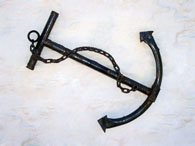
Two very basic naval appurtenances are the anchor and the buoy. The first has been used since pre-Christian times as a device for holding a ship fast. The English word, derived from a Greek word for “weight,” was soon used figuratively for any base of strength, and in Christian terminology, for a symbol of hope. During World War II, the word “anchor” was occasionally used as a slang term for a spouse. The buoy is a floating channel marker to indicate a safe course, shoals, or other obstruction, or even to serve as a mooring for a boat. Because it seems to bob up freely on the water’s surface, it acquired a figurative meaning: to buoy up involves encouraging or sustaining someone.
A favorite hedging expression is by and large, meaning “for the most part.” It comes from sailing, where it means to sail a vessel as close as possible to the wind without being hard on it. On land, it indicates something probable but not absolutely definite, as in, “Our broker says that, by and large, the market will improve soon.”
Another directional nautical term is aloof, derived from the Dutch te loef, for “to the windward.” It meant to sail a ship to windward, hence avoiding a lee shore, and a vessel maintaining a position to the windward of other ships, thus avoiding them, is said to stand aloof. Used figuratively on land, a person who is reserved and keeps at an emotional or physical distance is said to be aloof.
Several nautical expressions refer to a demise of one kind or another. One is Davy Jones’s locker, referring to the bottom of the sea and hence the final resting place of ships that sank, anything swept overboard, or persons buried or lost at sea. No one knows for sure who Davy Jones was, if indeed there was such an individual. Some believe the term alludes to the devil, others to St. David (the patron saint of Wales who is often invoked by Welsh seamen), and still others to the Old Testament prophet Jonah, swallowed by a whale and later spewed up again. On land the expression usually denotes a place of death.
To deep six originally meant to bury a body at sea in at least six fathoms (36 feet) of water. It also meant to drown, or to dispose of or throw away something in deep water. On land, the term has been extended to somewhat more benign meanings, that is, to discard something, for example, the plan for a new building wing that has become unnecessary.
—MHQ
CHRISTINE AMMER is the author of several dozen wordbooks, including The Facts on File Dictionary of Clichés (2006).