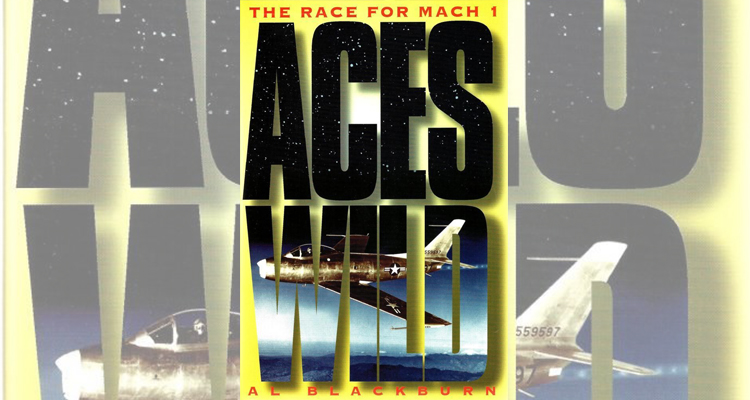
Aces Wild: The Race for Mach 1, by Al Blackburn, Scholarly Resources Inc.,Wilmington, Del., 1999, $24.95.
A strange contest was waged over the Mojave Desert of Southern California in 1947–a duel in which the contestants never acknowledged that any competition was in progress. At Muroc Army Air Field (later renamed Edwards Air Force Base) on Rogers Dry Lake in Southern California, flying faster than sound was the holy grail for two fliers, Captain Charles “Chuck” E. Yeager, of the newly minted U.S. Air Force, and George S. Welch, senior experimental test pilot for the North American Aviation Corporation. Yeager was an Air Force officer going for the record on behalf of his new service, and Welch was a civilian who was pursuing a personal goal.
The official record states that Yeager achieved Mach 1 on October 14, 1947, in the Bell X-1 rocket-propelled aircraft–an achievement that brought prestige to the U.S. Air Force and helped it maintain a high level of Congressional appropriations. The unofficial record, according to Al Blackburn in Aces Wild: The Race for Mach 1, is that George Welsh first breached the sound barrier on October 1, 1947, in North American’s XP-86 Sabre.
Welch simply wanted to know what supersonic flight was like, and when he found out, he was content to leave the publicity and the “Fastest Man Alive” title to Yeager. Blackburn’s account of these events is all based on interviews and circumstantial evidence with no official backup, but he makes a compelling and plausible case.
George Welch was a stereotypical fighter pilot: hell-on-wings against an enemy and a handful for his commanding officers. He is officially credited with 16 victories and may have shot down four or five more that he did not bother to report. Welch was killed in October 1954 while test-flying an F-100A jet fighter.
Blackburn, himself an experimental test pilot, briefly chronicles the advance to ever higher Mach numbers and the problems created by the so-called thermal thicket, the tendency of metals to melt when heated in supersonic collision with air molecules. His handling of the subject is engaging to the nontechnical reader and informative to those who have an aviation or engineering background.
John I. Witmer