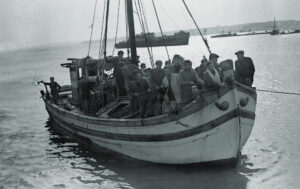
The Union soldiers saw no one as they marched out of Fort Moultrie just after sunset on December 26, 1860, and made their way through the tiny town of Moultrieville, South Carolina, to the sea wall where their bobbing boats were moored. The election one month before of Republican candidate Abraham Lincoln as president of the United States had caused a sense of crisis within the Federal garrison at Fort Moultrie. In the aftermath of the election, South Carolina had seceded from the Union, and the Northern soldiers knew it was only a matter of time before South Carolina asserted its claim to Fort Moultrie and the other forts guarding the approaches to Charleston Harbor.
The decision to abandon Fort Moultrie and withdraw its garrison to the more defensible Fort Sumter had not been an easy one for the fort’s commander, Major Robert Anderson. The 56-year-old Kentuckian had taken command of Fort Moultrie only a month before. Officials in Washington reasoned that Anderson, a native Southerner, would do nothing to provoke war.
Despite his Kentucky birth, Anderson was loyal to the Union and determined to do his duty. He became convinced that his command was vulnerable inside Fort Moultrie and that the best thing to do was to move the garrison to Fort Sumter, a large masonry fort on an artificial island overlooking the seaward approaches to Charleston. Anderson knew that if he were going to make the move he needed to do it soon. For two days, rumors had circulated that the rebellious South Carolinians had stationed a steamer in the waters off Charleston Harbor to prevent the Federal troops from escaping. Anderson desperately sought authorization from Washington to withdraw his command to Fort Sumter. ‘I think I could…were I to receive instructions so to do, throw my garrison into that work, Anderson wrote to Secretary of War Simon Cameron.
Despite the urgency of his request, Anderson received no immediate response from Washington. Finally, on his own initiative and without orders, he withdrew his men to the island fortress on the day after Christmas 1860. It was my solemn duty to move my command from a fort which we could not have held longer than forty-eight or sixty hours, to this one, where my power of resistance is increased to a very great degree, he reported to Washington.
The arrival of Anderson and his men certainly took the occupants of the fort by surprise. The civilian workmen at Fort Sumter were just settling down for the evening when a Union landing party appeared at their door. The Northern soldiers wasted no time securing their hold on the fort. There were doubts as to the true loyalty of many of Sumter’s civilian workers, and one of the first acts of Anderson’s men was to remove them from the fort. There was no parleying, no explaining; nothing but stern commands, silent astonishment, and prompt obedience, wrote Captain James Chester of the 3rd U.S. Artillery about the removal of the civilians. The workmen were on the wharf, outside the fort, before they were certain whether their captors were secessionists or Yankees.
Anderson’s move to Fort Sumter had its drawbacks for the Union garrison. In the hasty evacuation of Fort Moultrie, most of Anderson’s supplies had to be left behind. The withdrawal forced Anderson, as he later wrote to Washington, to sacrifice the greater part of my stores as it is now too late to attempt their removal. The stage was set for a confrontation at Fort Sumter that no one wanted.

This article first appeared in America’s Civil War magazine


The Union soldiers were well-protected in the fort, but they could only hold out as long as their supplies lasted. We have one [month’s] supply of hospital stores and about four months’ supply of provisions for my command, Anderson reported to Washington about the situation at Fort Sumter. If Anderson and his men were to hold the fort for long against the Southerners, they would soon have to receive supplies and reinforcements.
Efforts to do so were both halfhearted and slow in coming. On the evening of Saturday, January 5, 1861, a force of 200 men, under the command of U.S. Army Lieutenant Charles R. Wood, boarded the steamer Star of the West at Governor’s Island in New York Harbor and immediately sailed for Charleston. Four days later, Star of the West approached within two miles of Fort Sumter before Southerners opened fire from a masked battery at the north end of Morris Island. A brisk fire was kept up on us by the battery as long as we remained within range, but, fortunately, without damage to us, Wood later said in his report about the unsuccessful effort to reach Fort Sumter.
Union Captain Abner Doubleday watched the entire encounter through his spyglass from inside Fort Sumter. He first noticed Star of the West when she passed over the bar at the entrance to Charleston Harbor just after first daylight. Doubleday immediately notified Anderson, who ordered Fort Sumter’s barbette guns to be manned. By the time Doubleday’s men were in position, however, the Southern guns at Fort Moultrie had already opened fire on the approaching relief ship.
Despite the drama taking place before his eyes, Doubleday could do little to aid the Northern steamer. Anderson had ordered the guns to be manned but had not authorized them to fire on Fort Moultrie. Without supporting fire from the fort, Wood reluctantly ordered Star of the West to withdraw. Finding it impossible to take my command to Fort Sumter, I was obliged most reluctantly to turn about and to try and make my way out of the harbor, Wood later reported. This, too, Doubleday witnessed through his spyglass, reporting that Star of the West turned about and steamed seaward.
Following the failure of Star of the West to reach the fort, indecisive officials in Washington vacillated over what policy to pursue. Fearing further efforts would provoke intense Confederate retaliation, little was done to reinforce and resupply Anderson’s men.
In February, U.S. Navy Captain James Ward proposed a plan for several light-draft steamers loaded with men and provisions to run past the Confederate guns and land at Fort Sumter. It was a daring plan that called for Ward and his men to abandon their steamers and join Anderson’s beleaguered garrison inside Fort Sumter. He proposed to employ four or more small steamers belonging to the U.S. Coastal Survey to make the landing.
Many officials in Washington felt that Ward’s plan had every prospect of success. Nonetheless, outgoing President James Buchanan, fearing the operation might provoke a Confederate attack upon Fort Sumter, refused to authorize the plan. We have the opinion of General [Winfield] Scott that he has no doubt that Captain Ward at that time would have succeeded with his proposed expedition, Secretary of War Cameron reported to Lincoln, but was not allowed by the late President to attempt the execution of the plan.
Not everyone accepted the governmental inaction. Among the supporters of firm action was a former U.S. naval officer named Gustavus V. Fox. Born in Massachusetts in 1821, Fox entered the Navy as a midshipman in 1838. His subsequent service, including duty on coastal survey ships and during the Mexican War, proved him to be an able officer. Nonetheless, Fox left the Navy in 1856 with the rank of lieutenant to enter the wool-manufacturing business. Despite his early departure from the Navy, Fox retained a good reputation among military authorities in Washington. General Scott, for one, described him as an ex-officer of the Navy, a gentleman of high standing, as well as possessed of extraordinary nautical ability.
Fox’s plan to relieve Fort Sumter was a straightforward one. He proposed to anchor three small warships off Charleston Harbor near the entrance to Swash Channel, about four miles from the beleaguered fort. To avoid the obstructions at the harbor’s entrance, soldiers and provisions would be transferred from a large, oceangoing steamer to small, armed launches that would be towed to Fort Sumter by three steam tugs that were to accompany the expedition from New York.
Fox’s plan was not without risk. To reach Fort Sumter, the launches and tugs had to pass within 1,300 yards of the Confederate batteries on nearby Morris and Sullivan’s islands. Moreover, Fox believed that the failure of Star of the West‘s expedition made his own task even more difficult. The Southerners, he felt, would have surely taken precautions to prevent a similar attempt to relieve Fort Sumter. Since the repulse of the steamer Star of the West at Charleston it may be assumed that all channels over the bar are obstructed, Fox wrote. Nonetheless, he remained optimistic that the boats and light-draft tugs could avoid such obstacles. As the bar is more than four miles in length, said Fox, the spaces between these channels are too extensive to be closed.
Fox’s plan met with enthusiastic approval from his civilian friends. He first explained his plan to George W. Blunt of New York. Convinced of its prospects for success, Fox and Blunt then enlisted the aid of Charles H. Marshall, who agreed to furnish and provision the necessary vessels without arousing suspicion.
The response of Federal authorities in Washington to Fox’s plan was less enthusiastic. In February, Fox was called to Washington to explain the plan to Scott, who reported upon it favorably. In the end, however, the plan was rejected because Buchanan’s administration decided to take no action to relieve Fort Sumter. The plan was better received, however, by advisers of President Lincoln, who was inaugurated on March 4, although they, too, initially rejected it. Scott now worried that the increased number of Southern batteries erected at Charleston since February made the plan impractical. But the initiative and daring of Fox’s scheme impressed the new president. On March 19, 1861, Fox was dispatched to Charleston to visit Fort Sumter. Our Uncle Abe Lincoln has taken a high esteem for me, Fox wrote to his wife, and wishes me to take dispatches to Major Anderson at Fort Sumter with regard to its final evacuation and to obtain a clear statement of his condition which his letters, probably guarded, do not fully exhibit.
The trip gave Fox the opportunity to observe firsthand the situation at Fort Sumter. Upon his return to Washington, he finally won over those who were skeptical of his plan. With the help of Commodore Silas H. Stringham, the Navy Department’s detailing officer, Fox finally convinced Lincoln of the rescue plan’s viability. On March 30, the president dispatched Fox to New York with instructions to prepare for the voyage to Charleston.
During the preceding months, Fox had endured seemingly endless delays. Now, with the authorization in hand to proceed with the mission, he was forced to mount his relief expedition in great haste. In all, Fox had only nine days to assemble and prepare his force to sail.
Some of the preparations were completed with relative ease. Fox immediately engaged the services of the large civilian steamer Baltic to carry the bulk of his expedition. Other elements of Fox’s plan did not come together so easily, however. The Navy had placed all its commissioned ships in the Atlantic waters at Fox’s disposal, ordering the naval warships Powhatan, Pocahontas and Pawnee and the revenue cutter Harriet Lane to be placed in readiness for sea service. Preparing the naval warships for the mission, however, proved no easy task. The 2,415-ton side-wheel steamer Powhatan, for instance, had already been decommissioned at the Brooklyn Navy Yard and her crew transferred to the receiving ship North Carolina by the time orders arrived for the vessel to join Fox’s force. Crew members with less than a year remaining on their enlistments were expecting to be discharged, and many of the officers had already departed on leave. The demands of Fox’s mission, however, meant that all leaves, transfers and discharges were canceled, and all crew members were ordered to return to the ship.
Hiring the tugboats for the mission proved to be the most difficult task of all for Fox. Because obvious danger surrounded the endeavor, Northern shipowners were reluctant to lend their tugs to the cause. Only the payment of the most exorbitant rates, Fox complained, finally secured the services of three tugs–Yankee, Uncle Ben and Thomas Freeborn.
Other problems also plagued Fox’s preparations. The quality of the troops provided by the U.S. Army for the mission left something to be desired. Fox later complained that the soldiers were totally unfit to be thrown into a fort likely to be attacked by the rebels.
Fortunately for Fox, obtaining supplies to provision Fort Sumter was a simpler task. He found a staunch supporter in Major Amos B. Eaton of the Commissary Department, who thanked God that an attempt was made to relieve Major Anderson’s command and immediately provisioned for all contingencies.
Finally, when all preparations for Fox’s mission were complete, the various vessels sailed for Charleston. Each made its way south separately. On April 6 the frigate Powhatan, under the command of Captain Samuel Mercer, prepared to sail from New York. Other vessels, including the revenue cutter Harriet Lane and tugs Uncle Ben and Yankee, soon made their way south. The sloop of war Pawnee, under the command of Commander Stephen C. Rowan, sailed from Norfolk, Va., on April 9. Baltic, with Fox on board, dropped down to Sandy Hook at the mouth of New York Harbor on the evening of April 8 and put out to sea the following morning.
Almost from the beginning, the weather played havoc with the carefully laid plans. Soon after the steamer Baltic sailed, a heavy gale set in, badly scattering the expedition’s vessels and delaying the arrival of Fox’s force. When Baltic arrived at Charleston at 3 a.m. on April 12, only Harriet Lane had completed the voyage. By 6 a.m., Pawnee joined the force, but her orders limited her usefulness. Fox boarded the vessel to ask Commander Rowan to stand in toward shore, but the captain could not comply because his orders required him to remain 10 miles east of the lighthouse and await Powhatan‘s arrival. Meanwhile, the Confederates had opened fire on Fort Sumter at 4:30 a.m. on April 12.
Bad weather was not the only problem plaguing Fox’s mission. Complications with her owners prevented the tug Thomas Freeborn from ever sailing from New York. Another tug, Uncle Ben, did sail from New York, only to be seized by the Confederates after the gale drove her to seek shelter at Wilmington, N.C. Of the tugs, only Yankee reached Charleston Harbor, and even her arrival was delayed by rough weather.
Poor communications in Washington proved to be the biggest obstacle to Fox’s plan. Fort Sumter was not the only Federal-held fort in Southern territory that was threatened by the Confederates. The strategically vital forts along Florida’s Gulf Coast–Fort Taylor at Key West, Fort Jefferson in the Dry Tortugas and Fort Pickens at Pensacola–also required Federal attention. To support those forts, a relief expedition similar to Fox’s was being fitted out under the command of Navy Lieutenant David D. Porter. Secretary of State William H. Seward, without the knowledge of Secretary of the Navy Gideon Welles, had obtained Lincoln’s authorization to divert Powhatan to the gulf expedition. Just as she was preparing to sail from New York on April 6, Powhatan was ordered to leave the Charleston expedition and was sent to sea as part of the expedition to the Gulf of Mexico.
Powhatan‘s transfer had a devastating impact on Fox’s mission. The Northern warship carried the armed launches and crews necessary to land troops and supplies from Baltic. To make matters worse, Fox did not learn of Powhatan‘s diversion until April 13, a week after it had taken place.
Despite the absence of Powhatan and her boats, Fox was determined to salvage what he could of his operation. He still had one serviceable boat and crew, and despite the heavy seas and continuing gale, Fox was finally ready to attempt a landing at the beleaguered fort.
Circumstances, however, eventually forced Fox to abandon even that faint hope. On the foggy morning of Saturday, April 13, Fox transferred to Pawnee and witnessed firsthand the scene at the embattled Fort Sumter. Union resistance inside the fort was clearly waning. Confederate fire had devastated the beleaguered fortress. As we drew near [Pawnee] I saw, with horror, black volumes of smoke issuing from Sumpter [sic], Fox later reported. The barbarians, to their everlasting disgrace be it said, redoubled their fire, and through the flames and smoke the noble band of true men continued their response.
Pocahontas finally arrived off Charleston at 2 p.m. that afternoon, and with the arrival of the Northern warship, all was ready for Fox’s plan to proceed. I had everything ready, Fox later reported, boats, muffled oars, small packages of provisions, in fact everything but the 300 sailors promised to me by the [department].
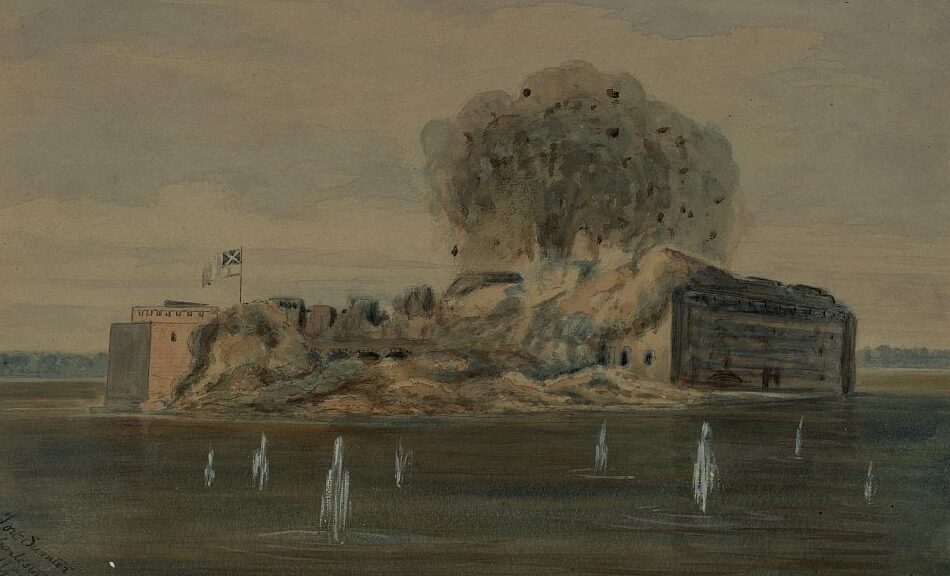
Pocahontas, however, had arrived too late. At the same time the warship was arriving, the defenders inside the fort decided that they could hold out no longer. The fort had withstood 34 hours of bombardment, and Major Anderson felt that it was in no condition to withstand any more. The quarters were entirely burned, the main gates destroyed by fire, the gorge walls seriously injured, the magazine surrounded by flames, and its door closed from the effects of heat, he reported. When a Confederate cannonball shot away the Federal flag flying high above Fort Sumter, it was not replaced. The time had come for Anderson to surrender his command.
Fox and his expedition had come very close to accomplishing their rescue mission. If the men and supplies aboard Baltic had been able to land, Anderson and his men might have held out much longer. Had the Powhatan arrived [on] the 12th, we should have had the men and provisions into Fort Sumpter [sic], Fox later lamented. In the end, however, it was not to be.
With the surrender of Anderson and his men, there was nothing else for Fox and his men to do. He entered the harbor under a flag of truce and offered passage north for Anderson and his command when their Southern captors chose to release them.
On Sunday, April 14, Anderson and his 60 men formally turned Fort Sumter over to the Confederates. During the surrender ceremonies, Anderson attempted to fire a 100-gun salute to the flag. A premature explosion of one of the cannons killed two of his men and wounded three others. Ironically, they were the only Northern casualties during the entire battle.
The Southern victors did not hold Anderson and his men captive for long. At noon the following day, the Northern prisoners were transported out into Charleston Harbor aboard the Southern steamer Isabel. There, Anderson and his men were transferred to Baltic for the voyage north with Fox and his expedition.
Fox’s failure to rescue Fort Sumter was a bitter disappointment to the Northern officer. Watching the surrender of Fort Sumter from aboard Baltic, Fox found the scene galling. I had the mortification of witnessing the surrender of the Fort with no part of my proposed plan arrived, Fox later reported. The failure made the Northern sailor resentful. As for our expedition, somebody’s influence has made it ridiculous, he later wrote.
Nonetheless, Fox’s efforts in planning and commanding the expedition to relieve Fort Sumter won him the admiration of Lincoln and Secretary of the Navy Welles. I most cheerfully and truly declare that the failure of the undertaking has not lowered you a particle while the qualities you developed in the effort have greatly heightened you in my estimation, Lincoln wrote to Fox. For a daring and dangerous enterprise of a similar character you would to-day be the man, of all acquaintances, whom I would select.
Despite such praise from high places, the secrecy surrounding the mission to relieve Fort Sumter kept Fox’s part in the plan from becoming widely known. Under no circumstances is any mention of it whatever to get into the papers, Fox wrote to his wife. The whole affair is in able hands and in due time will appear.
Lack of public recognition did not keep Fox from having a distinguished wartime career, however. On May 9, he was appointed chief clerk of the Navy, and on August 1, Lincoln appointed him assistant secretary of the Navy, a position he held for the remainder of the war. As assistant secretary, Fox proved to be a superb planner and administrator.
Few Northerners would ever know of Fox’s daring—if unsuccessful—plan to reinforce and supply the Northern garrison at Fort Sumter. Like much of the action in the first chaotic days of the war, it would soon be overshadowed by the inexorable march of even more dramatic and bloody events. In some ways, Gustavus Fox was the hero that never was.